Thank you for visiting SNEWPapers!
Sign up free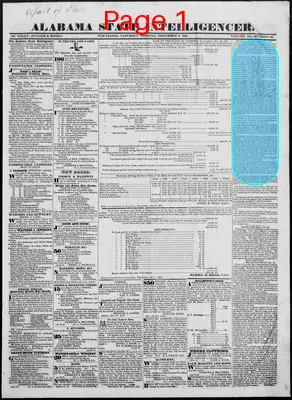
Alabama State Intelligencer
Tuscaloosa, Tuscaloosa County, Alabama
What is this article about?
Kentucky legislature convened in Frankfort on Dec. 7, 1831, electing officers led by Speaker J.C. Crittenden. Gov. Metcalfe's Dec. 8 message highlighted internal improvements via railroads and education's vital role for the State's progress and liberty.
Clipping
OCR Quality
Full Text
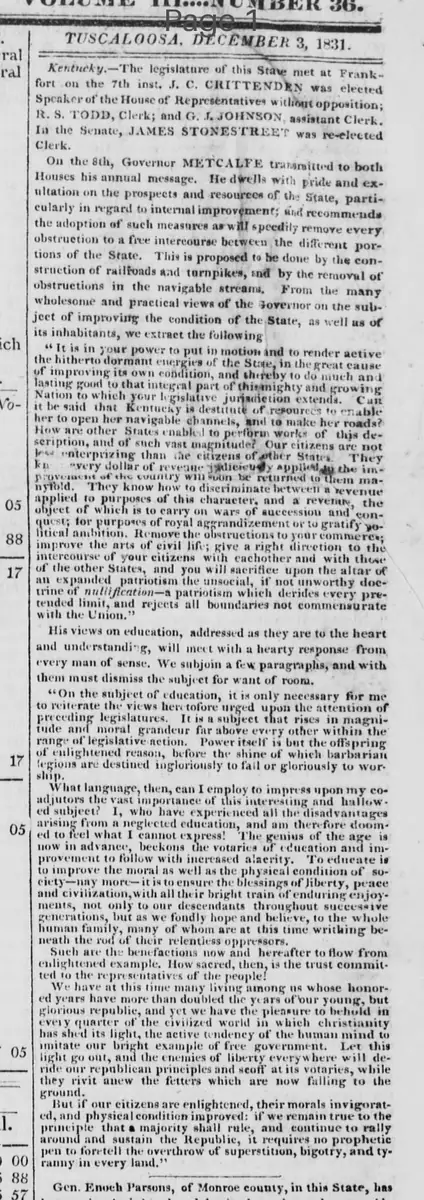
Kentucky.—The legislature of this State met at Frankfort on the 7th inst. J. C. CRITTENDEN was elected Speaker of the House of Representatives without opposition; R. S. TODD, Clerk; and G. J. JOHNSON, assistant Clerk. In the Senate, JAMES STONESTREET was re-elected Clerk.
On the 8th, Governor METCALFE transmitted to both Houses his annual message. He dwells with pride and exultation on the prospects and resources of the State, particularly in regard to internal improvement; and recommends the adoption of such measures as will speedily remove every obstruction to a free intercourse between the different portions of the State. This is proposed to be done by the construction of railroads and turnpikes, and by the removal of obstructions in the navigable streams. From the many wholesome and practical views of the Governor on the subject of improving the condition of the State, as well as of its inhabitants, we extract the following:
"It is in your power to put in motion and to render active the hitherto dormant energies of the State, in the great cause of improving its own condition, and thereby to do much and lasting good to that integral part of this mighty and growing Nation to which your legislative jurisdiction extends. Can it be said that Kentucky is destitute of resources to enable her to open her navigable channels, and to make her roads? How are other States enabled to perform works of this description, and of such vast magnitude? Our citizens are not less enterprising than the citizens of other States. They know that every dollar of revenue judiciously applied by the improvement of the country will be returned to them manifold. They know how to discriminate between a revenue applied to purposes of this character, and a revenue, the object of which is to carry on wars of succession and conquest; for purposes of royal aggrandizement or to gratify political ambition. Remove the obstructions to your commerce; improve the arts of civil life; give a right direction to the intercourse of your citizens with each other and with those of the other States, and you will sacrifice upon the altar of an expanded patriotism the unsocial, if not unworthy doctrine of nullification—a patriotism which derides every pretended limit, and rejects all boundaries not commensurate with the Union."
His views on education, addressed as they are to the heart and understanding, will meet with a hearty response from every man of sense. We subjoin a few paragraphs, and with them must dismiss the subject for want of room.
"On the subject of education, it is only necessary for me to reiterate the views heretofore urged upon the attention of preceding legislatures. It is a subject that rises in magnitude and moral grandeur far above every other within the range of legislative action. Power itself is but the offspring of enlightened reason, before the shine of which barbarian legions are destined ingloriously to fall or gloriously to worship.
What language, then, can I employ to impress upon my coadjutors the vast importance of this interesting and hallowed subject? I, who have experienced all the disadvantages arising from a neglected education, and am therefore doomed to feel what I cannot express! The genius of the age is now in advance, beckons the votaries of education and improvement to follow with increased alacrity. To educate is to improve the moral as well as the physical condition of society—nay more—it is to ensure the blessings of liberty, peace and civilization, with all their bright train of enduring enjoyments, not only to our descendants throughout successive generations, but as we fondly hope and believe, to the whole human family, many of whom are at this time writhing beneath the rod of their relentless oppressors.
Such are the benefactions now and hereafter to flow from enlightened example. How sacred, then, is the trust committed to the representatives of the people!
We have at this time many living among us whose honored years have more than doubled the years of our young, but glorious republic, and yet we have the pleasure to behold in every quarter of the civilized world in which christianity has shed its light, the active tendency of the human mind to imitate our bright example of free government. Let this light go out, and the enemies of liberty everywhere will deride our republican principles and scoff at its votaries, while they rivet anew the fetters which are now falling to the ground.
But if our citizens are enlightened, their morals invigorated, and physical condition improved: if we remain true to the principle that a majority shall rule, and continue to rally around and sustain the Republic, it requires no prophetic pen to foretell the overthrow of superstition, bigotry, and tyranny in every land."
What sub-type of article is it?
What keywords are associated?
What entities or persons were involved?
Where did it happen?
Domestic News Details
Primary Location
Frankfort, Kentucky
Event Date
December 7 8, 1831
Key Persons
Event Details
The Kentucky legislature met at Frankfort on December 7, 1831. J. C. CRITTENDEN was elected Speaker of the House without opposition; R. S. TODD, Clerk; G. J. JOHNSON, assistant Clerk. In the Senate, JAMES STONESTREET was re-elected Clerk. On December 8, Governor METCALFE transmitted his annual message to both Houses, dwelling on the State's prospects and resources, particularly internal improvements by railroads, turnpikes, and clearing navigable streams. He recommended measures to remove obstructions to intercourse between State portions and discussed education's importance.