Thank you for visiting SNEWPapers!
Sign up free
Literary
December 20, 1910
The Caucasian
Shreveport, Caddo County, Louisiana
What is this article about?
O. Henry recounts a reporter's tale of a real-life romantic drama near Abingdon Square: a bridegroom's jealousy leads to separation after a wedding mishap; 20 years later, the wife encounters her presumed-dead husband and a violinist, resolving in comedic reunion, highlighting life's theatrical absurdities.
Merged-components note: Images are illustrations for the short story 'The Thing's the Play'; bboxes overlap with story columns in reading order.
Clipping
OCR Quality
95%
Excellent
Full Text
THE THING'S THE PLAY
Story That a Reporter Failed to Find Funny
By O. HENRY
Copyright, 1910, by Doubleday, Page & Co.
Being acquainted with a newspaper reporter who had a couple of free passes, I got to see the performance a few nights ago at one of the popular vaudeville houses.
One of the numbers was a violin solo by a striking looking man not much past forty, but with very gray, thick hair.
"There was a story about that chap a month or two ago," said the reporter. "They gave me the assignment. It was to run a column and was to be on the extremely light and joking order. The old man seems to like the funny touch I give to local happenings. Oh, yes, I'm working on a farce comedy now. Well, I went down to the house and got all the details, but I certainly fell down on that job. I went back and turned in a comic writeup of an east side funeral instead. Why? Oh, I couldn't seem to get hold of it with my funny hooks somehow. Maybe you could make a one act tragedy out of it for a curtain raiser. I'll give you the details."
After the performance my friend the reporter recited to me the facts over the Wurzburger.
"I see no reason," said I when he had concluded, "why that shouldn't make a rattling good funny story. Those three people couldn't have acted in a more absurd and preposterous manner if they had been real actors in a real theater. I'm really afraid that all the stage is a world, anyhow, and all the players merely men and women. 'The thing's the play,' is the way I quote Mr. Shakespeare."
"Try it," said the reporter.
"I will," said I, and I did, to show him how he could have made a humorous column of it for his paper.
There stands a house near Abingdon square. On the ground floor there has been for twenty-five years a little store where toys and notions and stationery are sold.
One night twenty years ago there was a wedding in the rooms above the store. The Widow Mayo owned the house and store. Her daughter Helen was married to Frank Barry. John Delaney was best man. Helen was eighteen and a belle of the lower west side.
Frank Barry and John Delaney were prominent young beaux of the same side and bosom friends, whom you expected to turn upon each other every time the curtain went up. Both had made a great race for Helen's hand. When Frank won John shook his hand and congratulated him—honestly, he did.
After the ceremony Helen ran upstairs to put on her hat. She was getting married in a traveling dress.
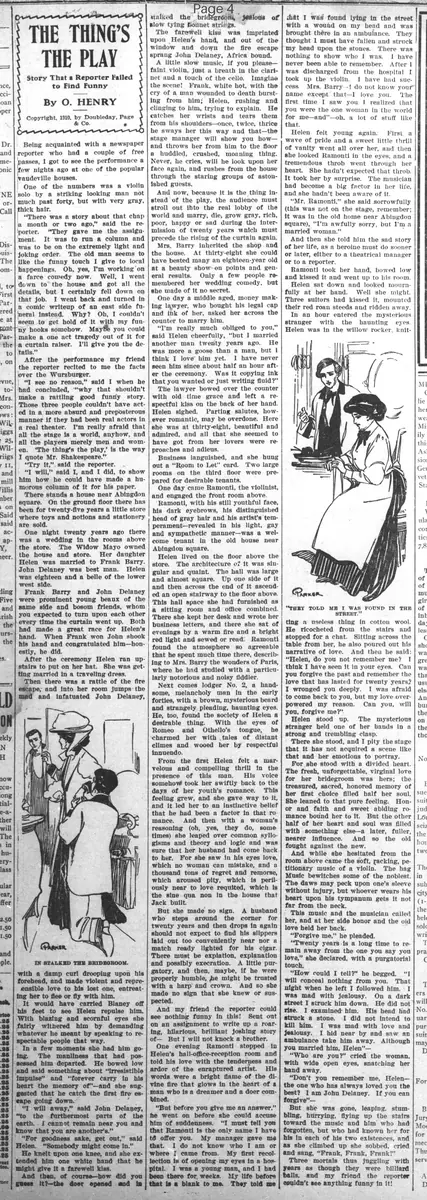
Then there was a rattle of the fire escape, and into her room jumps the mad and infatuated John Delaney, with a damp curl drooping upon his forehead, and made violent and reprehensible love to his lost one, entreating her to flee or fly with him.
It would have carried Blaney off his feet to see Helen repulse him. With blazing and scornful eyes she fairly withered him by demanding whatever he meant by speaking to respectable people that way.
In a few moments she had him going. The manliness that had possessed him departed. He bowed low and said something about "irresistible impulse" and "forever carry in his heart the memory of"—and she suggested that he catch the first fire escape going down.
"I will away," said John Delaney, "to the furthermost parts of the earth. I cannot remain near you and know that you are another's."
"For goodness sake, get out," said Helen. "Somebody might come in."
He knelt upon one knee and she extended him one white hand that he might give it a farewell kiss.
And then, of course—how did you guess it?—the door opened and in stalked the bridegroom, jealous of slow tying bonnet strings.
The farewell kiss was imprinted upon Helen's hand, and out of the window and down the fire escape sprang John Delaney, Africa bound.
A little slow music, if you please—faint violin, just a breath in the clarinet and a touch of the cello. Imagine the scene! Frank, white hot, with the cry of a man wounded to death bursting from him; Helen, rushing and clinging to him, trying to explain. He catches her wrists and tears them from his shoulders—once, twice, thrice he sways her this way and that—the stage manager will show you how—and throws her from him to the floor a huddled, crushed, moaning thing.
Never, he cries, will he look upon her face again, and rushes from the house through the staring groups of astonished guests.
And now, because it is the thing instead of the play, the audience must stroll out into the real lobby of the world and marry, die, grow gray, rich, poor, happy or sad during the intermission of twenty years which must precede the rising of the curtain again.
Mrs. Barry inherited the shop and the house. At thirty-eight she could have bested many an eighteen-year old at a beauty show on points and general results. Only a few people remembered her wedding comedy, but she made of it no secret.
One day a middle aged, money making lawyer, who bought his legal cap and ink of her, asked her across the counter to marry him.
"I'm really much obliged to you," said Helen cheerfully, "but I married another man twenty years ago. He was more a goose than a man, but I think I love him yet. I have never seen him since about half an hour after the ceremony. Was it copying ink that you wanted or just writing fluid?"
The lawyer bowed over the counter with old time grace and left a respectful kiss on the back of her hand.
Helen sighed. Parting salutes, however romantic, may be overdone. Here she was at thirty-eight, beautiful and admired, and all that she seemed to have got from her lovers were reproaches and adieus.
Business languished, and she hung out a "Room to Let" card. Two large rooms on the third floor were prepared for desirable tenants.
One day came Ramonti, the violinist and engaged the front room above.
Ramonti, with his still youthful face, his dark eyebrows, his distinguished head of gray hair and his artist's temperament—revealed in his light, gay and sympathetic manner—was a welcome tenant in the old house near Abingdon square.
Helen lived on the floor above the store. The architecture of it was singular and quaint. The hall was large and almost square. Up one side of it and then across the end of it ascended an open stairway to the floor above. This hall space she had furnished as a sitting room and office combined. There she kept her desk and wrote her business letters, and there she sat of evenings by a warm fire and a bright red light and sewed or read. Ramonti found the atmosphere so agreeable that he spent much time there, describing to Mrs. Barry the wonders of Paris, where he had studied with a particularly notorious and noisy fiddler.
Next comes lodger No. 2, a handsome, melancholy man in the early forties, with a brown, mysterious beard and strangely pleading, haunting eyes. He, too, found the society of Helen a desirable thing. With the eyes of Romeo and Othello's tongue, he charmed her with tales of distant climes and wooed her by respectful innuendo.
From the first Helen felt a marvelous and compelling thrill in the presence of this man. His voice somehow took her swiftly back to the days of her youth's romance. This feeling grew, and she gave way to it, and it led her to an instinctive belief that he had been a factor in that romance. And then with a woman's reasoning (oh, yes, they do, sometimes) she leaped over common syllogisms and theory and logic and was sure that her husband had come back to her. For she saw in his eyes love, which no woman can mistake, and a thousand tons of regret and remorse, which aroused pity, which is perilously near to love requited, which is the sine qua non in the house that Jack built.
But she made no sign. A husband who steps around the corner for twenty years and then drops in again should not expect to find his slippers laid out too conveniently near nor a match ready lighted for his cigar. There must be expiation, explanation and possibly execration. A little purgatory, and then, maybe, if he were properly humble, he might be trusted with a harp and crown. And so she made no sign that she knew or suspected.
And my friend the reporter could see nothing funny in this! Sent out on an assignment to write up a roaring, hilarious, brilliant joshing story of—But I will not knock a brother.
One evening Ramonti stopped in Helen's hall-office-reception room and told his love with the tenderness and ardor of the enraptured artist. His words were a bright flame of the divine fire that glows in the heart of a man who is a dreamer and a doer combined.
"But before you give me an answer," he went on before she could accuse him of suddenness, "I must tell you that Ramonti is the only name I have to offer you. My manager gave me that. I do not know who I am or where I came from. My first recollection is of opening my eyes in a hospital. I was a young man, and I had been there for weeks. My life before that is a blank to me. They told me that I was found lying in the street with a wound on my head and was brought there in an ambulance. They thought I must have fallen and struck my head upon the stones. There was nothing to show who I was. I have never been able to remember. After I was discharged from the hospital I took up the violin. I have had success. Mrs. Barry—I do not know your name except that—I love you. The first time I saw you I realized that you were the one woman in the world for me—and"—oh, a lot of stuff like that.
Helen felt young again. First a wave of pride and a sweet little thrill of vanity went all over her, and then she looked Ramonti in the eyes, and a tremendous throb went through her heart. She hadn't expected that throb. It took her by surprise. The musician had become a big factor in her life, and she hadn't been aware of it.
"Mr. Ramonti," she said sorrowfully (this was not on the stage, remember; it was in the old home near Abingdon square), "I'm awfully sorry, but I'm a married woman."
And then she told him the sad story of her life, as a heroine must do sooner or later, either to a theatrical manager or to a reporter.
Ramonti took her hand, bowed low and kissed it and went up to his room.
Helen sat down and looked mournfully at her hand. Well she might. Three suitors had kissed it, mounted their red roan steeds and ridden away.
In an hour entered the mysterious stranger with the haunting eyes.
Helen was in the willow rocker, knitting a useless thing in cotton wool.
He ricocheted from the stairs and stopped for a chat. Sitting across the table from her, he also poured out his narrative of love. And then he said:
"Helen, do you not remember me? I think I have seen it in your eyes. Can you forgive the past and remember the love that has lasted for twenty years? I wronged you deeply. I was afraid to come back to you, but my love overpowered my reason. Can you, will you, forgive me?"
Helen stood up. The mysterious stranger held one of her hands in a strong and trembling clasp.
There she stood, and I pity the stage that it has not acquired a scene like that and her emotions to portray.
For she stood with a divided heart. The fresh, unforgettable, virginal love for her bridegroom was hers; the treasured, sacred, honored memory of her first choice filled half her soul. She leaned to that pure feeling. Honor and faith and sweet abiding romance bound her to it. But the other half of her heart and soul was filled with something else—a later, fuller, nearer influence. And so the old fought against the new.
And while she hesitated from the room above came the soft, racking, petitionary music of a violin. The hag Music bewitches some of the noblest. The daws may peck upon one's sleeve without injury, but whoever wears his heart upon his tympanum gets it not far from the neck.
This music and the musician called her, and at her side honor and the old love held her back.
"Forgive me," he pleaded.
"Twenty years is a long time to remain away from the one you say you love," she declared, with a purgatorial touch.
"How could I tell?" he begged. "I will conceal nothing from you. That night when he left I followed him. I was mad with jealousy. On a dark street I struck him down. He did not rise. I examined him. His head had struck a stone. I did not intend to kill him. I was mad with love and jealousy. I hid near by and saw an ambulance take him away. Although you married him, Helen—"
"Who are you?" cried the woman, with wide open eyes, snatching her hand away.
"Don't you remember me, Helen—the one who has always loved you the best? I am John Delaney. If you can forgive"—
But she was gone, leaping, stumbling, hurrying, flying up the stairs toward the music and him who had forgotten, but who had known her for his in each of his two existences, and as she climbed up she sobbed, cried and sang, "Frank. Frank. Frank!"
Three mortals thus juggling with years as though they were billiard balls, and my friend the reporter couldn't see anything funny in it!
Story That a Reporter Failed to Find Funny
By O. HENRY
Copyright, 1910, by Doubleday, Page & Co.
Being acquainted with a newspaper reporter who had a couple of free passes, I got to see the performance a few nights ago at one of the popular vaudeville houses.
One of the numbers was a violin solo by a striking looking man not much past forty, but with very gray, thick hair.
"There was a story about that chap a month or two ago," said the reporter. "They gave me the assignment. It was to run a column and was to be on the extremely light and joking order. The old man seems to like the funny touch I give to local happenings. Oh, yes, I'm working on a farce comedy now. Well, I went down to the house and got all the details, but I certainly fell down on that job. I went back and turned in a comic writeup of an east side funeral instead. Why? Oh, I couldn't seem to get hold of it with my funny hooks somehow. Maybe you could make a one act tragedy out of it for a curtain raiser. I'll give you the details."
After the performance my friend the reporter recited to me the facts over the Wurzburger.
"I see no reason," said I when he had concluded, "why that shouldn't make a rattling good funny story. Those three people couldn't have acted in a more absurd and preposterous manner if they had been real actors in a real theater. I'm really afraid that all the stage is a world, anyhow, and all the players merely men and women. 'The thing's the play,' is the way I quote Mr. Shakespeare."
"Try it," said the reporter.
"I will," said I, and I did, to show him how he could have made a humorous column of it for his paper.
There stands a house near Abingdon square. On the ground floor there has been for twenty-five years a little store where toys and notions and stationery are sold.
One night twenty years ago there was a wedding in the rooms above the store. The Widow Mayo owned the house and store. Her daughter Helen was married to Frank Barry. John Delaney was best man. Helen was eighteen and a belle of the lower west side.
Frank Barry and John Delaney were prominent young beaux of the same side and bosom friends, whom you expected to turn upon each other every time the curtain went up. Both had made a great race for Helen's hand. When Frank won John shook his hand and congratulated him—honestly, he did.
After the ceremony Helen ran upstairs to put on her hat. She was getting married in a traveling dress.
Then there was a rattle of the fire escape, and into her room jumps the mad and infatuated John Delaney, with a damp curl drooping upon his forehead, and made violent and reprehensible love to his lost one, entreating her to flee or fly with him.
It would have carried Blaney off his feet to see Helen repulse him. With blazing and scornful eyes she fairly withered him by demanding whatever he meant by speaking to respectable people that way.
In a few moments she had him going. The manliness that had possessed him departed. He bowed low and said something about "irresistible impulse" and "forever carry in his heart the memory of"—and she suggested that he catch the first fire escape going down.
"I will away," said John Delaney, "to the furthermost parts of the earth. I cannot remain near you and know that you are another's."
"For goodness sake, get out," said Helen. "Somebody might come in."
He knelt upon one knee and she extended him one white hand that he might give it a farewell kiss.
And then, of course—how did you guess it?—the door opened and in stalked the bridegroom, jealous of slow tying bonnet strings.
The farewell kiss was imprinted upon Helen's hand, and out of the window and down the fire escape sprang John Delaney, Africa bound.
A little slow music, if you please—faint violin, just a breath in the clarinet and a touch of the cello. Imagine the scene! Frank, white hot, with the cry of a man wounded to death bursting from him; Helen, rushing and clinging to him, trying to explain. He catches her wrists and tears them from his shoulders—once, twice, thrice he sways her this way and that—the stage manager will show you how—and throws her from him to the floor a huddled, crushed, moaning thing.
Never, he cries, will he look upon her face again, and rushes from the house through the staring groups of astonished guests.
And now, because it is the thing instead of the play, the audience must stroll out into the real lobby of the world and marry, die, grow gray, rich, poor, happy or sad during the intermission of twenty years which must precede the rising of the curtain again.
Mrs. Barry inherited the shop and the house. At thirty-eight she could have bested many an eighteen-year old at a beauty show on points and general results. Only a few people remembered her wedding comedy, but she made of it no secret.
One day a middle aged, money making lawyer, who bought his legal cap and ink of her, asked her across the counter to marry him.
"I'm really much obliged to you," said Helen cheerfully, "but I married another man twenty years ago. He was more a goose than a man, but I think I love him yet. I have never seen him since about half an hour after the ceremony. Was it copying ink that you wanted or just writing fluid?"
The lawyer bowed over the counter with old time grace and left a respectful kiss on the back of her hand.
Helen sighed. Parting salutes, however romantic, may be overdone. Here she was at thirty-eight, beautiful and admired, and all that she seemed to have got from her lovers were reproaches and adieus.
Business languished, and she hung out a "Room to Let" card. Two large rooms on the third floor were prepared for desirable tenants.
One day came Ramonti, the violinist and engaged the front room above.
Ramonti, with his still youthful face, his dark eyebrows, his distinguished head of gray hair and his artist's temperament—revealed in his light, gay and sympathetic manner—was a welcome tenant in the old house near Abingdon square.
Helen lived on the floor above the store. The architecture of it was singular and quaint. The hall was large and almost square. Up one side of it and then across the end of it ascended an open stairway to the floor above. This hall space she had furnished as a sitting room and office combined. There she kept her desk and wrote her business letters, and there she sat of evenings by a warm fire and a bright red light and sewed or read. Ramonti found the atmosphere so agreeable that he spent much time there, describing to Mrs. Barry the wonders of Paris, where he had studied with a particularly notorious and noisy fiddler.
Next comes lodger No. 2, a handsome, melancholy man in the early forties, with a brown, mysterious beard and strangely pleading, haunting eyes. He, too, found the society of Helen a desirable thing. With the eyes of Romeo and Othello's tongue, he charmed her with tales of distant climes and wooed her by respectful innuendo.
From the first Helen felt a marvelous and compelling thrill in the presence of this man. His voice somehow took her swiftly back to the days of her youth's romance. This feeling grew, and she gave way to it, and it led her to an instinctive belief that he had been a factor in that romance. And then with a woman's reasoning (oh, yes, they do, sometimes) she leaped over common syllogisms and theory and logic and was sure that her husband had come back to her. For she saw in his eyes love, which no woman can mistake, and a thousand tons of regret and remorse, which aroused pity, which is perilously near to love requited, which is the sine qua non in the house that Jack built.
But she made no sign. A husband who steps around the corner for twenty years and then drops in again should not expect to find his slippers laid out too conveniently near nor a match ready lighted for his cigar. There must be expiation, explanation and possibly execration. A little purgatory, and then, maybe, if he were properly humble, he might be trusted with a harp and crown. And so she made no sign that she knew or suspected.
And my friend the reporter could see nothing funny in this! Sent out on an assignment to write up a roaring, hilarious, brilliant joshing story of—But I will not knock a brother.
One evening Ramonti stopped in Helen's hall-office-reception room and told his love with the tenderness and ardor of the enraptured artist. His words were a bright flame of the divine fire that glows in the heart of a man who is a dreamer and a doer combined.
"But before you give me an answer," he went on before she could accuse him of suddenness, "I must tell you that Ramonti is the only name I have to offer you. My manager gave me that. I do not know who I am or where I came from. My first recollection is of opening my eyes in a hospital. I was a young man, and I had been there for weeks. My life before that is a blank to me. They told me that I was found lying in the street with a wound on my head and was brought there in an ambulance. They thought I must have fallen and struck my head upon the stones. There was nothing to show who I was. I have never been able to remember. After I was discharged from the hospital I took up the violin. I have had success. Mrs. Barry—I do not know your name except that—I love you. The first time I saw you I realized that you were the one woman in the world for me—and"—oh, a lot of stuff like that.
Helen felt young again. First a wave of pride and a sweet little thrill of vanity went all over her, and then she looked Ramonti in the eyes, and a tremendous throb went through her heart. She hadn't expected that throb. It took her by surprise. The musician had become a big factor in her life, and she hadn't been aware of it.
"Mr. Ramonti," she said sorrowfully (this was not on the stage, remember; it was in the old home near Abingdon square), "I'm awfully sorry, but I'm a married woman."
And then she told him the sad story of her life, as a heroine must do sooner or later, either to a theatrical manager or to a reporter.
Ramonti took her hand, bowed low and kissed it and went up to his room.
Helen sat down and looked mournfully at her hand. Well she might. Three suitors had kissed it, mounted their red roan steeds and ridden away.
In an hour entered the mysterious stranger with the haunting eyes.
Helen was in the willow rocker, knitting a useless thing in cotton wool.
He ricocheted from the stairs and stopped for a chat. Sitting across the table from her, he also poured out his narrative of love. And then he said:
"Helen, do you not remember me? I think I have seen it in your eyes. Can you forgive the past and remember the love that has lasted for twenty years? I wronged you deeply. I was afraid to come back to you, but my love overpowered my reason. Can you, will you, forgive me?"
Helen stood up. The mysterious stranger held one of her hands in a strong and trembling clasp.
There she stood, and I pity the stage that it has not acquired a scene like that and her emotions to portray.
For she stood with a divided heart. The fresh, unforgettable, virginal love for her bridegroom was hers; the treasured, sacred, honored memory of her first choice filled half her soul. She leaned to that pure feeling. Honor and faith and sweet abiding romance bound her to it. But the other half of her heart and soul was filled with something else—a later, fuller, nearer influence. And so the old fought against the new.
And while she hesitated from the room above came the soft, racking, petitionary music of a violin. The hag Music bewitches some of the noblest. The daws may peck upon one's sleeve without injury, but whoever wears his heart upon his tympanum gets it not far from the neck.
This music and the musician called her, and at her side honor and the old love held her back.
"Forgive me," he pleaded.
"Twenty years is a long time to remain away from the one you say you love," she declared, with a purgatorial touch.
"How could I tell?" he begged. "I will conceal nothing from you. That night when he left I followed him. I was mad with jealousy. On a dark street I struck him down. He did not rise. I examined him. His head had struck a stone. I did not intend to kill him. I was mad with love and jealousy. I hid near by and saw an ambulance take him away. Although you married him, Helen—"
"Who are you?" cried the woman, with wide open eyes, snatching her hand away.
"Don't you remember me, Helen—the one who has always loved you the best? I am John Delaney. If you can forgive"—
But she was gone, leaping, stumbling, hurrying, flying up the stairs toward the music and him who had forgotten, but who had known her for his in each of his two existences, and as she climbed up she sobbed, cried and sang, "Frank. Frank. Frank!"
Three mortals thus juggling with years as though they were billiard balls, and my friend the reporter couldn't see anything funny in it!
What sub-type of article is it?
Prose Fiction
Satire
What themes does it cover?
Love Romance
What keywords are associated?
Short Story
Romance
Jealousy
Mistaken Identity
O Henry
Vaudeville
Abingdon Square
Violinist
What entities or persons were involved?
By O. Henry
Literary Details
Title
The Thing's The Play
Author
By O. Henry
Subject
Story That A Reporter Failed To Find Funny
Key Lines
'The Thing's The Play,' Is The Way I Quote Mr. Shakespeare.
Three Mortals Thus Juggling With Years As Though They Were Billiard Balls, And My Friend The Reporter Couldn't See Anything Funny In It!
Helen Stood With A Divided Heart. The Fresh, Unforgettable, Virginal Love For Her Bridegroom Was Hers; The Treasured, Sacred, Honored Memory Of Her First Choice Filled Half Her Soul.
And As She Climbed Up She Sobbed, Cried And Sang, "Frank. Frank. Frank!"
I'm Really Much Obliged To You," Said Helen Cheerfully, "But I Married Another Man Twenty Years Ago. He Was More A Goose Than A Man, But I Think I Love Him Yet.