Thank you for visiting SNEWPapers!
Sign up free
Editorial
February 4, 1946
The Daily Alaska Empire
Juneau, Juneau County, Alaska
What is this article about?
Drew Pearson reports on a White House meeting where Wilson Wyatt proposes an ambitious housing program to build 3 million houses in two years, facing opposition from John Snyder but support from Truman and Charlie Ross amid post-war shortages.
Merged-components note: Continued editorial across pages 1 and 4.
Clippings
1 of 2
OCR Quality
95%
Excellent
Full Text
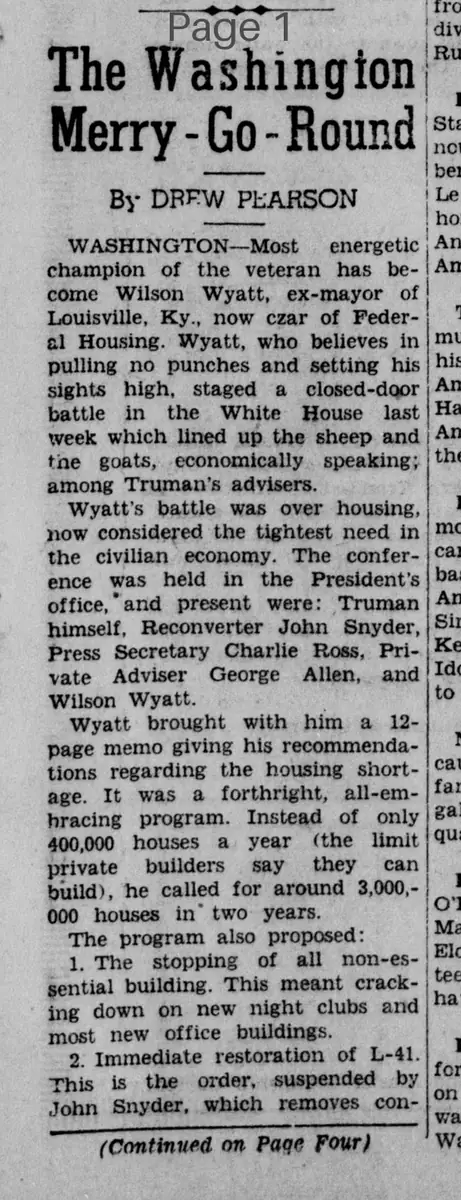
The Washington Merry-Go-Round
By DREW PEARSON
WASHINGTON-Most energetic champion of the veteran has become Wilson Wyatt, ex-mayor of Louisville, Ky., now czar of Federal Housing. Wyatt, who believes in pulling no punches and setting his sights high, staged a closed-door battle in the White House last week which lined up the sheep and the goats, economically speaking, among Truman's advisers.
Wyatt's battle was over housing, now considered the tightest need in the civilian economy. The conference was held in the President's office, and present were: Truman himself, Reconverter John Snyder, Press Secretary Charlie Ross, Private Adviser George Allen, and Wilson Wyatt.
Wyatt brought with him a 12-page memo giving his recommendations regarding the housing shortage. It was a forthright, all-embracing program. Instead of only 400,000 houses a year (the limit private builders say they can build), he called for around 3,000,000 houses in two years.
The program also proposed:
1. The stopping of all non-essential building. This meant cracking down on new night clubs and most new office buildings.
2. Immediate restoration of L-41. This is the order, suspended by John Snyder, which removes controls from building materials. Wyatt's plan is to place all building materials on a priority basis.
3. Give subsidies for low-cost houses up to 25 percent-if necessary. Wyatt did not believe, however, that many subsidies would be necessary after builders got into mass production.
4. Convert Army camps into housing by removing units which are suitable for civilian use.
5. Keep all housing under $10,000. and give the largest share of building materials to those putting up $5,000 houses.
Finally, Wyatt called for a tremendous use of fabricated materials as the quickest way to build houses.
SNYDER SAYS NO
The program hit Reconverter Snyder like a ton of bricks. He was in favor of none of it. George Allen also was negative, though not as much as Snyder.
"I'm not sure you can rush in with this before you've cleared it on Capitol Hill, and also with labor and the real estate boys," Allen said. "There are a million bills on the Hill dealing with housing, including the Patman Bill and the Wagner-Ellender Bill. Let's look things over carefully."
However, Allen added: "Thank God someone has come in with an idea."
President Truman, on the other hand, was favorable, though he wanted his advisers to iron out their various differences.
Snyder's initial argument was that press reaction to such a program would be bad. This question was referred to Press Secretary Charlie Ross, who has spent 40 years as a newsman. Ross disagreed, said newspaper comment would be excellent. He endorsed the Wyatt program heartily.
Snyder also objected on the ground that people didn't like going back to wartime restrictions.
But Wyatt disagreed.
"Look at the public's endorsement of the OPA when it replaced price ceilings on citrus fruits," he said "We have to keep our sights high," the hard-hitting ex-Mayor of Louisville insisted. "Unless you do, we'll come through with no program at all."
After a long discussion, it was finally decided to postpone the program until Wyatt could straighten out some of his differences with Snyder and Civilian Administrator Jack Small. In the end, President Truman gave this emphatic endorsement of Wyatt's general ideas.
"As I told you before, I want no little plan," he said.
Odds are that Wyatt will win out with most of his program.
By DREW PEARSON
WASHINGTON-Most energetic champion of the veteran has become Wilson Wyatt, ex-mayor of Louisville, Ky., now czar of Federal Housing. Wyatt, who believes in pulling no punches and setting his sights high, staged a closed-door battle in the White House last week which lined up the sheep and the goats, economically speaking, among Truman's advisers.
Wyatt's battle was over housing, now considered the tightest need in the civilian economy. The conference was held in the President's office, and present were: Truman himself, Reconverter John Snyder, Press Secretary Charlie Ross, Private Adviser George Allen, and Wilson Wyatt.
Wyatt brought with him a 12-page memo giving his recommendations regarding the housing shortage. It was a forthright, all-embracing program. Instead of only 400,000 houses a year (the limit private builders say they can build), he called for around 3,000,000 houses in two years.
The program also proposed:
1. The stopping of all non-essential building. This meant cracking down on new night clubs and most new office buildings.
2. Immediate restoration of L-41. This is the order, suspended by John Snyder, which removes controls from building materials. Wyatt's plan is to place all building materials on a priority basis.
3. Give subsidies for low-cost houses up to 25 percent-if necessary. Wyatt did not believe, however, that many subsidies would be necessary after builders got into mass production.
4. Convert Army camps into housing by removing units which are suitable for civilian use.
5. Keep all housing under $10,000. and give the largest share of building materials to those putting up $5,000 houses.
Finally, Wyatt called for a tremendous use of fabricated materials as the quickest way to build houses.
SNYDER SAYS NO
The program hit Reconverter Snyder like a ton of bricks. He was in favor of none of it. George Allen also was negative, though not as much as Snyder.
"I'm not sure you can rush in with this before you've cleared it on Capitol Hill, and also with labor and the real estate boys," Allen said. "There are a million bills on the Hill dealing with housing, including the Patman Bill and the Wagner-Ellender Bill. Let's look things over carefully."
However, Allen added: "Thank God someone has come in with an idea."
President Truman, on the other hand, was favorable, though he wanted his advisers to iron out their various differences.
Snyder's initial argument was that press reaction to such a program would be bad. This question was referred to Press Secretary Charlie Ross, who has spent 40 years as a newsman. Ross disagreed, said newspaper comment would be excellent. He endorsed the Wyatt program heartily.
Snyder also objected on the ground that people didn't like going back to wartime restrictions.
But Wyatt disagreed.
"Look at the public's endorsement of the OPA when it replaced price ceilings on citrus fruits," he said "We have to keep our sights high," the hard-hitting ex-Mayor of Louisville insisted. "Unless you do, we'll come through with no program at all."
After a long discussion, it was finally decided to postpone the program until Wyatt could straighten out some of his differences with Snyder and Civilian Administrator Jack Small. In the end, President Truman gave this emphatic endorsement of Wyatt's general ideas.
"As I told you before, I want no little plan," he said.
Odds are that Wyatt will win out with most of his program.
What sub-type of article is it?
Economic Policy
Infrastructure
What keywords are associated?
Housing Shortage
Wyatt Program
Truman Advisers
Building Controls
Postwar Reconversion
Veteran Housing
What entities or persons were involved?
Wilson Wyatt
President Truman
John Snyder
Charlie Ross
George Allen
Jack Small
Editorial Details
Primary Topic
Wilson Wyatt's Ambitious Housing Program Proposal
Stance / Tone
Supportive Of Expansive Housing Initiative
Key Figures
Wilson Wyatt
President Truman
John Snyder
Charlie Ross
George Allen
Jack Small
Key Arguments
Propose Building 3 Million Houses In Two Years
Stop Non Essential Building Like Night Clubs And Office Buildings
Restore L 41 Order For Priority On Building Materials
Provide Up To 25% Subsidies For Low Cost Houses
Convert Army Camps To Civilian Housing
Limit Housing To Under $10,000 With Priority For $5,000 Units
Use Fabricated Materials For Quick Construction
Press Reaction Would Be Positive
Public Supports Necessary Restrictions For Housing