Thank you for visiting SNEWPapers!
Sign up free
The Enquirer
Richmond, Henrico County, Virginia
What is this article about?
Correspondence from 1805-1806 involving Commodore Thomas Truxtun, Charles Biddle, and Richard Dale clarifies that Truxtun did not resign his navy commission but declined Mediterranean command without a subordinate captain. Navy Secretary Robert Smith denies reinstatement, citing prior resignation and officers' opinions. Includes historical notes on naval practices.
Clipping
OCR Quality
Full Text
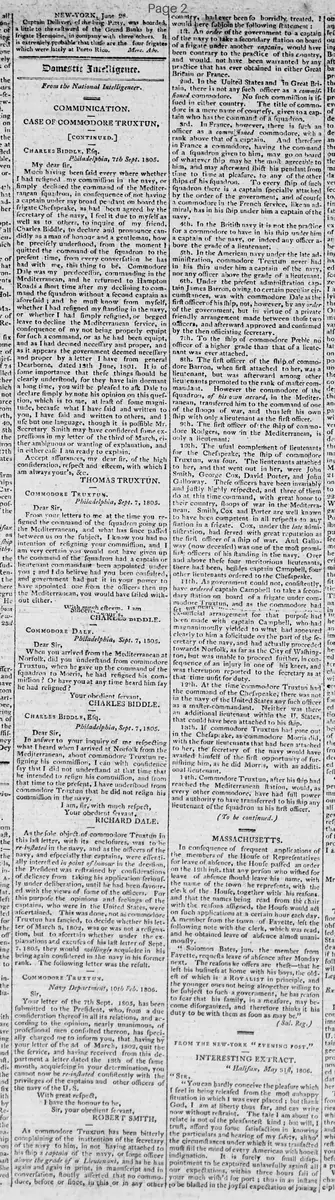
From the National Intelligencer.
COMMUNICATION.
CASE OF COMMODORE TRUXTUN,
[continued.]
Charles Biddle, Esq.
Philadelphia, 7th Sept. 1805.
My dear sir,
Much having been said every where whether I had resigned my commission in the navy, or simply declined the command of the Mediterranean squadron, in consequence of not having a captain under my broad pendant on board the frigate Chesapeake, as had been agreed by the Secretary of the navy, I feel it due to myself as well as to others, to inquire of my friend, Charles Biddle, to declare and pronounce candidly as a man of honour and a gentleman, how he precisely understood, from the moment I quitted the command of the squadron to the present time, from every conversation he has had with me, this thing to be. Commodore Dale was my predecessor, commanding in the Mediterranean, and he returned to Hampton Roads a short time after my declining to command the squadron without a second captain as aforesaid; and he must know from myself, whether I had resigned my standing in the navy, or whether I had simply resigned, or begged leave to decline the Mediterranean service, in consequence of my not being properly equipped for such a command, or as he had been equipped, and as I had deemed necessary and proper, and as it appears the government deemed necessary and proper by a letter I have from general Dearborne, dated 18th June, 1801. It is of some importance that these things should be clearly understood, for they have lain dormant a long time, you will be pleased to ask Dale to declare simply by note his opinion on this question, which is to me, at least of some magnitude, because what I have said and written to you, I have said and written to others, and I use but one language, though it is possible Mr. Secretary Smith may have considered some expressions in my letter of the third of March, either ambiguous or wanting of explanation, and in either case I am ready to explain.
Accept assurances, my dear sir, of the high consideration, respect and esteem, with which I am always your's, &c.
THOMAS TRUXTUN.
Commodore Truxtun.
Philadelphia, Sept. 7, 1805.
Dear Sir,
From your letters to me at the time you resigned the command of the squadron going up the Mediterranean, and what has since passed between us on the subject, I know you had no intention of resigning your commission, and I am very certain you would not have given up the command of the squadron had a captain or lieutenant commandant been appointed under you; and I do believe had you been consulted, and government had put it in your power to have appointed one from the officers then up the Mediterranean, you would have sailed without either.
With great esteem. I am your's,
CHARLES BIDDLE.
Commodore Dale.
Dear Sir,
Philadelphia, Sept. 7, 1805.
When you arrived from the Mediterranean at Norfolk, did you understand from commodore Truxtun, when he gave up the command of the squadron to Morris, he had resigned his commission? Or have you at any time heard him say he had resigned?
Your obedient servant,
CHARLES BIDDLE.
Charles Biddle, Esq.
Philadelphia, Sept.7, 1805.
Dear Sir,
In answer to your inquiry of me respecting what I heard when I arrived at Norfolk from the Mediterranean, about commodore Truxtun resigning his commission, I can with confidence say that I did not understand at that time that he intended to resign his commission, and from that time to the present, I have understood from commodore Truxtun that he did not resign his commission in the navy.
I am, sir, with much respect,
Your obedient Servant,
RICHARD DALE.
As the sole object of commodore Truxtun in this last letter, with its enclosures, was to be re-instated in the navy, and as the officers of the navy, and especially the captains, were essentially interested in point of honour in the decision, the President was restrained by considerations of delicacy from taking his application seriously under deliberation, until he had been favoured with the views of some of the officers. For this purpose the opinions and feelings of the captains, who were in the United States, were ascertained. This was done, not as commodore Truxtun has fancied, to decide whether his letter of March 3, 1802, was or was not a resignation, but to ascertain whether under the explanations and excuses of his last letter of Sept. 7, 1805, they would willingly acquiesce in his being again considered in the navy in his former rank. The following letter was the result.
Commodore Truxtun.
Navy Department, 10th Feb. 1806.
Sir,
Your letter of the 7th Sept. 1805, has been submitted to the President, who, from a due consideration thereof in all its relations, and according to the opinion, nearly unanimous, of professional men consulted thereon, has specially charged me to inform you, that having by your letter of the 3d of March, 1802, quit the service, and having received from this department a letter dated the 18th of the same month, acquiescing in your determination, you cannot now be re-instated consistently with the privileges of the captains and other officers of the navy of the U.S.
With great respect,
I have the honour to be,
Sir, your obedient servant,
ROBERT SMITH.
As commodore Truxtun has been bitterly complaining of the inattention of the secretary of the navy to him, in not having attached to his ship a captain of the navy, or some officer above the grade of a Lieutenant, and as he has again and again in print, in manuscript and in conversation, stoutly asserted that no commodore, before or since, in this or in any other country, had ever been so horridly treated. I would here subjoin the following statement:
1st. An order of the government to a captain of the navy to take a secondary station on board of a frigate under another captain, would have been contrary to the practice of this country, and would not have been warranted by any practice that has ever obtained in either Great Britain or France.
2nd. In the United States and in Great Britain, there is not any such officer as a commissioned commodore. No such commission is issued in either country. The title of commodore is a mere name of courtesy, given to a captain who has the command of a squadron.
3rd. In France, however, there is such an officer as a commissioned commodore, with a rank above that of a captain. And therefore in France a commodore, having the command of a squadron given to him, may go on board of whatever ship may be the most agreeable to him, and may afterward shift his pendant from time to time at pleasure, to any of the other Ships of his squadron. To every Ship of such squadron there is a captain specially attached by the order of the government, and of course a commodore in the French service, like an admiral, has in his ship under him a captain of the navy.
4th. In the British navy it is not the practice for a commodore to have in his ship under him a captain of the navy, or indeed any officer above the grade of a lieutenant.
5th. In the American navy under the late administration, commodore Truxtun never had in his Ship under him a captain of the navy, nor any officer above the grade of a lieutenant.
6th. Under the present administration captain James Barron, owing to certain peculiar circumstances, was with commodore Dale as the first officer of his ship, not, however, by any order of the government, but in virtue of a private friendly arrangement made between those two officers, and afterward approved and confirmed by the then officiating secretary.
7th. To the Ship of commodore Preble no officer of a higher grade than that of a lieutenant was ever attached.
8th. The first officer of the Ship of commodore Barron, when first attached to her, was a lieutenant, but was afterward among other lieutenants promoted to the rank of master commandant. However the commodore of the squadron, of his own accord, in the Mediterranean, transferred him to the command of one of the sloops of war, and thus left his own Ship with only a lieutenant as the first officer.
9th. The first officer of the Ship of commodore Rodgers, now in the Mediterranean, is only a lieutenant.
10th. The usual complement of lieutenants for the Chesapeake, the Ship of commodore Truxtun, was four. The lieutenants attached to her, and that went out in her, were John Smith, George Cox, David Porter, and John Galloway. These officers have been invariably and justly highly respected, and three of them do at this time command, with great honor to their country, Sloops of war in the Mediterranean. Smith, Cox and Porter are well known to have been competent in all respects to any station in a frigate. Cox, under the late administration, had served with great reputation as the first officer of a ship of war. And Galloway (now deceased) was one of the most promising officers of his standing in the navy.
Over and above these four meritorious lieutenants, there had been, besides captain Campbell, four other lieutenants ordered to the Chesapeake.
11th. As government could not, consistently, have ordered captain Campbell to take a secondary station on board of a frigate under commodore Truxtun, and as the commodore had set his mind so near against it, no official arrangement for that purpose had been made with captain Campbell, who had magnanimously yielded to what had appeared clearly to him a solicitude on the part of the secretary of the navy, and had actually proceeded towards Norfolk, as far as the City of Washington, but was unable to proceed further, in consequence of an injury in one of his knees, and was thereupon reported to the secretary as at that time unfit for duty.
12th. At the time commodore Truxtun had the command of the Chesapeake, there was not in the navy of the United States any such officer as a master-commandant. Neither was there an additional lieutenant within the U. States, that could have been attached to his ship.
13th. If commodore Truxtun had gone out in the Chesapeake, as commodore Morris did, with the four lieutenants that had been attached to her, the secretary of the navy would have availed himself of the first opportunity of furnishing him, as he did Morris, with an additional lieutenant.
14th. Commodore Truxtun, after his ship had reached the Mediterranean station, would, as every other commodore, have had full power and authority to have transferred to his ship any lieutenant of the squadron as his first officer.
(To be continued.)
What sub-type of article is it?
What themes does it cover?
What keywords are associated?
What entities or persons were involved?
Where did it happen?
Story Details
Key Persons
Location
Philadelphia, Mediterranean, Norfolk, Hampton Roads
Event Date
1801 1806
Story Details
Commodore Truxtun seeks clarification and reinstatement after declining Mediterranean command due to lack of subordinate captain; letters from Biddle and Dale confirm no resignation; Navy denies reinstatement based on 1802 letter and officers' views; detailed naval practices refute his complaints.