Thank you for visiting SNEWPapers!
Sign up free
Story
April 20, 1959
The Augusta Courier
Augusta, Richmond County, Georgia
What is this article about?
Senator Strom Thurmond opposes pending civil rights bills before the Senate Judiciary Committee, labeling them a 'conquered province bill' born of Northern hatred toward the South, contrasting with magnanimous post-WWII aid to Axis powers and echoing post-Civil War attitudes.
Clipping
OCR Quality
95%
Excellent
Full Text
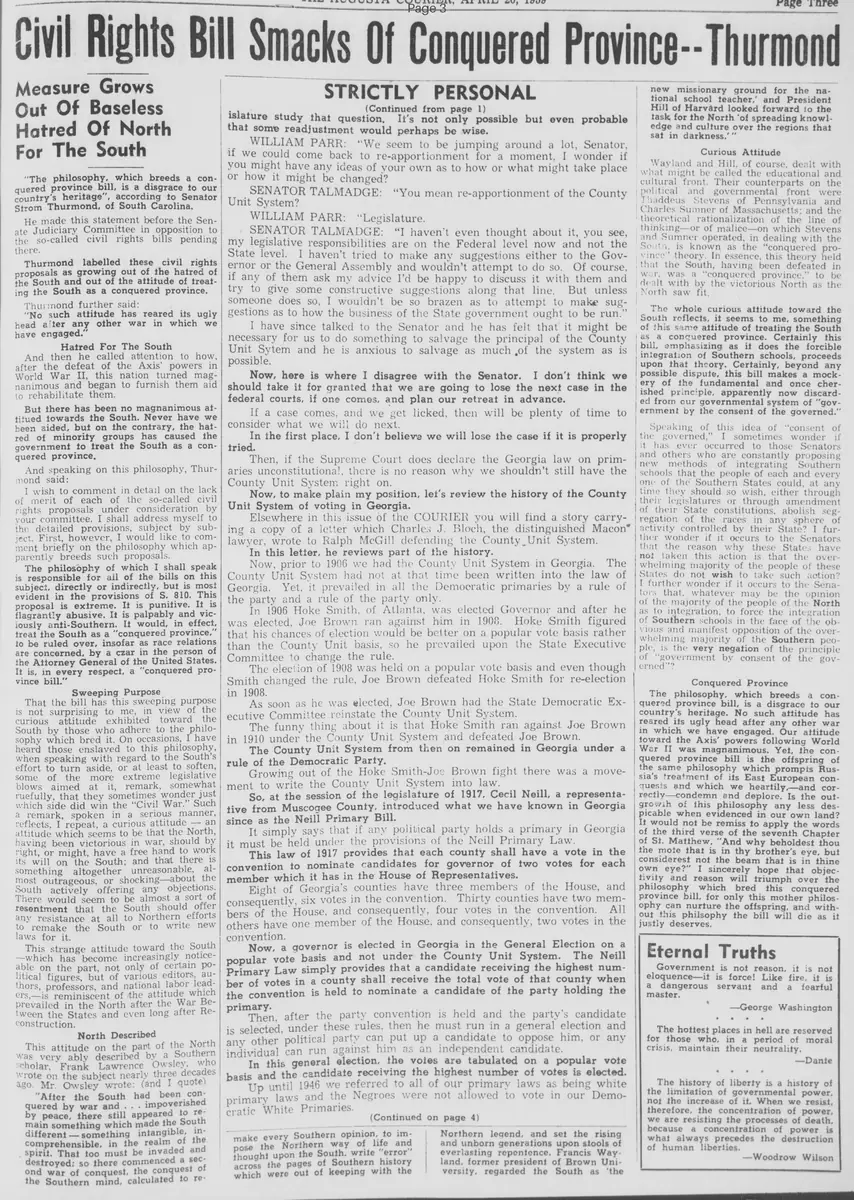
Civil Rights Bill Smacks of Conquered Province--Thurmond
Measure Grows Out Of Baseless Hatred Of North For The South
"The philosophy which breeds a conquered province bill, is a disgrace to our country's heritage", according to Senator Strom Thurmond, of South Carolina.
He made this statement before the Senate Judiciary Committee in opposition to the so-called civil rights bills pending there.
Thurmond labelled these civil rights proposals as growing out of the hatred of the South and out of the attitude of treating the South as a conquered province.
Thurmond further said:
"No such attitude has reared its ugly head after any other war in which we have engaged."
Hatred For The South
And then he called attention to how, after the defeat of the Axis' powers in World War II, this nation turned magnanimous and began to furnish them aid to rehabilitate them.
But there has been no magnanimous attitude towards the South. Never have we been aided, but on the contrary, the hatred of minority groups has caused the government to treat the South as a conquered province.
And speaking on this philosophy, Thurmond said:
I wish to comment in detail on the lack of merit of each of the so-called civil rights proposals under consideration by your committee. I shall address myself to the detailed provisions, subject by subject. First, however, I would like to comment briefly on the philosophy which apparently breeds such proposals.
The philosophy of which I shall speak is responsible for all of the bills on this subject, directly or indirectly, but is most evident in the provisions of S. 810. This proposal is extreme. It is punitive. It is flagrantly abusive. It is palpably and viciously anti-Southern. It would, in effect treat the South as a "conquered province," to be ruled over, insofar as race relations are concerned, by a czar in the person of the Attorney General of the United States.
It is, in every respect, a "conquered province bill."
Sweeping Purpose
That the bill has this sweeping purpose is not surprising to me, in view of the curious attitude exhibited toward the South by those who adhere to the philosophy which bred it. On occasions, I have heard those enslaved to this philosophy, when speaking with regard to the South's effort to turn aside, or at least to soften, some of the more extreme legislative blows aimed at it, remark, somewhat ruefully, that they sometimes wonder just which side did win the "Civil War." Such a remark, spoken in a serious manner, reflects, I repeat, a curious attitude - an attitude which seems to be that the North, having been victorious in war, should by right, or might, have a free hand to work its will on the South: and that there is something altogether unreasonable, almost outrageous, or shocking-about the South actively offering any objections.
There would seem to be almost a sort of resentment that the South should offer any resistance at all to Northern efforts to remake the South or to write new laws for it.
This strange attitude toward the South -which has become increasingly noticeable on the part, not only of certain political figures, but of various editors, authors, professors, and national labor leaders,—is reminiscent of the attitude which prevailed in the North after the War Between the States and even long after Reconstruction.
North Described
This attitude on the part of the North was very ably described by a Southern scholar, Frank Lawrence Owsley, who wrote on the subject nearly three decades ago. Mr. Owsley wrote: (and I quote)
"After the South had been conquered by war and ... impoverished by peace, there still appeared to remain something which made the South different something intangible, inspirational. That too must be invaded and comprehensible, in the realm of the second war of conquest, the conquest of the Southern mind, calculated to reconstruct; so there commenced a second war of conquest, the conquest of the destroyed; so the Southern mind, calculated to re-make every Southern opinion, to impose thought upon the South, write "error" across the pages of Southern history which were out of keeping with the Northern legend, and set the rising and unborn generations upon stools of everlasting repentance. Francis Wayland, former president of Brown University, regarded the South as 'the new missionary ground for the national school teacher,' and President Hill of Harvard looked forward to the task for the North 'of spreading knowledge and culture over the regions that sat in darkness.'"
Curious Attitude
Wayland and Hill, of course, dealt with what might be called the educational and cultural front. Their counterparts on the political and governmental front were Thaddeus Stevens of Pennsylvania and Charles Sumner of Massachusetts; and the theoretical rationalization of the line of thinking—or of malice—on which Stevens and Sumner operated, in dealing with the South, is known as the "conquered province' theory. In essence, this theory held that the South, having been defeated in war, was a "conquered province," to be dealt with by the victorious North as the North saw fit.
The whole curious attitude toward the South reflects, it seems to me, something of this same attitude of treating the South as a conquered province. Certainly this bill, emphasizing as it does the forcible integration of Southern schools, proceeds upon that theory. Certainly, beyond any possible dispute, this bill makes a mockery of the fundamental and once cherished principle, apparently now discarded from our governmental system of "government by the consent of the governed."
Speaking of this idea of "consent of the governed," I sometimes wonder if it has ever occurred to those Senators and others who are constantly proposing new methods of integrating Southern schools that the people of each and every one of the Southern States could, at any time they should so wish, either through their legislatures or through amendment of their State constitutions, abolish segregation of the races in any sphere of activity controlled by their State? I further wonder if it occurs to the Senators that the reason why these States have not taken this action is that the overwhelming majority of the people of these States do not wish to take such action?
I further wonder if it occurs to the Senators that, whatever may be the opinion of the majority of the people of the North as to integration, to force the integration of Southern schools in the face of the obvious and manifest opposition of the overwhelming majority of the Southern people, is the very negation of the principle of "government by consent of the governed"?
Conquered Province
The philosophy, which breeds a conquered province bill, is a disgrace to our country's heritage. No such attitude has reared its ugly head after any other war in which we have engaged. Our attitude toward the Axis' powers following World War II was magnanimous. Yet, the conquered province bill is the offspring of the same philosophy which prompts Russia's treatment of its East European conquests and which we heartily and correctly condemn and deplore. Is the outgrowth of this philosophy any less despicable when evidenced in our own land?
It would not be remiss to apply the words of the third verse of the seventh Chapter of St. Matthew, "And why beholdest thou the mote that is in thy brother's eye, but considerest not the beam that is in thine own eye?" I sincerely hope that objectivity and reason will triumph over the philosophy which bred this conquered province bill, for only this mother philosophy can nurture the offspring, and without this philosophy the bill will die as it justly deserves.
Eternal Truths
Government is not reason, it is not eloquence-it is force! Like fire, it is a dangerous servant and a fearful master.
George Washington
The hottest places in hell are reserved for those who, in a period of moral crisis, maintain their neutrality.
-Dante
The history of liberty is a history of the limitation of governmental power, not the increase of it. When we resist, therefore, the concentration of power, we are resisting the processes of death, because a concentration of power is what always precedes the destruction of human liberties.
—Woodrow Wilson
Measure Grows Out Of Baseless Hatred Of North For The South
"The philosophy which breeds a conquered province bill, is a disgrace to our country's heritage", according to Senator Strom Thurmond, of South Carolina.
He made this statement before the Senate Judiciary Committee in opposition to the so-called civil rights bills pending there.
Thurmond labelled these civil rights proposals as growing out of the hatred of the South and out of the attitude of treating the South as a conquered province.
Thurmond further said:
"No such attitude has reared its ugly head after any other war in which we have engaged."
Hatred For The South
And then he called attention to how, after the defeat of the Axis' powers in World War II, this nation turned magnanimous and began to furnish them aid to rehabilitate them.
But there has been no magnanimous attitude towards the South. Never have we been aided, but on the contrary, the hatred of minority groups has caused the government to treat the South as a conquered province.
And speaking on this philosophy, Thurmond said:
I wish to comment in detail on the lack of merit of each of the so-called civil rights proposals under consideration by your committee. I shall address myself to the detailed provisions, subject by subject. First, however, I would like to comment briefly on the philosophy which apparently breeds such proposals.
The philosophy of which I shall speak is responsible for all of the bills on this subject, directly or indirectly, but is most evident in the provisions of S. 810. This proposal is extreme. It is punitive. It is flagrantly abusive. It is palpably and viciously anti-Southern. It would, in effect treat the South as a "conquered province," to be ruled over, insofar as race relations are concerned, by a czar in the person of the Attorney General of the United States.
It is, in every respect, a "conquered province bill."
Sweeping Purpose
That the bill has this sweeping purpose is not surprising to me, in view of the curious attitude exhibited toward the South by those who adhere to the philosophy which bred it. On occasions, I have heard those enslaved to this philosophy, when speaking with regard to the South's effort to turn aside, or at least to soften, some of the more extreme legislative blows aimed at it, remark, somewhat ruefully, that they sometimes wonder just which side did win the "Civil War." Such a remark, spoken in a serious manner, reflects, I repeat, a curious attitude - an attitude which seems to be that the North, having been victorious in war, should by right, or might, have a free hand to work its will on the South: and that there is something altogether unreasonable, almost outrageous, or shocking-about the South actively offering any objections.
There would seem to be almost a sort of resentment that the South should offer any resistance at all to Northern efforts to remake the South or to write new laws for it.
This strange attitude toward the South -which has become increasingly noticeable on the part, not only of certain political figures, but of various editors, authors, professors, and national labor leaders,—is reminiscent of the attitude which prevailed in the North after the War Between the States and even long after Reconstruction.
North Described
This attitude on the part of the North was very ably described by a Southern scholar, Frank Lawrence Owsley, who wrote on the subject nearly three decades ago. Mr. Owsley wrote: (and I quote)
"After the South had been conquered by war and ... impoverished by peace, there still appeared to remain something which made the South different something intangible, inspirational. That too must be invaded and comprehensible, in the realm of the second war of conquest, the conquest of the Southern mind, calculated to reconstruct; so there commenced a second war of conquest, the conquest of the destroyed; so the Southern mind, calculated to re-make every Southern opinion, to impose thought upon the South, write "error" across the pages of Southern history which were out of keeping with the Northern legend, and set the rising and unborn generations upon stools of everlasting repentance. Francis Wayland, former president of Brown University, regarded the South as 'the new missionary ground for the national school teacher,' and President Hill of Harvard looked forward to the task for the North 'of spreading knowledge and culture over the regions that sat in darkness.'"
Curious Attitude
Wayland and Hill, of course, dealt with what might be called the educational and cultural front. Their counterparts on the political and governmental front were Thaddeus Stevens of Pennsylvania and Charles Sumner of Massachusetts; and the theoretical rationalization of the line of thinking—or of malice—on which Stevens and Sumner operated, in dealing with the South, is known as the "conquered province' theory. In essence, this theory held that the South, having been defeated in war, was a "conquered province," to be dealt with by the victorious North as the North saw fit.
The whole curious attitude toward the South reflects, it seems to me, something of this same attitude of treating the South as a conquered province. Certainly this bill, emphasizing as it does the forcible integration of Southern schools, proceeds upon that theory. Certainly, beyond any possible dispute, this bill makes a mockery of the fundamental and once cherished principle, apparently now discarded from our governmental system of "government by the consent of the governed."
Speaking of this idea of "consent of the governed," I sometimes wonder if it has ever occurred to those Senators and others who are constantly proposing new methods of integrating Southern schools that the people of each and every one of the Southern States could, at any time they should so wish, either through their legislatures or through amendment of their State constitutions, abolish segregation of the races in any sphere of activity controlled by their State? I further wonder if it occurs to the Senators that the reason why these States have not taken this action is that the overwhelming majority of the people of these States do not wish to take such action?
I further wonder if it occurs to the Senators that, whatever may be the opinion of the majority of the people of the North as to integration, to force the integration of Southern schools in the face of the obvious and manifest opposition of the overwhelming majority of the Southern people, is the very negation of the principle of "government by consent of the governed"?
Conquered Province
The philosophy, which breeds a conquered province bill, is a disgrace to our country's heritage. No such attitude has reared its ugly head after any other war in which we have engaged. Our attitude toward the Axis' powers following World War II was magnanimous. Yet, the conquered province bill is the offspring of the same philosophy which prompts Russia's treatment of its East European conquests and which we heartily and correctly condemn and deplore. Is the outgrowth of this philosophy any less despicable when evidenced in our own land?
It would not be remiss to apply the words of the third verse of the seventh Chapter of St. Matthew, "And why beholdest thou the mote that is in thy brother's eye, but considerest not the beam that is in thine own eye?" I sincerely hope that objectivity and reason will triumph over the philosophy which bred this conquered province bill, for only this mother philosophy can nurture the offspring, and without this philosophy the bill will die as it justly deserves.
Eternal Truths
Government is not reason, it is not eloquence-it is force! Like fire, it is a dangerous servant and a fearful master.
George Washington
The hottest places in hell are reserved for those who, in a period of moral crisis, maintain their neutrality.
-Dante
The history of liberty is a history of the limitation of governmental power, not the increase of it. When we resist, therefore, the concentration of power, we are resisting the processes of death, because a concentration of power is what always precedes the destruction of human liberties.
—Woodrow Wilson
What sub-type of article is it?
Historical Event
What themes does it cover?
Justice
Social Manners
Misfortune
What keywords are associated?
Civil Rights Bills
Strom Thurmond
Conquered Province
Southern Opposition
School Integration
Northern Hatred
What entities or persons were involved?
Strom Thurmond
Frank Lawrence Owsley
Thaddeus Stevens
Charles Sumner
Francis Wayland
President Hill
Where did it happen?
Senate Judiciary Committee, South
Story Details
Key Persons
Strom Thurmond
Frank Lawrence Owsley
Thaddeus Stevens
Charles Sumner
Francis Wayland
President Hill
Location
Senate Judiciary Committee, South
Story Details
Senator Thurmond argues against civil rights bills, particularly S. 810, as punitive measures treating the South as a conquered province, rooted in post-Civil War Northern attitudes of conquest and lacking consent of the governed, contrasting with magnanimous treatment of post-WWII enemies.