Thank you for visiting SNEWPapers!
Sign up free
Story
November 21, 1853
Daily Evening Star
Washington, District Of Columbia
What is this article about?
Washington Irving's tale of Tom Walker, a miserly usurer who bargains with the devil for riches, grows religious to cheat his fate, but is abducted by the devil in a thunderstorm, his wealth reduced to ashes as punishment for greed.
Clipping
OCR Quality
98%
Excellent
Full Text
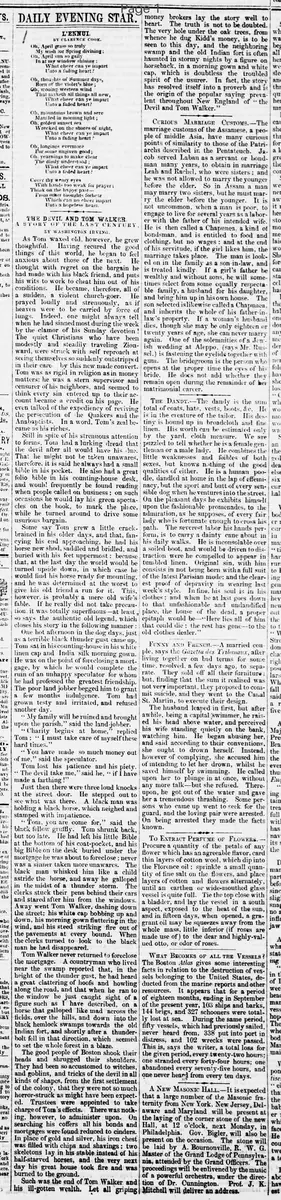
THE DEVIL AND TOM WALKER
A STORY OF THE LAST CENTURY
BY WASHINGTON IRVING.
As Tom waxed old, however, he grew
thoughtful. Having secured the good
things of this world, he began to feel
anxious about those of the next. He
thought with regret on the bargain he
had made with his black friend, and put
his wits to work to cheat him out of his
conditions. He became, therefore, all of
a sudden, a violent church-goer. He
prayed loudly and strenuously, as if
heaven were to be carried by force of
lungs. Indeed, one might always tell
when he had sinned most during the week
by the clamor of his Sunday devotion.
The quiet Christians who have been
modestly and steadily traveling Zion-
ward, were struck with self-reproach at
seeing themselves so suddenly outstripped
in their career by this new-made convert.
Tom was as rigid in religion as in money
matters: he was a stern supervisor and
censurer of his neighbors, and seemed to
think every sin entered up to their ac-
count became a credit on his page. He
even talked of the expediency of reviving
the persecution of the Quakers and the
Anabaptists. In a word, Tom's zeal be-
came as notorious as his riches.
Still in spite of his strenuous attention
to forms, Tom had a lurking dread that
the devil, after all, would have his due.
That he might not be taken unawares,
therefore, it is said he always had a small
Bible in his pocket. He also had a great
folio Bible in his counting-house desk,
and would frequently be found reading
when people called on business; on such
occasions he would lay his green spec-
tacles on the book, to mark the place,
while he turned around to drive some
usurious bargain.
Some say Tom grew a little crack-
brained in his older days; and that, fan-
cying his end approaching, he had his
horse new-shod, saddled and bridled, and
buried with his feet uppermost: because
that, at the last day, the world would be
turned upside down, in which case he
would find his horse ready for mounting,
and he was determined, at the worst, to
give his old friend a run for it. This,
however, is probably a mere old wife's
fable. If he really did take such a precau-
tion, it was totally superfluous—at least
so says the authentic old legend, which
closes his story in the following manner:
One hot afternoon in the dog-days, just
as a terrible black thunder-gust was com-
ing up, Tom sat in his counting-house in his white
linen cap and India silk morning-gown. He was on
the point of foreclosing a mort-
gage, by which he would complete the
ruin of an unhappy speculator, for whom
he had professed the greatest friendship.
The poor land-jobber begged him to grant
a few months indulgence. Tom had
grown testy and irritated, and refused
another day.
"My family will be ruined and brought
upon the parish," said the land-jobber.
"Charity begins at home," replied
Tom: "I must take care of myself these
hard times."
"You have made so much money out
of me," said the speculator.
Tom lost his patience and his piety.
"The devil take me," said he, "if I have
made a farthing!"
Just then there were three loud knocks
at the street door. He stepped out to
see what was there. A black man was
holding a black horse, which neighed and
stamped with impatience.
"Tom, you are come for," said the
black fellow gruffly. Tom shrunk back,
but too late. He had left his little Bible
at the bottom of his coat-pocket, and his
big Bible on the desk buried under the
mortgage he was about to foreclose: never
was a sinner taken more unawares. The
black man whisked him like a child
astride the horse, and away he galloped
in the midst of a thunder-storm. The
clerks stuck their pens behind their ears
and stared after him from the windows.
Away went Tom Walker, dashing down
the street; his white cap bobbing up and
down; his morning-gown fluttering in the
wind, and his steed striking fire out of
the pavements at every bound. When
the clerks turned to look for the black
man he had disappeared.
Tom Walker never returned to foreclose
the mortgage. A countryman who lived
near the swamp reported that, in the
height of the thunder-gust, he had heard
a great clattering of hoofs and howling
along the road, and that when he ran to
the window he just caught sight of a
figure such as I have described, on a
horse that galloped like mad across the
fields, over the hills, and down into the
black hemlock swamps towards the old
Indian fort, and shortly after a thunder-
bbolt fell in that direction, which seemed
to set the whole forest in a blaze.
The good people of Boston shook their
heads and shrugged their shoulders.
They had been so accustomed to witches,
and goblins, and tricks of the devil in all
kinds of shapes, from the first settlement
of the colony, that they were not so much
horror-struck as might have been expect-
ed. Trustees were appointed to take
charge of Tom's effects. There was nothing,
however, to administer upon. On
searching his coffers all his bonds and
mortgages were found reduced to cinders.
In place of gold and silver, his iron chest
was filled with chips and shavings; two
skeletons lay in his stable instead of his
half-starved horses, and the very next
day his great house took fire and was
burned to the ground.
Such was the end of Tom Walker and
his ill-gotten wealth. Let all griping
money-brokers lay the story well to
heart. The truth is not to be doubted.
The very hole under the oak-trees, from
whence he dug Kidd's money, is to be
seen to this day; and the neighboring
swamp and the old Indian fort is often
haunted in stormy nights by a figure on
horseback, in a morning-gown and white
cap, which is doubtless the troubled
spirit of the usurer. In fact, the story
has resolved itself into a proverb, and is
the origin of the popular saying prevalent
throughout New England, of "the
Devil and Tom Walker."
A STORY OF THE LAST CENTURY
BY WASHINGTON IRVING.
As Tom waxed old, however, he grew
thoughtful. Having secured the good
things of this world, he began to feel
anxious about those of the next. He
thought with regret on the bargain he
had made with his black friend, and put
his wits to work to cheat him out of his
conditions. He became, therefore, all of
a sudden, a violent church-goer. He
prayed loudly and strenuously, as if
heaven were to be carried by force of
lungs. Indeed, one might always tell
when he had sinned most during the week
by the clamor of his Sunday devotion.
The quiet Christians who have been
modestly and steadily traveling Zion-
ward, were struck with self-reproach at
seeing themselves so suddenly outstripped
in their career by this new-made convert.
Tom was as rigid in religion as in money
matters: he was a stern supervisor and
censurer of his neighbors, and seemed to
think every sin entered up to their ac-
count became a credit on his page. He
even talked of the expediency of reviving
the persecution of the Quakers and the
Anabaptists. In a word, Tom's zeal be-
came as notorious as his riches.
Still in spite of his strenuous attention
to forms, Tom had a lurking dread that
the devil, after all, would have his due.
That he might not be taken unawares,
therefore, it is said he always had a small
Bible in his pocket. He also had a great
folio Bible in his counting-house desk,
and would frequently be found reading
when people called on business; on such
occasions he would lay his green spec-
tacles on the book, to mark the place,
while he turned around to drive some
usurious bargain.
Some say Tom grew a little crack-
brained in his older days; and that, fan-
cying his end approaching, he had his
horse new-shod, saddled and bridled, and
buried with his feet uppermost: because
that, at the last day, the world would be
turned upside down, in which case he
would find his horse ready for mounting,
and he was determined, at the worst, to
give his old friend a run for it. This,
however, is probably a mere old wife's
fable. If he really did take such a precau-
tion, it was totally superfluous—at least
so says the authentic old legend, which
closes his story in the following manner:
One hot afternoon in the dog-days, just
as a terrible black thunder-gust was com-
ing up, Tom sat in his counting-house in his white
linen cap and India silk morning-gown. He was on
the point of foreclosing a mort-
gage, by which he would complete the
ruin of an unhappy speculator, for whom
he had professed the greatest friendship.
The poor land-jobber begged him to grant
a few months indulgence. Tom had
grown testy and irritated, and refused
another day.
"My family will be ruined and brought
upon the parish," said the land-jobber.
"Charity begins at home," replied
Tom: "I must take care of myself these
hard times."
"You have made so much money out
of me," said the speculator.
Tom lost his patience and his piety.
"The devil take me," said he, "if I have
made a farthing!"
Just then there were three loud knocks
at the street door. He stepped out to
see what was there. A black man was
holding a black horse, which neighed and
stamped with impatience.
"Tom, you are come for," said the
black fellow gruffly. Tom shrunk back,
but too late. He had left his little Bible
at the bottom of his coat-pocket, and his
big Bible on the desk buried under the
mortgage he was about to foreclose: never
was a sinner taken more unawares. The
black man whisked him like a child
astride the horse, and away he galloped
in the midst of a thunder-storm. The
clerks stuck their pens behind their ears
and stared after him from the windows.
Away went Tom Walker, dashing down
the street; his white cap bobbing up and
down; his morning-gown fluttering in the
wind, and his steed striking fire out of
the pavements at every bound. When
the clerks turned to look for the black
man he had disappeared.
Tom Walker never returned to foreclose
the mortgage. A countryman who lived
near the swamp reported that, in the
height of the thunder-gust, he had heard
a great clattering of hoofs and howling
along the road, and that when he ran to
the window he just caught sight of a
figure such as I have described, on a
horse that galloped like mad across the
fields, over the hills, and down into the
black hemlock swamps towards the old
Indian fort, and shortly after a thunder-
bbolt fell in that direction, which seemed
to set the whole forest in a blaze.
The good people of Boston shook their
heads and shrugged their shoulders.
They had been so accustomed to witches,
and goblins, and tricks of the devil in all
kinds of shapes, from the first settlement
of the colony, that they were not so much
horror-struck as might have been expect-
ed. Trustees were appointed to take
charge of Tom's effects. There was nothing,
however, to administer upon. On
searching his coffers all his bonds and
mortgages were found reduced to cinders.
In place of gold and silver, his iron chest
was filled with chips and shavings; two
skeletons lay in his stable instead of his
half-starved horses, and the very next
day his great house took fire and was
burned to the ground.
Such was the end of Tom Walker and
his ill-gotten wealth. Let all griping
money-brokers lay the story well to
heart. The truth is not to be doubted.
The very hole under the oak-trees, from
whence he dug Kidd's money, is to be
seen to this day; and the neighboring
swamp and the old Indian fort is often
haunted in stormy nights by a figure on
horseback, in a morning-gown and white
cap, which is doubtless the troubled
spirit of the usurer. In fact, the story
has resolved itself into a proverb, and is
the origin of the popular saying prevalent
throughout New England, of "the
Devil and Tom Walker."
What sub-type of article is it?
Supernatural
Deception Fraud
Tragedy
What themes does it cover?
Deception
Crime Punishment
Moral Virtue
What keywords are associated?
Devil Bargain
Tom Walker
Usury
Supernatural Abduction
Moral Punishment
Thunderstorm
Haunted Swamp
What entities or persons were involved?
Tom Walker
The Devil
Where did it happen?
Boston, Black Hemlock Swamps, Old Indian Fort
Story Details
Key Persons
Tom Walker
The Devil
Location
Boston, Black Hemlock Swamps, Old Indian Fort
Event Date
Last Century
Story Details
Tom Walker regrets his bargain with the devil for wealth and tries to cheat it by becoming zealously religious, but is taken unawares and abducted by the devil on horseback during a thunderstorm, his riches turning to chips and his property burning as retribution.