Thank you for visiting SNEWPapers!
Sign up free
Editorial
April 29, 1847
Watchman And Observer
Richmond, Virginia
What is this article about?
H. B. responds to critics Epinetus, Countryman, and Z. in a debate on Union Theological Seminary's challenges, advocating for scholarships, better funding from Virginia Synod churches, and considering relocation to compete with Princeton, emphasizing focus on issues over personal attacks.
Clipping
OCR Quality
85%
Good
Full Text
sums, which shall receive their proper destination:
For Board of Education,
From Nottoway Church,
From Brunswick Church,
Communications.
For the Watchman and Observer.
UNION THEOLOGICAL SEMINARY,
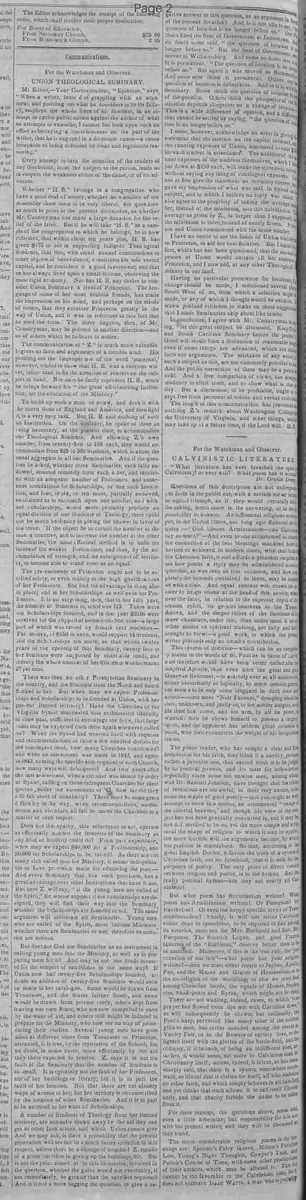
Mr. Editor,—Your Correspondent, "Epinetus," says. "When a writer, instead of grappling with an argument, and pointing out what he considers to be its fallacy, employs the whole force of his intellect, in an attempt to excite public odium against the author of what he attempts to examine, I cannot but look upon such an effort as betraying a consciousness on the part of the writer, that he is engaged in a desperate cause—a cause incapable of being defended by clear and legitimate reasoning."
Every attempt to turn the attention of the readers of any discussion, from the subject to the person, leads us to suspect the weakness either of the cause, or of its advocate.
Whether "H. B." belongs to a congregation who have a good deal of money, whether the statistics of the Assembly show them to be very liberal, are questions as much in point in the present discussion, as whether Mr. Countryman has made a large donation for the relief of the Irish. But if he will take "H. B." as a sample of the congregation to which he belongs, he is now informed, that within about ten years past, H. B. has given $175 to aid in supporting indigent Theological Students, that this, with small annual contributions to other objects of benevolence, constitutes his sole vested capital, and he considers it a good investment; and that he has always lived upon a small income, observing the most rigid economy. Nor has H. B. any desire to consider Union Seminary a rival of Princeton. The language of some of her most zealous friends, has made the impression on his mind, and perhaps on the minds of others, that they consider Princeton greatly in the way of Union, and it was in reference to this fact that he used the term. The three daggers, then, of Mr. Countryman, may be pointed in another direction-and so of others which he forbears to notice.
The communication of "Z." is much more valuable. It gives us facts and arguments of a forcible kind. His pointing out the improper use of the word 'maternal,' however, tended to show that H. B. was a careless writer, rather than to fix the attention of readers on the subject in hand. Nor does he fairly represent H. B., when he brings forward his "one great all-absorbing Institution, for the education of the Ministry."
To build up such a man of straw, and deck it with the corruptions of England and America, and then fight it, is a very easy task. But H. B. said nothing of such an Institution. On the contrary, he spoke of three as being necessary, at the present time, to accommodate our Theological Students. And allowing Z.'s own number, from seventy-five to 100 each, they would accommodate from 225 to 300 Students, which is about the usual aggregate in all our Seminaries. And if the question be asked, whether three Seminaries, each fully endowed, situated remotely from each other, and furnished with an adequate number of Professors, and numerous foundations for Scholarships, or one such Institution, and four, or six, or ten more, partially endowed, so situated as to encroach upon one another, and without scholarships, would more probably produce an equal division of our Students of Theology, there could not be much hesitancy in giving the answer in favor of the three. If the object be to curtail the number at the most attractive, and to increase the number at the other Seminaries, the most effectual method is to unite the forces of the weaker Institutions; and thus, by the accumulation of strength, and the enlargement of territory, to become able to stand erect as an equal.
The pre-eminence of Princeton ought not to be ascribed solely, or even mainly to the high qualifications of her Professors. She had the advantage in time; also in place; and in her Scholarships as well as in her Professors. It is no surprising, then, that in her 12th year, the number of Students reported was 113. There were ten Scholarships founded, and in that year $2166 were received for the support of necessitous Students-a large part of which was raised by female cent Societies.-- This money, at $150 to each, would support 14 Students, and the Scholarships ten more; so that within twelve years of the opening of that Seminary, twenty-four of her Students were supported by charitable funds, and thereby the whole number of her Students was increased 27 per cent.
There was then no other Presbyterian Seminary in the country, and the Students from the North and South flocked to her. But when may we expect Professorships and Scholarships to be founded at Union, with her present limited territory? Have the Churches of the Virginia Synod manifested that enthusiastic liberality in time past, sufficient to encourage the hope, that large sums may be expected from them again whenever called for? When the Synod had wearied itself with requests and recommendations to raise a few hundred dollars for the contingent fund, how many Churches contributed? and when an assessment was made in 1842, and again in 1843, naming the specific sum required of each Church, how many were still delinquent? And two years after the last assessment, when a circular was issued by order of Synod, calling on those delinquent Churches for their quotas, under the assessment of '43, how far did they still fall short of unanimity? There must be some great difficulty in the way, when recommendations, assessments and circulars, all fail to move the Churches in a matter of such import.
Does not this apathy, this reluctance to act, operate as effectually against the interests of the Seminary as any kind of hostility could do? From past experience, when may we expect $40,000 for a Professorship, and $50,000 for Scholarships to be raised? As there are not many rich called into the Ministry, it seems indispensable to have provision made for educating the poor.- And every Seminary that has such provision, has a great advantage over other Institutions that have it not.
But here Z. will say, "if the young men are called of the Spirit," for whose support these scholarships are designed, they will find their way into the Seminary, whether the scholarships are founded or not. The same argument will obliterate all Seminaries. Young men who are called of the Spirit, must become Ministers whether there are Seminaries or not; therefore Seminaries are useless.
But does not God use Seminaries as an instrument in calling young men into the Ministry, as well as in preparing them for it? And may he not use funds invested for the support of candidates in the same way? If Union now had twenty-five Scholarships founded, no doubt an addition of twenty-five Students would soon be made to her catalogue, Some would be drawn from Tennessee, and the States farther South, and some would be drawn from private study, others kept from leaving our own State, who are now compelled to leave by the want of aid, and others still might be induced to prepare for the Ministry, who now see no way of prosecuting their studies. Several young men have gone afoot at different times from Tennessee to Princeton, attracted, it is true, by the reputation of the School; but no doubt, in some cases, more effectually by the aid they there expected to receive. Z. says it is not the fault of the Seminary that the number of Students is so small, It is certainly not the fault of her Professors, nor of her buildings or library; but it is in part the fault of her location. Not that there are not already ways of access to her; but her territory is circumscribed by the location of other Seminaries. And it is in part to be ascribed to her want of Scholarships
A number of Students of Theology from her limited territory, are annually drawn away by the aid they can get at other Institutions, and which Union cannot give And we may ask, is there a probability that the present generation will see her in a much better situation in this respect, unless there be a change of location? Z. speaks of a great sacrifice in giving up the buildings, &c. But is not the point aimed at in this discussion, involved in the question, whether the gains would not eventually, if not immediately, be greater than the sacrifice required? And is it not a mere begging the question, to give a negative answer to this question, as an argument in favor of the present fixed location of the Seat of Government And some now think it permanent. Others say that the question of location is no longer before us. But the question has been moved before to Williamsburg us But the Seat of some of the And Seat some of is Government no the And longer question is it before at of location is moved to Richmond is no longer
But again The it question moved of location to Richmond is no longer But question of location is debatable Seminary. Some think the question of location is out of the question Others think the prosperity stitution depends altogether on a change of location wide difference of opinion and differen that cannot be settled by saying, "the question of location is no longer before us."
I must, however, acknowledge an error in giving the statement that the interest on the capital invested, and the running expenses of Union, amounted to near $50 for each student in attendance. The addition of the annual expenses of the students themselves, which I had put down at $150 each, will make the statement correct without saying any thing of contingent expenses. I d nt frst ive the statement as certainy coe,b gave my impression of what was said in Synod on the subject, and to which I believe no reply was made. I also agree to the propriety of taking the average number, instead of the minimum, into this calculation. The average as given by Z., is larger than I supposed; and the minimum is three, instead of nearly fifteen. Princeton and Union commenced with the same number.
I have no desire to see the funds of Union transferred to Princeton, to aid her beneficiaries. But I stated as a fact, which has not been questioned, that the annual expenses of Union would sustain all her students Princeton, and I now add, at any other Theological minary in our land.
Having no particular preference for locations, as a change should be made, I mentioned several places South West of us, from which a selection might be made, or any of which I thought would be suitable. I was a profound criticism to make on these suggestions that I made Seminaries skip about like lambs.
In conclusion, I agree with Mr. Countryman in saying, "let this great subject be discussed. Keep Union and South Carolina Seminary before the people. Good will result from a discussion of reasonable length even if some things are advanced, which are neither facts nor arguments. The mistakes of any writer, on such a subject as this, are not commonly peculiar to him And the public correction of them may be a public benefit. And a free comparison of views, has always tendency to elicit truth, and to show what is true policy. But a discussion, to be profitable, ought to be kept free from personal allusions and verbal criticism The length of this communication has prevented me noticing Z.'s remarks about Washington College and the University of Virginia, and other things, which may take up at a future time, if the Lord will. H. B
For Board of Education,
From Nottoway Church,
From Brunswick Church,
Communications.
For the Watchman and Observer.
UNION THEOLOGICAL SEMINARY,
Mr. Editor,—Your Correspondent, "Epinetus," says. "When a writer, instead of grappling with an argument, and pointing out what he considers to be its fallacy, employs the whole force of his intellect, in an attempt to excite public odium against the author of what he attempts to examine, I cannot but look upon such an effort as betraying a consciousness on the part of the writer, that he is engaged in a desperate cause—a cause incapable of being defended by clear and legitimate reasoning."
Every attempt to turn the attention of the readers of any discussion, from the subject to the person, leads us to suspect the weakness either of the cause, or of its advocate.
Whether "H. B." belongs to a congregation who have a good deal of money, whether the statistics of the Assembly show them to be very liberal, are questions as much in point in the present discussion, as whether Mr. Countryman has made a large donation for the relief of the Irish. But if he will take "H. B." as a sample of the congregation to which he belongs, he is now informed, that within about ten years past, H. B. has given $175 to aid in supporting indigent Theological Students, that this, with small annual contributions to other objects of benevolence, constitutes his sole vested capital, and he considers it a good investment; and that he has always lived upon a small income, observing the most rigid economy. Nor has H. B. any desire to consider Union Seminary a rival of Princeton. The language of some of her most zealous friends, has made the impression on his mind, and perhaps on the minds of others, that they consider Princeton greatly in the way of Union, and it was in reference to this fact that he used the term. The three daggers, then, of Mr. Countryman, may be pointed in another direction-and so of others which he forbears to notice.
The communication of "Z." is much more valuable. It gives us facts and arguments of a forcible kind. His pointing out the improper use of the word 'maternal,' however, tended to show that H. B. was a careless writer, rather than to fix the attention of readers on the subject in hand. Nor does he fairly represent H. B., when he brings forward his "one great all-absorbing Institution, for the education of the Ministry."
To build up such a man of straw, and deck it with the corruptions of England and America, and then fight it, is a very easy task. But H. B. said nothing of such an Institution. On the contrary, he spoke of three as being necessary, at the present time, to accommodate our Theological Students. And allowing Z.'s own number, from seventy-five to 100 each, they would accommodate from 225 to 300 Students, which is about the usual aggregate in all our Seminaries. And if the question be asked, whether three Seminaries, each fully endowed, situated remotely from each other, and furnished with an adequate number of Professors, and numerous foundations for Scholarships, or one such Institution, and four, or six, or ten more, partially endowed, so situated as to encroach upon one another, and without scholarships, would more probably produce an equal division of our Students of Theology, there could not be much hesitancy in giving the answer in favor of the three. If the object be to curtail the number at the most attractive, and to increase the number at the other Seminaries, the most effectual method is to unite the forces of the weaker Institutions; and thus, by the accumulation of strength, and the enlargement of territory, to become able to stand erect as an equal.
The pre-eminence of Princeton ought not to be ascribed solely, or even mainly to the high qualifications of her Professors. She had the advantage in time; also in place; and in her Scholarships as well as in her Professors. It is no surprising, then, that in her 12th year, the number of Students reported was 113. There were ten Scholarships founded, and in that year $2166 were received for the support of necessitous Students-a large part of which was raised by female cent Societies.-- This money, at $150 to each, would support 14 Students, and the Scholarships ten more; so that within twelve years of the opening of that Seminary, twenty-four of her Students were supported by charitable funds, and thereby the whole number of her Students was increased 27 per cent.
There was then no other Presbyterian Seminary in the country, and the Students from the North and South flocked to her. But when may we expect Professorships and Scholarships to be founded at Union, with her present limited territory? Have the Churches of the Virginia Synod manifested that enthusiastic liberality in time past, sufficient to encourage the hope, that large sums may be expected from them again whenever called for? When the Synod had wearied itself with requests and recommendations to raise a few hundred dollars for the contingent fund, how many Churches contributed? and when an assessment was made in 1842, and again in 1843, naming the specific sum required of each Church, how many were still delinquent? And two years after the last assessment, when a circular was issued by order of Synod, calling on those delinquent Churches for their quotas, under the assessment of '43, how far did they still fall short of unanimity? There must be some great difficulty in the way, when recommendations, assessments and circulars, all fail to move the Churches in a matter of such import.
Does not this apathy, this reluctance to act, operate as effectually against the interests of the Seminary as any kind of hostility could do? From past experience, when may we expect $40,000 for a Professorship, and $50,000 for Scholarships to be raised? As there are not many rich called into the Ministry, it seems indispensable to have provision made for educating the poor.- And every Seminary that has such provision, has a great advantage over other Institutions that have it not.
But here Z. will say, "if the young men are called of the Spirit," for whose support these scholarships are designed, they will find their way into the Seminary, whether the scholarships are founded or not. The same argument will obliterate all Seminaries. Young men who are called of the Spirit, must become Ministers whether there are Seminaries or not; therefore Seminaries are useless.
But does not God use Seminaries as an instrument in calling young men into the Ministry, as well as in preparing them for it? And may he not use funds invested for the support of candidates in the same way? If Union now had twenty-five Scholarships founded, no doubt an addition of twenty-five Students would soon be made to her catalogue, Some would be drawn from Tennessee, and the States farther South, and some would be drawn from private study, others kept from leaving our own State, who are now compelled to leave by the want of aid, and others still might be induced to prepare for the Ministry, who now see no way of prosecuting their studies. Several young men have gone afoot at different times from Tennessee to Princeton, attracted, it is true, by the reputation of the School; but no doubt, in some cases, more effectually by the aid they there expected to receive. Z. says it is not the fault of the Seminary that the number of Students is so small, It is certainly not the fault of her Professors, nor of her buildings or library; but it is in part the fault of her location. Not that there are not already ways of access to her; but her territory is circumscribed by the location of other Seminaries. And it is in part to be ascribed to her want of Scholarships
A number of Students of Theology from her limited territory, are annually drawn away by the aid they can get at other Institutions, and which Union cannot give And we may ask, is there a probability that the present generation will see her in a much better situation in this respect, unless there be a change of location? Z. speaks of a great sacrifice in giving up the buildings, &c. But is not the point aimed at in this discussion, involved in the question, whether the gains would not eventually, if not immediately, be greater than the sacrifice required? And is it not a mere begging the question, to give a negative answer to this question, as an argument in favor of the present fixed location of the Seat of Government And some now think it permanent. Others say that the question of location is no longer before us. But the question has been moved before to Williamsburg us But the Seat of some of the And Seat some of is Government no the And longer question is it before at of location is moved to Richmond is no longer
But again The it question moved of location to Richmond is no longer But question of location is debatable Seminary. Some think the question of location is out of the question Others think the prosperity stitution depends altogether on a change of location wide difference of opinion and differen that cannot be settled by saying, "the question of location is no longer before us."
I must, however, acknowledge an error in giving the statement that the interest on the capital invested, and the running expenses of Union, amounted to near $50 for each student in attendance. The addition of the annual expenses of the students themselves, which I had put down at $150 each, will make the statement correct without saying any thing of contingent expenses. I d nt frst ive the statement as certainy coe,b gave my impression of what was said in Synod on the subject, and to which I believe no reply was made. I also agree to the propriety of taking the average number, instead of the minimum, into this calculation. The average as given by Z., is larger than I supposed; and the minimum is three, instead of nearly fifteen. Princeton and Union commenced with the same number.
I have no desire to see the funds of Union transferred to Princeton, to aid her beneficiaries. But I stated as a fact, which has not been questioned, that the annual expenses of Union would sustain all her students Princeton, and I now add, at any other Theological minary in our land.
Having no particular preference for locations, as a change should be made, I mentioned several places South West of us, from which a selection might be made, or any of which I thought would be suitable. I was a profound criticism to make on these suggestions that I made Seminaries skip about like lambs.
In conclusion, I agree with Mr. Countryman in saying, "let this great subject be discussed. Keep Union and South Carolina Seminary before the people. Good will result from a discussion of reasonable length even if some things are advanced, which are neither facts nor arguments. The mistakes of any writer, on such a subject as this, are not commonly peculiar to him And the public correction of them may be a public benefit. And a free comparison of views, has always tendency to elicit truth, and to show what is true policy. But a discussion, to be profitable, ought to be kept free from personal allusions and verbal criticism The length of this communication has prevented me noticing Z.'s remarks about Washington College and the University of Virginia, and other things, which may take up at a future time, if the Lord will. H. B
What sub-type of article is it?
Education
Moral Or Religious
What keywords are associated?
Union Seminary
Theological Education
Scholarships
Seminary Funding
Location Debate
Presbyterian Synod
Student Support
Princeton Seminary
What entities or persons were involved?
Union Theological Seminary
Princeton Seminary
H. B.
Epinetus
Countryman
Z.
Virginia Synod
Nottoway Church
Brunswick Church
Editorial Details
Primary Topic
Debate On Union Theological Seminary's Funding, Scholarships, And Potential Relocation
Stance / Tone
Defensive Advocacy For Improving Union Seminary Through Better Funding And Possible Relocation
Key Figures
Union Theological Seminary
Princeton Seminary
H. B.
Epinetus
Countryman
Z.
Virginia Synod
Nottoway Church
Brunswick Church
Key Arguments
Attacks On Personal Character Indicate Weak Arguments; Focus Should Remain On Issues.
H. B. Has Contributed Modestly To Theological Students And Benevolence.
Union Seminary Not Seen As Rival To Princeton; Some Friends View Princeton As Obstacle.
Three Well Endowed Seminaries Better Than Multiple Partially Funded Ones For Distributing Students.
Princeton's Success Due To Early Start, Location, Scholarships, And No Competition Initially.
Virginia Synod Churches Show Apathy In Funding Union Seminary.
Scholarships Essential For Attracting And Supporting Indigent Students.
Seminaries And Funds Aid In Calling And Preparing Ministers.
Union's Location Limits Territory And Draws Students Away To Other Seminaries With Aid.
Relocation Could Increase Gains Over Sacrifices; Location Question Remains Debatable.
Correction: Expenses Per Student Higher When Including Student Costs.
Union's Expenses Could Support All Students At Princeton Or Other Seminaries.
Suggestions For Southwestern Locations Suitable If Change Made.
Discussion Should Be Free From Personal Allusions To Elicit Truth.