Thank you for visiting SNEWPapers!
Sign up free
Literary
July 14, 1895
San Antonio Daily Light
San Antonio, Bexar County, Texas
What is this article about?
In a London suburb, Constable Metcalf encounters lodger Albert Steinworth locked in his room at dawn. After ringing the bell, Miss Rodney screams upon finding landlady Mrs. Davorn dead in bed. Metcalf suspects foul play due to a forced window and unusual locks, while another lodger Vickery remains asleep.
Clipping
OCR Quality
95%
Excellent
Full Text
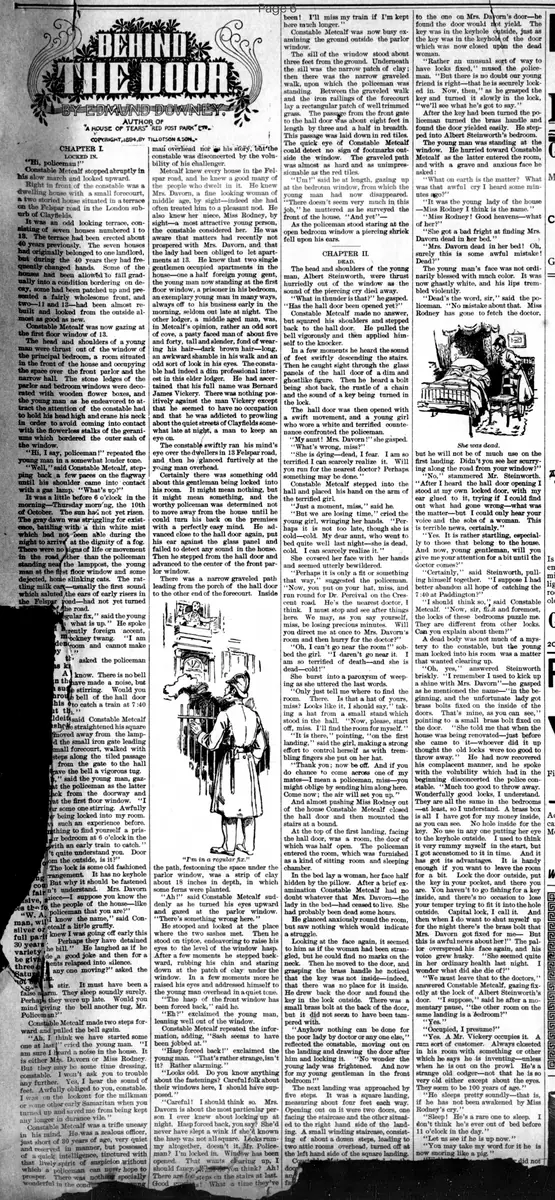
No man overhead nor a history, but the constable was disconcerted by the volubility of his challenger.
Constable Metcalf stopped abruptly in his slow march and looked upward. Right in front of the constable was a dwelling house with a small forecourt, a two-storied house situated in a terrace on the Felspar road in the London suburb of Clayfields. It was an odd looking terrace, consisting of seven houses numbered 1 to 13. The terrace had been erected about 40 years previously. The seven houses had originally belonged to one landlord, but during the 40 years they had frequently changed hands. Some of the houses had been allowed to fall gradually into a condition bordering on decay, some had been patched up and presented a fairly wholesome front, and two—11 and 13—had been almost rebuilt and looked from the outside almost as good as new. Constable Metcalf was now gazing at the first floor window of 13. The head and shoulders of a young man were thrust out of the window of the principal bedroom, a room situated in the front of the house and occupying the space over the front parlor and the narrow hall. The stone ledges of the parlor and bedroom windows were decorated with wooden flower boxes, and the young man as he endeavored to attract the attention of the constable had to hold his head high and crane his neck in order to avoid coming into contact with the flowerless stalks of the geraniums which bordered the outer sash of the window.
"Hi, I say, policeman!" repeated the young man in a somewhat louder tone.
"Well," said Constable Metcalf, stepping back a few paces on the flagway until his shoulder came into contact with a gas lamp. "What's up?"
It was a little before 6 o'clock in the morning—Thursday morning, the 10th of October. The sun had not yet risen. The gray dawn was struggling for existence, battling with a thin white mist which had not been able during the night to arrive at the dignity of a fog. There were no signs of life or movement in the road other than the policeman standing beneath the lamppost, the young man at the first floor window and some dejected, home-slinking cats. The rattling milk cart—usually the first sound which saluted the ears of early risers in the Felspar road—had not yet turned the road.
"I'm in a regular fix," said the young man. "What is up."
He spoke with a slightly foreign accent, not a Cockney twang.
"I am locked in and cannot make myself heard."
"What," asked the policeman.
"I know. There is no bell in the house. I have made a noise, but no one is stirring. Would you mind ringing the bell of the hall door? I have to catch a train at 7:40."
"All right."
Constable Metcalf shrugged his shoulders, straightened his square form and moved away from the lamp-post. He opened the small iron gate leading into the small forecourt, walked with quick steps along the tiled passage from the gate to the hall door and gave the bell a vigorous tug.
"Ah!" said the young man, gazing at the policeman as the latter walked back from the doorway and stationed himself at the first floor window. "I thought I heard some one stirring. Awfully sorry to trouble you, but I don't like being locked into my room. I have had such an experience before—nothing to find yourself a prisoner in your bedroom at 6 o'clock in the morning with an early train to catch."
"I don't quite understand you. Locked in from the outside, is it?"
The lock is some old fashioned arrangement. It has no keyhole on the inside. But why it should be fastened I can't understand. Mrs. Davorn—pardon me, you don't know the people of the house, do you, policeman?"
"No."
"I know the name," said Constable Metcalf a little gruffly.
"Well, I knew I was going off early this morning. Perhaps they have overslept themselves or something. Here's the bill."
He laughed as if he had made a good joke and then for a few moments relapsed into silence.
"Haven't you heard any one moving?" asked the policeman.
"Not a stir. It must have been a false alarm. They sleep soundly surely. Perhaps they were up late. Would you mind giving the bell another tug, Mr. Policeman?"
Constable Metcalf made two steps forward and pulled the bell again.
"Ah, I think we have started some one at last," cried the young man. "I am sure I heard a noise in the house. It is either Mrs. Davorn or Miss Rodney. But they may be some time dressing. Thank you, constable. I won't ask you to trouble any further. Yes, I hear the sound of feet. Awfully obliged to you, constable. I was on the lookout for the milkman or some other early Samaritan when you turned up and saved me from being kept any longer in durance vile."
Constable Metcalf was a trifle uneasy in his mind. He was a zealous officer, just short of 30 years of age, very quiet and reserved in manner, but possessed of a quick intelligence, tinctured with that lively spirit of suspicion without which a policeman can never hope to prosper. There was nothing specially wonderful in the condition of affairs as they appeared to him at the moment, but Metcalf knew every house in the Felspar road, and he knew a good many of the people who dwelt in it. He knew Mrs. Davorn, a fine looking woman of middle age, by sight—indeed she had often treated him to a pleasant nod. He also knew her niece, Miss Rodney, by sight—a most attractive young person, the constable considered her. He was aware that matters had recently not prospered with Mrs. Davorn, and that the lady had been obliged to let apartments at 13. He knew that two single gentlemen occupied apartments in the house—one a half foreign young gent, the young man now standing at the first floor window, a prisoner in his bedroom, an exemplary young man in many ways, always off to his business early in the morning, seldom out late at night. The other lodger, a middle aged man, was, in Metcalf's opinion, rather an odd sort of cove, a pasty faced man of about five and forty, tall and slender, fond of wearing his hair—dark brown hair—long, an awkward shamble in his walk and an odd sort of look in his eyes. The constable had indeed a dim professional interest in this elder lodger. He had ascertained that his full name was Bernard James Vickery. There was nothing positively against the man Vickery except that he seemed to have no occupation and that he was addicted to prowling about the quiet streets of Clayfields somewhat late at night, a man to keep an eye on.
The constable swiftly ran his mind's eye over the dwellers in 13 Felspar road, and then he glanced furtively at the young man overhead. Certainly there was something odd about this gentleman being locked into his room. It might mean nothing, but it might mean something, and the worthy policeman was determined not to move away from the house until he could turn his back on the premises with a perfectly easy mind. He advanced close to the hall door again, put his ear against the glass panel and failed to detect any sound in the house. Then he stepped from the hall door and advanced to the center of the front parlor window.
There was a narrow graveled path leading from the porch of the hall door to the other end of the forecourt. Inside the path, festooning the space under the parlor window, was a strip of clay about 18 inches in depth, in which some ferns were planted.
"Ah!" said Constable Metcalf suddenly as he turned his eyes upward and gazed at the parlor window. "There's something wrong here."
He stooped and looked at the place where the two sashes met. Then he stood on tiptoe, endeavoring to raise his eyes to the level of the window hasp. After a few moments he stepped backward, rubbing his chin and staring down at the patch of clay under the window. In a few moments more he raised his eyes and addressed himself to the young man overhead in a quiet tone.
"The hasp of the front window has been forced back," said he.
"Eh?" exclaimed the young man, leaning well out of the window.
Constable Metcalf repeated the information, adding, "Sash seems to have been jobbed at."
"Hasp forced back!" exclaimed the young man. "That's rather strange, isn't it? Rather alarming."
"Looks odd. Do you know anything about the fastenings? Careful folk about their windows here, I should have supposed."
"Careful! I should think so. Mrs. Davorn is about the most particular person I ever knew about locking up at night. Hasp forced back, you say? She'd never have slept a wink if she'd known the hasp was not all square. Looks rummy altogether, doesn't it, Mr. Policeman? I'm locked in. Window has been opened. That wants clearing up. I should fancy. What do you think? Ah! There are footsteps on the stairs at last. Good! What a time they've been! I'll miss my train if I'm kept here much longer."
Constable Metcalf was now busy examining the ground outside the parlor window. The sill of the window stood about three feet from the ground. Underneath the sill was the narrow patch of clay then there was the narrow graveled walk, upon which the policeman was standing. Between the graveled walk and the iron railings of the forecourt lay a rectangular patch of well trimmed grass. The passage from the front gate to the hall door was about eight feet in length by three and a half in breadth. This passage was laid down in red tiles. The quick eye of Constable Metcalf could detect no sign of footmarks outside the window. The graveled path was almost as hard and as unimpresionable as the red tiles.
"Um!" said he at length, gazing up at the bedroom window, from which the young man had now disappeared. "There doesn't seem very much in this job," he muttered as he surveyed the front of the house. "And yet—"
As the policeman stood staring at the open bedroom window a piercing shriek fell upon his ears.
CHAPTER II
DEAD.
The head and shoulders of the young man, Albert Steinworth, were thrust hurriedly out of the window as the sound of the piercing cry died away.
"What in thunder is that?" he gasped. "Has the hall door been opened yet?"
Constable Metcalf made no answer but squared his shoulders and stepped back to the hall door. He pulled the bell vigorously and then applied himself to the knocker. In a few moments he heard the sound of feet swiftly descending the stairs. Then he caught sight through the glass panels of the hall door of a dim and ghostlike figure. Then he heard a bolt being shot back, the rustle of a chain and the sound of a key being turned in the lock.
The hall door was then opened with a swift movement, and a young girl who wore a white and terrified countenance confronted the policeman.
"My aunt! Mrs. Davorn!" she gasped.
"What's wrong, miss?"
"She is dying—dead. I fear. I am so terrified I can scarcely realize it. Will you run for the nearest doctor? Perhaps something may be done."
Constable Metcalf stepped into the hall and placed his hand on the arm of the terrified girl.
"Just a moment, miss," said he.
"But we are losing time," cried the young girl, wringing her hands. "Perhaps it is not too late, though she is cold—cold. My dear aunt, who went to bed quite well last night—she is dead. cold. I can scarcely realize it."
She covered her face with her hands and seemed utterly bewildered.
"Perhaps it is only a fit or something that way," suggested the policeman. "Now, you put on your hat, miss, and run round for Dr. Percival on the Crescent road. He's the nearest doctor, I think. I must stop and see after things here. We may, as you say yourself, miss, be losing precious minutes. Will you direct me at once to Mrs. Davorn's room and then hurry for the doctor?"
"Oh. I can't go near the room!" sobbed the girl. "I daren't go near it. I am so terrified of death—and she is dead—cold!"
She burst into a paroxysm of weeping as she uttered the last words.
"Only just tell me where to find the room. There. Is that a hat of yours, miss? Looks like it, I should say," taking a hat from a small stand which stood in the hall. "Now, please, start off, miss. I'll find the room for myself."
"It is there," pointing, "on the first landing," said the girl, making a strong effort to control herself as with trembling fingers she put on her hat.
"Thank you: now be off. And if you do chance to come across one of my mates—I mean a policeman, miss—you might oblige by sending him along here. Come now; the air will set you up."
And almost pushing Miss Rodney out of the house Constable Metcalf closed the hall door and then mounted the stairs at a bound.
At the top of the first landing, facing the hall door, was a room, the door of which was half open. The policeman entered the room, which was furnished as a kind of sitting room and sleeping chamber.
In the bed lay a woman, her face half hidden by the pillow. After a brief examination Constable Metcalf had no doubt whatever that Mrs. Davorn—the lady in the bed—had ceased to live. She had probably been dead some hours. He glanced anxiously round the room, but saw nothing which would indicate a struggle. Looking at the face again, it seemed to him as if the woman had been strangled, but he could find no marks on the neck. Then he moved to the door, and grasping the brass handle he noticed that the key was not inside—indeed, that there was no place for it inside. He drew back the door and found the key in the lock outside. There was a small brass bolt at the back of the door, but it did not seem to have been tampered with.
"Anyhow nothing can be done for the poor lady by doctor or any one else," reflected the constable, moving out on the landing and drawing the door after him and locking it. "No wonder the young lady was frightened. And now for my young gentleman in the front bedroom!"
The next landing was approached by five steps. It was a square landing, measuring about four feet each way. Opening out on it were two doors, one facing the staircase and the other situated to the right hand side of the landing. A small winding staircase, consisting of about a dozen steps, leading to two attic rooms overhead, turned off at the left hand side of the square landing.
to the one on Mrs. Davorn's door—he found the door would not yield. The key was in the keyhole outside, just as the key was in the keyhole of the door which was now closed upon the dead woman.
"Rather an unusual sort of way to have locks fixed," mused the policeman. "But there is no doubt our young friend is right—that he is securely locked in. Now, then," as he grasped the key and turned it slowly in the lock, "we'll see what he's got to say."
After the key had been turned the policeman turned the brass handle and found the door yielded easily. He stepped into Albert Steinworth's bedroom. The young man was standing at the window. He hurried toward Constable Metcalf as the latter entered the room, and with a grave and anxious face he asked:
"What on earth is the matter? What was that awful cry I heard some minutes ago?"
"It was the young lady of the house—Miss Rodney I think is the name."
"Miss Rodney! Good heavens—what of her?"
"She got a bad fright at finding Mrs. Davorn dead in her bed."
"Mrs. Davorn dead in her bed! Oh, surely this is some awful mistake! Dead?"
The young man's face was not ordinarily blessed with much color. It was now ghastly white, and his lips trembled violently.
"Dead's the word, sir," said the policeman, "No mistake about that. Miss Rodney has gone to fetch the doctor, but he will not be of much use on the first landing. Didn't you see her scurrying along the road from your window?"
"No," stammered Mr. Steinworth. "After I heard the hall door opening I stood at my own locked door, with my ear glued to it, trying if I could find out what had gone wrong—what was the matter—but I could only hear your voice and the sobs of a woman. This is terrible news, certainly."
"Yes. It is rather startling, especially to those that belong to the house. And now, young gentleman, will you give me your attention for a bit until the doctor comes?"
"Certainly," said Steinworth, pulling himself together. "I suppose I had better abandon all hope of catching the 7:40 at Paddington?"
"I should think so," said Constable Metcalf. "Now, sir, first and foremost, the locks of these bedrooms puzzle me. They are different from other locks. Can you explain about them?"
A dead body was not much of a mystery to the constable, but the young man locked into his room was a matter that wanted clearing up.
"Oh, yes," answered Steinworth briskly. "I remember I used to kick up a shine with Mrs. Davorn"—he gasped as he mentioned the name—"in the beginning, and the unfortunate lady got brass bolts fixed on the inside of the doors. That's mine, as you can see," pointing to a small brass bolt fixed on the door. "She told me that when the house was being renovated just before she came to it whoever did it up thought the old locks were too good to throw away. He had now recovered his complacent manner, and he spoke with the volubility which had in the beginning disconcerted the police constable. "Much too good to throw away. Wonderfully good locks, I understand. They are all the same in the bedrooms—at least, so I understand. A brass bolt is all I have got for my money inside, as you can see. No hole inside for the key. No use in any one putting her eye to the keyhole outside. I used to think it very rummy myself in the start, but I got accustomed to it in time. And it has got its advantages. It is handy enough if you want to leave the room for a bit. Lock the door outside, put the key in your pocket, and there you are. You haven't to go fishing for a key inside, and there's no occasion to lose your temper trying to fit it into the hole outside. Capital lock, I call it. And then when I do want to shut myself up for the night there's the brass bolt that Mrs. Davorn got fixed for me. But this is awful news about her!" The pallor overspread his face again, and his voice grew husky.
"She seemed quite in her ordinary health last night. I wonder what did she die of?"
"We must leave that to the doctors," answered Constable Metcalf, gazing fixedly at the lock of Albert Steinworth's door.
"I suppose," said he after a momentary pause, "the other room on the same landing is a bedroom?"
"Yes."
"Occupied, I presume?"
"Yes. A Mr. Vickery occupies it. A rum sort of customer. Always closeted in his room with something or other which he says he is inventing—unless when he is out on the prowl. He's a strange old codger—not that he is so very old either except about the eyes. They seem to be 100 years of age."
"He sleeps pretty soundly—that is, if he has not been awakened by Miss Rodney's cry."
"Sleep! He's a rare one to sleep. I don't think he's ever out of bed before 11 o'clock in the day."
"Let us see if he is up now."
"You may take my word for it he is now snoring like a pig."
Constable Metcalf stopped abruptly in his slow march and looked upward. Right in front of the constable was a dwelling house with a small forecourt, a two-storied house situated in a terrace on the Felspar road in the London suburb of Clayfields. It was an odd looking terrace, consisting of seven houses numbered 1 to 13. The terrace had been erected about 40 years previously. The seven houses had originally belonged to one landlord, but during the 40 years they had frequently changed hands. Some of the houses had been allowed to fall gradually into a condition bordering on decay, some had been patched up and presented a fairly wholesome front, and two—11 and 13—had been almost rebuilt and looked from the outside almost as good as new. Constable Metcalf was now gazing at the first floor window of 13. The head and shoulders of a young man were thrust out of the window of the principal bedroom, a room situated in the front of the house and occupying the space over the front parlor and the narrow hall. The stone ledges of the parlor and bedroom windows were decorated with wooden flower boxes, and the young man as he endeavored to attract the attention of the constable had to hold his head high and crane his neck in order to avoid coming into contact with the flowerless stalks of the geraniums which bordered the outer sash of the window.
"Hi, I say, policeman!" repeated the young man in a somewhat louder tone.
"Well," said Constable Metcalf, stepping back a few paces on the flagway until his shoulder came into contact with a gas lamp. "What's up?"
It was a little before 6 o'clock in the morning—Thursday morning, the 10th of October. The sun had not yet risen. The gray dawn was struggling for existence, battling with a thin white mist which had not been able during the night to arrive at the dignity of a fog. There were no signs of life or movement in the road other than the policeman standing beneath the lamppost, the young man at the first floor window and some dejected, home-slinking cats. The rattling milk cart—usually the first sound which saluted the ears of early risers in the Felspar road—had not yet turned the road.
"I'm in a regular fix," said the young man. "What is up."
He spoke with a slightly foreign accent, not a Cockney twang.
"I am locked in and cannot make myself heard."
"What," asked the policeman.
"I know. There is no bell in the house. I have made a noise, but no one is stirring. Would you mind ringing the bell of the hall door? I have to catch a train at 7:40."
"All right."
Constable Metcalf shrugged his shoulders, straightened his square form and moved away from the lamp-post. He opened the small iron gate leading into the small forecourt, walked with quick steps along the tiled passage from the gate to the hall door and gave the bell a vigorous tug.
"Ah!" said the young man, gazing at the policeman as the latter walked back from the doorway and stationed himself at the first floor window. "I thought I heard some one stirring. Awfully sorry to trouble you, but I don't like being locked into my room. I have had such an experience before—nothing to find yourself a prisoner in your bedroom at 6 o'clock in the morning with an early train to catch."
"I don't quite understand you. Locked in from the outside, is it?"
The lock is some old fashioned arrangement. It has no keyhole on the inside. But why it should be fastened I can't understand. Mrs. Davorn—pardon me, you don't know the people of the house, do you, policeman?"
"No."
"I know the name," said Constable Metcalf a little gruffly.
"Well, I knew I was going off early this morning. Perhaps they have overslept themselves or something. Here's the bill."
He laughed as if he had made a good joke and then for a few moments relapsed into silence.
"Haven't you heard any one moving?" asked the policeman.
"Not a stir. It must have been a false alarm. They sleep soundly surely. Perhaps they were up late. Would you mind giving the bell another tug, Mr. Policeman?"
Constable Metcalf made two steps forward and pulled the bell again.
"Ah, I think we have started some one at last," cried the young man. "I am sure I heard a noise in the house. It is either Mrs. Davorn or Miss Rodney. But they may be some time dressing. Thank you, constable. I won't ask you to trouble any further. Yes, I hear the sound of feet. Awfully obliged to you, constable. I was on the lookout for the milkman or some other early Samaritan when you turned up and saved me from being kept any longer in durance vile."
Constable Metcalf was a trifle uneasy in his mind. He was a zealous officer, just short of 30 years of age, very quiet and reserved in manner, but possessed of a quick intelligence, tinctured with that lively spirit of suspicion without which a policeman can never hope to prosper. There was nothing specially wonderful in the condition of affairs as they appeared to him at the moment, but Metcalf knew every house in the Felspar road, and he knew a good many of the people who dwelt in it. He knew Mrs. Davorn, a fine looking woman of middle age, by sight—indeed she had often treated him to a pleasant nod. He also knew her niece, Miss Rodney, by sight—a most attractive young person, the constable considered her. He was aware that matters had recently not prospered with Mrs. Davorn, and that the lady had been obliged to let apartments at 13. He knew that two single gentlemen occupied apartments in the house—one a half foreign young gent, the young man now standing at the first floor window, a prisoner in his bedroom, an exemplary young man in many ways, always off to his business early in the morning, seldom out late at night. The other lodger, a middle aged man, was, in Metcalf's opinion, rather an odd sort of cove, a pasty faced man of about five and forty, tall and slender, fond of wearing his hair—dark brown hair—long, an awkward shamble in his walk and an odd sort of look in his eyes. The constable had indeed a dim professional interest in this elder lodger. He had ascertained that his full name was Bernard James Vickery. There was nothing positively against the man Vickery except that he seemed to have no occupation and that he was addicted to prowling about the quiet streets of Clayfields somewhat late at night, a man to keep an eye on.
The constable swiftly ran his mind's eye over the dwellers in 13 Felspar road, and then he glanced furtively at the young man overhead. Certainly there was something odd about this gentleman being locked into his room. It might mean nothing, but it might mean something, and the worthy policeman was determined not to move away from the house until he could turn his back on the premises with a perfectly easy mind. He advanced close to the hall door again, put his ear against the glass panel and failed to detect any sound in the house. Then he stepped from the hall door and advanced to the center of the front parlor window.
There was a narrow graveled path leading from the porch of the hall door to the other end of the forecourt. Inside the path, festooning the space under the parlor window, was a strip of clay about 18 inches in depth, in which some ferns were planted.
"Ah!" said Constable Metcalf suddenly as he turned his eyes upward and gazed at the parlor window. "There's something wrong here."
He stooped and looked at the place where the two sashes met. Then he stood on tiptoe, endeavoring to raise his eyes to the level of the window hasp. After a few moments he stepped backward, rubbing his chin and staring down at the patch of clay under the window. In a few moments more he raised his eyes and addressed himself to the young man overhead in a quiet tone.
"The hasp of the front window has been forced back," said he.
"Eh?" exclaimed the young man, leaning well out of the window.
Constable Metcalf repeated the information, adding, "Sash seems to have been jobbed at."
"Hasp forced back!" exclaimed the young man. "That's rather strange, isn't it? Rather alarming."
"Looks odd. Do you know anything about the fastenings? Careful folk about their windows here, I should have supposed."
"Careful! I should think so. Mrs. Davorn is about the most particular person I ever knew about locking up at night. Hasp forced back, you say? She'd never have slept a wink if she'd known the hasp was not all square. Looks rummy altogether, doesn't it, Mr. Policeman? I'm locked in. Window has been opened. That wants clearing up. I should fancy. What do you think? Ah! There are footsteps on the stairs at last. Good! What a time they've been! I'll miss my train if I'm kept here much longer."
Constable Metcalf was now busy examining the ground outside the parlor window. The sill of the window stood about three feet from the ground. Underneath the sill was the narrow patch of clay then there was the narrow graveled walk, upon which the policeman was standing. Between the graveled walk and the iron railings of the forecourt lay a rectangular patch of well trimmed grass. The passage from the front gate to the hall door was about eight feet in length by three and a half in breadth. This passage was laid down in red tiles. The quick eye of Constable Metcalf could detect no sign of footmarks outside the window. The graveled path was almost as hard and as unimpresionable as the red tiles.
"Um!" said he at length, gazing up at the bedroom window, from which the young man had now disappeared. "There doesn't seem very much in this job," he muttered as he surveyed the front of the house. "And yet—"
As the policeman stood staring at the open bedroom window a piercing shriek fell upon his ears.
CHAPTER II
DEAD.
The head and shoulders of the young man, Albert Steinworth, were thrust hurriedly out of the window as the sound of the piercing cry died away.
"What in thunder is that?" he gasped. "Has the hall door been opened yet?"
Constable Metcalf made no answer but squared his shoulders and stepped back to the hall door. He pulled the bell vigorously and then applied himself to the knocker. In a few moments he heard the sound of feet swiftly descending the stairs. Then he caught sight through the glass panels of the hall door of a dim and ghostlike figure. Then he heard a bolt being shot back, the rustle of a chain and the sound of a key being turned in the lock.
The hall door was then opened with a swift movement, and a young girl who wore a white and terrified countenance confronted the policeman.
"My aunt! Mrs. Davorn!" she gasped.
"What's wrong, miss?"
"She is dying—dead. I fear. I am so terrified I can scarcely realize it. Will you run for the nearest doctor? Perhaps something may be done."
Constable Metcalf stepped into the hall and placed his hand on the arm of the terrified girl.
"Just a moment, miss," said he.
"But we are losing time," cried the young girl, wringing her hands. "Perhaps it is not too late, though she is cold—cold. My dear aunt, who went to bed quite well last night—she is dead. cold. I can scarcely realize it."
She covered her face with her hands and seemed utterly bewildered.
"Perhaps it is only a fit or something that way," suggested the policeman. "Now, you put on your hat, miss, and run round for Dr. Percival on the Crescent road. He's the nearest doctor, I think. I must stop and see after things here. We may, as you say yourself, miss, be losing precious minutes. Will you direct me at once to Mrs. Davorn's room and then hurry for the doctor?"
"Oh. I can't go near the room!" sobbed the girl. "I daren't go near it. I am so terrified of death—and she is dead—cold!"
She burst into a paroxysm of weeping as she uttered the last words.
"Only just tell me where to find the room. There. Is that a hat of yours, miss? Looks like it, I should say," taking a hat from a small stand which stood in the hall. "Now, please, start off, miss. I'll find the room for myself."
"It is there," pointing, "on the first landing," said the girl, making a strong effort to control herself as with trembling fingers she put on her hat.
"Thank you: now be off. And if you do chance to come across one of my mates—I mean a policeman, miss—you might oblige by sending him along here. Come now; the air will set you up."
And almost pushing Miss Rodney out of the house Constable Metcalf closed the hall door and then mounted the stairs at a bound.
At the top of the first landing, facing the hall door, was a room, the door of which was half open. The policeman entered the room, which was furnished as a kind of sitting room and sleeping chamber.
In the bed lay a woman, her face half hidden by the pillow. After a brief examination Constable Metcalf had no doubt whatever that Mrs. Davorn—the lady in the bed—had ceased to live. She had probably been dead some hours. He glanced anxiously round the room, but saw nothing which would indicate a struggle. Looking at the face again, it seemed to him as if the woman had been strangled, but he could find no marks on the neck. Then he moved to the door, and grasping the brass handle he noticed that the key was not inside—indeed, that there was no place for it inside. He drew back the door and found the key in the lock outside. There was a small brass bolt at the back of the door, but it did not seem to have been tampered with.
"Anyhow nothing can be done for the poor lady by doctor or any one else," reflected the constable, moving out on the landing and drawing the door after him and locking it. "No wonder the young lady was frightened. And now for my young gentleman in the front bedroom!"
The next landing was approached by five steps. It was a square landing, measuring about four feet each way. Opening out on it were two doors, one facing the staircase and the other situated to the right hand side of the landing. A small winding staircase, consisting of about a dozen steps, leading to two attic rooms overhead, turned off at the left hand side of the square landing.
to the one on Mrs. Davorn's door—he found the door would not yield. The key was in the keyhole outside, just as the key was in the keyhole of the door which was now closed upon the dead woman.
"Rather an unusual sort of way to have locks fixed," mused the policeman. "But there is no doubt our young friend is right—that he is securely locked in. Now, then," as he grasped the key and turned it slowly in the lock, "we'll see what he's got to say."
After the key had been turned the policeman turned the brass handle and found the door yielded easily. He stepped into Albert Steinworth's bedroom. The young man was standing at the window. He hurried toward Constable Metcalf as the latter entered the room, and with a grave and anxious face he asked:
"What on earth is the matter? What was that awful cry I heard some minutes ago?"
"It was the young lady of the house—Miss Rodney I think is the name."
"Miss Rodney! Good heavens—what of her?"
"She got a bad fright at finding Mrs. Davorn dead in her bed."
"Mrs. Davorn dead in her bed! Oh, surely this is some awful mistake! Dead?"
The young man's face was not ordinarily blessed with much color. It was now ghastly white, and his lips trembled violently.
"Dead's the word, sir," said the policeman, "No mistake about that. Miss Rodney has gone to fetch the doctor, but he will not be of much use on the first landing. Didn't you see her scurrying along the road from your window?"
"No," stammered Mr. Steinworth. "After I heard the hall door opening I stood at my own locked door, with my ear glued to it, trying if I could find out what had gone wrong—what was the matter—but I could only hear your voice and the sobs of a woman. This is terrible news, certainly."
"Yes. It is rather startling, especially to those that belong to the house. And now, young gentleman, will you give me your attention for a bit until the doctor comes?"
"Certainly," said Steinworth, pulling himself together. "I suppose I had better abandon all hope of catching the 7:40 at Paddington?"
"I should think so," said Constable Metcalf. "Now, sir, first and foremost, the locks of these bedrooms puzzle me. They are different from other locks. Can you explain about them?"
A dead body was not much of a mystery to the constable, but the young man locked into his room was a matter that wanted clearing up.
"Oh, yes," answered Steinworth briskly. "I remember I used to kick up a shine with Mrs. Davorn"—he gasped as he mentioned the name—"in the beginning, and the unfortunate lady got brass bolts fixed on the inside of the doors. That's mine, as you can see," pointing to a small brass bolt fixed on the door. "She told me that when the house was being renovated just before she came to it whoever did it up thought the old locks were too good to throw away. He had now recovered his complacent manner, and he spoke with the volubility which had in the beginning disconcerted the police constable. "Much too good to throw away. Wonderfully good locks, I understand. They are all the same in the bedrooms—at least, so I understand. A brass bolt is all I have got for my money inside, as you can see. No hole inside for the key. No use in any one putting her eye to the keyhole outside. I used to think it very rummy myself in the start, but I got accustomed to it in time. And it has got its advantages. It is handy enough if you want to leave the room for a bit. Lock the door outside, put the key in your pocket, and there you are. You haven't to go fishing for a key inside, and there's no occasion to lose your temper trying to fit it into the hole outside. Capital lock, I call it. And then when I do want to shut myself up for the night there's the brass bolt that Mrs. Davorn got fixed for me. But this is awful news about her!" The pallor overspread his face again, and his voice grew husky.
"She seemed quite in her ordinary health last night. I wonder what did she die of?"
"We must leave that to the doctors," answered Constable Metcalf, gazing fixedly at the lock of Albert Steinworth's door.
"I suppose," said he after a momentary pause, "the other room on the same landing is a bedroom?"
"Yes."
"Occupied, I presume?"
"Yes. A Mr. Vickery occupies it. A rum sort of customer. Always closeted in his room with something or other which he says he is inventing—unless when he is out on the prowl. He's a strange old codger—not that he is so very old either except about the eyes. They seem to be 100 years of age."
"He sleeps pretty soundly—that is, if he has not been awakened by Miss Rodney's cry."
"Sleep! He's a rare one to sleep. I don't think he's ever out of bed before 11 o'clock in the day."
"Let us see if he is up now."
"You may take my word for it he is now snoring like a pig."
What sub-type of article is it?
Prose Fiction
What themes does it cover?
Death Mortality
What keywords are associated?
Locked Room
Forced Window
Sudden Death
Constable Investigation
Lodgers
Mrs Davorn
Albert Steinworth
Bernard Vickery
Literary Details
Title
Chapter Ii Dead.
Form / Style
Detective Mystery Narrative
Key Lines
"The Hasp Of The Front Window Has Been Forced Back," Said He.
"My Aunt! Mrs. Davorn!" She Gasped.
"Mrs. Davorn Dead In Her Bed! Oh, Surely This Is Some Awful Mistake! Dead?"
"A Dead Body Was Not Much Of A Mystery To The Constable, But The Young Man Locked Into His Room Was A Matter That Wanted Clearing Up."