Thank you for visiting SNEWPapers!
Sign up free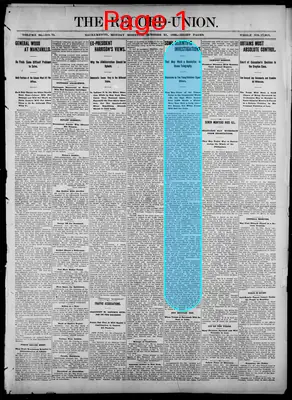
Story
October 31, 1898
The Record Union
Sacramento, Sacramento County, California
What is this article about?
Professors A. C. Crehore and George O. Squier, under General Greely, developed the sign-wave system for ocean telegraphy, transmitting over 3,000 words per minute on long lines and cables, potentially revolutionizing commercial communications.
Clipping

OCR Quality
98%
Excellent
Full Text
SOME SCIENTIFIC
INVESTIGATIONS
That May Work a Revolution in Ocean Telegraphy.
Discoveries by Two Young Volunteer Signal Officers,
They May Prove of the Utmost Value to the Commercial World
-By the Sign Wave System Over 3,000 Words a Minute Were Sent Over a Long Line—
Not Known Yet When Troops Will Sail for Cuba.
WASHINGTON, Oct. 30.—One point in the annual report of General Greely has escaped public attention, owing to its disassociation with the late war. It relates to the discoveries of two young physicists, Professor A. C. Crehore and Lieutenant Colonel George O. Squier, volunteer signal officers, who have lately pursued, under the direction of the Chief Signal Officer of the army, certain scientific investigations that promise to work a revolution in methods of ocean telegraphy.
General Greely expresses his belief that these discoveries and inventions have assumed such form and phase as to be of the greatest value to the commercial world. The discovery outlines the true scientific methods of telegraph known as the sign-wave system. The first experiments were made at the artillery school, Fort Monroe, Va., and were discussed theoretically in 1897 under the title of the "synchronograph." A new method of rapidly transmitting information by the alternating current. The next step was the testing of this system on a long telegraph line, and for this purpose Professor Crehore and Colonel Squier visited England, where they were afforded every facility for experimental work over the Government telegraph lines through the courtesy of the Postmaster General and the distinguished electrician, Chief Engineer Preece.
The experiments, the report sets forth, proved conclusively the superiority of a modern alternating current smooth wave, the typical form of which is a simple sign wave as compared with the system now exclusively used throughout the world in code telegraphy. Under the sign-wave system words were sent and received over a line 1100 miles long at a rate of over 3000 words per minute.
Under this new system the speed of the Wheatstone commercial receiver was increased as much as three-fold when operated under identically the system of the old code of telegraphy.
The superiority of the sign wave having been decided by experimental apparatus, the next step is to construct transmitters for actual commercial conditions. Two apparatuses were devised, one for operating land lines and the other for the transmission of messages over long cables. The cable transmitter was completed and land instruments advanced, when the late war interrupted progress, which has only lately been renewed by direction of General Greely.
The first practical tests of the cable transmitter have just been made through the courtesy of George Clapperton and other officials of the Commercial Cable Company of New York. The experiments were made over the cable between New York City and Canso, which had a length of 827 knots and electrical resistance of 13,700 ohms, and an electric distributing capacity of 231 microfarads. These tests were made between September 25th and October 16, 1898.
The change from existing telegraphic methods consists in the substitution for the present appliance of a transmitter sending smooth waves, such as are obtained in alternating currents working, without making any other changes whatever in the elements of the present system. The conditions in the transmission of messages over long cables are distinctly and widely different from those on aerial lines.
The necessity of increased speed over ocean cables, the report continues, while not generally appreciated, is strikingly obvious when examined from a commercial standpoint. Since every cable spanning the Atlantic costs several million dollars, the value of any discovery that will increase the working power of the cables is at once apparent. General Greely says he has no hesitation in expressing his opinion that the sign-wave system, which also admits of easy duplexing, will, within a year or two, increase very materially the working capacity of every cable to which it is applied.
INVESTIGATIONS
That May Work a Revolution in Ocean Telegraphy.
Discoveries by Two Young Volunteer Signal Officers,
They May Prove of the Utmost Value to the Commercial World
-By the Sign Wave System Over 3,000 Words a Minute Were Sent Over a Long Line—
Not Known Yet When Troops Will Sail for Cuba.
WASHINGTON, Oct. 30.—One point in the annual report of General Greely has escaped public attention, owing to its disassociation with the late war. It relates to the discoveries of two young physicists, Professor A. C. Crehore and Lieutenant Colonel George O. Squier, volunteer signal officers, who have lately pursued, under the direction of the Chief Signal Officer of the army, certain scientific investigations that promise to work a revolution in methods of ocean telegraphy.
General Greely expresses his belief that these discoveries and inventions have assumed such form and phase as to be of the greatest value to the commercial world. The discovery outlines the true scientific methods of telegraph known as the sign-wave system. The first experiments were made at the artillery school, Fort Monroe, Va., and were discussed theoretically in 1897 under the title of the "synchronograph." A new method of rapidly transmitting information by the alternating current. The next step was the testing of this system on a long telegraph line, and for this purpose Professor Crehore and Colonel Squier visited England, where they were afforded every facility for experimental work over the Government telegraph lines through the courtesy of the Postmaster General and the distinguished electrician, Chief Engineer Preece.
The experiments, the report sets forth, proved conclusively the superiority of a modern alternating current smooth wave, the typical form of which is a simple sign wave as compared with the system now exclusively used throughout the world in code telegraphy. Under the sign-wave system words were sent and received over a line 1100 miles long at a rate of over 3000 words per minute.
Under this new system the speed of the Wheatstone commercial receiver was increased as much as three-fold when operated under identically the system of the old code of telegraphy.
The superiority of the sign wave having been decided by experimental apparatus, the next step is to construct transmitters for actual commercial conditions. Two apparatuses were devised, one for operating land lines and the other for the transmission of messages over long cables. The cable transmitter was completed and land instruments advanced, when the late war interrupted progress, which has only lately been renewed by direction of General Greely.
The first practical tests of the cable transmitter have just been made through the courtesy of George Clapperton and other officials of the Commercial Cable Company of New York. The experiments were made over the cable between New York City and Canso, which had a length of 827 knots and electrical resistance of 13,700 ohms, and an electric distributing capacity of 231 microfarads. These tests were made between September 25th and October 16, 1898.
The change from existing telegraphic methods consists in the substitution for the present appliance of a transmitter sending smooth waves, such as are obtained in alternating currents working, without making any other changes whatever in the elements of the present system. The conditions in the transmission of messages over long cables are distinctly and widely different from those on aerial lines.
The necessity of increased speed over ocean cables, the report continues, while not generally appreciated, is strikingly obvious when examined from a commercial standpoint. Since every cable spanning the Atlantic costs several million dollars, the value of any discovery that will increase the working power of the cables is at once apparent. General Greely says he has no hesitation in expressing his opinion that the sign-wave system, which also admits of easy duplexing, will, within a year or two, increase very materially the working capacity of every cable to which it is applied.
What sub-type of article is it?
Curiosity
Historical Event
What themes does it cover?
Triumph
What keywords are associated?
Sign Wave System
Ocean Telegraphy
Scientific Discovery
Telegraph Speed
Alternating Current
Cable Transmission
What entities or persons were involved?
Professor A. C. Crehore
Lieutenant Colonel George O. Squier
General Greely
Chief Engineer Preece
George Clapperton
Where did it happen?
Washington, Fort Monroe Va., England, New York City To Canso
Story Details
Key Persons
Professor A. C. Crehore
Lieutenant Colonel George O. Squier
General Greely
Chief Engineer Preece
George Clapperton
Location
Washington, Fort Monroe Va., England, New York City To Canso
Event Date
Oct. 30, 1898; Experiments 1897 And September 25 To October 16, 1898
Story Details
Two physicists developed the sign-wave system for faster telegraphy, testing it on long lines in England and cables between New York and Canso, achieving over 3000 words per minute, promising commercial revolution.