Thank you for visiting SNEWPapers!
Sign up free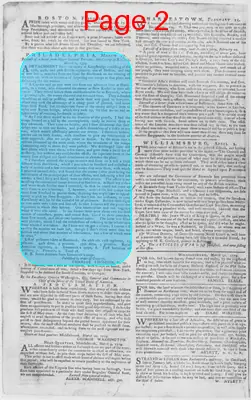
The Virginia Gazette
Richmond, Williamsburg, Richmond County, Virginia
What is this article about?
In 1779, Major General Putnam describes a British force's raid on Horeneck, NY, aiming to surprise Americans and destroy salt works. U.S. scouts detected them; troops retreated orderly, fired artillery, then withdrew. Putnam gathered militia, pursued raiders, captured 38 prisoners from various regiments, and recovered stolen goods. American losses: ~10 soldiers and inhabitants.
Clipping
OCR Quality
Full Text
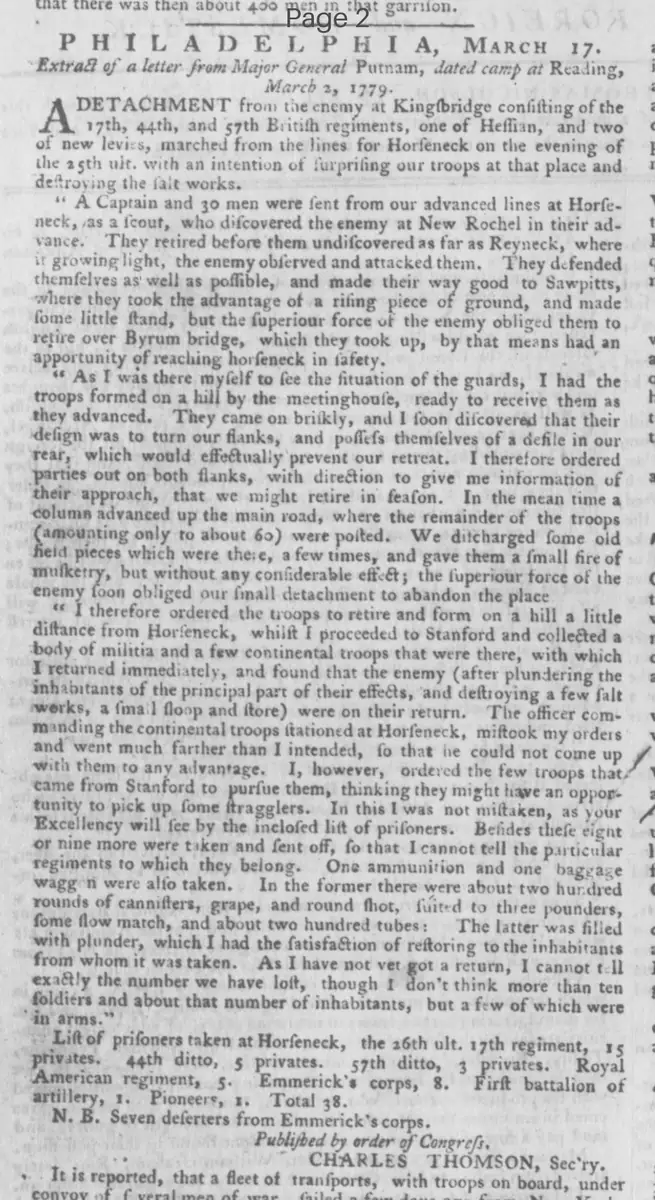
Extract of a letter from Major General Putnam, dated camp at Reading, March 2, 1779.
A detachment from the enemy at King's Bridge consisting of the 17th, 44th, and 57th British regiments, one of Hessian, and two of new levies, marched from the lines for Horeneck on the evening of the 25th ult. with an intention of surprising our troops at that place and destroying the salt works.
A Captain and 30 men were sent from our advanced lines at Horeneck, as a scout, who discovered the enemy at New Rochelle in their advance. They retired before them undiscovered as far as Rye Neck, where it growing light, the enemy observed and attacked them. They defended themselves as well as possible, and made their way good to Saw Pits, where they took the advantage of a rising piece of ground, and made some little stand, but the superior force of the enemy obliged them to retire over Byram bridge, which they took up, by that means had an opportunity of reaching Horeneck in safety.
As I was there myself to see the situation of the guards, I had the troops formed on a hill by the meeting house, ready to receive them as they advanced. They came on briskly, and I soon discovered that their design was to turn our flanks, and possess themselves of a defile in our rear, which would effectually prevent our retreat. I therefore ordered parties out on both flanks, with direction to give me information of their approach, that we might retire in season. In the mean time a column advanced up the main road, where the remainder of the troops (amounting only to about 60) were posted. We discharged some old field pieces which were there, a few times, and gave them a small fire of musketry, but without any considerable effect; the superior force of the enemy soon obliged our small detachment to abandon the place.
I therefore ordered the troops to retire and form on a hill a little distance from Horeneck, whilst I proceeded to Stanford and collected a body of militia and a few continental troops that were there, with which I returned immediately, and found that the enemy (after plundering the inhabitants of the principal part of their effects, and destroying a few salt works, a small sloop and store) were on their return. The officer commanding the continental troops stationed at Horeneck, mistook my orders and went much farther than I intended, so that he could not come up with them to any advantage. I, however, ordered the few troops that came from Stanford to pursue them, thinking they might have an opportunity to pick up some stragglers. In this I was not mistaken, as your Excellency will see by the enclosed list of prisoners. Besides these eight or nine more were taken and sent off, so that I cannot tell the particular regiments to which they belong. One ammunition and one baggage wagon were also taken. In the former there were about two hundred rounds of canisters, grape, and round shot, suited to three pounders, some slow match, and about two hundred tubes. The latter was filled with plunder, which I had the satisfaction of restoring to the inhabitants from whom it was taken. As I have not yet got a return, I cannot tell exactly the number we have lost, though I don't think more than ten soldiers and about that number of inhabitants, but a few of which were in arms.
List of prisoners taken at Horeneck, the 26th ult. 17th regiment, 15 privates. 44th ditto, 5 privates. 57th ditto, 3 privates. Royal American regiment, 5. Emmerick's corps, 8. First battalion of artillery, 1. Pioneers, 1. Total 38.
N. B. Seven deserters from Emmerick's corps.
Published by order of Congress.
CHARLES THOMSON, Sec'ry.
What sub-type of article is it?
What themes does it cover?
What keywords are associated?
What entities or persons were involved?
Where did it happen?
Story Details
Key Persons
Location
Horeneck
Event Date
February 25 26, 1779
Story Details
A British detachment attempted to surprise American troops at Horeneck and destroy salt works but was repelled after Americans retreated strategically; Putnam rallied militia to pursue, capturing 38 prisoners and recovering plunder.