Thank you for visiting SNEWPapers!
Sign up free
Alexandria Daily Advertiser
Alexandria, Virginia
What is this article about?
In the U.S. House of Representatives on December 8, Mr. Goddard continues his speech opposing Senate-proposed amendments to the Constitution's presidential election process, arguing against reducing candidates to three, potential sectional exclusions, and transferring election power to the Senate.
Clipping
OCR Quality
Full Text
OF THE
UNITED STATES.
HOUSE OF REPRESENTATIVES.
Thursday Dec. 8.
Debates on the Amendment to the Constitution.
(Continued.)
(Mr. Goddard's speech continued.)
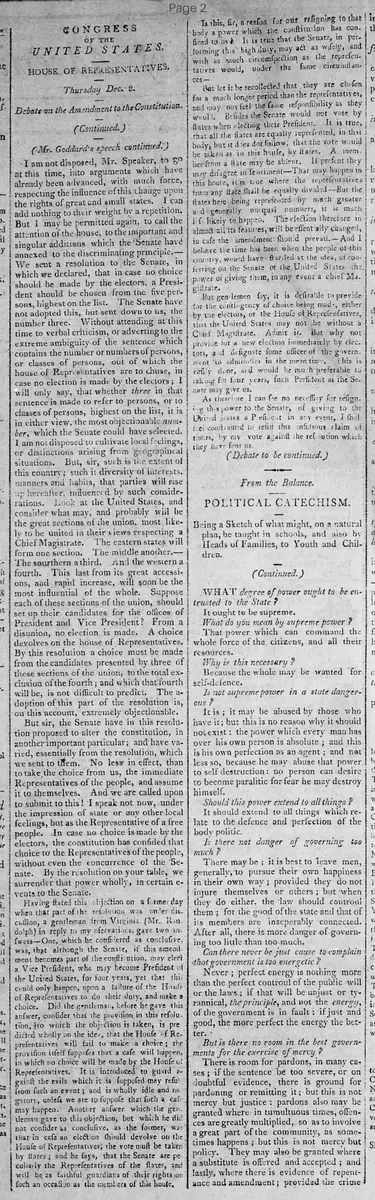
—I am not disposed, Mr. Speaker, to go at this time, into arguments which have already been advanced, with much force, respecting the influence of this change upon the rights of great and small states. I can add nothing to their weight by a repetition. But I may be permitted again, to call the attention of the house; to the important and singular additions which the Senate have annexed to the discriminating principle.—We sent a resolution to the Senate, in which we declared, that in case no choice should be made by the electors, a President should be chosen from the five persons, highest on the list. The Senate have not adopted this, but sent down to us, the number three. Without attending at this time to verbal criticism, or adverting to the extreme ambiguity of the sentence which contains the number or numbers of persons, or classes of persons, out of which the house of Representatives are to chuse, in case no election is made by the electors; I will only say, that whether three in that sentence is made to refer to persons, or to classes of persons, highest on the list, it is in either view, the most objectionable number, which the Senate could have selected.
I am not disposed to cultivate local feelings, or distinctions arising from geographical situations. But, sir, such is the extent of this country; such its diversity of interests, manners and habits, that parties will rise up hereafter, influenced by such considerations. Look at the United States, and consider what may, and probably will be the great sections of the union, most likely to be united in their views respecting a Chief Magistrate. The eastern states will form one section. The middle another.—The southern a third. And the western a fourth. This last from its great accessions, and rapid increase, will soon be the most influential of the whole. Suppose each of these sections of the union, should set up their candidates for the offices of President and Vice President? From a disunion, no election is made. A choice devolves on the house of Representatives. By this resolution a choice must be made from the candidates presented by three of these sections of the union, to the total exclusion of the fourth; and which that fourth will be, is not difficult to predict. The adoption of this part of the resolution is, on this account, extremely objectionable.
But sir, the Senate have in this resolution proposed to alter the constitution, in another important particular; and have varied, essentially from the resolution, which we sent to them. No less in effect, than to take the choice from us, the immediate Representatives of the people, and assume it to themselves. And we are called upon to submit to this! I speak not now, under the impression of state or any other local feelings, but as the Representative of a free people. In case no choice is made by the electors, the constitution has confided that choice to the Representatives of the people, without even the concurrence of the Senate. By the resolution on your table, we surrender that power wholly, in certain events to the Senate.
Having stated this objection on a former day when that part of the resolution was under discussion, a gentleman from Virginia (Mr. Randolph) in reply to my observations, gave two answers—One, which he considered as conclusive, was, that although the Senate, if this amendment becomes part of the constitution, may elect a Vice President, who may become President of the United States, for four years, yet that this could only happen, upon a failure of the House of Representatives to do their duty, and make a choice. Did the gentleman, before he gave this answer, consider that the provision in this resolution, to which the objection is taken, is predicated wholly on the idea, that the House of Representatives will fail to make a choice; the provision itself supposes that a case will happen, in which no choice will be made by the House of Representatives. It is introduced to guard against the evils which it is supposed may result from such an event; and is wholly idle and nugatory, unless we are to suppose that such a case may happen.
Another answer which the gentleman gave to this objection, but which he did not consider as conclusive, as the former, was that in case an election should devolve on the House of Representatives, the vote must be taken by states; and he says, that the Senate are peculiarly the Representatives of the states, and will be as faithful guardians of their rights on such an occasion as the members of this house.
body a power which the constitution has confided to us. Is this, sir, a reason for our resigning to that body a power which the constitution has confided to us? It is true that the Senate, in performing this high duty, may act as wisely, and with as much circumspection as the representatives would, under the same circumstances—But let it be recollected that they are chosen for a much longer period than the representatives, and may not feel the same responsibility as they would. Besides the Senate would not vote by states when electing their President. It is true, that all the states are equally represented, in that body. but it does not follow; that the vote would be taken as in this house, by states. A member from a state may be absent. If present they may disagree in sentiment—That may happen in this house, it is true where the representatives from any state shall be equally divided—But the states here being represented by much greater and generally unequal numbers, it is much less likely to happen. The election therefore in almost all its features, will be essentially changed, in case the amendment should prevail.—And I believe the time has been when the people of this country, would have startled at the idea, of conferring on the Senate of the United States the power of giving them, in any event a chief Magistrate.
But gentlemen say, it is desirable to provide for the contingency of choice being made, either by the electors, or the House of Representatives, that the United States may not be without a Chief Magistrate. Admit it. But why not provide for a new election immediately by electors, and designate some officer of the government to administer in the mean time. This is easily done, and would be much preferable to taking for four years, such President as the Senate may give us.
As therefore I can see no necessity for resigning this power to the Senate, of giving to the United States a President in any event, I feel constrained to resist this insidious claim of theirs, by my vote against the resolution which they have sent us.
(Debate to be continued.)
What sub-type of article is it?
What keywords are associated?
What entities or persons were involved?
Domestic News Details
Event Date
Thursday Dec. 8.
Key Persons
Event Details
Mr. Goddard continues his speech in the House of Representatives opposing the Senate's proposed constitutional amendment on presidential election, criticizing the reduction to three candidates, potential exclusion of sectional interests, and the transfer of election power to the Senate in cases of failure by electors or the House.