Thank you for visiting SNEWPapers!
Sign up free
Edgefield Advertiser
Edgefield, Edgefield County, South Carolina
What is this article about?
Captain Walker's account of the Moquis, an advanced Native American people in the Great Basin, California, living in secure villages atop a butte, farming below, raided by Navajos, known for honesty and including albinos.
Clipping
OCR Quality
Full Text
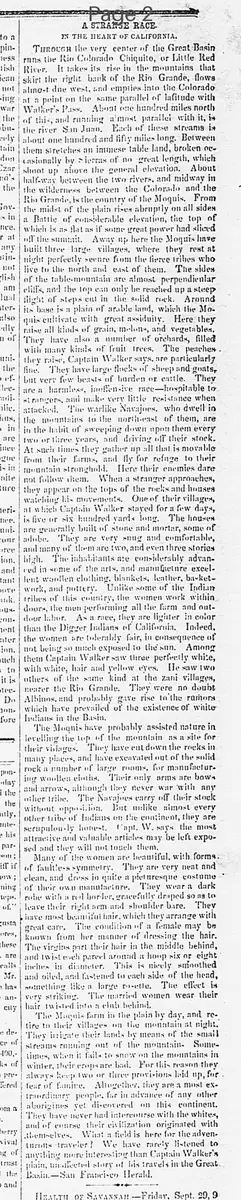
Through the very center of the Great Basin runs the Rio Colorado Chiquito, or Little Red River. It takes its rise in the mountains that skirt the right bank of the Rio Grande, flows almost due west, and empties into the Colorado at a point on the same parallel of latitude with Walker's Pass. About one hundred miles north of this, and running almost parallel with it, is the river San Juan. Each of these streams is about one hundred and fifty miles long. Between them stretches an immense tableland, broken occasionally by sierras of no great length, which shoot up above the general elevation. About half-way between the two rivers, and midway in the wilderness between the Colorado and the Rio Grande, is the country of the Moquis. From the midst of the plain rises abruptly on all sides a Butte of considerable elevation, the top of which is as flat as if some great power had sliced off the summit. Away up here the Moquis have built three large villages, where they rest at night perfectly secure from the fierce tribes who live to the north and east of them. The sides of the table-mountain are almost perpendicular cliffs, and the top can only be reached up a steep flight of steps cut in the solid rock. Around its base is a plain of arable land, which the Moquis cultivate with great assiduity. Here they raise all kinds of grain, melons, and vegetables. They have also a number of orchards, filled with many kinds of fruit trees. The peaches they raise, Captain Walker says, are particularly fine. They have large flocks of sheep and goats, but very few beasts of burden or cattle. They are a harmless, inoffensive race—hospitable to strangers, and make very little resistance when attacked. The warlike Navajos, who dwell in the mountains to the north-east of them, are in the habit of sweeping down upon them every two or three years, and driving off their stock. At such times they gather up all that is movable from their farms, and fly for refuge to their mountain stronghold. Here their enemies dare not follow them. When a stranger approaches, they appear on the tops of the rocks and houses watching his movements. One of their villages, at which Captain Walker stayed for a few days, is five or six hundred yards long. The houses are generally built of stone and mortar, some of adobe. They are very snug and comfortable, and many of them are two, and even three stories high. The inhabitants are considerably advanced in some of the arts, and manufacture excellent woollen clothing, blankets, leather, basket-work, and pottery. Unlike some of the Indian tribes of this country, the women work within doors, the men performing all the farm and out-door labor. As a race, they are lighter in color than the Digger Indians of California. Indeed the women are tolerably fair, in consequence of not being so much exposed to the sun. "Among them Captain Walker saw three perfectly white, with white hair and yellow eyes. He saw two others of the same kind at the Zuni villages, nearer the Rio Grande. They were no doubt Albinos, and probably gave rise to the rumors which have prevailed of the existence of white Indians in the Basin."
The Moquis have probably assisted nature in levelling the top of the mountain as a site for their villages. They have cut down the rocks in many places, and have excavated out of the solid rock a number of large rooms, for manufacturing woollen cloths. Their only arms are bows and arrows, although they never war with any other tribe. The Navajos carry off their stock without opposition. But unlike almost every other tribe of Indians on the continent, they are scrupulously honest. Capt. W. says the most attractive and valuable articles may be left exposed and they will not touch them.
Many of the women are beautiful, with forms of faultless symmetry. They are very neat and clean, and dress in quite a picturesque costume of their own manufacture. They wear a dark robe with a red border, gracefully draped so as to leave their right arm and shoulder bare. They have most beautiful hair, which they arrange with great care. The condition of a female may be known from her manner of dressing the hair. The virgins part their hair in the middle behind, and twist each parted around a hoop six or eight inches in diameter. This is nicely smoothed and oiled, and fastened to each side of the head, something like a large rattle. The effect is very striking. The married women wear their hair twisted into a club behind.
The Moquis farm in the plain by day, and retire to their villages on the mountain at night. They irrigate their lands by means of the small streams running out of the mountain. Sometimes, when it fails to snow on the mountains in winter, their crops are bad. For this reason they always keep two or three provisions laid up, for fear of famine. Altogether, they are a most extraordinary people, far in advance of any other aborigines yet discovered on this continent. They have never had intercourse with the whites, and of course their civilization originated with themselves. What a field is here for the adventurous traveler? We have rarely listened to anything more interesting than Captain Walker's plain, unvarnished story of his travels in the Great Basin.—San Francisco Herald.
What sub-type of article is it?
What themes does it cover?
What keywords are associated?
What entities or persons were involved?
Where did it happen?
Story Details
Key Persons
Location
Country Of The Moquis, Great Basin, California
Story Details
Captain Walker describes the Moquis' secure villages on a flat-topped butte between the Rio Colorado Chiquito and San Juan rivers, their agriculture and orchards at the base, raids by Navajos prompting retreat to the stronghold, their honesty, advanced crafts, lighter skin, albinos mistaken for white Indians, women's beauty and hairstyles, and self-originated civilization.