Thank you for visiting SNEWPapers!
Sign up free
Daily National Intelligencer
Washington, District Of Columbia
What is this article about?
On March 11, the U.S. House of Representatives debated a petition from Vincente Pazos, agent for Venezuelan, Buenos Aires, New Granada, and Mexican authorities, complaining of the U.S. capture of Amelia Island and denial of justice by the Executive. Key speakers argued over propriety of receiving foreign agents' appeals. The House voted 124-28 not to receive it.
Merged-components note: These components continue the same House of Representatives debate on the petition from Vincente Pazos regarding Amelia Island; text flows directly from one to the next, with sequential reading orders.
Clippings
1 of 2
OCR Quality
Full Text
WEDNESDAY, MARCH 11
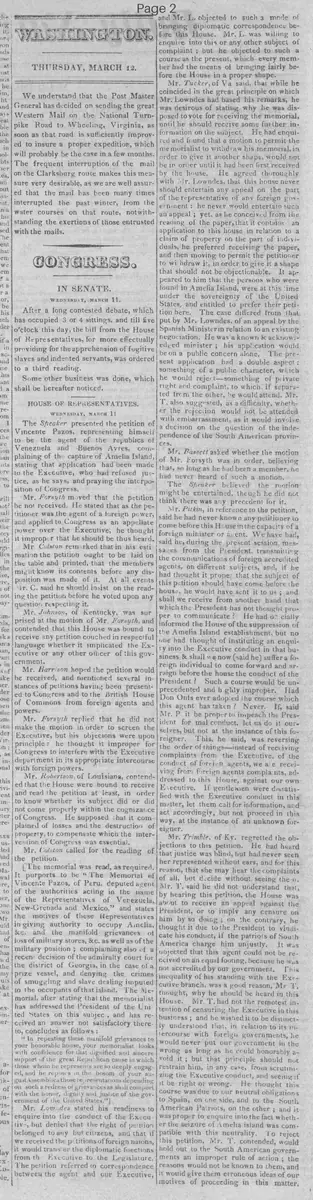
The Speaker presented the petition of Vincente Pazos, representing himself to be the agent of the republics of Venezuela and Buenos Ayres, complaining of the capture of Amelia Island, stating that application had been made to the Executive, who had refused justice, as he says, and praying the interposition of Congress,
Mr. Forsyth moved that the petition be not received. He stated that as the petitioner was the agent of a foreign power, and applied to Congress as an appellate power over the Executive, he thought it improper that he should be thus heard.
Mr. Colston remarked that in his estimation the petition ought to be laid on the table and printed, that the members might know its contents before any disposition was made of it. At all events Mr. C. said he should insist on the reading the petition before he voted upon any question respecting it.
Mr. Johnson, of Kentucky, was surprised at the motion of Mr. Forsyth, and contended that this House was bound to receive any petition couched in respectful language whether it implicated the Executive or any other officer of this government.
Mr. Harrison hoped the petition would be received, and mentioned several instances of petitions having been presented to Congress and to the British House of Commons from foreign agents and powers.
Mr. Forsyth replied that he did not make the motion in order to screen the Executive, but his objections were upon principle : he thought it improper for Congress to interfere with the Executive department in its appropriate intercourse with foreign powers.
Mr. Robertson, of Louisiana, contended that the House were bound to receive and read the petition at least, in order to know whether its subject did or did not come properly within the cognizance of Congress. He supposed that it complained of losses and the destruction of property, to compensate which the intervention of Congress was essential.
Mr. Colston called for the reading of the petition.
[The memorial was read, as required. It purports to be "The Memorial of Vincente Pazos, of Peru, deputed agent of the authorities acting in the name of the Representatives of Venezuela, New-Grenada and Mexico," and states the motives of these Representatives in giving authority to occupy Amelia, &c. and the manifold grievances of loss of military stores, &c. as well as of the military position; complaining also of a recent decision of the admiralty court for the district of Georgia, in the case of a prize vessel, and denying the crimes of smuggling and slave dealing imputed to the occupants of that island. The Memorial, after stating that the memorialist has addressed the President of the United States on this subject, and has received an answer not satisfactory thereto, concludes as follows :
"In repeating these manifold grievances to your honorable house, your memorialist looks with confidence for that dignified and sincere support of the great Republican cause in which those whom he represents are so deeply engaged, and he reposes in the bosom of your august Assemblies those representations depending on such a redress or grievances as shall comport with the honor, dignity and justice of the government of the United States."]
Mr. Lowndes stated his readiness to enquire into the conduct of the Executive, but denied that the right of petition belonged to any but citizens, and that if we received the petitions of foreign nations, it would transfer the diplomatic functions from the Executive to the Legislature. The petition referred to correspondence between the agent and our Executive, and Mr. L. objected to such a mode of bringing diplomatic correspondence before this House. Mr. L. was willing to enquire into this or any other subject of complaint ; but he objected to such a course as the present, which every member had the means of bringing fairly before the House in a proper shape.
Mr. Tucker, of Va said, that while he coincided in the great principle on which Mr. Lowndes had based his remarks, he was desirous of stating why he was disposed to vote for receiving the memorial, until he should receive some further information on the subject. He had enquired and found that a motion to permit the memorialist to withdraw his memorial, in order to give it another shape, would not be in order until it had been first received by the house. He agreed thoroughly with Mr. Lowndes, that this house never should entertain any appeal on the part of the representative of any foreign government : he never would entertain such an appeal; yet, as he conceived from the reading of the paper, that it contain an application to this house in relation to a claim of property on the part of individuals, he preferred receiving the paper, and then moving to permit the petitioner to withdraw it, in order to give it a shape that should not be objectionable. It appeared to him that the persons who were found in Amelia Island, were at this time under the sovereignty of the United States, and entitled to prefer their petition here. The case differed from that put by Mr. Lowndes, of an appeal by the Spanish Minister in relation to an existing negociation. He was a known & acknowledged minister ; his application would be on a public concern alone, The present application had a double aspect: something of a public character, which he would reject—something of private right and complaint, to which, if separated from the other, he would attend. Mr. T. also suggested, as a difficulty, whether the rejection would not be attended with embarrassment, as it would involve a decision on the question of the independence of the South American provinces.
Mr. Bassett asked whether the motion of Mr. Forsyth was in order, believing that, so long as he had been a member, he had never heard of such a motion.
The Speaker believed the motion might be entertained, though he did not think there was any precedent for it.
Mr. Pitkin, in reference to the petition, said he had never known any petitioner to come before this House in the capacity of a foreign minister or agent. We have had, said he, during the present session messages from the President. transmitting the communications of foreign accredited agents, on different subjects, and, if he had thought it proper that the subject of this petition should have come before the house. he would have sent it to us : and shall we receive from another hand that which the President has not thought proper to communicate? He had officially informed the House of the suppression of the Amelia Island establishment. but no one had thought of instituting an enquiry into the Executive conduct in that business & shall we now (said he) suffer a foreigner to come forward and arraign before the house the conduct of the President? Such a course would be unprecedented and highly improper. Had Don Onis ever adopted the course which this agent has taken ? Never. If, said Mr. P it be proper to impeach the President for mal conduct, let us do it ourselves, but not at the instance of this foreigner. This, he said, was reversing the order of things—instead of receiving complaints from the Executive, of the conduct of foreign agents, we are receiving from foreign agents complaints, addressed to this House, against our own Executive. If gentlemen were dissatisfied with the Executive conduct in this matter, let them call for information, and act accordingly, but not proceed in this way, at the instance of an unknown foreigner.
Mr. Trimble, of Ky. regretted the objections to this petition. He had heard that justice was blind, but had never seen her represented without ears, and for this reason, that she may hear the complaints of all, but decide without seeing the n.
Mr. T. said he did not understand that, by hearing this petition, the House was about to receive an appeal against the President, or to imply any censure on him by so doing ; on the contrary, he thought it due to the President to vindicate his conduct, if the patriots of South America charge him unjustly. It was objected that this agent could not be received on an equal footing, because he was not accredited by our government. This inequality of his standing with the Executive branch, was a good reason, Mr T. thought, why he should be heard in this House. Mr. T. had not the remotest intention of censuring the Executive in this business; and he wished it to be distinctly understood that, in relation to its intercourse with foreign governments, he would never put our government in the wrong as long as he could honorably avoid it ; but that principle should not restrain him, in any case, from scrutinizing the Executive conduct, and seeing it be right or wrong. He thought this course was due to our neutral obligations to Spain, on one side, and to the South American Patriots, on the other ; and it was proper to enquire into the fact whether the seizure of Amelia island was compatible with this neutrality. To reject this petition, Mr. T. contended, would hold out to the South American governments an improper rule of action ; the reasons would not be known to them, and it would give them erroneous ideas of our motives of proceeding in this matter.
As to the character of the agent, Mr. T. would not enquire into it—it was sufficient that he presented himself here in the capacity that he did; and his not being accredited, Mr. T repeated, was a reason for hearing him in this house.
Mr. Poindexter, of Miss., declared himself as friendly to the cause of the patriots as any man in the House, but, notwithstanding this feeling, he justified the Executive in suppressing the establishments of Amelia Island and Galveston. Not a vessel had sailed from New Orleans, Mr. P. said, whether American or Spanish, which did not dread those pirates. [The Speaker reminded Mr. P. that his remarks were taking too wide a scope to be in order.] Mr. P. said he considered the conduct of the President to be aspersed by the paper on the table, and, whenever the subject should be called up, he would vindicate that conduct and shew that the establishments put down by the Executive, instead of being connected with the patriots and the real patriot cause, were establishments of pirates and robbers. As to the petition, Mr. P. said it was enough for us to manage our own affairs without meddling in foreign matters, nor ought we to allow foreigners to interfere in our affairs. He cared not whether this self-styled agent was really so or not; had such a petition been presented by an American citizen, he would not receive it unless accompanied by a motion to impeach the President. If gentlemen wish that, let them, said Mr. P., come forward openly, and not cloak the design under a memorial from a Venezuela agent; nor receive from that agent a philippic whose only object could be to inculpate the conduct of the President. Mr. P. asked if the House could take on itself judicial powers, and go into an investigation of the rights of property in Amelia Island? This enquiry he said belonged to the judicial department, and the House could not take it up unless as the ground of a motion to impeach the President. This was one of the most impudent applications, Mr. P. said, that was ever made to any branch of this government, and had it been made by a regular accredited minister, Mr. P. declared he would have voted to send him out of the country. What, he asked, had been the conduct of Don Onis? He had presented himself to the nation under an anonymous signature, on the conduct of the Executive in taking possession of Florida as far as the Perdido, but he had never thought of presenting himself before this House for an investigation into that measure; he had appealed to the nation in a pamphlet, but his pamphlet had been totally disregarded.
Mr. P. referred to the case of Mr. Jackson, the English minister, who had been dismissed by the Executive for disrespectful language, which step had been approved by the nation; and asked if, after that, this House would receive respectfully an impudent philippic against the President from an unaccredited foreign agent. Such a course would be degrading to the House as well as to the Executive. In reply to Mr. Tucker, Mr. P. said this petition might be rejected on the shewing of the petitioner himself, because he came forward as a foreign agent, and from such a source a petition could not be received. The House could just as well, Mr. P. said, take an essay from a partizan newspaper and refer it to the committee of foreign relations, as to refer the paper now presented, and one too so abhorrent to the feelings and dignity of the House.
Mr. Pindall made a few remarks in reply to Mr. Tucker. If the petition was received, Mr. P. said, it necessarily admitted that the southern republics were not sovereign; if this was admitted, then these people were pirates, and the petition was received from pirates, and the House might next receive an application from them to change the laws against piracy. As to the pamphlet of Don Onis which had been referred to, he had read it, and was willing to treat this petition as he had treated that—to take no further notice of it.
Mr. Mills, of Massachusetts, said the right of petition was a sacred one, and belonged equally to the meanest and the greatest citizen in the nation—& if such a petition as this, implicating the conduct of the Executive, had been presented from the meanest citizen, he would receive it, and, if it complained of grievances without pointing out the redress, it would be the duty of the House to give the proper redress; but it was to our own citizens only, Mr. M. said, he would turn this listening ear. What right had a foreign subject to petition this House? No matter whether a private man, or the agent of a foreign government, recognised or not recognised, he had no right to lay his grievances before this House. If this be permitted, then, said Mr. M., we may receive petitions from the suffering people of Ireland, or the people of any other country, to exercise our power for their relief. In this government Mr. M. said, the powers had been distinctly distributed, & there was a proper channel designated through which foreign agents were required to make their communications; that channel was the Executive, and the Executive could as well interfere in the Legislative department as this house could interpose in the Executive duties. This agent said he had applied to the Executive without receiving satisfaction; suppose he had, and suppose, said Mr. M., the President had treated him improperly—admit all this to be true—shall we be told of it by this foreign agent? Shall we listen to his complaints, and permit him to call on us to punish the President? No. sir, said Mr. M. that is the business of the members of this house. As to the authority of this agent to ask an investigation into the rights of property at Amelia Island, he did not appear, Mr. M. said, to be an agent on the part of the persons lately holding possession of that Island, nor had he offered any evidence that he was their agent.
Mr. Bull, of Virginia, said, the President might have acted correctly in this affair, or he might not. That was not the question. The question was, whether the House would receive this petition, and thus cast an indirect censure on him for his conduct. If the Executive had acted wrong, no one, Mr. B. said, would sooner call for an enquiry than himself: but shall we, said he, be instigated by this foreigner to go into an investigation of the Executive conduct? The petitioner styled himself a foreign agent, and that was a sufficient reason for not receiving it. The agent did not appear to be acting on the part of individuals, as there were no names signed to the memorial. He claimed to be the agent of a foreign government; he had applied to the Executive, now to this House, and he might perhaps next appeal to the people. This, Mr B. said, had once been done, but he hoped it would not be now tolerated.
Mr. Johnson, of Kentucky, observed, that it was not his purpose, either to vindicate or abuse the people who had been mentioned; nor should he reject the petition because it was likened to a partizan newspaper publication; neither would he oppose it from a fear that it might be considered as an act of opposition to the President: the character of that venerable and respected citizen was not implicated in this matter, and the feelings entertained towards the President were not, therefore, involved in this question, tho' he was glad to find that it had brought forward a vindication of the Executive conduct in the case alluded to. Whenever that conduct should be brought before the House in a proper manner, Mr. J. said, he should enter into the enquiry without regard to any considerations but those of truth and justice. The present petition, Mr. J. said, was a claim for property alleged to be unjustly seized by the troops of the United States. How was this a philippic against the President? He cared not whether such an application came from Old Spain or New Spain, from patriots or others; such a petition was entitled to attention. If this application had been made to the House before it had gone to the President, Mr. J said he should have voted against it, as it might then have appeared disrespectful to the Executive. In this case he took the broad ground, that, if the property was not given up, we ought to pay for it, whether the people from whom it is taken be patriots or not. He did not contest the right of the Executive to suppress those establishments—the present was a contest about property, and how could the President pay for it without the interference of Congress? In the case of Beaumarchais, it was thought proper to send a message, recommending it to the consideration of Congress, and this after several of the Secretaries and other officers of the government had declared that the claim was unfounded: but in this case, where property is held by the troops of the United States, and a person comes forward for redress, it is called a philippic against the President! Instead of viewing it in this light, Mr. J. said he acted in this matter on the principle of friendship to the President. He denied that there was any ground to say, that this petition was a tissue of falsehoods—all petitions bore prima facie evidence of being true, until enquiry should prove them to be otherwise; this had not yet been investigated, & ought to be considered as true until it was. Mr. J. said he should be glad to see any difference pointed out between this petition and the claim of Beaumarchais, the petition of the Irish emigrants, or that of the Swiss emigrants, none of whom had even pretended that we had injured them, or had their property in our possession. Why this feverish feeling in the present case, Mr. J. asked. For his part he wished the President had gone on, and from Amelia passed on to all Florida. The receiving this petition involved no hostility to the conduct of the Executive in that measure, &c.
The remainder of the sketch of this debate we are compelled to defer to our next. The result of the whole proceeding was, that the House determined, after a debate of nearly three hours, by a vote of 124 to 28, that the paper SHOULD NOT BE RECEIVED.
The House then proceeded to the other business of the day.
Mr. Rhea, from the committee of pensions, reported a bill for the relief of Richard King, which was twice read and committed.
What sub-type of article is it?
What themes does it cover?
What keywords are associated?
What entities or persons were involved?
Where did it happen?
Story Details
Key Persons
Location
House Of Representatives
Event Date
Wednesday, March 11
Story Details
Debate in the House on receiving Vincente Pazos's petition as agent for South American republics protesting U.S. capture of Amelia Island, denial of justice by Executive, and admiralty court decision; House votes 124-28 not to receive it after arguments on propriety of foreign appeals and separation of powers.