Thank you for visiting SNEWPapers!
Sign up free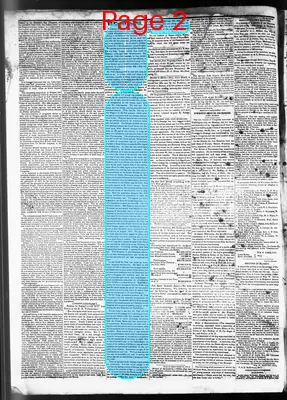
Editorial
December 12, 1845
Wilmington Journal
Wilmington, New Hanover County, North Carolina
What is this article about?
The Wilmington Journal editorial praises President James K. Polk's first annual message for its clarity and firmness. It highlights his stance on Oregon negotiations with Britain, advocating full U.S. claim after rejections; tariff reduction to revenue levels; Texas annexation; Mexico diplomacy; and rejection of European interference in American affairs.
Clipping
OCR Quality
98%
Excellent
Full Text
WILMINGTON JOURNAL.
Friday, December 12, 1845.
THE PRESIDENT'S MESSAGE.
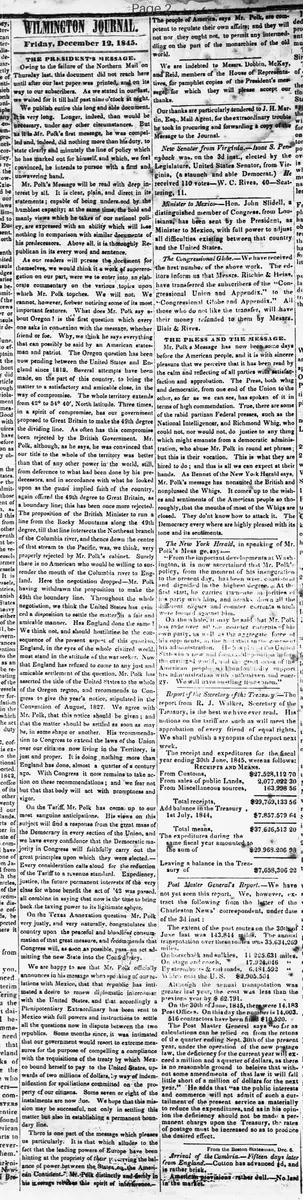
Owing to the failure of the Northern Mail on Thursday last, this document did not reach here until after our last paper was printed, and on its way to our subscribers. As we stated in our last, we waited for it till half past nine o'clock at night. We publish entire this long and able document. It is very long. Longer, indeed, than would be necessary, under any other circumstances. But as it is Mr. Polk's first message, he was compelled and, indeed, did nothing more than his duty, to state clearly and minutely the line of policy which he has marked out for himself, and which, we feel convinced, he intends to pursue with a firm and unwavering hand.
Mr. Polk's Message will be read with deep interest by all. It is clear, plain, and direct in its statements; capable of being understood by the humblest capacity; at the same time, the bold and manly views which he takes of our national policy, are expressed with an ability which will lose nothing in comparison with similar documents of his predecessors. Above all, it is publican in its every word and sentence.
As our readers will peruse the document for themselves, we would think it a work of supererogation on our part, were we to enter into an elaborate commentary on the various topics upon which Mr. Polk touches. We will not. We cannot, however, forbear noticing some of its most important features. What does Mr. Polk say about Oregon? is the first question which every one asks in connexion with the message, whether friend or foe. Why, we think he says everything that can possibly be said by an American statesman and patriot. The Oregon question has been now pending between the United States and England since 1818. Several attempts have been made, on the part of this country, to bring the matter to a satisfactory and amicable close, in the way of compromise. The whole territory extends from 42° to 54° 40', North latitude. Three times, in a spirit of compromise, has our government proposed to Great Britain to make the 49th degree the dividing line. As often has this compromise been rejected by the British Government. Mr. Polk, although, as he says, he was convinced that our title to the whole of the territory was better than that of any other power in the world, still, from deference to what had been done by his predecessors, and in accordance with what he looked upon as the quasi implied faith of the country, again offered the 49th degree to Great Britain, as a boundary line; this has been once more rejected. The proposition of the British Minister to run a line from the Rocky Mountains along the 49th degree, till that line intersects the Northeast branch of the Columbia river, and thence down the centre of that stream to the Pacific, was, we think, very properly rejected by Mr. Polk's cabinet. Surely there is no American who would be willing to surrender the mouth of the Columbia river to England. Here the negotiation dropped—Mr. Polk having withdrawn the proposition to make the 49th the boundary line. Throughout the whole negotiation, we think the United States has evinced a disposition to settle the matter in a fair and amicable manner. Has England done the same? We think not, and should hostilities be the consequence of the present aspect of this question, England, in the eyes of the whole civilized world, must stand in the attitude of the war seeker. Now that England has refused to come to any just and amicable settlement of the question, Mr. Polk has asserted the title of the United States to the whole of the Oregon region, and recommends to Congress to give the year's notice, stipulated in the Convention of August, 1827. We agree with Mr. Polk, that this notice should be given; and that the matter should be settled as soon as may be, in some shape or another. His recommendation to Congress to extend the laws of the Union over our citizens now living in the Territory, is just and proper. It is doing nothing more than England has done, almost a quarter of a century ago.
With Congress it now remains to take action on these recommendations; and we fear not but that that body will act with promptness and vigor.
On the Tariff, Mr. Polk has come up to our most sanguine anticipations. His views on this subject will find a response from the great mass of the Democracy in every section of the Union, and we have every confidence that the Democratic majority in Congress will faithfully carry out the great principles upon which they were elected. Every consideration calls aloud for the reduction of the Tariff to a revenue standard. Expediency, justice, the future permanent interests of the very class for whose benefit the act of '42 was passed, all combine in saying that now is the time to bring back the taxing power to its legitimate sphere.
On the Texas Annexation question—Mr. Polk very justly, and very naturally, congratulates the country upon the peaceful and bloodless consummation of that great measure, and recommends that Congress will, as soon as possible, pass an act admitting the new State into the Confederacy.
We are happy to see that Mr. Polk officially announces in his message when speaking of our relations with Mexico, that that republic has intimated a desire to renew diplomatic intercourse with the United States, and that accordingly a Plenipotentiary Extraordinary has been sent to Mexico with full powers and instructions to settle all the questions now in dispute between the two republics. Some months since, it was intimated that our government would resort to extreme measures for the purpose of compelling a compliance with the requisitions of the treaty by which Mexico bound herself to pay to the United States, upwards of two millions of dollars, by way of indemnification for spoliations committed on the property of our citizens. Some seven or eight of the instalments are now due. We hope that this mission may be successful, not only in settling this matter but also in establishing a permanent boundary line.
There is one part of the message which pleases us particularly: It is that which alludes to the fact that the leading powers of Europe have been hinting at the propriety of their preserving the balance of power between the States on the American Continent. Mr. Polk distinctly and firmly in his message rebukes this spirit of interference.
The people of America, says Mr. Polk, are competent to regulate their own affairs: and they will not nor they ought not, to permit any intermeddling on the part of the monarchies of the old world.
Friday, December 12, 1845.
THE PRESIDENT'S MESSAGE.
Owing to the failure of the Northern Mail on Thursday last, this document did not reach here until after our last paper was printed, and on its way to our subscribers. As we stated in our last, we waited for it till half past nine o'clock at night. We publish entire this long and able document. It is very long. Longer, indeed, than would be necessary, under any other circumstances. But as it is Mr. Polk's first message, he was compelled and, indeed, did nothing more than his duty, to state clearly and minutely the line of policy which he has marked out for himself, and which, we feel convinced, he intends to pursue with a firm and unwavering hand.
Mr. Polk's Message will be read with deep interest by all. It is clear, plain, and direct in its statements; capable of being understood by the humblest capacity; at the same time, the bold and manly views which he takes of our national policy, are expressed with an ability which will lose nothing in comparison with similar documents of his predecessors. Above all, it is publican in its every word and sentence.
As our readers will peruse the document for themselves, we would think it a work of supererogation on our part, were we to enter into an elaborate commentary on the various topics upon which Mr. Polk touches. We will not. We cannot, however, forbear noticing some of its most important features. What does Mr. Polk say about Oregon? is the first question which every one asks in connexion with the message, whether friend or foe. Why, we think he says everything that can possibly be said by an American statesman and patriot. The Oregon question has been now pending between the United States and England since 1818. Several attempts have been made, on the part of this country, to bring the matter to a satisfactory and amicable close, in the way of compromise. The whole territory extends from 42° to 54° 40', North latitude. Three times, in a spirit of compromise, has our government proposed to Great Britain to make the 49th degree the dividing line. As often has this compromise been rejected by the British Government. Mr. Polk, although, as he says, he was convinced that our title to the whole of the territory was better than that of any other power in the world, still, from deference to what had been done by his predecessors, and in accordance with what he looked upon as the quasi implied faith of the country, again offered the 49th degree to Great Britain, as a boundary line; this has been once more rejected. The proposition of the British Minister to run a line from the Rocky Mountains along the 49th degree, till that line intersects the Northeast branch of the Columbia river, and thence down the centre of that stream to the Pacific, was, we think, very properly rejected by Mr. Polk's cabinet. Surely there is no American who would be willing to surrender the mouth of the Columbia river to England. Here the negotiation dropped—Mr. Polk having withdrawn the proposition to make the 49th the boundary line. Throughout the whole negotiation, we think the United States has evinced a disposition to settle the matter in a fair and amicable manner. Has England done the same? We think not, and should hostilities be the consequence of the present aspect of this question, England, in the eyes of the whole civilized world, must stand in the attitude of the war seeker. Now that England has refused to come to any just and amicable settlement of the question, Mr. Polk has asserted the title of the United States to the whole of the Oregon region, and recommends to Congress to give the year's notice, stipulated in the Convention of August, 1827. We agree with Mr. Polk, that this notice should be given; and that the matter should be settled as soon as may be, in some shape or another. His recommendation to Congress to extend the laws of the Union over our citizens now living in the Territory, is just and proper. It is doing nothing more than England has done, almost a quarter of a century ago.
With Congress it now remains to take action on these recommendations; and we fear not but that that body will act with promptness and vigor.
On the Tariff, Mr. Polk has come up to our most sanguine anticipations. His views on this subject will find a response from the great mass of the Democracy in every section of the Union, and we have every confidence that the Democratic majority in Congress will faithfully carry out the great principles upon which they were elected. Every consideration calls aloud for the reduction of the Tariff to a revenue standard. Expediency, justice, the future permanent interests of the very class for whose benefit the act of '42 was passed, all combine in saying that now is the time to bring back the taxing power to its legitimate sphere.
On the Texas Annexation question—Mr. Polk very justly, and very naturally, congratulates the country upon the peaceful and bloodless consummation of that great measure, and recommends that Congress will, as soon as possible, pass an act admitting the new State into the Confederacy.
We are happy to see that Mr. Polk officially announces in his message when speaking of our relations with Mexico, that that republic has intimated a desire to renew diplomatic intercourse with the United States, and that accordingly a Plenipotentiary Extraordinary has been sent to Mexico with full powers and instructions to settle all the questions now in dispute between the two republics. Some months since, it was intimated that our government would resort to extreme measures for the purpose of compelling a compliance with the requisitions of the treaty by which Mexico bound herself to pay to the United States, upwards of two millions of dollars, by way of indemnification for spoliations committed on the property of our citizens. Some seven or eight of the instalments are now due. We hope that this mission may be successful, not only in settling this matter but also in establishing a permanent boundary line.
There is one part of the message which pleases us particularly: It is that which alludes to the fact that the leading powers of Europe have been hinting at the propriety of their preserving the balance of power between the States on the American Continent. Mr. Polk distinctly and firmly in his message rebukes this spirit of interference.
The people of America, says Mr. Polk, are competent to regulate their own affairs: and they will not nor they ought not, to permit any intermeddling on the part of the monarchies of the old world.
What sub-type of article is it?
Foreign Affairs
Economic Policy
War Or Peace
What keywords are associated?
Polk's Message
Oregon Negotiations
Tariff Reduction
Texas Annexation
Mexico Relations
European Interference
Democratic Policy
What entities or persons were involved?
Mr. Polk
United States
England
Congress
Mexico
Texas
Editorial Details
Primary Topic
Praise And Analysis Of President Polk's First Message On Key National Policies
Stance / Tone
Strongly Supportive And Approving
Key Figures
Mr. Polk
United States
England
Congress
Mexico
Texas
Key Arguments
Message Is Clear, Direct, And Able, Worthy Of Predecessors
Us Has Superior Title To Entire Oregon Territory; Britain Rejected Compromises
Recommend Giving Notice To End Joint Occupation Of Oregon And Extending Us Laws There
Tariff Should Be Reduced To Revenue Standard For Justice And Expediency
Congratulate Peaceful Texas Annexation And Urge Prompt Admission To Union
Support Diplomatic Mission To Mexico To Settle Disputes And Boundaries
Rebuke European Interference In American Balance Of Power