Thank you for visiting SNEWPapers!
Sign up free
Story
September 9, 1913
Rock Island Argus
Rock Island, Rock Island County County, Illinois
What is this article about?
New York syndicate including Bourne, Vanderbilt, and Morgan will finance a 75-foot defender for America's Cup, accommodating Lipton's challenge and overriding club's stance on size limits. Herreshoff unrestricted in design.
Clipping
OCR Quality
98%
Excellent
Full Text
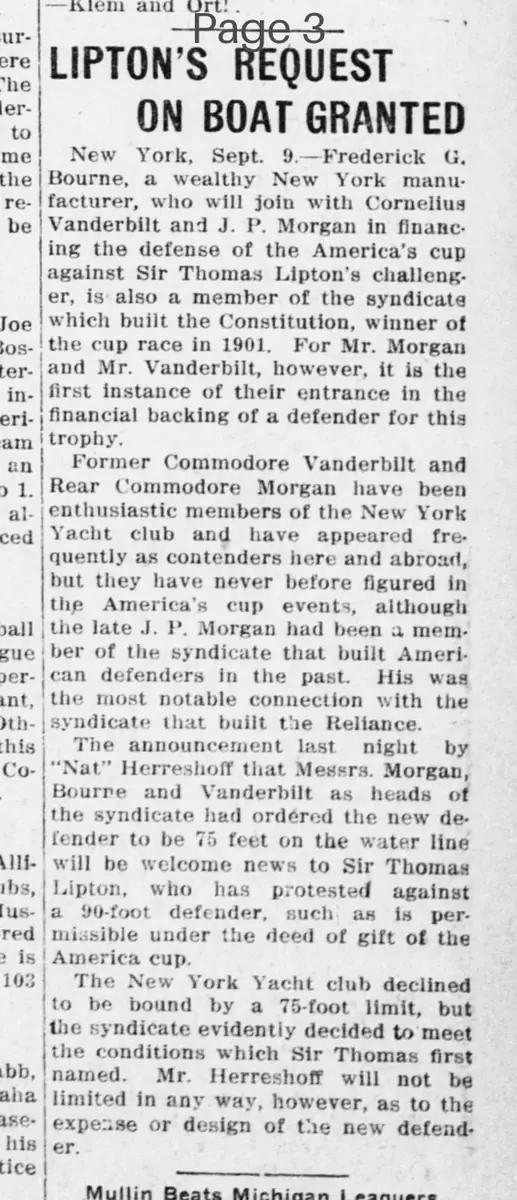
LIPTON'S REQUEST ON BOAT GRANTED
New York, Sept. 9.—Frederick G. Bourne, a wealthy New York manufacturer, who will join with Cornelius Vanderbilt and J. P. Morgan in financing the defense of the America's cup against Sir Thomas Lipton's challenger, is also a member of the syndicate which built the Constitution, winner of the cup race in 1901. For Mr. Morgan and Mr. Vanderbilt, however, it is the first instance of their entrance in the financial backing of a defender for this trophy.
Former Commodore Vanderbilt and Rear Commodore Morgan have been enthusiastic members of the New York Yacht club and have appeared frequently as contenders here and abroad, but they have never before figured in the America's cup events, although the late J. P. Morgan had been a member of the syndicate that built American defenders in the past.
His was the most notable connection with the syndicate that built the Reliance.
The announcement last night by "Nat" Herreshoff that Messrs. Morgan, Bourne and Vanderbilt as heads of the syndicate had ordered the new defender to be 75 feet on the water line will be welcome news to Sir Thomas Lipton, who has protested against a 90-foot defender, such as is permissible under the deed of gift of the America cup.
The New York Yacht club declined to be bound by a 75-foot limit, but the syndicate evidently decided to meet the conditions which Sir Thomas first named. Mr. Herreshoff will not be limited in any way, however, as to the expense or design of the new defender.
New York, Sept. 9.—Frederick G. Bourne, a wealthy New York manufacturer, who will join with Cornelius Vanderbilt and J. P. Morgan in financing the defense of the America's cup against Sir Thomas Lipton's challenger, is also a member of the syndicate which built the Constitution, winner of the cup race in 1901. For Mr. Morgan and Mr. Vanderbilt, however, it is the first instance of their entrance in the financial backing of a defender for this trophy.
Former Commodore Vanderbilt and Rear Commodore Morgan have been enthusiastic members of the New York Yacht club and have appeared frequently as contenders here and abroad, but they have never before figured in the America's cup events, although the late J. P. Morgan had been a member of the syndicate that built American defenders in the past.
His was the most notable connection with the syndicate that built the Reliance.
The announcement last night by "Nat" Herreshoff that Messrs. Morgan, Bourne and Vanderbilt as heads of the syndicate had ordered the new defender to be 75 feet on the water line will be welcome news to Sir Thomas Lipton, who has protested against a 90-foot defender, such as is permissible under the deed of gift of the America cup.
The New York Yacht club declined to be bound by a 75-foot limit, but the syndicate evidently decided to meet the conditions which Sir Thomas first named. Mr. Herreshoff will not be limited in any way, however, as to the expense or design of the new defender.
What sub-type of article is it?
Historical Event
What themes does it cover?
Triumph
What keywords are associated?
Americas Cup
Yacht Defender
Liptons Request
Syndicate Decision
New York Yacht Club
What entities or persons were involved?
Frederick G. Bourne
Cornelius Vanderbilt
J. P. Morgan
Sir Thomas Lipton
Nat Herreshoff
Where did it happen?
New York
Story Details
Key Persons
Frederick G. Bourne
Cornelius Vanderbilt
J. P. Morgan
Sir Thomas Lipton
Nat Herreshoff
Location
New York
Event Date
Sept. 9
Story Details
Syndicate led by Bourne, Vanderbilt, and Morgan decides to build a 75-foot defender yacht for America's Cup, granting Lipton's request against a larger 90-foot boat, despite club's refusal to limit size.