Thank you for visiting SNEWPapers!
Sign up free
Gazette Of The United States, & Philadelphia Daily Advertiser
Philadelphia, Philadelphia County, Pennsylvania
What is this article about?
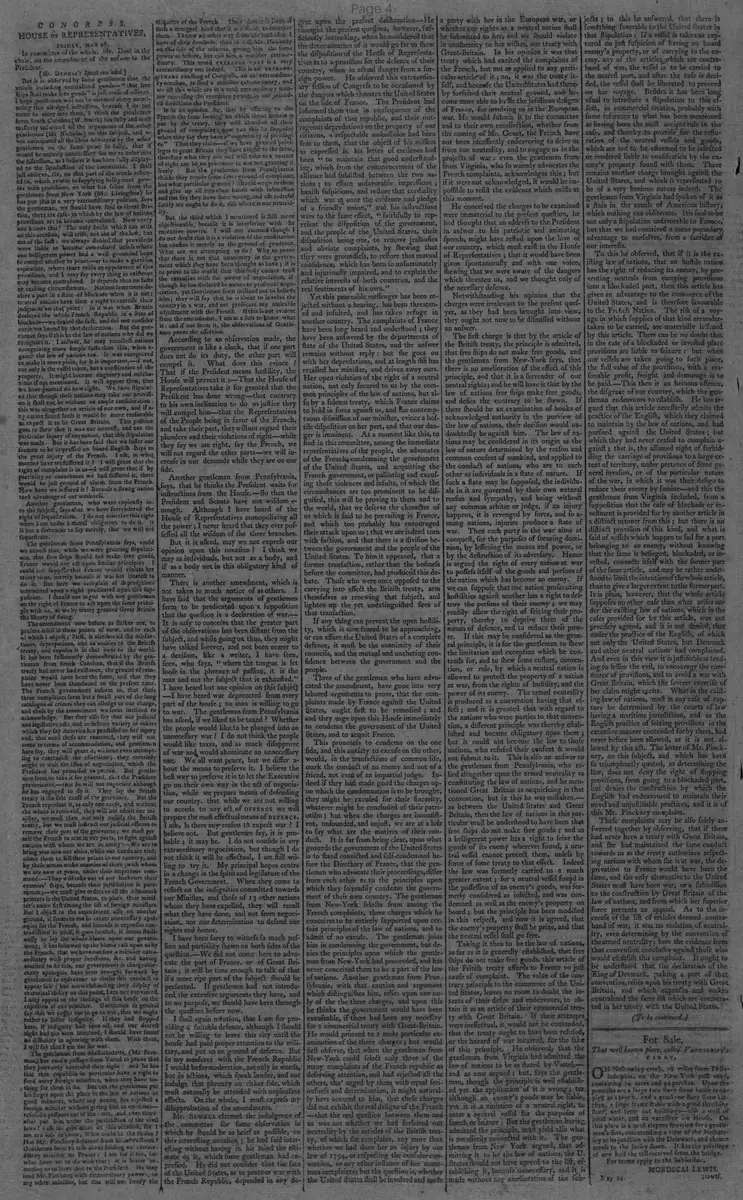
Transcript of US House of Representatives debate on May 26, in committee of the whole, on amending the response to the President. Speakers, including Dennis, Sewall, and others, defend the British treaty, US neutrality, and law of nations principles against French complaints and depredations, criticizing French rejection of Pinckney and advocating defense preparations without war.
Clipping
OCR Quality
Full Text
HOUSE OF REPRESENTATIVES,
FRIDAY, MAY 26.
In committee of the whole, Mr. Dent in the chair, on the amendment of the answer to the President.
[Mr. Dennis's Speech concluded.]
But it is observed by some gentlemen that the article including contraband goods—'that free ships shall make free goods' is just cause of offense. I hope gentlemen will not be alarmed at my mentioning this alleged infraction, because I do not mean to enter into them, I think the gentleman from South Carolina (W. Smith) has fully and most masterly answered all the arguments of the other gentleman (Mr. Nicholas) on this subject, and even anticipated all the ideas advanced by the other gentlemen on the same point of utility, that it would be entirely unnecessary for me to enter into the discussion, as I believe it has been fully displayed to the satisfaction of the committee. I shall just observe, Sir, on that part of the article referred to, which relates to supplying belligerent powers with provisions, on what has fallen from the gentleman from New York (Mr. Livingston) he has put this in a very extraordinary position, says the gentleman, we should have said to Great Britain, provisions are to become contraband. Now every captain, there are cases in which by the law of nations one knows this! The only doubt which can arise on this occasion, will arise, not out of the law, but out of the fact: we always denied that provisions were liable to become contraband unless where one belligerent power had a well grounded hope to compel another to peace—or to make a garrison capitulate, where there exists an appearance of this provisions, and I may say every thing in existence may become contraband. It depends then on facts or existing circumstances. Nations sometimes declare a port in a state of blockade when it is not; neutral nations have then a right to exercise their judgment on that point: so it was when Britain declared the whole French Republic in a state of blockade—we denied the fact, and did not consider ourselves bound by that declaration. But the gentleman says if this be the law of nations why did we recognize it. I answer, he may recollect nations recognizing more simple acts than this, when against the law of nations too. It was recognized to make it more plain, or it is important,—if not, property. It might become nugatory and mischief not only is the vessel taken, but a confiscation of the previous if not mentioned. It will appear then, that we have granted no new right. We have stipulated that though these nations may take our provisions it shall not be without an ample consideration. This was altogether an article of our own, and if any nation found fault it would be more reasonable to expect it to be Great Britain. This position goes to show that it was our interest, and not the particular injury of any nation, that this stipulation was made. But it has been said that we use our seamen to be impressed on board English Ships to the great injury of the French. I ask, in what manner have we suffered it? I will grant that the right of complaint is in us—I will grant that if by partiality or connivance we had suffered it, there would be just ground of alarm from the French. How have we suffered it? Because a strong nation took advantage of our weakness.
Another gentleman, who went copiously into the subject, says that we have surrendered the right of sequestration. I do not conceive this right when I am under a moral obligation to do it. It is not a surrender to say merely, that we will not sequestrate.
The gentleman from Pennsylvania says, could we expect that, while we were granting stipulations, that free ships should not make free goods, France would not act upon similar principles? I could not suppose that France would violate her treaty to us, merely because it was her interest to do it. But here we complain of depredations committed upon a right predicated upon this supposition. I should not argue with any gentleman on the right of France to act upon the same principle with us, as we by treaty granted Great Britain the liberty of doing.
The amendment now before us strikes me, to present itself in three points of view, and to each of which I object; First, it ascribes all the misfortunes, depredations, and calamities to the British treaty, and exposes it in that view to the world. It has been sufficiently demonstrated by the gentleman from South Carolina, that if the British treaty had never had existence, the ground of complaint would have been the same, and that they have never been abandoned to the present time. The French government inform us, that those three complaints form but a small part of the long catalogue of crimes they can allege to our charge, and these by the amendment we seem inclined to acknowledge. But they also say that our judicial and legislative acts, and an infinite variety of others which they say America has practiced to her injury and, that until these are removed, they will not come to terms of accommodation, and gentlemen here say, they will grant it, without even attempting to contradict the assertions; they certainly ought to wait the issue of negotiation, which the President has promised to pursue. But gentlemen seem to take it for granted, that the President prevaricates, that he will not negotiate although he has engaged to do it. They say the British treaty is the sole cause of the grievance. But the French represent it, as only one cause, and without the whole is removed, they will not admit our minister, we must then not only nullify the British treaty, but we must instruct our judicial officers to remove their part of the grievance; we must permit the French to arm in our ports, to fight against nations with whom we are in amity:—We are to bring war into our cities, while our hands are tied; admit them to sell their prizes in our country, and by these means make enemies of those with whom we are now at peace, under their imperious command: They will take out of our harbours their enemies' ships, because their jurisdiction is paramount; we must give orders to all the Almanack printers in the United States, to place their minister's name first among the list of foreign ministers. But I object to the amendment also on another ground, it seems to me to create unnecessary apologies for the French, and because it expresses contradiction in itself, it goes further, it seems studiously to lay the whole blame upon our government; it has followed up the blame cast upon us by the French, that we have not sent a minister extraordinary with proper functions, &c. and having omitted to do this, our government is chargeable: many apologies have been brought forward by gentlemen to endeavour to clothe this conduct to appear fair; but notwithstanding their display of oratorical ability on this point, I am not convinced. I only appeal to the feelings of this house on the rejection of our minister. Gentlemen in general say that we ought not to go to war, that we ought rather to suffer indignity. If they had stopped here, if indignity had been all, and our dearest right had not been involved, I should have found no difficulty in agreeing with them. With them, I will say that I am not for war.
The gentleman from Massachusetts, (Mr. Freeman) has read a passage from Vattel to prove that they have only exercised their right: and he has said that republics in particular have a right to send away foreign ministers, when they have nothing for them to do. But can the gentleman put his finger upon the place in the law of nations or good manners, where any nation has rejected a foreign minister without giving him an audience—refused a passport out of the gate, and even thereafter put him under the jurisdiction of the civil laws? I ask the gentleman on this occasion, for I am at a loss to know, What could be the reason? Has Mr. Pinckney departed from his instructions? Gentlemen seem to talk about sending an extraordinary minister to France: I am for it too, but what have we to do with that; it is better becoming us to leave that to the President. He may send Mr. Pinckney with extraordinary powers, or any other minister, but this will not satisfy the etiquette of the French. Their demands seem of such a mongrel kind that it is difficult to conceive them. I know no other way from the least idea I have of their demands, than to call Mr. Pinckney on this side of the Atlantic, giving him the same power as before, but call him a minister extraordinary. This Word EXTRAORDINARY is a very extraordinary one indeed. This is an Extraordinary enacting of Congress, on an extraordinary occasion, to send a minister extraordinary, and we all this while are in a most extraordinary manner exercising the executive powers in our intended directions the President.
It is an opinion, Sir, that by offering to the French the same footing on which Great Britain is put by the treaty, they will abandon all their ground of complaint: now can this be supposed when they say they have a 'community of privileges.' That they claim—if we have granted privileges to Great Britain they have a right to the same, therefore what they can and will take as a matter of right can be no grievance in our not granting it freely. But the gentleman from Pennsylvania thinks they recede from some ground of complaint; but what particular ground? Should we go to them and give up all into their hands with submission and not say they have done wrong, and ask redress? Surely we ought to do it, else where is our neutrality.
But the third which I mentioned is still more objectionable, because it is interfering with the executive powers. I will not contend though I do not doubt that it is a violation of the constitution but confine it merely to the ground of prudence. What are we attempting to do? Why to prove that there is not that unanimity in the government which they have been thought to have; it is to prove to the world that this body cannot trust the executive with the power of negotiation, although he has declared he means to prosecute negotiation, yet Gentlemen seem inclined not to believe him; they will say that he is about to involve the country in a war, and not prosecute any amicable adjustment with the French. If this is not evident from the amendment, I am at a loss to know what is: and if not from it, the observations of Gentlemen prove the assertion.
According to an observation made, the government is like a clock, that if one part does not do its duty, the other part will compel it. What does this evince? That if the President means hostility, the House will prevent it;—That the House of Representatives take it for granted that the President has done wrong—that contrary to his own inclination to do us justice they will compel him—that the Representatives of the People being in favor of the French, and take their part, they will not regard their plunders and their violations of right—while they say we are right, say the French, we will not regard the other parts we will increase in our demands while they are on our side.
Another gentleman from Pennsylvania, says, that he thinks the President waits for instructions from the House.—So then the President and Senate have not wisdom enough. Although I have heard of the House of Representatives monopolizing all the power; I never heard that they ever possessed all the wisdom of the three branches. But it is asked, may we not express our opinion upon this occasion? I think we may as individuals, but not as a body, and if as a body not in this obligatory kind of manner.
There is another amendment, which is not taken so much notice of as others. I have said that the arguments of gentlemen seem to be predicated upon a supposition that the question is a declaration of war.—It is easy to conceive that the greater part of the observations has been distant from the subject, and while going on thus, they might have talked forever, and not been nearer to a decision, like a writer, I have seen, who says, 'where the tongue is let loose in the phrenzy of passion, it is the man and not the subject that is exhausted.' I have heard but one opinion on this subject—I have heard war deprecated from every part of the house; no man is willing to go to war. The gentleman from Pennsylvania has asked, if we liked to be taxed? Whether the people would like to be plunged into an unnecessary war? I do not think the people would like taxes, and as much disapprove of war and would abominate an unnecessary one. We all want peace, but we differ about the means to preserve it. I believe the best way to preserve it is to let the Executive go on their own way in the act of negotiation, while we prepare means of defending our country. that while we are not willing to accede to any act of offence we will prepare the most effectual means of defence. I ask, is there any reason to expect war? I believe not. But gentlemen say, it is probable; it may be. I do not confide in any extraordinary negotiation, but though I do not think it will be effectual, I am still willing to try it. My principal hopes centre in a change in the spirit and legislature of the French Government. When they come to reflect on the indignities committed towards our Minister, and those of 13 other nations whom they have expelled, they will recall what they have done, and not from negotiation, nor our determination to defend our rights and honor.
I have been sorry to witness so much passion and partiality shewn on both sides of the question.—We did not come here to advocate the part of France. or of Great Britain; it will be time enough to talk of that if a more ripe part of the subject should be presented. If gentlemen had not introduced the extensive arguments they have, and to no purpose, we should have been through the question before now.
I shall again mention, that I am for providing a suitable defence, although I should not be willing to leave this city until the house had paid proper attention to the military, and put us on ground of defence. But in my measures with the French Republic I would be for moderation, not only in words, but in actions, which speak louder, and not indulge that phrenzy on either side, which must naturally be attended with unpleasant effects. On the whole, I must express my disapprobation of the amendments.
Mr. Sewall claimed the indulgence of the committee for some observation in which he should be as brief as possible, on this interesting occasion; he had said interesting without having in his mind the estimate of it, which some gentleman had expressed. He did not consider that the fate of the United States, as to peace or war with the French Republic, depended in any degree upon the present deliberation—He thought the present question, however, sufficiently interesting, when he considered that the determination of it would go far to shew the disposition of the House of Representatives as to a provision for the defence of their country, when in actual danger from a foreign power. He observed this extraordinary session of Congress to be occasioned by the dangers which threaten the United States on the side of France. The President had informed them that in consequence of the complaints of that republic, and their outrageous depredations on the property of our citizens, a respectable ambassador had been sent to them, that the object of his mission as expressed in his letters of credence had been 'to maintain that good understanding, which from the commencement of the alliance had subsisted between the two nations; to efface unfavorable impressions; banish suspicions, and restore that cordiality which was at once the evidence and pledge of a friendly union,' and his instructions were to the same effect, 'faithfully to represent the disposition of the government, and the people of the United States, their disposition being one, to remove jealousies and obviate complaints, by shewing that they were groundless, to restore that mutual confidence, which has been so unfortunately and injuriously impaired, and to explain the relative interests of both countries, and the real sentiments of his own.' Yet this peaceable messenger has been rejected without a hearing, has been threatened and insulted, and has taken refuge in another country. The complaints of France have been long heard and understood; they have been answered by the departments of state of the United States, and the answer remains without reply: but she goes on with her depredations, and at length she has recalled her minister, and driven away ours. Her open violation of the right of a neutral nation, not only secured to us by the common principles of the law of nations, but also by a solemn treaty, which France claims to hold in force against us, and one contemptuous dismission of our minister, evince a hostile disposition on her part, and that our danger is imminent. At a moment like this, to find in this committee, among the immediate representatives of the people, the advocates of the French condemning the government of the United States, and acquitting the French government, or palliating and excusing those violences and insults, of which the circumstances are too prominent to be disguised, this will be proving to them and to the world, that we deserve the character of us which is said to be prevailing in France, and which too probably has encouraged their attack upon us; that we are indeed torn with faction, and that there is a division between the government and the people of the United States. To him it appeared, that a former transaction, rather than the business before the committee, had produced this debate. Those who were once opposed to the carrying into effect the British treaty, arm themselves as renewing that subject, and lighten up the yet unextinguished fires of that transaction.
If any thing can prevent the open hostility, which is now feared to be approaching, or can assure the United States of a complete defence, it must be the unanimity of their councils, and the mutual and unabating confidence between the government and the people.
Three of the gentlemen who have advocated the amendment, have gone into very labored arguments to prove, that the complaints made by France against the United States, ought first to be remedied; and they urge upon this House immediately to condemn the government of the United States, and to acquit France. This proneness to condemn on the one side, and this anxiety to excuse on the other, would, in the transactions of common life, mark the conduct of an enemy and not of a friend, not even of an impartial judge. Indeed if they had made good the charges upon which the condemnation is to be brought, they might be excused for their sincerity, whatever might be concluded of their patriotism; but when the charges are inconsistent, unfounded, and unjust, we are at a loss to say what are the motives of their conduct. It is far from being clear, upon what grounds the government of the United States is to stand convicted and self-condemned before the Directory of France, that the gentlemen who advocate their proceedings, differ from each other as to the principles upon which they so readily condemn the government of their own country. The gentleman from New-York selects from among the French complaints, three charges which he conceives to be entirely supported upon certain principles of the law of nations, and to admit of no excuse. The gentleman joins him in condemning the government, but denies the principles upon which the gentleman from New-York had proceeded, and has never conceived them to be a part of the law of nations. Another gentleman from Pennsylvania, with that caution and argument which distinguishes him, relies upon one only of the three charges, and upon this he thinks the government would have been excusable, if there had been any necessity for a commercial treaty with Great-Britain.
He would proceed to a more particular examination of the three charges; but would first observe, that when the gentleman from New-York could select only three of the many complaints of the French republic as deserving attention, and had rejected all the others, tho' urged by them with equal earnestness and determination, it might naturally have occurred to him, that these charges did not exhibit the real designs of the French—that the real question between them and us was not whether we had forfeited our neutrality by the articles of the British treaty, of which he complains, any more than whether we had done her an injury by our law of 1794, or respecting the consular convention, or any other instance of her numerous complaints; but the question is, whether the United States shall be involved and made a party with her in the European war, or whether our rights as a neutral nation shall be submitted to her, and we should violate in conformity to her wishes, our treaty with Great-Britain. In his opinion it was that treaty which had excited the complaints of the French, but not as applied to any particular article of it; no, it was the treaty itself, and because the United States had thereby forfeited their neutral ground, and become more able to baffle the insidious designs of France, for involving us in the European war. He would submit it to the committee and to their own recollection, whether from the coming of Mr. Genet, the French have not been incessantly endeavoring to drive us from our neutrality, and to engage us in the projects of war: even the gentleman from Virginia, who so warmly advocates the French complaints, acknowledges this; but if it were not acknowledged, it would be impossible to resist the evidence which exists at this moment.
He conceived the charges to be examined were immaterial to the present question, he had thought that an address to the President in answer to his patriotic and animating speech, might have rested upon the love of our country, which must exist in the House of Representatives; that it would have been given spontaneously and with one voice, shewing that we were aware of the dangers which threaten us, and we thought only of the necessary defence.
Notwithstanding his opinion that the charges were irrelevant to the present question yet, as they had been brought into view, they ought not now to be dismissed without an answer.
The first charge is that by the article of the British treaty, the principle is admitted, that free ships do not make free goods, and the gentleman from New-York says, that there is no amelioration of the effect of this principle, and that it is a surrender of our neutral rights; and he will have it that by the law of nations free ships make free goods, and defies the contrary to be shewn. If there should be an examination of books of acknowledged authority in the purview of the law of nations, their decision would undoubtedly be against him. The law of nations may be considered in its origin as the law of nature determined by the reason and common consent of mankind, and applied to the conduct of nations, who are to each other as individuals in a state of nature. If such a state may be supposed, the individuals in it are governed by their own natural reason and sympathy, and being without any common arbiter or judge, if an injury happens, it is revenged by force, and so among nations, injuries produce a state of war. Then each party in the war aims at conquest, for the purposes of securing dominion, by lessening the means and power, or by the destruction of its adversary. Hence is argued the right of every nation at war to possess itself of the goods and persons of the nation which has become an enemy. If we can suppose that one nation prosecuting hostilities against another has a right to destroy the persons of their enemy; we may readily allow the right of seizing their property, thereby to deprive them of the means of defence, and to reduce their power. If this may be considered as the general principle, it is for the gentleman to shew the limitation and exception which he contends for, and to shew some custom, convention, or rule, by which a neutral nation is allowed to protect the property of a nation at war, from the rights of hostility, and the power of its enemy. The armed neutrality is produced as a convention having that effect; and it is granted that with regard to the nations who were parties to that convention, a different principle was thereby established and became obligatory upon them; but it could not become the law to those nations, who refused their consent & would not submit to it. This is also an answer to the gentleman from Pennsylvania, who relied altogether upon the armed neutrality as constituting the law of nations, and he mentioned Great Britain as acquiescing in that convention, but in this he was mistaken.—as between the United States and Great Britain, then the law of nations in this particular must be understood to have been that free ships do not make free goods; and as a belligerent power has a right to seize the goods of its enemy wherever found, a neutral vessel cannot protect them, unless by force of some treaty to that effect. Indeed the law was formerly carried to a much greater extent; for a neutral vessel found in the possession of an enemy's goods, was formerly considered as infected, and was condemned as well as the enemy's property on board; but the principle has been modified in this respect, and now it is agreed, that the enemy's property shall be prize, and that the neutral vessel shall go free.
Taking it then to be the law of nations, as far as it is generally established, that free ships do not make free goods. this article of the British treaty affords to France no just cause of complaint. The value of the contrary principle to the commerce of the United States, leaves no room to doubt the intents of their desire and endeavours, to obtain it as an article of their commercial treaty with Great Britain. If their attempts were ineffectual, it would not be contended, that the treaty ought to have been refused, or the hazard of war incurred, for the sake of this principle. He observed, that the gentleman from Virginia had admitted the law of nations to be as stated by Vattel,—and as now argued; but, says the gentleman, though the principle is well established yet the application of it is wrong; for although an enemy's goods may be liable, yet it is a violation of a neutral right, to enter a neutral vessel for the purposes of search or seizure : But the gentleman having admitted the principle, must yield also what is necessarily connected with it. The gentleman from New York argued, that admitting it to be the law of nations, the U. States should not have agreed to the list, establishing it, because unnecessary, and it is made without any amelioration of the subjects; to this he answered, that there is something favorable to the United States in that stipulation : If a vessel is taken or captured on just suspicion of having on board enemy's property, or of carrying to the enemy. any of the articles which are contraband of war, the vessel is to be carried to the nearest port, and after the case is decided, the vessel shall be liberated to proceed on her voyage. Besides it has been long usual to introduce a stipulation to this effect, in commercial treaties, probably with some reference to what has been mentioned as having been the most ancient rule in the case, and thereby to provide for the restoration-of the neutral vessels and goods, which are not to be. esteemed to be infected or rendered liable to confiscation by the enemy's property found with them. There remains another charge brought against the United States, and which is represented to be of a very heinous nature indeed. The gentleman from Virginia had spoken of it as a stain in the annals of American history, which nothing can obliterate. It is said to be not only a stipulation unfavorable to France, but that we had contrived a mean pecuniary. advantage to ourselves, from a sacrifice of our interests.
To this he observed, that if it is the existing law of nations, that an hostile nation has the right of reducing its enemy, by preventing neutrals from carrying provisions into a blockaded port, then this article has given an advantage to the commerce of the United States, and is therefore favourable to the French Nation. The risk of a voyage in which supplies of that kind are undertaken to be carried, are materially lessened by this article. There can be no doubt that in the case of a blockaded or invested place provisions are liable to seizure : but when our vessels are taken going to such place, the full value of the provisions, with a reasonable profit, freight and demurrage is to be paid. This then is an heinous offence, the disgrace of our country, which the gentleman endeavours to establish. He has argued that this article necessarily admits the practice of the English, which they claimed to maintain by the law of nations, and had pursued against the United States; but which they had never ceased to complain against; that is, the assumed right of forbidding the carriage of provisions to a large extent of territory, under pretence of some general invasion, or of the particular nature of the war, in which it was their design to reduce their enemy by famine—and this the gentleman from Virginia included, from a supposition that the case of blockade or investment is provided for by another article in a distinct manner from this ; but there is no distinct provision of this kind, and what is said of vessels which happen to sail for a port belonging to an enemy, without knowing that the same is besieged, blockaded, or invested, connects itself with the former part of the same article, and may be rather understood to limit the intention of the whole article, than to give a larger extent to the former part. It is plain, however, that the whole article supposes no other case than what arises under the existing law of nations, which in the cases provided for by this article, was not precisely agreed, and it is not denied, that under the practice of the English, of which not only the United States, but Denmark and other neutral nations had complained. And even in this view it is justifiable as tending to lessen the evil, to encourage the commerce of provisions, and to avoid a war with Great Britain, which the severer exercise of her claim might excite. What in the existing law of nations, must in any case of capture be determined by the courts of law having a maritime jurisdiction, and as the English practice of seizing provisions in the extensive manner contended for by them, had never before been allowed, as it is not allowed by this act. The letter of Mr. Pinckney, on this subject, and which has been so triumphantly quoted, as determining the law, does not deny the right of stopping provisions, from going to a blockaded port, but denies the construction by which the English had endeavoured to maintain their novel and unjustifiable practices, and it is of this Mr. Pinckney complains.
These complaints may be also fairly answered together by observing, that if there had never been a treaty with Great Britain, and she had maintained the same conduct towards us as the treaty authorizes respecting nations with whom she is at war, the deprivation to France would have been the same, and the only alternative to the United States must have been war, or a submission to the construction by Great Britain of the law of nations, and from which her superior force prevents an appeal. As to the increase of the list of articles deemed contraband of war, it was no violation of neutrality, even determining by the convention of the armed neutrality: here the evidence from that convention concludes against those who would establish this complaint. It ought to be understood that the declaration of the King of Denmark, making a part of that convention, relies upon his treaty with Great Britain, and which expresses and makes contraband the same list which are enumerated in her treaty with the United States.
(To be continued.)
What sub-type of article is it?
What themes does it cover?
What keywords are associated?
What entities or persons were involved?
Where did it happen?
Story Details
Key Persons
Location
House Of Representatives
Event Date
Friday, May 26
Story Details
Debate on amendment to the President's message, defending British treaty against French complaints, discussing law of nations on contraband, free ships, provisions, and US neutrality; criticizing French rejection of Pinckney and advocating defense without declaring war.