Thank you for visiting SNEWPapers!
Sign up free
Literary
March 24, 1832
Republican Herald
Providence, Providence County, Rhode Island
What is this article about?
Historical memoir detailing religious divisions in 1630s Massachusetts, including Antinomian controversy, synod condemnations, and banishments leading to Rhode Island settlement. Quotes historians like Mather and Neal on theological debates over covenants, sanctification, and assurance of salvation.
Clipping
OCR Quality
95%
Excellent
Full Text
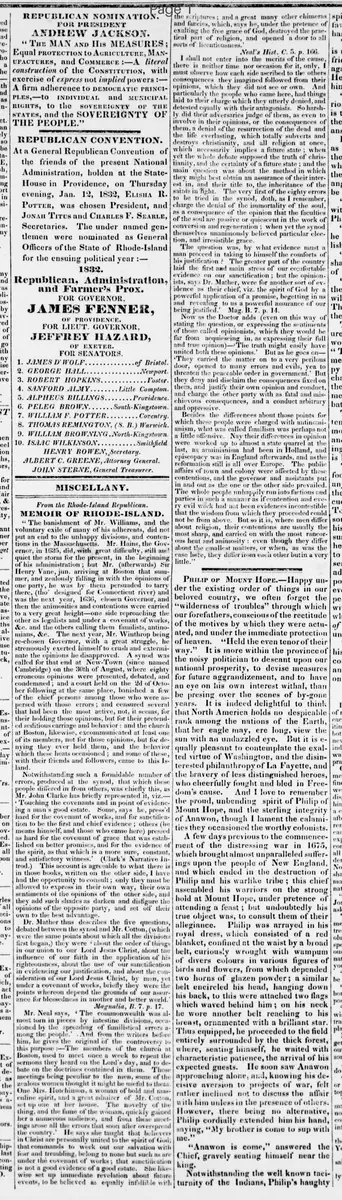
MISCELLANY.
From the Rhode-Island Republican.
MEMOIR OF RHODE-ISLAND.
"The banishment of Mr. Williams, and the voluntary exile of many of his adherents, did not put an end to the unhappy divisions, and contentions in the Massachusetts. Mr. Hains, the Governor, in 1635, did, with great difficulty, still and quiet the storm for the present, in the beginning of his administration; but Mr. (afterwards) Sir Henry Vane, jun. arriving at Boston that summer, and zealously falling in with the opinions of one party, he was by them persuaded to tarry there, (tho' designed for Connecticut river) and was the next year, 1636, chosen Governor, and then the animosities and contentions were carried to a very great height—one side reproaching the other as legalists and under a covenant of works. &c. and the others calling them familists, antinomians, &c. The next year, Mr. Winthrop being re-chosen Governor, with a great struggle, he strenuously exerted himself to crush and exterminate the opinions he disapproved. A synod was called for that end at New-Town (since named Cambridge) on the 30th of August, where eighty erroneous opinions were presented, debated, and condemned; and a court held on the 2d of October following at the same place, banished a few of the chief persons among those who were aspersed with those errors; and censured several that had been the most active, not, it seems, for their holding those opinions, but for their pretended seditious carriage and behavior : and the church at Boston, likewise, excommunicated at least one of its members, not for those opinions, but for denying they ever held them, and the behavior which these heats occasioned ; and some of these, with their friends and followers, came to this Island.
Notwithstanding such a formidable number of errors, produced at the synod, that which these people differed in from others, was chiefly this, as Mr. John Clarke has briefly represented it, viz.— Touching the covenants and in point of evidencing a man's good estate. Some, says he, press'd hard for the covenant of works, and for sanctification to be the first and chief evidence ; others (he means himself, and those who came here) pressed as hard for the covenant of grace that was established on better promises, and for the evidence of the spirit, as that which is a more sure, constant, and satisfactory witness.' (Clark's Narrative Intro d.) This account is agreeable to what there is in those books, written on the other side, I have had the opportunity to consult; only they must be allowed to express in their own way, their own sentiments of the opinions of the other side, and they add such shades as darken and disfigure the opinions of the opposite party, and set off their own to the best advantage.
Dr. Mather thus describes the five questions, debated between the synod and Mr. Cotton, (which were the same points about which all the divisions first began,) they were 'about the order of things in our union to our Lord Jesus Christ, about the influence of our faith in the application of his righteousness, about the use of our sanctification in evidencing our justification, and about the consideration of our Lord Jesus Christ, by men, yet under a covenant of works, briefly they were the points whereon depend the grounds of our assurance for blessedness in another and better world.' Magnalia, B. 7. p. 17.
Mr. Neal says, 'The commonwealth was almost torn in pieces by intestine divisions, occasioned by the spreading of familistical errors among the people.' And from the writers before him, he gives the original of the controversy to this purpose:—The members of the church at Boston, used to meet once a week to repeat the sermons they heard on the Lord's day, and to debate on the doctrines contained in them. Those meetings being peculiar to the men, some of the zealous women thought it might be useful to them. One Mrs. Hutchinson, a woman of bold and masculine spirit, and a great admirer of Mr. Cotton, set up one at her house. The novelty of the thing, and the fame of the woman, quickly gained her a numerous audience, and from these meetings arose all the errors that soon after overspread the country.' He says she taught that believers in Christ are personally united to the spirit of God; that commands to work out our salvation with fear and trembling, belong to none but such as are under the covenant of works: that sanctification is not a good evidence of a good estate. She likewise set up immediate revelation about future events, to be believed as equally infallible with the scriptures : and a great many other chimeras and fancies, which, says he, under the pretence of exalting the free grace of God, destroyed the practical part of religion, and opened 'a door to all sorts of licentiousness.' Neal's Hist. C. 5. p. 166.
I shall not enter into the merits of the cause, there is neither time nor occasion for it, only I must observe how each side ascribed to the others consequences they imagined followed from their opinions, which they did not see or own. And particularly the people who came here, had things laid to their charge which they utterly denied, and detested equally with their antagonists. So harshly did their adversaries judge of them, as even to involve in their opinions, or the consequences of them, a denial of the resurrection of the dead and the life everlasting, which totally subverts and destroys christianity, and all religion at once, which necessarily implies a future state; when yet the whole debate supposed the truth of christianity, and the certainty of a future state ; and the main question was about the method in which they might best obtain an assurance of their interest in, and their title to, the inheritance of the saints in light. The very first of the eighty errors to be tried in the synod, doth, as I remember, charge the denial of the immortality of the soul, as a consequence of the opinion that the faculties of the soul are passive or quiescent in the work of conversion and regeneration ; when yet the synod themselves unanimously believed particular election, and irresistible grace.
The question was, by what evidence must a man proceed in taking to himself the comforts of his justification ? The greater part of the country laid the first and main stress of our comfortable evidence on our sanctification : but the opinionists, says Dr. Mather, were for another sort of evidence as their chief, viz. the spirit of God by a powerful application of a promise, begetting in us and revealing to us a powerful assurance of our being justified.' Mag. B. 7. p. 14.
Now as the Doctor adds (even on this way of stating the question, or expressing the sentiments of those called opinionists, which they would be far from acquiescing in, as expressing their full and true opinion)—'Tthe truth might easily have united both these opinions.' But as he goes on— 'They carried the matter on to a very perilous door, opened to many errors and evils, yea to threaten the peaceable order in government.' But they deny and disclaim the consequences fixed on them, and justify their own opinion and conduct, and charge the other party with as fatal and mischievous consequences, and a conduct arbitrary and oppressive.
Besides the differences about those points for which these people were charged with antinomianism, what was called familism was perhaps not a little offensive. Nay their differences in opinion were worked up to almost a state quarrel at last, as arminianism had been in Holland, and episcopacy was in England afterwards, and as the reformation still is all over Europe. The public affairs of town and colony were affected by these contentions, and the governor and assistants put in and out as the one or the other side prevailed. The whole people unhappily run into factions and parties in such a manner as if contention and every evil work had not been evidences incontestable that the wisdom from which they proceeded could not be from above. But so it is, where men differ about religion, their contentions are usually the most sharp, and carried on with the most rancorous heat and animosity : even though they differ about the smallest matters, or when, as was the case here, they differ from each other but in a very little."
From the Rhode-Island Republican.
MEMOIR OF RHODE-ISLAND.
"The banishment of Mr. Williams, and the voluntary exile of many of his adherents, did not put an end to the unhappy divisions, and contentions in the Massachusetts. Mr. Hains, the Governor, in 1635, did, with great difficulty, still and quiet the storm for the present, in the beginning of his administration; but Mr. (afterwards) Sir Henry Vane, jun. arriving at Boston that summer, and zealously falling in with the opinions of one party, he was by them persuaded to tarry there, (tho' designed for Connecticut river) and was the next year, 1636, chosen Governor, and then the animosities and contentions were carried to a very great height—one side reproaching the other as legalists and under a covenant of works. &c. and the others calling them familists, antinomians, &c. The next year, Mr. Winthrop being re-chosen Governor, with a great struggle, he strenuously exerted himself to crush and exterminate the opinions he disapproved. A synod was called for that end at New-Town (since named Cambridge) on the 30th of August, where eighty erroneous opinions were presented, debated, and condemned; and a court held on the 2d of October following at the same place, banished a few of the chief persons among those who were aspersed with those errors; and censured several that had been the most active, not, it seems, for their holding those opinions, but for their pretended seditious carriage and behavior : and the church at Boston, likewise, excommunicated at least one of its members, not for those opinions, but for denying they ever held them, and the behavior which these heats occasioned ; and some of these, with their friends and followers, came to this Island.
Notwithstanding such a formidable number of errors, produced at the synod, that which these people differed in from others, was chiefly this, as Mr. John Clarke has briefly represented it, viz.— Touching the covenants and in point of evidencing a man's good estate. Some, says he, press'd hard for the covenant of works, and for sanctification to be the first and chief evidence ; others (he means himself, and those who came here) pressed as hard for the covenant of grace that was established on better promises, and for the evidence of the spirit, as that which is a more sure, constant, and satisfactory witness.' (Clark's Narrative Intro d.) This account is agreeable to what there is in those books, written on the other side, I have had the opportunity to consult; only they must be allowed to express in their own way, their own sentiments of the opinions of the other side, and they add such shades as darken and disfigure the opinions of the opposite party, and set off their own to the best advantage.
Dr. Mather thus describes the five questions, debated between the synod and Mr. Cotton, (which were the same points about which all the divisions first began,) they were 'about the order of things in our union to our Lord Jesus Christ, about the influence of our faith in the application of his righteousness, about the use of our sanctification in evidencing our justification, and about the consideration of our Lord Jesus Christ, by men, yet under a covenant of works, briefly they were the points whereon depend the grounds of our assurance for blessedness in another and better world.' Magnalia, B. 7. p. 17.
Mr. Neal says, 'The commonwealth was almost torn in pieces by intestine divisions, occasioned by the spreading of familistical errors among the people.' And from the writers before him, he gives the original of the controversy to this purpose:—The members of the church at Boston, used to meet once a week to repeat the sermons they heard on the Lord's day, and to debate on the doctrines contained in them. Those meetings being peculiar to the men, some of the zealous women thought it might be useful to them. One Mrs. Hutchinson, a woman of bold and masculine spirit, and a great admirer of Mr. Cotton, set up one at her house. The novelty of the thing, and the fame of the woman, quickly gained her a numerous audience, and from these meetings arose all the errors that soon after overspread the country.' He says she taught that believers in Christ are personally united to the spirit of God; that commands to work out our salvation with fear and trembling, belong to none but such as are under the covenant of works: that sanctification is not a good evidence of a good estate. She likewise set up immediate revelation about future events, to be believed as equally infallible with the scriptures : and a great many other chimeras and fancies, which, says he, under the pretence of exalting the free grace of God, destroyed the practical part of religion, and opened 'a door to all sorts of licentiousness.' Neal's Hist. C. 5. p. 166.
I shall not enter into the merits of the cause, there is neither time nor occasion for it, only I must observe how each side ascribed to the others consequences they imagined followed from their opinions, which they did not see or own. And particularly the people who came here, had things laid to their charge which they utterly denied, and detested equally with their antagonists. So harshly did their adversaries judge of them, as even to involve in their opinions, or the consequences of them, a denial of the resurrection of the dead and the life everlasting, which totally subverts and destroys christianity, and all religion at once, which necessarily implies a future state; when yet the whole debate supposed the truth of christianity, and the certainty of a future state ; and the main question was about the method in which they might best obtain an assurance of their interest in, and their title to, the inheritance of the saints in light. The very first of the eighty errors to be tried in the synod, doth, as I remember, charge the denial of the immortality of the soul, as a consequence of the opinion that the faculties of the soul are passive or quiescent in the work of conversion and regeneration ; when yet the synod themselves unanimously believed particular election, and irresistible grace.
The question was, by what evidence must a man proceed in taking to himself the comforts of his justification ? The greater part of the country laid the first and main stress of our comfortable evidence on our sanctification : but the opinionists, says Dr. Mather, were for another sort of evidence as their chief, viz. the spirit of God by a powerful application of a promise, begetting in us and revealing to us a powerful assurance of our being justified.' Mag. B. 7. p. 14.
Now as the Doctor adds (even on this way of stating the question, or expressing the sentiments of those called opinionists, which they would be far from acquiescing in, as expressing their full and true opinion)—'Tthe truth might easily have united both these opinions.' But as he goes on— 'They carried the matter on to a very perilous door, opened to many errors and evils, yea to threaten the peaceable order in government.' But they deny and disclaim the consequences fixed on them, and justify their own opinion and conduct, and charge the other party with as fatal and mischievous consequences, and a conduct arbitrary and oppressive.
Besides the differences about those points for which these people were charged with antinomianism, what was called familism was perhaps not a little offensive. Nay their differences in opinion were worked up to almost a state quarrel at last, as arminianism had been in Holland, and episcopacy was in England afterwards, and as the reformation still is all over Europe. The public affairs of town and colony were affected by these contentions, and the governor and assistants put in and out as the one or the other side prevailed. The whole people unhappily run into factions and parties in such a manner as if contention and every evil work had not been evidences incontestable that the wisdom from which they proceeded could not be from above. But so it is, where men differ about religion, their contentions are usually the most sharp, and carried on with the most rancorous heat and animosity : even though they differ about the smallest matters, or when, as was the case here, they differ from each other but in a very little."
What sub-type of article is it?
Essay
What themes does it cover?
Religious
Political
Liberty Freedom
What keywords are associated?
Rhode Island Memoir
Antinomian Controversy
Massachusetts Synod
Religious Divisions
Covenant Of Grace
Anne Hutchinson
Roger Williams
Henry Vane
What entities or persons were involved?
From The Rhode Island Republican.
Literary Details
Title
Memoir Of Rhode Island.
Author
From The Rhode Island Republican.
Subject
Religious Controversies In Massachusetts Leading To Rhode Island Settlement
Key Lines
The Banishment Of Mr. Williams, And The Voluntary Exile Of Many Of His Adherents, Did Not Put An End To The Unhappy Divisions, And Contentions In The Massachusetts.
A Synod Was Called For That End At New Town (Since Named Cambridge) On The 30th Of August, Where Eighty Erroneous Opinions Were Presented, Debated, And Condemned;
The Question Was, By What Evidence Must A Man Proceed In Taking To Himself The Comforts Of His Justification ?
Where Men Differ About Religion, Their Contentions Are Usually The Most Sharp, And Carried On With The Most Rancorous Heat And Animosity