Thank you for visiting SNEWPapers!
Sign up free
Editorial
October 19, 1786
Fowle's New Hampshire Gazette And General Advertiser
Portsmouth, Rockingham County, New Hampshire
What is this article about?
The Examiner advocates for New Hampshire to issue £50,000 in paper bills as a circulating medium, addressing objections on depreciation and trade balances. Compares outcomes in other states like Rhode Island (failed due to tender laws) and New York (successful). Estimates state gains of £1,000.
Clipping
OCR Quality
95%
Excellent
Full Text
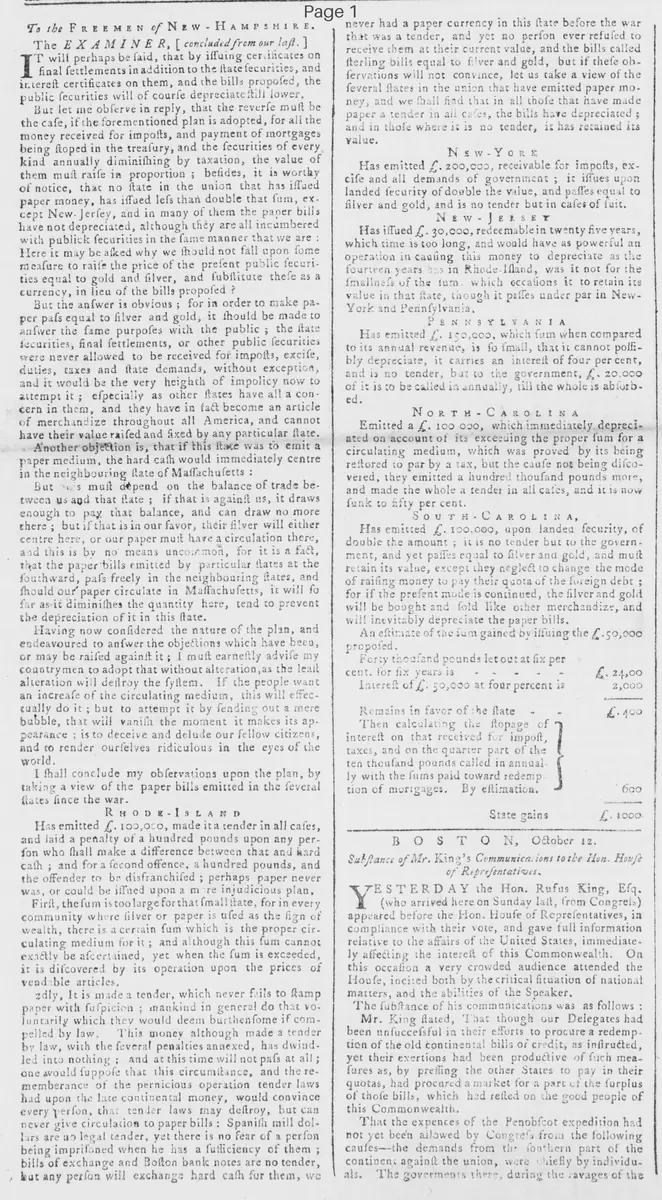
To the FREEMEN of NEW-HAMPSHIRE.
The EXAMINER, [concluded from our last.]
It will perhaps be said, that by issuing certificates on final settlements in addition to the state securities, and interest certificates on them, and the bills proposed, the public securities will of course depreciate still lower.
But let me observe in reply, that the reverse must be the case, if the aforementioned plan is adopted, for all the money received for imposts, and payment of mortgages being stopped in the treasury, and the securities of every kind annually diminishing by taxation, the value of them must raise in proportion; besides, it is worthy of notice, that no state in the union that has issued paper money, has issued less than double that sum, except New Jersey, and in many of them the paper bills have not depreciated, although they are all encumbered with public securities in the same manner that we are:
Here it may be asked why we should not fall upon some measure to raise the price of the present public securities equal to gold and silver, and substitute these as a currency, in lieu of the bills proposed?
But the answer is obvious; for in order to make paper pass equal to silver and gold, it should be made to answer the same purposes with the public; the state securities, final settlements, or other public securities were never allowed to be received for imposts, excise, duties, taxes and state demands, without exception, and it would be the very height of impolicy now to attempt it; especially as other states have all a concern in them, and they have in fact become an article of merchandize throughout all America, and cannot have their value raised and fixed by any particular state.
Another objection is, that if this state was to emit a paper medium, the hard cash would immediately centre in the neighbouring state of Massachusetts:
But this must depend on the balance of trade between us and that state: if that is against us, it draws enough to pay that balance, and can draw no more there; but if that is in our favor, their silver will either centre here, or our paper must have a circulation there, and this is by no means uncommon, for it is a fact, that the paper bills emitted by particular states at the southward, pass freely in the neighbouring states, and should our paper circulate in Massachusetts, it will so far as it diminishes the quantity here, tend to prevent the depreciation of it in this state.
Having now considered the nature of the plan, and endeavoured to answer the objections which have been, or may be raised against it; I must earnestly advise my countrymen to adopt that without alteration, as the least alteration will destroy the system. If the people want an increase of the circulating medium, this will effectually do it; but to attempt it by sending out a mere bubble, that will vanish the moment it makes its appearance; is to deceive and delude our fellow citizens, and to render ourselves ridiculous in the eyes of the world.
I shall conclude my observations upon the plan, by taking a view of the paper bills emitted in the several states since the war.
RHODE-ISLAND
Has emitted £100,000, made it a tender in all cases, and laid a penalty of a hundred pounds upon any person who shall make a difference between that and hard cash; and for a second offence, a hundred pounds, and the offender to be disfranchised; perhaps paper never was, or could be issued upon a more injudicious plan,
First, the sum is too large for that small state, for in every community where silver or paper is used as the sign of wealth, there is a certain sum which is the proper circulating medium for it; and although this sum cannot exactly be ascertained, yet when the sum is exceeded, it is discovered by its operation upon the prices of vendible articles.
2dly, It is made a tender, which never fails to stamp paper with suspicion; mankind in general do that voluntarily which they would deem burdensome if compelled by law. This money although made a tender by law, with the several penalties annexed, has dwindled into nothing; and at this time will not pass at all; one would suppose that this circumstance, and the remembrance of the pernicious operation tender laws had upon the late continental money, would convince every person, that tender laws may destroy, but can never give circulation to paper bills: Spanish milled dollars are no legal tender, yet there is no fear of a person being imprisoned when he has a sufficiency of them;
bills of exchange and Boston bank notes are no tender, but any person will exchange hard cash for them, we never had a paper currency in this state before the war that was a tender, and yet no person ever refused to receive them at their current value. and the bills called sterling bills equal to silver and gold, but if these observations will not convince, let us take a view of the several states in the union that have emitted paper money, and we shall find that in all those that have made paper a tender in all cases, the bills have depreciated; and in those where it is no tender, it has retained its value.
NEW-YORK
Has emitted £200,000, receivable for imposts, excise and all demands of government: it issues upon landed security of double the value, and passes equal to silver and gold, and is no tender but in cases of suit.
NEW-JERSEY
Has issued £30,000, redeemable in twenty five years, which time is too long, and would have as powerful an operation in causing this money to depreciate as the fourteen years as in Rhode-Island, was it not for the smallness of the sum which occasions it to retain its value in that state, though it passes under par in New-York and Pennsylvania,
PENNSYLVANIA
Has emitted £100,000, which sum when compared to its annual revenue, is so small, that it cannot possibly depreciate, it carries an interest of four per cent, and is no tender, but to the government, £20,000 of it is to be called in annually, till the whole is absorbed.
NORTH-CAROLINA
Emitted a £100,000, which immediately depreciated on account of its exceeding the proper sum for a circulating medium, which was proved by its being restored to par by a tax, but the cause not being discovered, they emitted a hundred thousand pounds more, and made the whole a tender in all cases, and it is now sunk to fifty per cent.
SOUTH-CAROLINA,
Has emitted £100,000, upon landed security, of double the amount: it is no tender but to the government, and yet passes equal to silver and gold, and must retain its value, except they neglect to change the mode of raising money to pay their quota of the foreign debt:
for if the present mode is continued, the silver and gold will be bought and sold like other merchandize, and will inevitably depreciate the paper bills.
An estimate of the sum gained by issuing the £50,000 proposed.
Forty thousand pounds let out at six per cent. for six years is £24,000
Interest of £20,000 at four percent is 2,000
Remains in favor of the state £400
Then calculating the stoppage of interest on that received for impost, taxes, and on the quarter part of the ten thousand pounds called in annually with the sums paid toward redemption of mortgages. By estimation. 600
State gains £1000
The EXAMINER, [concluded from our last.]
It will perhaps be said, that by issuing certificates on final settlements in addition to the state securities, and interest certificates on them, and the bills proposed, the public securities will of course depreciate still lower.
But let me observe in reply, that the reverse must be the case, if the aforementioned plan is adopted, for all the money received for imposts, and payment of mortgages being stopped in the treasury, and the securities of every kind annually diminishing by taxation, the value of them must raise in proportion; besides, it is worthy of notice, that no state in the union that has issued paper money, has issued less than double that sum, except New Jersey, and in many of them the paper bills have not depreciated, although they are all encumbered with public securities in the same manner that we are:
Here it may be asked why we should not fall upon some measure to raise the price of the present public securities equal to gold and silver, and substitute these as a currency, in lieu of the bills proposed?
But the answer is obvious; for in order to make paper pass equal to silver and gold, it should be made to answer the same purposes with the public; the state securities, final settlements, or other public securities were never allowed to be received for imposts, excise, duties, taxes and state demands, without exception, and it would be the very height of impolicy now to attempt it; especially as other states have all a concern in them, and they have in fact become an article of merchandize throughout all America, and cannot have their value raised and fixed by any particular state.
Another objection is, that if this state was to emit a paper medium, the hard cash would immediately centre in the neighbouring state of Massachusetts:
But this must depend on the balance of trade between us and that state: if that is against us, it draws enough to pay that balance, and can draw no more there; but if that is in our favor, their silver will either centre here, or our paper must have a circulation there, and this is by no means uncommon, for it is a fact, that the paper bills emitted by particular states at the southward, pass freely in the neighbouring states, and should our paper circulate in Massachusetts, it will so far as it diminishes the quantity here, tend to prevent the depreciation of it in this state.
Having now considered the nature of the plan, and endeavoured to answer the objections which have been, or may be raised against it; I must earnestly advise my countrymen to adopt that without alteration, as the least alteration will destroy the system. If the people want an increase of the circulating medium, this will effectually do it; but to attempt it by sending out a mere bubble, that will vanish the moment it makes its appearance; is to deceive and delude our fellow citizens, and to render ourselves ridiculous in the eyes of the world.
I shall conclude my observations upon the plan, by taking a view of the paper bills emitted in the several states since the war.
RHODE-ISLAND
Has emitted £100,000, made it a tender in all cases, and laid a penalty of a hundred pounds upon any person who shall make a difference between that and hard cash; and for a second offence, a hundred pounds, and the offender to be disfranchised; perhaps paper never was, or could be issued upon a more injudicious plan,
First, the sum is too large for that small state, for in every community where silver or paper is used as the sign of wealth, there is a certain sum which is the proper circulating medium for it; and although this sum cannot exactly be ascertained, yet when the sum is exceeded, it is discovered by its operation upon the prices of vendible articles.
2dly, It is made a tender, which never fails to stamp paper with suspicion; mankind in general do that voluntarily which they would deem burdensome if compelled by law. This money although made a tender by law, with the several penalties annexed, has dwindled into nothing; and at this time will not pass at all; one would suppose that this circumstance, and the remembrance of the pernicious operation tender laws had upon the late continental money, would convince every person, that tender laws may destroy, but can never give circulation to paper bills: Spanish milled dollars are no legal tender, yet there is no fear of a person being imprisoned when he has a sufficiency of them;
bills of exchange and Boston bank notes are no tender, but any person will exchange hard cash for them, we never had a paper currency in this state before the war that was a tender, and yet no person ever refused to receive them at their current value. and the bills called sterling bills equal to silver and gold, but if these observations will not convince, let us take a view of the several states in the union that have emitted paper money, and we shall find that in all those that have made paper a tender in all cases, the bills have depreciated; and in those where it is no tender, it has retained its value.
NEW-YORK
Has emitted £200,000, receivable for imposts, excise and all demands of government: it issues upon landed security of double the value, and passes equal to silver and gold, and is no tender but in cases of suit.
NEW-JERSEY
Has issued £30,000, redeemable in twenty five years, which time is too long, and would have as powerful an operation in causing this money to depreciate as the fourteen years as in Rhode-Island, was it not for the smallness of the sum which occasions it to retain its value in that state, though it passes under par in New-York and Pennsylvania,
PENNSYLVANIA
Has emitted £100,000, which sum when compared to its annual revenue, is so small, that it cannot possibly depreciate, it carries an interest of four per cent, and is no tender, but to the government, £20,000 of it is to be called in annually, till the whole is absorbed.
NORTH-CAROLINA
Emitted a £100,000, which immediately depreciated on account of its exceeding the proper sum for a circulating medium, which was proved by its being restored to par by a tax, but the cause not being discovered, they emitted a hundred thousand pounds more, and made the whole a tender in all cases, and it is now sunk to fifty per cent.
SOUTH-CAROLINA,
Has emitted £100,000, upon landed security, of double the amount: it is no tender but to the government, and yet passes equal to silver and gold, and must retain its value, except they neglect to change the mode of raising money to pay their quota of the foreign debt:
for if the present mode is continued, the silver and gold will be bought and sold like other merchandize, and will inevitably depreciate the paper bills.
An estimate of the sum gained by issuing the £50,000 proposed.
Forty thousand pounds let out at six per cent. for six years is £24,000
Interest of £20,000 at four percent is 2,000
Remains in favor of the state £400
Then calculating the stoppage of interest on that received for impost, taxes, and on the quarter part of the ten thousand pounds called in annually with the sums paid toward redemption of mortgages. By estimation. 600
State gains £1000
What sub-type of article is it?
Economic Policy
What keywords are associated?
Paper Money
Public Securities
Depreciation
Circulating Medium
Tender Laws
State Emissions
Economic Gain
What entities or persons were involved?
New Hampshire
Rhode Island
New York
New Jersey
Pennsylvania
North Carolina
South Carolina
Massachusetts
Editorial Details
Primary Topic
Proposal To Issue Paper Currency In New Hampshire
Stance / Tone
Strong Advocacy For Adopting The Paper Money Plan Without Alteration
Key Figures
New Hampshire
Rhode Island
New York
New Jersey
Pennsylvania
North Carolina
South Carolina
Massachusetts
Key Arguments
Issuing Certificates And Bills Will Increase Value Of Public Securities Due To Reduced Supply And Taxation.
Other States' Paper Money Has Not Depreciated Despite Similar Encumbrances.
State Securities Cannot Be Used For Taxes And Have Become Merchandise Across America.
Trade Balance With Massachusetts Will Prevent Hard Cash Outflow; Paper May Circulate There.
Tender Laws Cause Depreciation, As Seen In Rhode Island And Continental Money.
Non Tender Paper In New York And South Carolina Passes At Par.
Adopt The Plan Unaltered To Increase Circulating Medium Without Deception.
Estimate Shows State Gains £1,000 From Issuing £50,000.