Thank you for visiting SNEWPapers!
Sign up free
Editorial
May 15, 1879
Rocky Mountain Husbandman
Great Falls, Diamond City, White Sulphur Springs, Cascade County, Broadwater County, Meagher County, Montana
What is this article about?
Editorial addresses immigrant concerns about opportunities in Montana, promoting mining, ranching, and farming. It counters fears of oversaturated farming markets by forecasting grain exports via railroads and rivers, drawing parallels to successful Colorado and Utah trade, and notes growing local demand.
Clipping
OCR Quality
98%
Excellent
Full Text
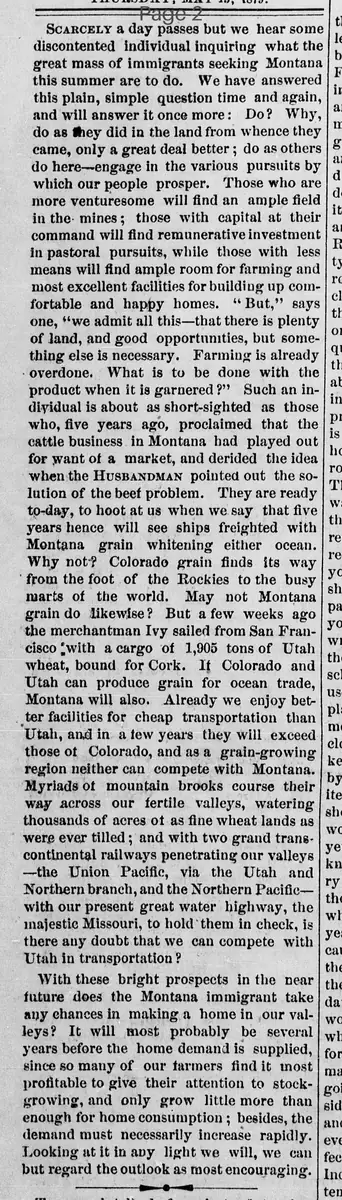
Scarcely a day passes but we hear some discontented individual inquiring what the great mass of immigrants seeking Montana this summer are to do. We have answered this plain, simple question time and again, and will answer it once more: Do? Why, do as they did in the land from whence they came, only a great deal better; do as others do here—engage in the various pursuits by which our people prosper. Those who are more venturesome will find an ample field in the mines; those with capital at their command will find remunerative investment in pastoral pursuits, while those with less means will find ample room for farming and most excellent facilities for building up comfortable and happy homes.
"But," says one, "we admit all this—that there is plenty of land, and good opportunities, but something else is necessary. Farming is already overdone. What is to be done with the product when it is garnered?" Such an individual is about as short-sighted as those who, five years ago, proclaimed that the cattle business in Montana had played out for want of a market, and derided the idea when the HUSBANDMAN pointed out the solution of the beef problem.
They are ready to-day, to hoot at us when we say that five years hence will see ships freighted with Montana grain whitening either ocean. Why not? Colorado grain finds its way from the foot of the Rockies to the busy marts of the world. May not Montana grain do likewise?
But a few weeks ago the merchantman Ivy sailed from San Francisco with a cargo of 1,905 tons of Utah wheat, bound for Cork. If Colorado and Utah can produce grain for ocean trade, Montana will also. Already we enjoy better facilities for cheap transportation than Utah, and in a few years they will exceed those of Colorado, and as a grain-growing region neither can compete with Montana.
Myriads of mountain brooks course their way across our fertile valleys, watering thousands of acres of as fine wheat lands as were ever tilled; and with two grand transcontinental railways penetrating our valleys—the Union Pacific, via the Utah and Northern branch, and the Northern Pacific—with our present great water highway, the majestic Missouri, to hold them in check, is there any doubt that we can compete with Utah in transportation?
With these bright prospects in the near future does the Montana immigrant take any chances in making a home in our valleys? It will most probably be several years before the home demand is supplied, since so many of our farmers find it most profitable to give their attention to stock-growing, and only grow little more than enough for home consumption; besides, the demand must necessarily increase rapidly.
Looking at it in any light we will, we can but regard the outlook as most encouraging.
"But," says one, "we admit all this—that there is plenty of land, and good opportunities, but something else is necessary. Farming is already overdone. What is to be done with the product when it is garnered?" Such an individual is about as short-sighted as those who, five years ago, proclaimed that the cattle business in Montana had played out for want of a market, and derided the idea when the HUSBANDMAN pointed out the solution of the beef problem.
They are ready to-day, to hoot at us when we say that five years hence will see ships freighted with Montana grain whitening either ocean. Why not? Colorado grain finds its way from the foot of the Rockies to the busy marts of the world. May not Montana grain do likewise?
But a few weeks ago the merchantman Ivy sailed from San Francisco with a cargo of 1,905 tons of Utah wheat, bound for Cork. If Colorado and Utah can produce grain for ocean trade, Montana will also. Already we enjoy better facilities for cheap transportation than Utah, and in a few years they will exceed those of Colorado, and as a grain-growing region neither can compete with Montana.
Myriads of mountain brooks course their way across our fertile valleys, watering thousands of acres of as fine wheat lands as were ever tilled; and with two grand transcontinental railways penetrating our valleys—the Union Pacific, via the Utah and Northern branch, and the Northern Pacific—with our present great water highway, the majestic Missouri, to hold them in check, is there any doubt that we can compete with Utah in transportation?
With these bright prospects in the near future does the Montana immigrant take any chances in making a home in our valleys? It will most probably be several years before the home demand is supplied, since so many of our farmers find it most profitable to give their attention to stock-growing, and only grow little more than enough for home consumption; besides, the demand must necessarily increase rapidly.
Looking at it in any light we will, we can but regard the outlook as most encouraging.
What sub-type of article is it?
Immigration
Agriculture
Trade Or Commerce
What keywords are associated?
Montana Immigration
Farming Opportunities
Grain Export
Transportation Facilities
Agricultural Prospects
Mining Ventures
Pastoral Investment
What entities or persons were involved?
Montana
Immigrants
Union Pacific
Northern Pacific
Colorado
Utah
Editorial Details
Primary Topic
Opportunities For Immigrants In Montana
Stance / Tone
Optimistic And Promotional
Key Figures
Montana
Immigrants
Union Pacific
Northern Pacific
Colorado
Utah
Key Arguments
Immigrants Can Engage In Mining, Pastoral Pursuits, Or Farming In Montana
Farming Is Not Overdone; Markets For Grain Will Develop Like The Cattle Industry Did
Montana Grain Will Be Shipped Overseas Within Five Years, Similar To Colorado And Utah
Utah Wheat Was Recently Shipped To Cork From San Francisco
Montana Has Better Transportation Via Railroads And The Missouri River Than Utah
Local Demand For Grain Will Increase As Population Grows
Stock Growing Is Currently More Profitable Than Extensive Farming
Outlook For Immigrants Building Homes In Montana Valleys Is Encouraging