Thank you for visiting SNEWPapers!
Sign up free
The National Intelligencer And Washington Advertiser
Washington, District Of Columbia
What is this article about?
Extract of a letter from Henry William Desaussure detailing the South Carolina legislative election of presidential electors on Tuesday in December 1800, where Federalists supported Adams and Pinckney against Anti-Federalists backing Jefferson and Burr. Vote tallies for both tickets are provided, along with strategic discussions among members.
Clipping
OCR Quality
Full Text
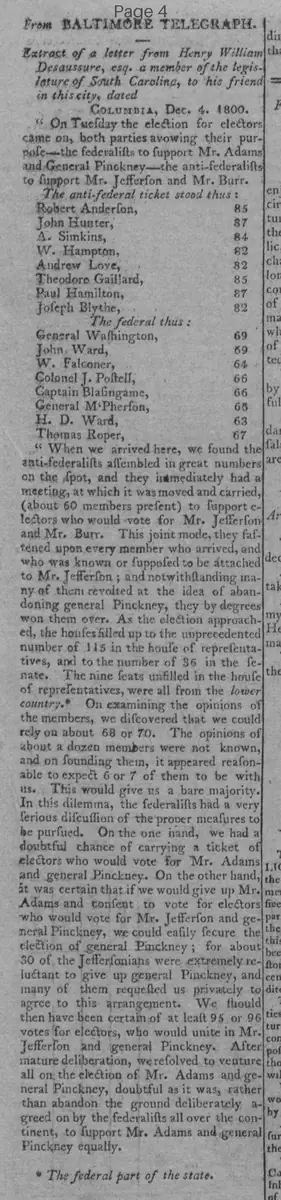
Extract of a letter from Henry William Desaussure, esq. a member of the legislature of South Carolina, to his friend in this city, dated
COLUMBIA, Dec. 4, 1800.
"On Tuesday the election for electors came on, both parties avowing their position—the federalists to support Mr. Adams and General Pinckney—the anti-federalists to support Mr. Jefferson and Mr. Burr.
The anti-federal ticket stood thus:
Robert Anderson, 85
John Hunter, 87
A. Simkins, 84
W. Hampton, 82
Andrew Love, 82
Theodore Gaillard, 85
Paul Hamilton, 87
Joseph Blythe, 82
The federal thus:
General Washington, 69
John Ward, 69
W. Falconer, 64
Colonel J. Postell, 66
Captain Blassingame, 66
General M'Pheron, 66
H. D. Ward, 63
Thomas Roper, 67
When we arrived here, we found the anti-federalists assembled in great numbers on the spot, and they immediately had a meeting, at which it was moved and carried, (about 60 members present) to support electors who would vote for Mr. Jefferson and Mr. Burr. This joint mode, they fastened upon every member who arrived, and who was known or supposed to be attached to Mr. Jefferson; and notwithstanding many of them revolted at the idea of abandoning general Pinckney, they by degrees won them over. As the election approached, the house filled up to the unprecedented number of 115 in the house of representatives, and to the number of 36 in the senate. The nine seats unfilled in the house of representatives, were all from the lower country.* On examining the opinions of the members, we discovered that we could rely on about 68 or 70. The opinions of about a dozen members were not known, and on sounding them, it appeared reasonable to expect 6 or 7 of them to be with us. This would give us a bare majority.
In this dilemma, the federalists had a very serious discussion of the proper measures to be pursued. On the one hand, we had a doubtful chance of carrying a ticket of electors who would vote for Mr. Adams and general Pinckney. On the other hand, it was certain that if we would give up Mr. Adams and consent to vote for electors who would vote for Mr. Jefferson and general Pinckney, we could easily secure the election of general Pinckney; for about 30 of the Jeffersonians were extremely reluctant to give up general Pinckney, and many of them requested us privately to agree to this arrangement. We should then have been certain of at least 95 or 96 votes for electors, who would unite in Mr. Jefferson and general Pinckney. After mature deliberation, we resolved to venture all on the election of Mr. Adams and general Pinckney, doubtful as it was, rather than abandon the ground deliberately agreed on by the federalists all over the continent, to support Mr. Adams and general Pinckney equally."
* The federal part of the state.
What sub-type of article is it?
What keywords are associated?
What entities or persons were involved?
Where did it happen?
Domestic News Details
Primary Location
Columbia, South Carolina
Event Date
Tuesday, December 1800 (Election); December 4, 1800 (Letter)
Key Persons
Outcome
federalists resolved to support electors for adams and pinckney despite a doubtful majority of about 74-75 votes; anti-federalists aimed for jefferson and burr with higher initial tallies (82-87). no final election result stated.
Event Details
In the South Carolina legislature, Federalists and Anti-Federalists competed to elect presidential electors. Anti-Federalists assembled early, passing a resolution to support Jefferson and Burr, influencing arriving members. The house had 115 members and senate 36, with 9 lower country seats vacant. Federalists estimated support at 68-70 plus 6-7 undecided, forming a bare majority. After debate, they rejected a compromise for Jefferson and Pinckney, opting to risk full support for Adams and Pinckney per national agreement.