Thank you for visiting SNEWPapers!
Sign up free
Editorial
March 13, 1793
Gazette Of The United States
New York, New York County, New York
What is this article about?
Editorial defends Congress's funding of public debt at lower interest against opponents who hypocritically favored higher rates and original creditors. Contrasts current elected government with 1775 patriots' fight against arbitrary rule, accuses opposition of spreading falsehoods to undermine federal union.
Clipping
OCR Quality
92%
Excellent
Full Text
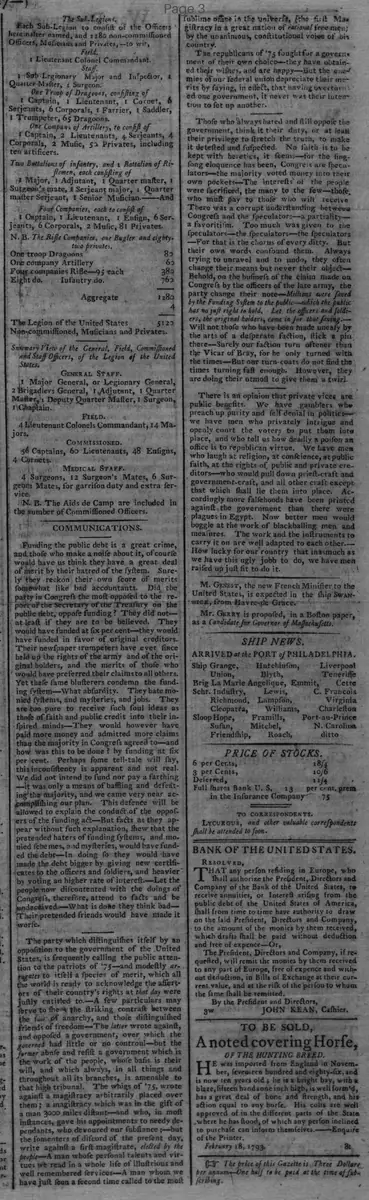
COMMUNICATIONS.
Funding the public debt is a great crime,
and those who make a noise about it, of course
would have us think they have a great deal
of merit by their hatred of the system. Surely
they reckon their own score of merits
somewhat like bad accountants. Did the
party in Congress the most opposed to the report
of the Secretary of the Treasury on the
public debt, oppose funding! They did not—
at least if they are to be believed. They
would have funded at six per cent—they would
have funded in favor of original creditors.
Their newspaper trumpeters have ever since
held up the rights of the army and of the original
holders, and the merits of those who
would have preferred their claims to all others.
Yet these same blusterers condemn the funding
system—What absurdity. They hate monied
systems, and mysteries, and jobs. They
are too pure to receive such foul ideas as
those of faith and public credit into their inspired
minds—They would however have
paid more money and admitted more claims
than the majority in Congress agreed to—and
how was this to be done? by funding at six
per cent. Perhaps some tell-tale will say,
this inconsistency is apparent and not real.
We did not intend to fund nor pay a farthing—
it was only a means of baffling and defeating
the majority, and we came very near accomplishing
our plan. This defence will be
allowed to explain the conduct, of the opposers
of the funding act—But facts as they appear
without such explanation, shew that the
pretended haters of funding systems, and monied
schemes, and mysteries, would have funded
the debt—In doing so they would have
made the debt bigger by giving new certificates
to the officers and soldiers, and heavier
by voting a higher rate of interest.—Let the
people now discontented with the doings of
Congress, therefore, attend to facts and be
undeceived.—What is done they think bad—
Their pretended friends would have made it
worse.
The party which distinguishes itself by an
opposition to the government of the United
States, is frequently calling the public attention
to the patriots of '75—and modestly arrogates
to itself a species of merit, which all
the world is ready to acknowledge the assertors
of their country's rights at that day were
justly entitled to.—A few particulars may
serve to shew the striking contrast between
the foes of anarchy, and those distinguished
friends of freedom—The latter wrote against,
and opposed a government, over which the
governed had little or no controul but the
former abhor and resist a government which is
the work of the people, whose basis is their
will, and which always, 'in all things and
throughout all its branches, is amenable to
that high tribunal. The whigs of '75, wrote
against a magistracy arbitrarily placed over
them; a magistracy which was in the gift of
a man 3000 miles distant—and who, in most
instances, gave his appointments to needy dependents,
who devoured our substance ;-but
the fomenters of discord of the present day,
write against a first magistrate, elected by the
people—A man whose personal talents and virtues
we read in a whole life of illustrious and
well remembered services—A man whom we
have just seen a second time called to the most
sublime office in the universe. (The first Magistracy
in a great nation of rational free men)
by the unanimous, constitutional voice of his
country.
The republicans of '75 fought for a government
of their own choice—they have obtained
their wishes, and are happy—But the enemies
of our federal union depreciate their merits by saying,
in effect, that having overturned
one government, it never was their intention to set up another.
Those who always hated and still oppose the
government, think it their duty, or at least
their privilege to stretch the truth, to make
it detested and suspected. No faith is to be
kept with heretics, it seems—for the ingenious
eloquence has been, Congress are speculators the majority voted money into their
own pockets—The interests of the people
were sacrificed, the many to the few—those
who must pay to those who will receive
There was a corrupt understanding between
Congress and the speculators—a partiality—
a favoritism, Too much was given to the
speculators—the speculators—the speculators
For that is the chorus of every ditty. But
their own words confound them. Always
trying to unravel and to undo, they often
change their means but never their object—
Behold, on the business of the claim made on
Congress by the officers of the late army, the
party change their note—Millions were saved
by the Funding System to the public→—which the public
has no just right to hold. Let the officers and soldiers,
the original holders, come in for that saving.—
Will not those who have been made uneasy by
the arts of a desperate faction, stick a pin
there—Surely our faction turn oftener than
the Vicar of Bray, for he only turned 'with
the times—But our turn-coats do not find the
times turning fast enough. However, they
are doing their utmost to give them a twirl.
There is an opinion that private vices are
public benefits. We have gamblers who
preach up purity and self denial in politics
we have men who privately intrigue and
openly court the voters to put them into
place, and who tell us how deadly a poison an
office is to republican virtue. We have men
who laugh at religion, at conscience, at public
faith, at the rights of public and private creditors—
who would pull down priest-craft and
government-craft, and all other craft except
that which shall lie them into place. Accordingly more falsehoods have been printed
against.the government than there were
plagues in Egypt.' Now better men would
boggle at the work of blackballing men and
measures. The work and the instruments to
carry it on are well adapted to each other.—
How lucky for our country that inasmuch as
we have this ugly job to do, we have men
raised up just fit to do it.
Funding the public debt is a great crime,
and those who make a noise about it, of course
would have us think they have a great deal
of merit by their hatred of the system. Surely
they reckon their own score of merits
somewhat like bad accountants. Did the
party in Congress the most opposed to the report
of the Secretary of the Treasury on the
public debt, oppose funding! They did not—
at least if they are to be believed. They
would have funded at six per cent—they would
have funded in favor of original creditors.
Their newspaper trumpeters have ever since
held up the rights of the army and of the original
holders, and the merits of those who
would have preferred their claims to all others.
Yet these same blusterers condemn the funding
system—What absurdity. They hate monied
systems, and mysteries, and jobs. They
are too pure to receive such foul ideas as
those of faith and public credit into their inspired
minds—They would however have
paid more money and admitted more claims
than the majority in Congress agreed to—and
how was this to be done? by funding at six
per cent. Perhaps some tell-tale will say,
this inconsistency is apparent and not real.
We did not intend to fund nor pay a farthing—
it was only a means of baffling and defeating
the majority, and we came very near accomplishing
our plan. This defence will be
allowed to explain the conduct, of the opposers
of the funding act—But facts as they appear
without such explanation, shew that the
pretended haters of funding systems, and monied
schemes, and mysteries, would have funded
the debt—In doing so they would have
made the debt bigger by giving new certificates
to the officers and soldiers, and heavier
by voting a higher rate of interest.—Let the
people now discontented with the doings of
Congress, therefore, attend to facts and be
undeceived.—What is done they think bad—
Their pretended friends would have made it
worse.
The party which distinguishes itself by an
opposition to the government of the United
States, is frequently calling the public attention
to the patriots of '75—and modestly arrogates
to itself a species of merit, which all
the world is ready to acknowledge the assertors
of their country's rights at that day were
justly entitled to.—A few particulars may
serve to shew the striking contrast between
the foes of anarchy, and those distinguished
friends of freedom—The latter wrote against,
and opposed a government, over which the
governed had little or no controul but the
former abhor and resist a government which is
the work of the people, whose basis is their
will, and which always, 'in all things and
throughout all its branches, is amenable to
that high tribunal. The whigs of '75, wrote
against a magistracy arbitrarily placed over
them; a magistracy which was in the gift of
a man 3000 miles distant—and who, in most
instances, gave his appointments to needy dependents,
who devoured our substance ;-but
the fomenters of discord of the present day,
write against a first magistrate, elected by the
people—A man whose personal talents and virtues
we read in a whole life of illustrious and
well remembered services—A man whom we
have just seen a second time called to the most
sublime office in the universe. (The first Magistracy
in a great nation of rational free men)
by the unanimous, constitutional voice of his
country.
The republicans of '75 fought for a government
of their own choice—they have obtained
their wishes, and are happy—But the enemies
of our federal union depreciate their merits by saying,
in effect, that having overturned
one government, it never was their intention to set up another.
Those who always hated and still oppose the
government, think it their duty, or at least
their privilege to stretch the truth, to make
it detested and suspected. No faith is to be
kept with heretics, it seems—for the ingenious
eloquence has been, Congress are speculators the majority voted money into their
own pockets—The interests of the people
were sacrificed, the many to the few—those
who must pay to those who will receive
There was a corrupt understanding between
Congress and the speculators—a partiality—
a favoritism, Too much was given to the
speculators—the speculators—the speculators
For that is the chorus of every ditty. But
their own words confound them. Always
trying to unravel and to undo, they often
change their means but never their object—
Behold, on the business of the claim made on
Congress by the officers of the late army, the
party change their note—Millions were saved
by the Funding System to the public→—which the public
has no just right to hold. Let the officers and soldiers,
the original holders, come in for that saving.—
Will not those who have been made uneasy by
the arts of a desperate faction, stick a pin
there—Surely our faction turn oftener than
the Vicar of Bray, for he only turned 'with
the times—But our turn-coats do not find the
times turning fast enough. However, they
are doing their utmost to give them a twirl.
There is an opinion that private vices are
public benefits. We have gamblers who
preach up purity and self denial in politics
we have men who privately intrigue and
openly court the voters to put them into
place, and who tell us how deadly a poison an
office is to republican virtue. We have men
who laugh at religion, at conscience, at public
faith, at the rights of public and private creditors—
who would pull down priest-craft and
government-craft, and all other craft except
that which shall lie them into place. Accordingly more falsehoods have been printed
against.the government than there were
plagues in Egypt.' Now better men would
boggle at the work of blackballing men and
measures. The work and the instruments to
carry it on are well adapted to each other.—
How lucky for our country that inasmuch as
we have this ugly job to do, we have men
raised up just fit to do it.
What sub-type of article is it?
Economic Policy
Partisan Politics
What keywords are associated?
Public Debt Funding
Opposition Party
Congress Actions
Federal Government
Original Creditors
Partisan Discord
What entities or persons were involved?
Congress
Secretary Of The Treasury
Opposition Party
Whigs Of '75
First Magistrate
Editorial Details
Primary Topic
Defense Of Public Debt Funding Against Opposition
Stance / Tone
Strongly Pro Funding And Pro Government
Key Figures
Congress
Secretary Of The Treasury
Opposition Party
Whigs Of '75
First Magistrate
Key Arguments
Opponents Claim To Hate Funding But Would Have Funded At Higher Interest
Opponents Favored Original Creditors More Than The Adopted System
Current Government Is Elected By The People Unlike British Rule
Opposition Misrepresents Congress As Speculators
Opposition Now Claims Savings Should Go To Original Holders
Opponents Spread Falsehoods Against The Government