Thank you for visiting SNEWPapers!
Sign up free
Editorial
July 15, 1856
New York Daily Tribune
New York, New York County, New York
What is this article about?
The editorial satirically critiques the redemption of the Duke of Grafton's hereditary pension for £193,177, tracing its origins to Charles II's illegitimate son with Barbara Villiers. It compares this to pensions for war heroes like Marlborough and Wellington, highlighting British generosity toward aristocratic privilege, and contrasts with American practices.
Clipping
OCR Quality
92%
Excellent
Full Text
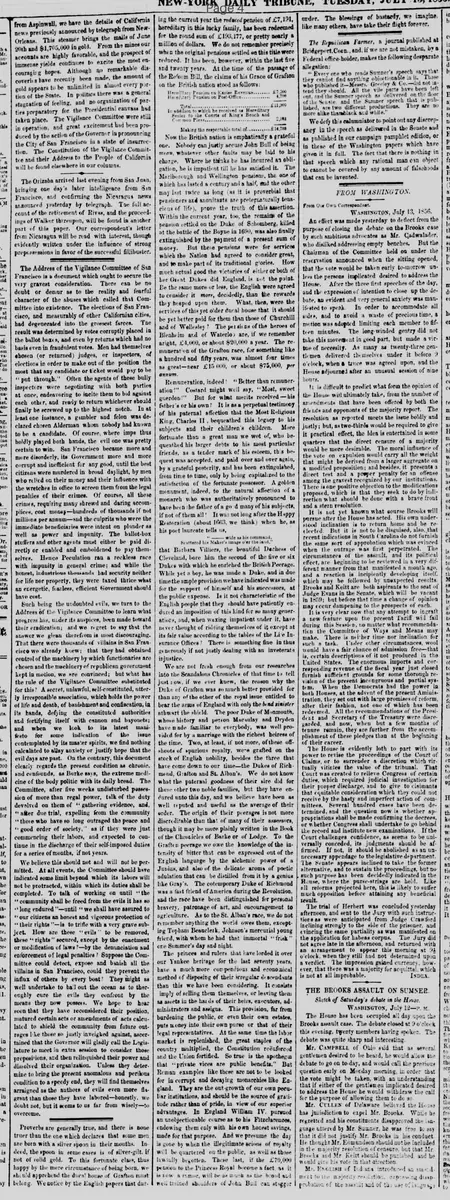
Proverbs are generally true, and there is none truer than the one which declares that some men are born with a silver spoon in their mouths. Indeed, the spoon in some cases is of silver-gilt, if not of solid gold. To this fortunate class, thus happy by the mere circumstance of being born, we should apprehend the ducal house of Grafton must belong. We notice by the English papers that during the current year the reduced pension of £7,191, hereditary in this lucky family, has been redeemed for the round sum of £193,177, or pretty nearly a million of dollars.
We do not remember precisely when the original pensions settled on this title were reduced. It has been, however, within the last five and twenty years. At the time of the passage of the Reform Bill, the claims of his Grace of Grafton on the British nation stood as follows:
Hereditary Pension on Excise Revenue.. £7,200
Hereditary Pension on Post-Office.. 4,700
Total.............. £11,900
In addition to which he received as Hereditary Receiver to the Courts of King's Bench and Common Pleas... £2,803
Making the respectable total of........... £14,703
Now the British nation is emphatically a grateful one. Nobody can justly accuse John Bull of being mean, whatever other faults may be laid to his charge. Where he thinks he has incurred an obligation, he is impatient till he has satisfied it. The Marlborough and Wellington pensions, the one of which has lasted a century and a half, and the other may last twice as long (as it is proverbial that pensioners and annuitants are preternaturally tenacious of life), prove the truth of this assertion.
Within the current year, too, the remnant of the pension settled on the Duke of Schomberg, killed at the battle of the Boyne in 1690, was also finally extinguished by the payment of a present sum of money.
But these pensions were for services which the Nation had agreed to consider great, and to make part of its traditional glories. How much actual good the victories of either or both of her Great Dukes did England, is not the point. Be the same more or less, the English were agreed to consider it more, decidedly, than the rewards they heaped upon them. What, then, were the services of this yet older ducal house that it should be yet better paid for them than those of Churchill and of Wellesley? The pensions of the heroes of Blenheim and of Waterloo are, if we remember aright, £4,000, or about $20,000 a year. The remuneration of the Grafton race, for something like a hundred and fifty years, was almost four times as great—near £15,000, or about $75,000, per annum.
Remuneration, indeed! "Better than remuneration!" Costard might well say, "Most, sweet guerdon!" But for what merits received—his father's or his own? It is as a perpetual testimony of his paternal affection that the Most Religious King, Charles II., bequeathed this legacy to his subjects and their children's children. More fortunate than a great man we wot of, who bequeathed his larger debts to his most particular friends, as a tender mark of his esteem, this bequest was accepted, and paid over and over again, by a grateful posterity, and has been extinguished, from time to time, only by being capitalized to the satisfaction of the fortunate possessor. A golden monument, indeed, to the natural affection of a monarch who was authoritatively pronounced to have been the father of a good many of his subjects, if not of them all: It was not long after the Happy Restoration (about 1663, we think) when he, as his poet laureate tells us,
Scattered his Maker's image o'er the land.
wide as his command.
that Barbara Villiers, the beautiful Duchess of Cleveland, bore him the second of the five or six Dukes with which he enriched the British Peerage. While yet a boy, he was made a Duke, and in due time the ample provision we have indicated was made for the support of himself and his successors, at the public expense. Is it not characteristic of the English people that they should have patiently endured an imposition of this kind for so many generations, and, when waxing impatient under it, have never thought of ridding themselves of it except at its fair value according to the tables of the Life Insurance Offices? There is something fine in thus generously if not justly dealing with an inveterate injustice.
We are not fresh enough from our researches into the Scandalous Chronicles of that time to tell just now, if we ever knew, the reason why the Duke of Grafton was so much better provided for than any of the other of the royal issue entitled to bear the arms of England with only the bend sinister athwart the shield. The poor Duke of Monmouth, whose history and person Macaulay and Dryden have made familiar to everybody, was well provided for by a marriage with the richest heiress of the time. Two, at least, if not more, of these off-shoots of spurious royalty, were grafted on the stock of English nobility, besides the three that have come down to our time—the Dukes of Richmond, Grafton and St. Albans. We do not know what the paternal goodness of their sire did for these other two noble families, but they have endured unto this day, and we believe have been as well reputed and useful as the average of their order. The origin of their peerages is not more discreditable than that of many of their assessors though it may be more plainly written in the Book of the Chronicles of Burke or of Lodge. To the Grafton peerage we owe the knowledge of the intensity of bitterness that can be expressed out of the English language by the alchemic power of a Junius, and also of the delicate aroma of poetic adulation that can be distilled from it by a genius like Gray's. The contemporary Duke of Richmond was a fast friend of America during the Revolution, and the race have been distinguished for personal bravery, patronage of art, and encouragement to agriculture. As to the St. Albans race, we do not remember anything the world owes them, excepting Topham Beauclerk, Johnson's mercurial young friend, with whom he had that immortal "frisk" one Summer's day and night.
The princes and rulers that have lorded it over our Yankee heritage for the last seventy years, have a much more compendious and economical method of disposing of their irregular descendants than this we have been considering. It consists simply of selling them themselves, or leaving them as assets in the hands of their heirs, executors, administrators and assigns. This provision, far from burdening the public, or even their own estates, puts money into their own purse or that of their legal representatives. At the same time the labor market is replenished, the great staples of the country multiplied, the Constitution reinforced and the Union fortified. So true is the apothegm that "private vices are public benefits." But Roman examples like these are not to be looked for in corrupt and decaying monarchies like England. They are the out-growth of our own peculiar institutions, and should be the source of gratitude rather than of pride, in view of our superior advantages. In England William IV. pursued an unobjectionable course as to his Fitzclarences, endowing them only with his own honest savings, made for that purpose. And we presume the day is gone by when the illegitimate scions of royalty will be quartered on the public, as well as those lawfully begotten. These last, if the £70,000 pension to the Princess Royal become a fact as it is now a rumor, will be as much as the broad and well trained shoulders of John Bull can stagger under. The blessings of bastardy, we imagine like many others, have taken their flight forever.
We do not remember precisely when the original pensions settled on this title were reduced. It has been, however, within the last five and twenty years. At the time of the passage of the Reform Bill, the claims of his Grace of Grafton on the British nation stood as follows:
Hereditary Pension on Excise Revenue.. £7,200
Hereditary Pension on Post-Office.. 4,700
Total.............. £11,900
In addition to which he received as Hereditary Receiver to the Courts of King's Bench and Common Pleas... £2,803
Making the respectable total of........... £14,703
Now the British nation is emphatically a grateful one. Nobody can justly accuse John Bull of being mean, whatever other faults may be laid to his charge. Where he thinks he has incurred an obligation, he is impatient till he has satisfied it. The Marlborough and Wellington pensions, the one of which has lasted a century and a half, and the other may last twice as long (as it is proverbial that pensioners and annuitants are preternaturally tenacious of life), prove the truth of this assertion.
Within the current year, too, the remnant of the pension settled on the Duke of Schomberg, killed at the battle of the Boyne in 1690, was also finally extinguished by the payment of a present sum of money.
But these pensions were for services which the Nation had agreed to consider great, and to make part of its traditional glories. How much actual good the victories of either or both of her Great Dukes did England, is not the point. Be the same more or less, the English were agreed to consider it more, decidedly, than the rewards they heaped upon them. What, then, were the services of this yet older ducal house that it should be yet better paid for them than those of Churchill and of Wellesley? The pensions of the heroes of Blenheim and of Waterloo are, if we remember aright, £4,000, or about $20,000 a year. The remuneration of the Grafton race, for something like a hundred and fifty years, was almost four times as great—near £15,000, or about $75,000, per annum.
Remuneration, indeed! "Better than remuneration!" Costard might well say, "Most, sweet guerdon!" But for what merits received—his father's or his own? It is as a perpetual testimony of his paternal affection that the Most Religious King, Charles II., bequeathed this legacy to his subjects and their children's children. More fortunate than a great man we wot of, who bequeathed his larger debts to his most particular friends, as a tender mark of his esteem, this bequest was accepted, and paid over and over again, by a grateful posterity, and has been extinguished, from time to time, only by being capitalized to the satisfaction of the fortunate possessor. A golden monument, indeed, to the natural affection of a monarch who was authoritatively pronounced to have been the father of a good many of his subjects, if not of them all: It was not long after the Happy Restoration (about 1663, we think) when he, as his poet laureate tells us,
Scattered his Maker's image o'er the land.
wide as his command.
that Barbara Villiers, the beautiful Duchess of Cleveland, bore him the second of the five or six Dukes with which he enriched the British Peerage. While yet a boy, he was made a Duke, and in due time the ample provision we have indicated was made for the support of himself and his successors, at the public expense. Is it not characteristic of the English people that they should have patiently endured an imposition of this kind for so many generations, and, when waxing impatient under it, have never thought of ridding themselves of it except at its fair value according to the tables of the Life Insurance Offices? There is something fine in thus generously if not justly dealing with an inveterate injustice.
We are not fresh enough from our researches into the Scandalous Chronicles of that time to tell just now, if we ever knew, the reason why the Duke of Grafton was so much better provided for than any of the other of the royal issue entitled to bear the arms of England with only the bend sinister athwart the shield. The poor Duke of Monmouth, whose history and person Macaulay and Dryden have made familiar to everybody, was well provided for by a marriage with the richest heiress of the time. Two, at least, if not more, of these off-shoots of spurious royalty, were grafted on the stock of English nobility, besides the three that have come down to our time—the Dukes of Richmond, Grafton and St. Albans. We do not know what the paternal goodness of their sire did for these other two noble families, but they have endured unto this day, and we believe have been as well reputed and useful as the average of their order. The origin of their peerages is not more discreditable than that of many of their assessors though it may be more plainly written in the Book of the Chronicles of Burke or of Lodge. To the Grafton peerage we owe the knowledge of the intensity of bitterness that can be expressed out of the English language by the alchemic power of a Junius, and also of the delicate aroma of poetic adulation that can be distilled from it by a genius like Gray's. The contemporary Duke of Richmond was a fast friend of America during the Revolution, and the race have been distinguished for personal bravery, patronage of art, and encouragement to agriculture. As to the St. Albans race, we do not remember anything the world owes them, excepting Topham Beauclerk, Johnson's mercurial young friend, with whom he had that immortal "frisk" one Summer's day and night.
The princes and rulers that have lorded it over our Yankee heritage for the last seventy years, have a much more compendious and economical method of disposing of their irregular descendants than this we have been considering. It consists simply of selling them themselves, or leaving them as assets in the hands of their heirs, executors, administrators and assigns. This provision, far from burdening the public, or even their own estates, puts money into their own purse or that of their legal representatives. At the same time the labor market is replenished, the great staples of the country multiplied, the Constitution reinforced and the Union fortified. So true is the apothegm that "private vices are public benefits." But Roman examples like these are not to be looked for in corrupt and decaying monarchies like England. They are the out-growth of our own peculiar institutions, and should be the source of gratitude rather than of pride, in view of our superior advantages. In England William IV. pursued an unobjectionable course as to his Fitzclarences, endowing them only with his own honest savings, made for that purpose. And we presume the day is gone by when the illegitimate scions of royalty will be quartered on the public, as well as those lawfully begotten. These last, if the £70,000 pension to the Princess Royal become a fact as it is now a rumor, will be as much as the broad and well trained shoulders of John Bull can stagger under. The blessings of bastardy, we imagine like many others, have taken their flight forever.
What sub-type of article is it?
Satire
Economic Policy
Moral Or Religious
What keywords are associated?
Hereditary Pensions
Duke Of Grafton
Charles Ii
British Nobility
Illegitimacy
Public Expenditure
Aristocratic Privilege
What entities or persons were involved?
Duke Of Grafton
Charles Ii
Barbara Villiers
Duke Of Marlborough
Duke Of Wellington
Duke Of Schomberg
Duke Of Monmouth
Duke Of Richmond
Duke Of St. Albans
Editorial Details
Primary Topic
Hereditary Pension To The Duke Of Grafton
Stance / Tone
Satirical Criticism Of Aristocratic Privilege And Public Expenditure
Key Figures
Duke Of Grafton
Charles Ii
Barbara Villiers
Duke Of Marlborough
Duke Of Wellington
Duke Of Schomberg
Duke Of Monmouth
Duke Of Richmond
Duke Of St. Albans
Key Arguments
Hereditary Pensions Reward Birth Rather Than Merit
Grafton Pension Originates From Charles Ii's Illegitimate Son
British Nation Generously Redeems Pensions At High Cost
Grafton Family Received More Than War Heroes Like Marlborough And Wellington
English Patience With Such Impositions Is Characteristic
Contrasts With American Handling Of Illegitimate Descendants Via Slavery
Illegitimate Royal Offspring No Longer Burden The Public