Thank you for visiting SNEWPapers!
Sign up free
Editorial
December 7, 1945
The Ypsilanti Daily Press
Ypsilanti, Washtenaw County, Michigan
What is this article about?
George E. Sokolsky argues that the U.S. Congress's vote on the $500 million UNRRA appropriation tests faith in international cooperation amid global tensions, emphasizing U.S. support's vital role in preventing European starvation and chaos, countering isolationism.
Clipping
OCR Quality
98%
Excellent
Full Text
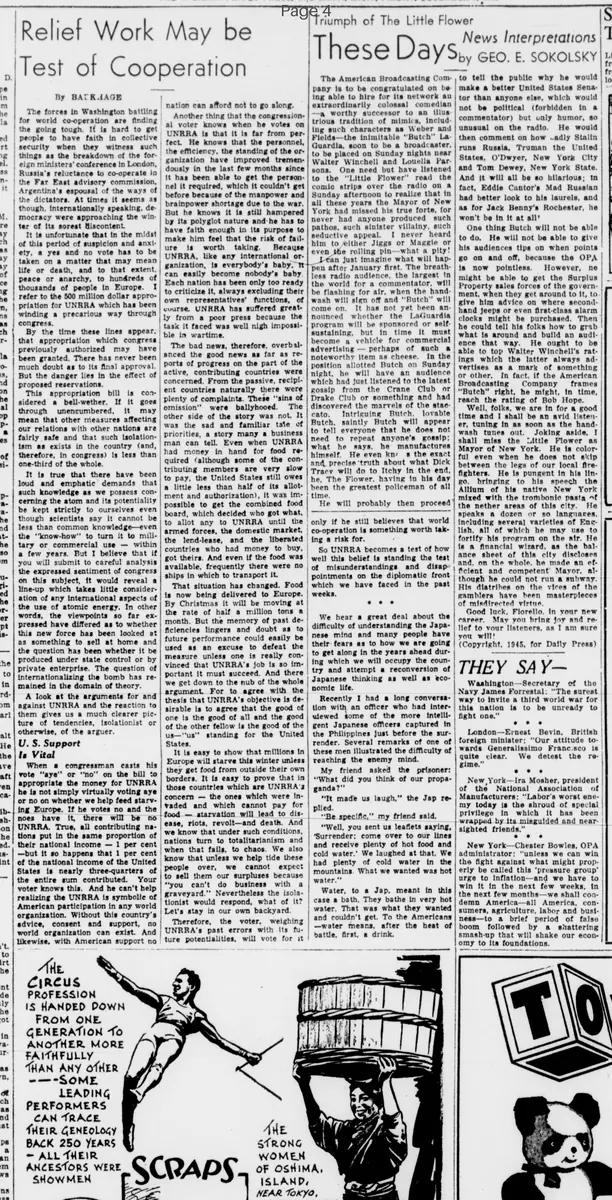
Relief Work May be Test of Cooperation
Triumph of the Little Flower
News Interpretations
These Days by GEO. E. SOKOLSKY
The forces in Washington battling for world co-operation are finding the going tough. It is hard to get people to have faith in collective security when they witness such things as the breakdown of the foreign ministers' conference in London, Russia's reluctance to co-operate in the Far East advisory commission, Argentina's espousal of the ways of the dictators. At times it seems as though, internationally speaking, democracy were approaching the winter of its sorest discontent.
It is unfortunate that in the midst of this period of suspicion and anxiety, a yes and no vote has to be taken on a matter that may mean life or death, and to that extent, peace or anarchy, to hundreds of thousands of people in Europe. I refer to the 500 million dollar appropriation for UNRRA which has been winding a precarious way through congress.
By the time these lines appear, that appropriation which congress previously authorized may have been granted. There has never been much doubt as to its final approval. But the danger lies in the effect of proposed reservations.
This appropriation bill is considered a bell-wether. If it goes through unencumbered, it may mean that other measures affecting our relations with other nations are fairly safe and that such isolationism as exists in the country (and, therefore, in congress) is less than one-third of the whole.
It is true that there have been loud and emphatic demands that such knowledge as we possess concerning the atom and its potentiality be kept strictly to ourselves even though scientists say it cannot be less than common knowledge—even the 'know-how' to turn it to military or commercial use—within a few years. But I believe that if you will submit to careful analysis the expressed sentiment of congress on this subject, it would reveal a line-up which takes little consideration of any international aspects of the use of atomic energy. In other words, the viewpoints so far expressed have differed as to whether this new force has been looked at as something to sell at home and the question has been whether it be produced under state control or by private enterprise. The question of internationalizing the bomb has remained in the domain of theory.
A look at the arguments for and against UNRRA and the reaction to them gives us a much clearer picture of tendencies, isolationist or otherwise, of the arguer.
U. S. Support Is Vital
When a congressman casts his vote "aye" or "no" on the bill to appropriate the money for UNRRA he is not simply virtually voting aye or no on whether we help feed starving Europe. If he votes no and the noes have it, there will be no UNRRA. True, all contributing nations put in the same proportion of their national income—1 per cent—but it so happens that 1 per cent of the national income of the United States is nearly three-quarters of the entire sum contributed. Your voter knows this. And he can't help realizing the UNRRA is symbolic of American participation in any world organization. Without this country's advice, consent and support, no world organization can exist. And likewise, with American support no nation can afford not to go along.
Another thing that the congressional voter knows when he votes on UNRRA is that it is far from perfect. He knows that the personnel, the efficiency, the standing of the organization have improved tremendously in the last few months since it has been able to get the personnel it required, which it couldn't get before because of the manpower and brainpower shortage due to the war.
But he knows it is still hampered by its polyglot nature and he has to have faith enough in its purpose to make him feel that the risk of failure is worth taking.
Because UNRRA, like any international organization, is everybody's baby. It can easily become nobody's baby.
Each nation has been only too ready to criticize it, always excluding their own representatives' functions, of course. UNRRA has suffered greatly from a poor press because the task it faced was well nigh impossible in wartime.
The bad news, therefore, overbalanced the good news as far as reports of progress on the part of the active, contributing countries were concerned. From the passive, recipient countries naturally there were plenty of complaints. These "sins of omission" were ballyhooed. The other side of the story was not. It was the sad and familiar tale of priorities, a story many a business man can tell. Even when UNRRA had money in hand for food required (although some of the contributing members are very slow to pay, the United States still owes a little less than half of its allotment and authorization), it was impossible to get the combined food board, which decided who got what, to allot any to UNRRA until the armed forces, the domestic market, the lend-lease, and the liberated countries who had money to buy, got theirs. And even if the food was available, frequently there were no ships in which to transport it.
That situation has changed. Food is now being delivered to Europe. By Christmas it will be moving at the rate of half a million tons a month. But the memory of past deficiencies lingers and doubt as to future performance could easily be used as an excuse to defeat the measure unless one is really convinced that UNRRA's job is so important it must succeed. And there we get down to the nub of the whole argument. For to agree with the thesis that UNRRA's objective is desirable is to agree that the good of one is the good of all and the good of the other fellow is the good of the us—'us' standing for the United States.
It is easy to show that millions in Europe will starve this winter unless they get food from outside their own borders. It is easy to prove that in those countries which are UNRRA's concern—the ones which were invaded and which cannot pay for food—starvation will lead to disease, riots, revolt—and death. And we know that under such conditions, nations turn to totalitarianism and when that fails, to chaos. We also know that unless we help tide these people over, we cannot expect to sell them our surpluses because "you can't do business with a graveyard."
Nevertheless the isolationist would respond, what of it? Let's stay in our own backyard.
Therefore, the voter, weighing UNRRA's past errors with its future potentialities, will vote for it only if he still believes that world co-operation is something worth taking a risk for.
So UNRRA becomes a test of how well this belief is standing the test of misunderstandings and disappointments on the diplomatic front which we have faced in the past weeks.
Triumph of the Little Flower
News Interpretations
These Days by GEO. E. SOKOLSKY
The forces in Washington battling for world co-operation are finding the going tough. It is hard to get people to have faith in collective security when they witness such things as the breakdown of the foreign ministers' conference in London, Russia's reluctance to co-operate in the Far East advisory commission, Argentina's espousal of the ways of the dictators. At times it seems as though, internationally speaking, democracy were approaching the winter of its sorest discontent.
It is unfortunate that in the midst of this period of suspicion and anxiety, a yes and no vote has to be taken on a matter that may mean life or death, and to that extent, peace or anarchy, to hundreds of thousands of people in Europe. I refer to the 500 million dollar appropriation for UNRRA which has been winding a precarious way through congress.
By the time these lines appear, that appropriation which congress previously authorized may have been granted. There has never been much doubt as to its final approval. But the danger lies in the effect of proposed reservations.
This appropriation bill is considered a bell-wether. If it goes through unencumbered, it may mean that other measures affecting our relations with other nations are fairly safe and that such isolationism as exists in the country (and, therefore, in congress) is less than one-third of the whole.
It is true that there have been loud and emphatic demands that such knowledge as we possess concerning the atom and its potentiality be kept strictly to ourselves even though scientists say it cannot be less than common knowledge—even the 'know-how' to turn it to military or commercial use—within a few years. But I believe that if you will submit to careful analysis the expressed sentiment of congress on this subject, it would reveal a line-up which takes little consideration of any international aspects of the use of atomic energy. In other words, the viewpoints so far expressed have differed as to whether this new force has been looked at as something to sell at home and the question has been whether it be produced under state control or by private enterprise. The question of internationalizing the bomb has remained in the domain of theory.
A look at the arguments for and against UNRRA and the reaction to them gives us a much clearer picture of tendencies, isolationist or otherwise, of the arguer.
U. S. Support Is Vital
When a congressman casts his vote "aye" or "no" on the bill to appropriate the money for UNRRA he is not simply virtually voting aye or no on whether we help feed starving Europe. If he votes no and the noes have it, there will be no UNRRA. True, all contributing nations put in the same proportion of their national income—1 per cent—but it so happens that 1 per cent of the national income of the United States is nearly three-quarters of the entire sum contributed. Your voter knows this. And he can't help realizing the UNRRA is symbolic of American participation in any world organization. Without this country's advice, consent and support, no world organization can exist. And likewise, with American support no nation can afford not to go along.
Another thing that the congressional voter knows when he votes on UNRRA is that it is far from perfect. He knows that the personnel, the efficiency, the standing of the organization have improved tremendously in the last few months since it has been able to get the personnel it required, which it couldn't get before because of the manpower and brainpower shortage due to the war.
But he knows it is still hampered by its polyglot nature and he has to have faith enough in its purpose to make him feel that the risk of failure is worth taking.
Because UNRRA, like any international organization, is everybody's baby. It can easily become nobody's baby.
Each nation has been only too ready to criticize it, always excluding their own representatives' functions, of course. UNRRA has suffered greatly from a poor press because the task it faced was well nigh impossible in wartime.
The bad news, therefore, overbalanced the good news as far as reports of progress on the part of the active, contributing countries were concerned. From the passive, recipient countries naturally there were plenty of complaints. These "sins of omission" were ballyhooed. The other side of the story was not. It was the sad and familiar tale of priorities, a story many a business man can tell. Even when UNRRA had money in hand for food required (although some of the contributing members are very slow to pay, the United States still owes a little less than half of its allotment and authorization), it was impossible to get the combined food board, which decided who got what, to allot any to UNRRA until the armed forces, the domestic market, the lend-lease, and the liberated countries who had money to buy, got theirs. And even if the food was available, frequently there were no ships in which to transport it.
That situation has changed. Food is now being delivered to Europe. By Christmas it will be moving at the rate of half a million tons a month. But the memory of past deficiencies lingers and doubt as to future performance could easily be used as an excuse to defeat the measure unless one is really convinced that UNRRA's job is so important it must succeed. And there we get down to the nub of the whole argument. For to agree with the thesis that UNRRA's objective is desirable is to agree that the good of one is the good of all and the good of the other fellow is the good of the us—'us' standing for the United States.
It is easy to show that millions in Europe will starve this winter unless they get food from outside their own borders. It is easy to prove that in those countries which are UNRRA's concern—the ones which were invaded and which cannot pay for food—starvation will lead to disease, riots, revolt—and death. And we know that under such conditions, nations turn to totalitarianism and when that fails, to chaos. We also know that unless we help tide these people over, we cannot expect to sell them our surpluses because "you can't do business with a graveyard."
Nevertheless the isolationist would respond, what of it? Let's stay in our own backyard.
Therefore, the voter, weighing UNRRA's past errors with its future potentialities, will vote for it only if he still believes that world co-operation is something worth taking a risk for.
So UNRRA becomes a test of how well this belief is standing the test of misunderstandings and disappointments on the diplomatic front which we have faced in the past weeks.
What sub-type of article is it?
Foreign Affairs
Economic Policy
What keywords are associated?
Unrra
International Cooperation
Isolationism
Congress Vote
European Relief
Collective Security
Atomic Energy
World Organization
What entities or persons were involved?
Unrra
U.S. Congress
United States
Europe
Russia
Argentina
Editorial Details
Primary Topic
Unrra Appropriation As Test Of World Cooperation
Stance / Tone
Supportive Of Unrra Funding And International Cooperation Against Isolationism
Key Figures
Unrra
U.S. Congress
United States
Europe
Russia
Argentina
Key Arguments
Unrra Vote Tests Faith In Collective Security Amid Diplomatic Failures
U.S. Contributes Nearly Three Quarters Of Unrra Funds, Making Support Essential
Without U.S. Participation, No World Organization Can Succeed
Starvation In Europe Leads To Disease, Revolt, Totalitarianism, And Chaos
Helping Europe Enables Future Trade; Can't Do Business With A Graveyard
Unrra's Imperfections Are Outweighed By Its Vital Purpose
Isolationism Ignores Interconnected Global Good