Thank you for visiting SNEWPapers!
Sign up free
Story
February 5, 1841
Southern Christian Advocate
Charleston, Charleston County, South Carolina
What is this article about?
Essay on the rarity and cost of consistency, likening it to a conscience, with musings on gluttony and money-driven souls, illustrated by a Wilmington shopkeeper who sells tobacco despite hating it to lecture customers against its use.
Clipping
OCR Quality
98%
Excellent
Full Text
From the Wilmington (Del.) Standard.
CONSISTENCY.
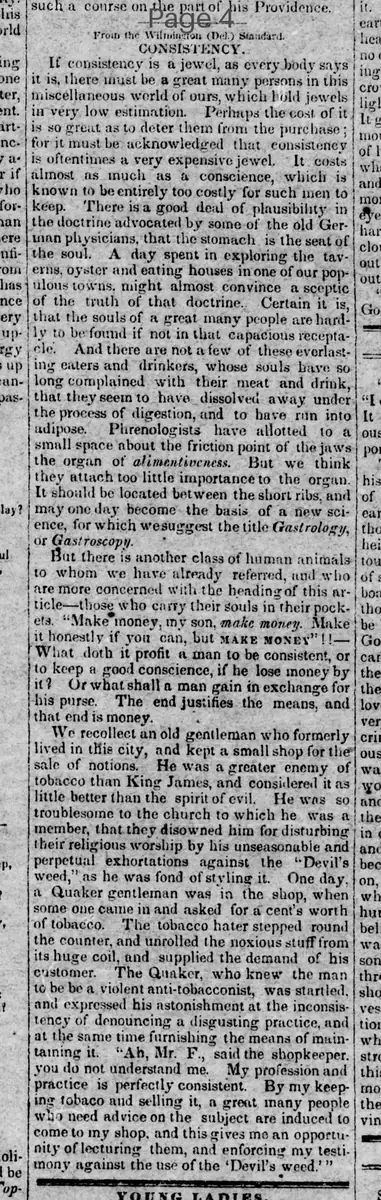
If consistency is a jewel, as every body says it is, there must be a great many persons in this miscellaneous world of ours, which hold jewels in very low estimation. Perhaps the cost of it is so great as to deter them from the purchase; for it must be acknowledged that consistency is oftentimes a very expensive jewel. It costs almost as much as a conscience, which is known to be entirely too costly for such men to keep. There is a good deal of plausibility in the doctrine advocated by some of the old German physicians, that the stomach is the seat of the soul. A day spent in exploring the taverns, oyster and eating houses in one of our populous towns, might almost convince a sceptic of the truth of that doctrine. Certain it is, that the souls of a great many people are hardly to be found if not in that capacious receptacle. And there are not a few of these everlasting caters and drinkers, whose souls have so long complained with their meat and drink, that they seem to have dissolved away under the process of digestion, and to have run into adipose. Phrenologists have allotted to a small space about the friction point of the jaws the organ of alimentiveness. But we think they attach too little importance to the organ. It should be located between the short ribs, and may one day become the basis of a new science, for which we suggest the title Gastrology, or Gastroscopy.
But there is another class of human animals to whom we have already referred, and who are more concerned with the heading of this article—those who carry their souls in their pockets. "Make money, my son, make money. Make it honestly if you can, but Make Money" !!— What doth it profit a man to be consistent, or to keep a good conscience, if he lose money by it? Or what shall a man gain in exchange for his purse. The end justifies the means, and that end is money.
We recollect an old gentleman who formerly lived in this city, and kept a small shop for the sale of notions. He was a greater enemy of tobacco than King James, and considered it as little better than the spirit of evil. He was so troublesome to the church to which he was a member, that they disowned him for disturbing their religious worship by his unseasonable and perpetual exhortations against the "Devil's weed," as he was fond of styling it. One day, a Quaker gentleman was in the shop, when some one came in and asked for a cent's worth of tobacco. The tobacco hater stepped round the counter, and unrolled the noxious stuff from its huge coil, and supplied the demand of his customer. The Quaker, who knew the man to be a violent anti-tobacconist, was startled, and expressed his astonishment at the inconsistency of denouncing a disgusting practice, and at the same time furnishing the means of maintaining it. "Ah, Mr. F.," said the shopkeeper, "you do not understand me. My profession and practice is perfectly consistent. By my keeping tobacco and selling it, a great many people who need advice on the subject are induced to come to my shop, and this gives me an opportunity of lecturing them, and enforcing my testimony against the use of the 'Devil's weed.'"
CONSISTENCY.
If consistency is a jewel, as every body says it is, there must be a great many persons in this miscellaneous world of ours, which hold jewels in very low estimation. Perhaps the cost of it is so great as to deter them from the purchase; for it must be acknowledged that consistency is oftentimes a very expensive jewel. It costs almost as much as a conscience, which is known to be entirely too costly for such men to keep. There is a good deal of plausibility in the doctrine advocated by some of the old German physicians, that the stomach is the seat of the soul. A day spent in exploring the taverns, oyster and eating houses in one of our populous towns, might almost convince a sceptic of the truth of that doctrine. Certain it is, that the souls of a great many people are hardly to be found if not in that capacious receptacle. And there are not a few of these everlasting caters and drinkers, whose souls have so long complained with their meat and drink, that they seem to have dissolved away under the process of digestion, and to have run into adipose. Phrenologists have allotted to a small space about the friction point of the jaws the organ of alimentiveness. But we think they attach too little importance to the organ. It should be located between the short ribs, and may one day become the basis of a new science, for which we suggest the title Gastrology, or Gastroscopy.
But there is another class of human animals to whom we have already referred, and who are more concerned with the heading of this article—those who carry their souls in their pockets. "Make money, my son, make money. Make it honestly if you can, but Make Money" !!— What doth it profit a man to be consistent, or to keep a good conscience, if he lose money by it? Or what shall a man gain in exchange for his purse. The end justifies the means, and that end is money.
We recollect an old gentleman who formerly lived in this city, and kept a small shop for the sale of notions. He was a greater enemy of tobacco than King James, and considered it as little better than the spirit of evil. He was so troublesome to the church to which he was a member, that they disowned him for disturbing their religious worship by his unseasonable and perpetual exhortations against the "Devil's weed," as he was fond of styling it. One day, a Quaker gentleman was in the shop, when some one came in and asked for a cent's worth of tobacco. The tobacco hater stepped round the counter, and unrolled the noxious stuff from its huge coil, and supplied the demand of his customer. The Quaker, who knew the man to be a violent anti-tobacconist, was startled, and expressed his astonishment at the inconsistency of denouncing a disgusting practice, and at the same time furnishing the means of maintaining it. "Ah, Mr. F.," said the shopkeeper, "you do not understand me. My profession and practice is perfectly consistent. By my keeping tobacco and selling it, a great many people who need advice on the subject are induced to come to my shop, and this gives me an opportunity of lecturing them, and enforcing my testimony against the use of the 'Devil's weed.'"
What sub-type of article is it?
Curiosity
Biography
What themes does it cover?
Moral Virtue
Social Manners
What keywords are associated?
Consistency
Tobacco
Shopkeeper
Anecdote
Moral Lesson
Inconsistency
Quaker
What entities or persons were involved?
Old Gentleman
Quaker Gentleman
Mr. F.
Where did it happen?
Wilmington (Del.)
Story Details
Key Persons
Old Gentleman
Quaker Gentleman
Mr. F.
Location
Wilmington (Del.)
Story Details
An old shopkeeper in Wilmington hates tobacco and preaches against it but sells it to attract customers for lecturing them on its evils, claiming consistency in his profession.