Thank you for visiting SNEWPapers!
Sign up free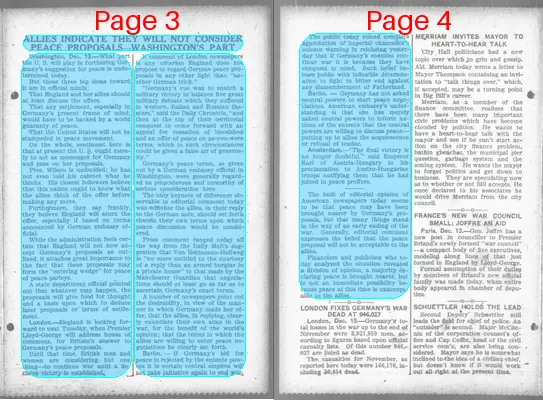
The Day Book
Chicago, Cook County County, Illinois
What is this article about?
International reactions to Germany's WWI peace proposals: US to act as messenger, Britain views as trick and awaits Lloyd George's response, Germany warns of continued war if rejected, Austria-Hungary confident in victory.
Merged-components note: Continuation of the foreign news story on Allies' response to German peace proposals across pages 3 and 4.
Clippings
1 of 2
OCR Quality
Full Text
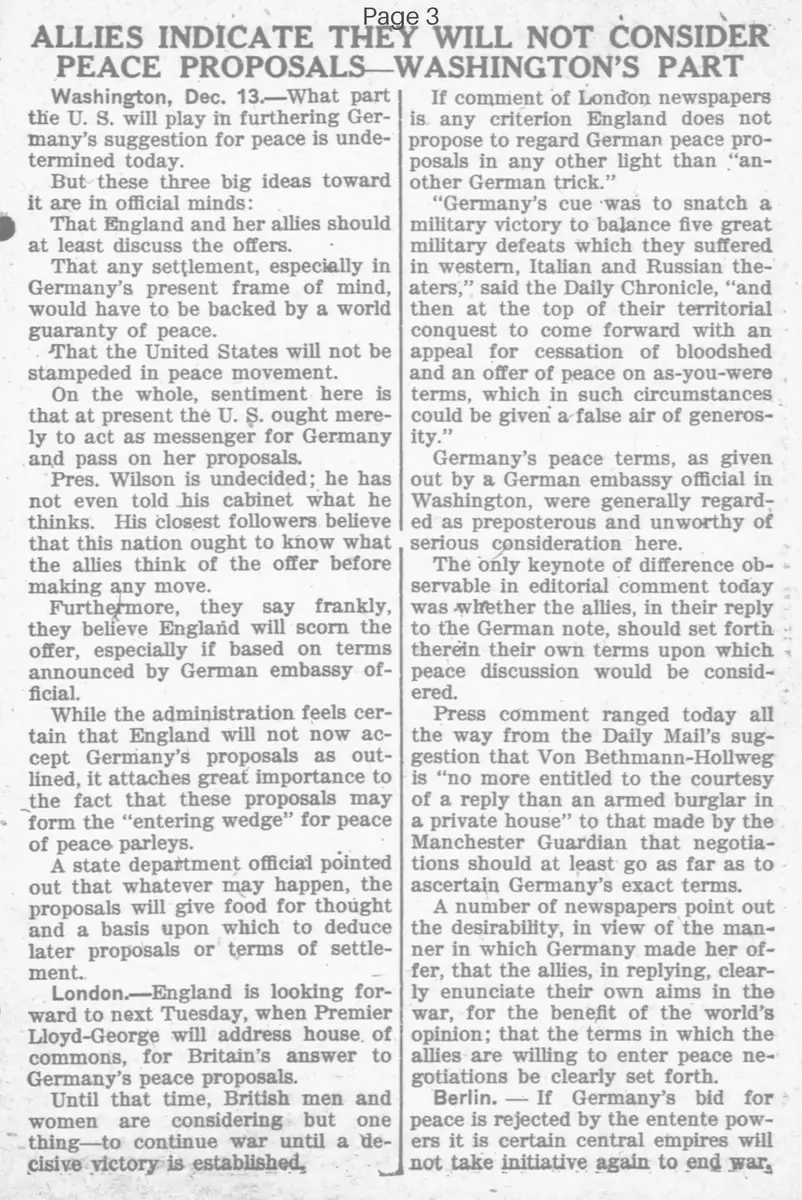
WASHINGTON, Dec. 13.—What part the U. S. will play in furthering Germany's suggestion for peace is undetermined today.
But these three big ideas toward it are in official minds:
That England and her allies should at least discuss the offers.
That any settlement, especially in Germany's present frame of mind, would have to be backed by a world guaranty of peace.
That the United States will not be stampeded in peace movement.
On the whole, sentiment here is that at present the U. S. ought merely to act as messenger for Germany and pass on her proposals.
Pres. Wilson is undecided; he has not even told his cabinet what he thinks.
His closest followers believe that this nation ought to know what the allies think of the offer before making any move.
Furthermore, they say frankly, they believe England will scorn the offer, especially if based on terms announced by German embassy official.
While the administration feels certain that England will not now accept Germany's proposals as outlined, it attaches great importance to the fact that these proposals may form the "entering wedge" for peace parleys.
A state department official pointed out that whatever may happen, the proposals will give food for thought and a basis upon which to deduce later proposals or terms of settlement.
LONDON.—England is looking forward to next Tuesday, when Premier Lloyd George will address house of commons, for Britain's answer to Germany's peace proposals.
Until that time, British men and women are considering but one thing—to continue war until a decisive victory is established.
If comment of London newspapers is any criterion, England does not propose to regard German peace proposals in any other light than "another German trick."
"Germany's coup was to snatch a military victory to balance five great military defeats which they suffered in western, Italian and Russian theaters," said the Daily Chronicle, "and then at the top of their territorial conquest to come forward with an appeal for cessation of bloodshed and an offer of peace on as-you-were terms, which in such circumstances could be given a false air of generosity."
Germany's peace terms, as given out by a German embassy official in Washington, were generally regarded as preposterous and unworthy of serious consideration here.
The only keynote of difference observable in editorial comment today was whether the allies, in their reply to the German note, should set forth therein their own terms upon which peace discussion would be considered.
Press comment ranged today all the way from the Daily Mail's suggestion that Von Bethmann-Hollweg is "no more entitled to the courtesy of a reply than an armed burglar in a private house" to that made by the Manchester Guardian that negotiations should at least go as far as to ascertain Germany's exact terms.
A number of newspapers point out the desirability, in view of the manner in which Germany made her offer, that the allies, in replying, clearly enunciate their own aims in the war, for the benefit of the world's opinion; that the terms in which the allies are willing to enter peace negotiations be clearly set forth.
BERLIN.—If Germany's bid for peace is rejected by the entente powers it is certain central empires will not take initiative again to end war.
The public today voiced complete approbation of imperial chancellor's solemn warning in reichstag yesterday that if Germany's enemies continue war it is because they have conquest in mind. Such belief imbues public with inflexible determination to fight to bitter end against any dismemberment of Fatherland.
Berlin. Germany has not asked neutral powers to start peace negotiations. American embassy's understanding is that she has merely asked neutral powers to inform nations of the entente that the central powers are willing to discuss peace putting up to allies the acquiescence or refusal of tender.
Amsterdam. "The final victory is no longer doubtful," said Emperor Karl of Austria-Hungary in his proclamation to Austro-Hungarian troops notifying them that he had joined in peace proffers.
The bulk of editorial opinion of American newspapers today seems to be that peace may have been brought nearer by Germany's proposals, but that many things stand in the way of an early ending of the war. Generally, editorial comment expresses the belief that the peace proposal will not be acceptable to the allies. Financiers and publicists who today analyzed the situation revealed a division of opinion, a majority declaring peace is brought nearer, but is not an immediate possibility because peace at this time is unacceptable to the allies.
What sub-type of article is it?
What keywords are associated?
What entities or persons were involved?
Where did it happen?
Foreign News Details
Primary Location
Europe
Event Date
Dec. 13
Key Persons
Outcome
allies likely to reject proposals; potential basis for future negotiations; public determination to continue war if rejected.
Event Details
Germany's peace proposals via neutral powers; US undecided, to act as messenger; Britain views as trick, awaits Lloyd George's speech; Germany warns of no further initiative if rejected; Austria-Hungary confident in victory.