Thank you for visiting SNEWPapers!
Sign up free
Story
May 2, 1777
The Virginia Gazette
Williamsburg, Virginia
What is this article about?
In a letter to General Howe, General Washington defends his refusal to exchange prisoners who died from mistreatment, criticizing Lt. Col. Walcott's demands as misrepresentative and calling for fair, humane prisoner exchanges during the Revolutionary War.
Clipping
OCR Quality
95%
Excellent
Full Text
WILLIAMSBURG, May 2.
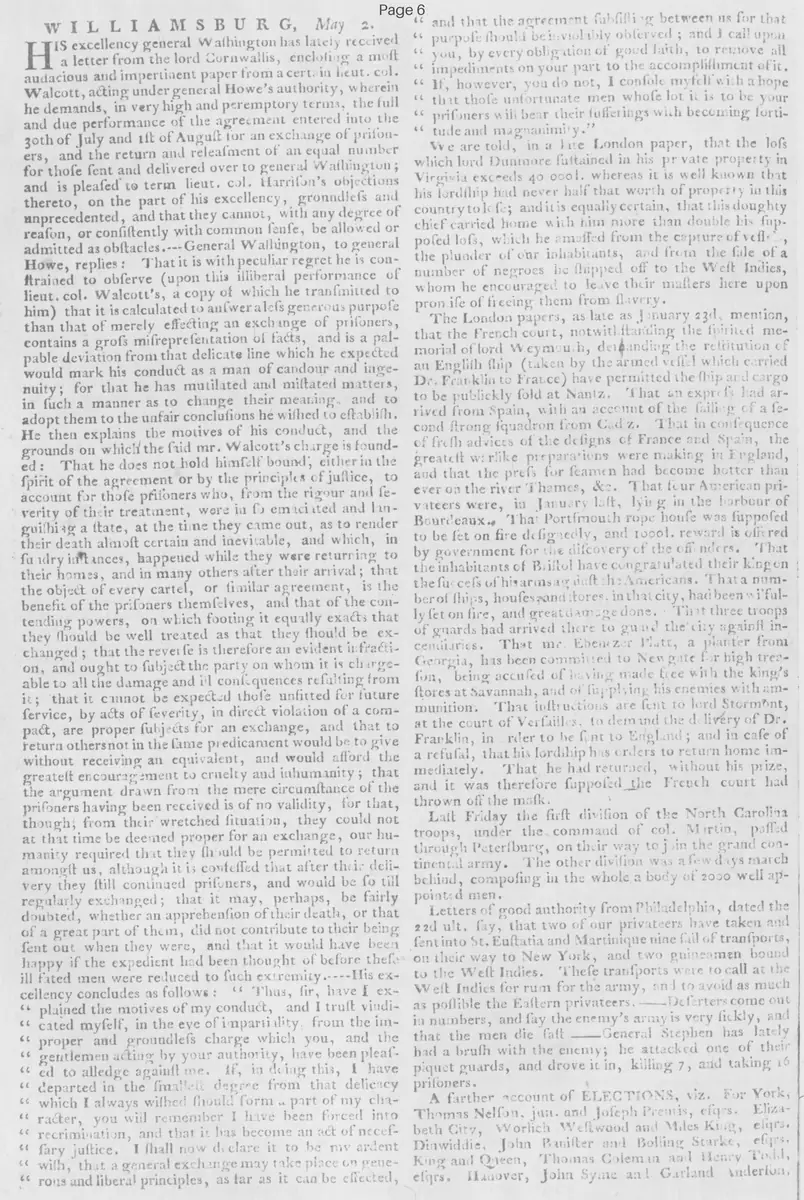
Most audacious and impertinent paper from a certain lieutenant colonel Walcott, acting under general Howe's authority, wherein he demands, in very high and peremptory terms, the full and due performance of the agreement entered into the 30th of July and 1st of August for an exchange of prisoners, and the return and releasement of an equal number for those sent and delivered over to general Washington; thereto, on the part of his excellency, groundless and is pleased to term lieutenant colonel Harrison's objections unprecedented, and that they cannot, with any degree of reason, or consistently with common sense, be allowed or admitted as obstacles.---General Washington, to general Howe, replies: That it is with peculiar regret he is constrained to observe (upon this illiberal performance of lieutenant colonel Walcott's, a copy of which he transmitted to him) that it is calculated to answer a less generous purpose than that of merely effecting an exchange of prisoners, contains a gross misrepresentation of facts, and is a palpable deviation from that delicate line which he expected would mark his conduct as a man of candour and ingenuity; for that he has mutilated and misstated matters, in such a manner as to change their meaning, and to adapt them to the unfair conclusions he wished to establish. He then explains the motives of his conduct, and the grounds on which the said Mr. Walcott's charge is founded: That he does not hold himself bound, either in the spirit of the agreement or by the principles of justice, to account for those prisoners who, from the rigour and severity of their treatment, were in so emaciated and languishing a state, at the time they came out, as to render their death almost certain and inevitable, and which, in sundry instances, happened while they were returning to their homes, and in many others after their arrival; that the object of every cartel, or similar agreement, is the benefit of the prisoners themselves, and that of the contending powers, on which footing it equally exacts that they should be well treated as that they should be exchanged; that the reverse is therefore an evident infraction, and ought to subject the party on whom it is chargeable to all the damage and ill consequences resulting from it; that it cannot be expected those unfitted for future service, by acts of severity, in direct violation of a compact, are proper subjects for an exchange, and that to return others not in the same predicament would be to give without receiving an equivalent, and would afford the greatest encouragement to cruelty and inhumanity; that the argument drawn from the mere circumstance of the prisoners having been received is of no validity, for that, though, from their wretched situation, they could not at that time be deemed proper for an exchange, our humanity required that they should be permitted to return amongst us, although it is confessed that after their delivery they still continued prisoners, and would be so till regularly exchanged; that it may, perhaps, be fairly doubted, whether an apprehension of their death, or that of a great part of them, did not contribute to their being sent out when they were, and that it would have been happy if the expedient had been thought of before these ill-fated men were reduced to such extremity.----His excellency concludes as follows: "Thus, sir, have I explained the motives of my conduct, and I trust vindicated myself, in the eye of impartiality from the improper and groundless charge which you, and the gentlemen acting by your authority, have been pleased to allege against me. If, in doing this, I have departed in the smallest degree from that delicacy which I always wished should form a part of my character, you will remember I have been forced into recrimination, and that it has become an act of necessary justice. I shall now declare it to be my ardent wish, that a general exchange may take place on generous and liberal principles, as far as it can be effected. And that the agreement subsisting between us for that purpose should be inviolably observed; and I call upon you, by every obligation of good faith, to remove all impediments on your part to the accomplishment of it. If, however, you do not, I console myself with a hope that those unfortunate men whose lot it is to be your prisoners will bear their sufferings with becoming fortitude and magnanimity."
Most audacious and impertinent paper from a certain lieutenant colonel Walcott, acting under general Howe's authority, wherein he demands, in very high and peremptory terms, the full and due performance of the agreement entered into the 30th of July and 1st of August for an exchange of prisoners, and the return and releasement of an equal number for those sent and delivered over to general Washington; thereto, on the part of his excellency, groundless and is pleased to term lieutenant colonel Harrison's objections unprecedented, and that they cannot, with any degree of reason, or consistently with common sense, be allowed or admitted as obstacles.---General Washington, to general Howe, replies: That it is with peculiar regret he is constrained to observe (upon this illiberal performance of lieutenant colonel Walcott's, a copy of which he transmitted to him) that it is calculated to answer a less generous purpose than that of merely effecting an exchange of prisoners, contains a gross misrepresentation of facts, and is a palpable deviation from that delicate line which he expected would mark his conduct as a man of candour and ingenuity; for that he has mutilated and misstated matters, in such a manner as to change their meaning, and to adapt them to the unfair conclusions he wished to establish. He then explains the motives of his conduct, and the grounds on which the said Mr. Walcott's charge is founded: That he does not hold himself bound, either in the spirit of the agreement or by the principles of justice, to account for those prisoners who, from the rigour and severity of their treatment, were in so emaciated and languishing a state, at the time they came out, as to render their death almost certain and inevitable, and which, in sundry instances, happened while they were returning to their homes, and in many others after their arrival; that the object of every cartel, or similar agreement, is the benefit of the prisoners themselves, and that of the contending powers, on which footing it equally exacts that they should be well treated as that they should be exchanged; that the reverse is therefore an evident infraction, and ought to subject the party on whom it is chargeable to all the damage and ill consequences resulting from it; that it cannot be expected those unfitted for future service, by acts of severity, in direct violation of a compact, are proper subjects for an exchange, and that to return others not in the same predicament would be to give without receiving an equivalent, and would afford the greatest encouragement to cruelty and inhumanity; that the argument drawn from the mere circumstance of the prisoners having been received is of no validity, for that, though, from their wretched situation, they could not at that time be deemed proper for an exchange, our humanity required that they should be permitted to return amongst us, although it is confessed that after their delivery they still continued prisoners, and would be so till regularly exchanged; that it may, perhaps, be fairly doubted, whether an apprehension of their death, or that of a great part of them, did not contribute to their being sent out when they were, and that it would have been happy if the expedient had been thought of before these ill-fated men were reduced to such extremity.----His excellency concludes as follows: "Thus, sir, have I explained the motives of my conduct, and I trust vindicated myself, in the eye of impartiality from the improper and groundless charge which you, and the gentlemen acting by your authority, have been pleased to allege against me. If, in doing this, I have departed in the smallest degree from that delicacy which I always wished should form a part of my character, you will remember I have been forced into recrimination, and that it has become an act of necessary justice. I shall now declare it to be my ardent wish, that a general exchange may take place on generous and liberal principles, as far as it can be effected. And that the agreement subsisting between us for that purpose should be inviolably observed; and I call upon you, by every obligation of good faith, to remove all impediments on your part to the accomplishment of it. If, however, you do not, I console myself with a hope that those unfortunate men whose lot it is to be your prisoners will bear their sufferings with becoming fortitude and magnanimity."
What sub-type of article is it?
Historical Event
What themes does it cover?
Justice
Moral Virtue
What keywords are associated?
Prisoner Exchange
American Revolution
General Washington
General Howe
Prisoner Treatment
Military Agreement
What entities or persons were involved?
General Washington
General Howe
Lieutenant Colonel Walcott
Lieutenant Colonel Harrison
Where did it happen?
Williamsburg
Story Details
Key Persons
General Washington
General Howe
Lieutenant Colonel Walcott
Lieutenant Colonel Harrison
Location
Williamsburg
Event Date
30th Of July And 1st Of August
Story Details
Lt. Col. Walcott demands fulfillment of prisoner exchange agreement; Washington replies criticizing misrepresentations, defends not accounting for prisoners who died from mistreatment, emphasizes humane treatment and fair exchanges, calls for removal of impediments.