Thank you for visiting SNEWPapers!
Sign up free
The Providence Journal, And Town And Country Advertiser
Providence, Providence County, Rhode Island
What is this article about?
Report on U.S. House of Representatives proceedings from December 30 to January 7, covering referrals of letters and petitions on refugees, arrests, Indian expeditions, taxes, and judiciary; debates on bills for duties, District of Columbia jurisdiction, and appropriations; announcement of Thomas Hartley's death; and committee reports on privileges and Winthrop Sargent's conduct.
Merged-components note: Direct continuation of Congress proceedings text across pages, merging for coherent component.
Clippings
1 of 2
OCR Quality
Full Text
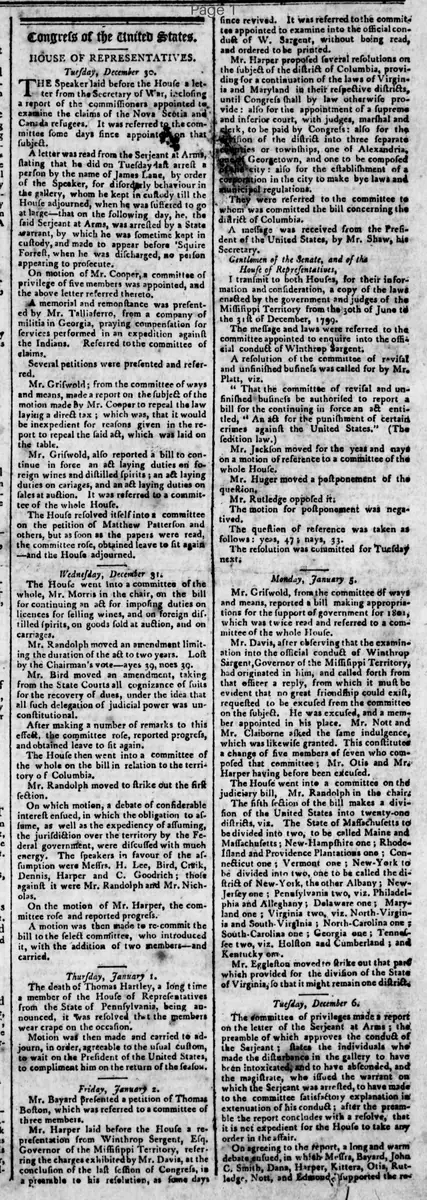
HOUSE OF REPRESENTATIVES.
Tuesday, December 30.
The Speaker laid before the House a letter from the Secretary of War, enclosing a report of the commissioners appointed to examine the claims of the Nova Scotia and Canada refugees. It was referred to the committee some days since appointed on that subject.
A letter was read from the Sergeant at Arms, stating that he did on Tuesday last arrest a person by the name of James Lane, by order of the Speaker, for disorderly behaviour in the gallery, whom he kept in custody till the House adjourned, when he was suffered to go at large—that on the following day, he, the said Sergeant at Arms, was arrested by a State warrant, by which he was sometime kept in custody, and made to appear before 'Squire Forrest, when he was discharged, no person appearing to prosecute.
On motion of Mr. Cooper, a committee of privilege of five members was appointed, and the above letter referred thereto.
A memorial and remonstrance was presented by Mr. Talliaferro, from a company of militia in Georgia, praying compensation for services performed in an expedition against the Indians. Referred to the committee of claims.
Several petitions were presented and referred.
Mr. Griswold, from the committee of ways and means, made a report on the subject of the motion made by Mr. Cooper to repeal the law laying a direct tax; which was, that it would be inexpedient for reasons given in the report to repeal the said act, which was laid on the table.
Mr. Griswold, also reported a bill to continue in force an act laying duties on foreign wines and distilled spirits; an act laying duties on carriages, and an act laying duties on sales at auction. It was referred to a committee of the whole House.
The House resolved itself into a committee on the petition of Matthew Patterson and others, but as soon as the papers were read, the committee rose, obtained leave to sit again—and the House adjourned.
Wednesday, December 31.
The House went into a committee of the whole, Mr. Morris in the chair, on the bill for continuing an act for imposing duties on licenses for selling wines, and on foreign distilled spirits, on goods sold at auction, and on carriages.
Mr. Randolph moved an amendment limiting the duration of the act to two years. Lost by the Chairman's vote—ayes 39, noes 39.
Mr. Bird moved an amendment, taking from the State Courts all cognizance of suits for the recovery of dues, under the idea that all such delegation of judicial power was unconstitutional.
After making a number of remarks to this effect, the committee rose, reported progress, and obtained leave to sit again.
The House then went into a committee of the whole on the bill in relation to the territory of Columbia.
Mr. Randolph moved to strike out the first section.
On which motion, a debate of considerable interest ensued, in which the obligation to assume, as well as the expediency of assuming, the jurisdiction over the territory by the Federal government, were discussed with much energy. The speakers in favour of the assumption were Messrs. H. Lee, Bird, Claik, Dennis, Harper and C. Goodrich; those against it were Mr. Randolph and Mr. Nicholas.
On the motion of Mr. Harper, the committee rose and reported progress.
A motion was then made to re-commit the bill to the select committee, who introduced it, with the addition of two members—and carried.
Thursday, January 1.
The death of Thomas Hartley, a long time a member of the House of Representatives from the State of Pennsylvania, being announced, it was resolved that the members wear crape on the occasion.
Motion was then made and carried to adjourn, in order, agreeable to the usual custom, to wait on the President of the United States, to compliment him on the return of the season.
Friday, January 2.
Mr. Bayard presented a petition of Thomas Boston, which was referred to a committee of three members.
Mr. Harper laid before the House a representation from Winthrop Sargent, Esq. Governor of the Mississippi Territory, referring to the charges exhibited by Mr. Davis, at the conclusion of the last session of Congress, in a preamble to his resolution, as some days since revived. It was referred to the committee appointed to examine into the official conduct of W. Sargent, without being read, and ordered to be printed.
Mr. Harper proposed several resolutions on the subject of the district of Columbia, providing for a continuation of the laws of Virginia and Maryland in their respective districts, until Congress shall by law otherwise provide: also for the appointment of a supreme and inferior court, with judges, marshal and clerk, to be paid by Congress: also for the division of the district into three separate counties or townships, one of Alexandria; Georgetown, and one to be composed of the city: also for the establishment of a corporation in the city to make bye laws and municipal regulations.
They were referred to the committee to whom was committed the bill concerning the district of Columbia.
A message was received from the President of the United States, by Mr. Shaw, his Secretary.
Gentlemen of the Senate, and of the House of Representatives,
I transmit to both Houses, for their information and consideration, a copy of the laws enacted by the government and judges of the Mississippi Territory from the 30th of June to the 31st of December, 1799.
The message and laws were referred to the committee appointed to enquire into the official conduct of Winthrop Sargent.
A resolution of the committee of revision and unfinished business was called for by Mr. Platt, viz.
"That the committee of revision and unfinished business be authorized to report a bill for the continuing in force an act entitled, 'An act for the punishment of certain crimes against the United States.' (The sedition law.)
Mr. Jackson moved for the yeas and nays on a motion of reference to a committee of the whole House.
Mr. Huger moved a postponement of the question,
Mr. Rutledge opposed it:
The motion for postponement was negatived.
The question of reference was taken as follows: yeas, 47; nays, 33.
The resolution was committed for Tuesday next.
Monday, January 5.
Mr. Griswold, from the committee of ways and means, reported a bill making appropriations for the support of government for 1801, which was twice read and referred to a committee of the whole House.
Mr. Davis, after observing that the examination into the official conduct of Winthrop Sargent, Governor of the Mississippi Territory; had originated in him, and called forth from that officer a reply, from which it must be evident that no great friendship could exist, requested to be excused from the committee on the subject. He was excused, and a member appointed in his place. Mr. Nott and Mr. Claiborne asked the same indulgence, which was likewise granted. This constitutes a change of five members of seven who composed that committee; Mr. Otis and Mr. Harper having before been excused.
The House went into a committee on the judiciary bill, Mr. Randolph in the chair
The fifth section of the bill makes a division of the United States into twenty-one districts, viz. The State of Massachusetts to be divided into two; to be called Maine and Massachusetts; New-Hampshire one; Rhode-Island and Providence Plantations one; Connecticut one; Vermont one; New-York to be divided into two, one to be called the district of New-York, the other Albany; New-Jersey one; Pennsylvania two, viz. Philadelphia and Alleghany; Delaware one; Maryland one; Virginia two, viz. North-Virginia and South-Virginia; North-Carolina one; South-Carolina one; Georgia one; Tennessee two, viz. Holston and Cumberland; and Kentucky one.
Mr. Eggleston moved to strike out that part which provided for the division of the State of Virginia; so that it might remain one district.
Tuesday, January 6.
The committee of privileges made a report on the letter of the Sergeant at Arms: the preamble of which approves the conduct of the Sergeant; states the individuals who made the disturbance in the gallery to have been intoxicated, and to have absconded, and the magistrate, who issued the warrant on which the Sergeant was arrested, to have made to the committee satisfactory explanation in extenuation of his conduct; after the preamble the report concludes with a resolve, that it is not expedient for the House to take any order in the affair.
On agreeing to the report, a long and warm debate ensued, in which—Messrs. Bayard, John C. Smith, Dana, Harper, Kittera, Otis, Rutledge, Nott, and Edmonds supported the report, and Messrs. Nicholas, Davis, Smilie, Macon, Alton, Stanford, Varnum, Eagle, Stanton and Kitchel, opposed it.
The report was finally agreed to by ayes and nays.
Wednesday, January 7.
The remonstrance from the Legislature of the State of Georgia was referred to a select committee. The petition of the office-keepers and messengers, for an increase of salary, was referred to the committee of ways and means, to insert the item in the incidental bill, and the select committee were discharged therefrom.
The House went into a committee on the judiciary bill.
Two parts only occupied the particular attention of the committee; one was the principle whether the State Judiciaries ever could, consistently with the constitution of the United States, take cognizance of causes arising under the laws of the United States. This produced a debate. Mr. Bayard, Mr. Harper and Mr. Dennis, contended that the courts of the several States could take cognizance. Mr. Bird and Mr. Nott contended that such a practice would be unconstitutional.
Mr. Nicholas at length, from the intricacy of the subject, moved a postponement, by the rising of the committee.
This was negatived. The postponement of this part was then carried.
The other question which engaged particular attention, was the amount of debt that should be made cognizable in the circuit courts. Mr. Nicholas moved $500 dollars.
This was at length negatived, 37 rising on each side, and the chairman (Mr. Rutledge) giving his vote in the negative. Four hundred dollars was then proposed. This was carried, 39 to 37.
The committee then rose, and the House adjourned.
What sub-type of article is it?
What keywords are associated?
What entities or persons were involved?
Domestic News Details
Event Date
Tuesday, December 30 To Wednesday, January 7
Key Persons
Outcome
various petitions and bills referred to committees; debates on tax duties, district of columbia jurisdiction, judiciary divisions, and sedition law continuation; privilege committee report approved; changes in committee membership; thomas hartley's death announced with mourning resolution.
Event Details
The House considered letters from the Secretary of War on refugee claims, Sergeant at Arms on an arrest for gallery disorder, militia memorial from Georgia on Indian expedition services, reports on direct tax repeal and duty continuations, petitions including Matthew Patterson's; debated amendments to duty and Columbia territory bills; announced Thomas Hartley's death; received presidential message on Mississippi laws; proposed resolutions on Columbia district governance; reported appropriations bill; excused members from Sargent inquiry committee; debated judiciary bill on districts and state court cognizance; approved privilege report after debate.