Thank you for visiting SNEWPapers!
Sign up free
Editorial
October 5, 1759
The New Hampshire Gazette
Portsmouth, Rockingham County, New Hampshire
What is this article about?
An editorial praises Prime Minister William Pitt's administration for national prosperity and mocks opposition arguments against him by quoting a satirical pamphlet that ironically criticizes his popularity with the people and potential impact on peace negotiations in the ongoing war.
Clipping
OCR Quality
95%
Excellent
Full Text
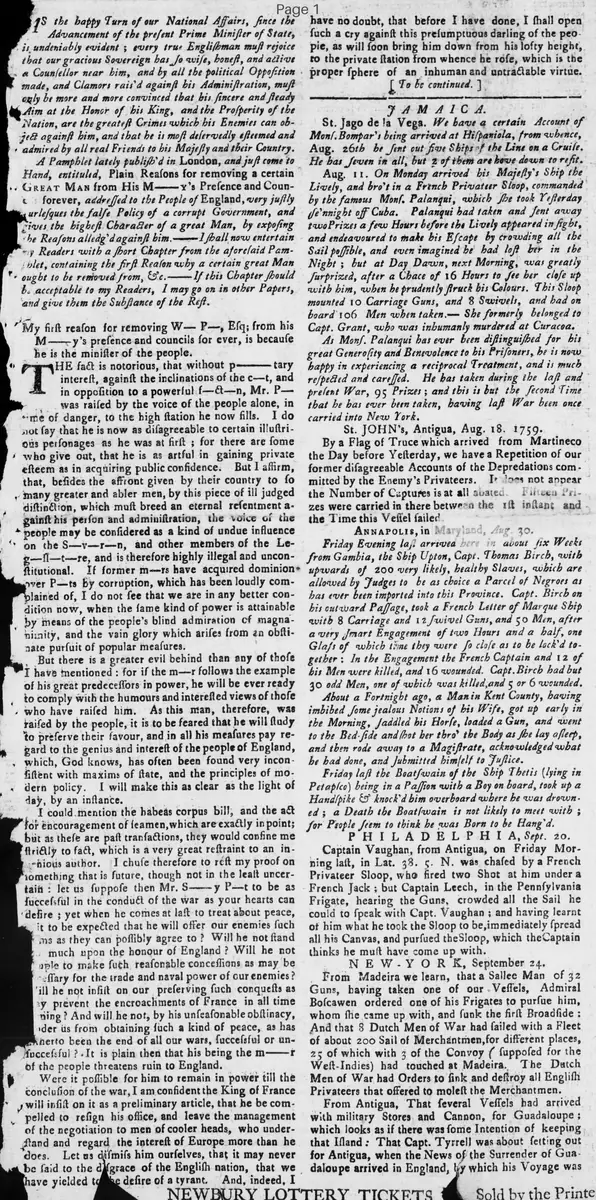
Is the happy Turn of our National Affairs, Since the Advancement of the present Prime Minister of State is undeniably evident; every true Englishman must rejoice that our gracious Sovereign has so wise, honest, and active a Counsellor near him, and by all the political Opposition made, and Clamours rais'd against his Administration, must only be more and more convinced that his sincere and steady Aim at the Honor of his King, and the Prosperity of the Nation, are the greatest Crimes which his Enemies can object against him, and that he is most deservedly esteemed and admired by all real Friends to his Majesty and their Country.
A Pamphlet lately publish'd in London, and just come to Hand, entituled, Plain Reasons for removing a certain GREAT Man from His M-a-J-e-s-t-Y's Presence and Councils forever, addressed to the People of England, very justly burlesques the false Policy of a corrupt Government, and gives the highest Character of a great Man, by exposing the Reasons alledg'd against him. I shall now entertain my Readers with a short Chapter from the aforesaid Pamphlet, containing the first Reason why a certain great Man ought to be removed from, &c. If this Chapter should be acceptable to my Readers, I may go on in other Papers, and give them the Substance of the Rest.
"My first reason for removing W-- P--, Esq; from his M--a--j-e-s-t-y's presence and councils for ever, is because he is the minister of the people."
The fact is notorious, that without par-t-iaments-ry interest, against the inclinations of the c--o-u-r-t, and in opposition to a powerful s-et--f-a-c-t-i-o-n. Mr. P-- was rais'd by the voice of the people alone, in time of danger, to the high station he now fills. I do not say that he is now as disagreeable to certain illust-rious personages as he was at first; for there are some who give out, that he is as artful in gaining private esteem as in acquiring public confidence. But I affirm, that, besides the affront given by their country to so many greater and abler men, by this piece of ill judged distinction, which must breed an eternal resentment a-gainst his person and administration, the voice of the people may be considered as a kind of undue influence on the S-o-v-e-r-e-i-g-n. and other members of the Le-g-i-s-l-a-t-u-r-e, and is therefore highly illegal and uncon-stitutional. If former m--i-n-i-s-t-e-r-s have acquired dominion over P-a-r-l-i-a-m-e-n-t-s by corruption, which has been loudly com-plained of, I do not see that we are in any better con-dition now, when the same kind of power is attainable by means of the people's blind admiration of magna-nimity. and the vain glory which arises from an obsti-nate pursuit of popular measures.
But there is a greater evil behind than any of those I have mentioned: for if the m--i-n-i-s-t-e-r follows the example of his great predecessors in power, he will be ever ready to comply with the humours and interested views of those who have rais'd him. As this man, therefore, was rais'd by the people, it is to be feared that he will study to preserve their favour, and in all his measures pay re-gard to the genius and interest of the people of England, which, God knows, has often been found very incon-sistent with maxims of state. and the principles of mo-dern policy. I will make this as clear as the light of day. by an instance.
I could mention the habeas corpus bill: and the act for encouragement of seamen, which are exactly in point; but as these are past transactions, they would confine me strictly to fact. which is a very great restraint to an in-genious author. I chuse therefore to rest my proof on something that is future, though not in the least uncer-tain: let us suppose then Mr. S-t-a-t-e-s-m-a-n P--i-t-t to be as successful in the conduct of the war as your hearts can desire; yet when he comes at last to treat about peace, it to be expected that he will offer our enemies such terms as they can possibly agree to? Will he not stand much upon the honour of England? Will he not strive to make such reasonable concessions as may be necessary for the trade and naval power of our enemies? Will he not insist on our preserving such conquests as may prevent the encroachments of France in all time coming? And will he not, by his unreasonable obstinacy, hinder us from obtaining such a kind of peace, as has hereto been the end of all our wars, successful or un-successful? It is plain then that his being the m--i-n-i-s-t-e-r of the people threatens ruin to England.
Were it possible for him to remain in power till the conclusion of the war. I am confident the King of France will insist on it as a preliminary article, that he be com-pelled to resign his office, and leave the management of the negotiation to men of cooler heads, who under-stand and regard the interest of Europe more than he does. Let us dismiss him ourselves, that it may never be said to the disgrace of the English nation, that we have yielded to the desire of a tyrant. And, indeed, I have no doubt, that before I have done, I shall open such a cry against this presumptuous darling of the peo-ple, as will soon bring him down from his lofty height, to the private station from whence he rose, which is the proper sphere of an inhuman and untractable virtue.
[To be continued.]
A Pamphlet lately publish'd in London, and just come to Hand, entituled, Plain Reasons for removing a certain GREAT Man from His M-a-J-e-s-t-Y's Presence and Councils forever, addressed to the People of England, very justly burlesques the false Policy of a corrupt Government, and gives the highest Character of a great Man, by exposing the Reasons alledg'd against him. I shall now entertain my Readers with a short Chapter from the aforesaid Pamphlet, containing the first Reason why a certain great Man ought to be removed from, &c. If this Chapter should be acceptable to my Readers, I may go on in other Papers, and give them the Substance of the Rest.
"My first reason for removing W-- P--, Esq; from his M--a--j-e-s-t-y's presence and councils for ever, is because he is the minister of the people."
The fact is notorious, that without par-t-iaments-ry interest, against the inclinations of the c--o-u-r-t, and in opposition to a powerful s-et--f-a-c-t-i-o-n. Mr. P-- was rais'd by the voice of the people alone, in time of danger, to the high station he now fills. I do not say that he is now as disagreeable to certain illust-rious personages as he was at first; for there are some who give out, that he is as artful in gaining private esteem as in acquiring public confidence. But I affirm, that, besides the affront given by their country to so many greater and abler men, by this piece of ill judged distinction, which must breed an eternal resentment a-gainst his person and administration, the voice of the people may be considered as a kind of undue influence on the S-o-v-e-r-e-i-g-n. and other members of the Le-g-i-s-l-a-t-u-r-e, and is therefore highly illegal and uncon-stitutional. If former m--i-n-i-s-t-e-r-s have acquired dominion over P-a-r-l-i-a-m-e-n-t-s by corruption, which has been loudly com-plained of, I do not see that we are in any better con-dition now, when the same kind of power is attainable by means of the people's blind admiration of magna-nimity. and the vain glory which arises from an obsti-nate pursuit of popular measures.
But there is a greater evil behind than any of those I have mentioned: for if the m--i-n-i-s-t-e-r follows the example of his great predecessors in power, he will be ever ready to comply with the humours and interested views of those who have rais'd him. As this man, therefore, was rais'd by the people, it is to be feared that he will study to preserve their favour, and in all his measures pay re-gard to the genius and interest of the people of England, which, God knows, has often been found very incon-sistent with maxims of state. and the principles of mo-dern policy. I will make this as clear as the light of day. by an instance.
I could mention the habeas corpus bill: and the act for encouragement of seamen, which are exactly in point; but as these are past transactions, they would confine me strictly to fact. which is a very great restraint to an in-genious author. I chuse therefore to rest my proof on something that is future, though not in the least uncer-tain: let us suppose then Mr. S-t-a-t-e-s-m-a-n P--i-t-t to be as successful in the conduct of the war as your hearts can desire; yet when he comes at last to treat about peace, it to be expected that he will offer our enemies such terms as they can possibly agree to? Will he not stand much upon the honour of England? Will he not strive to make such reasonable concessions as may be necessary for the trade and naval power of our enemies? Will he not insist on our preserving such conquests as may prevent the encroachments of France in all time coming? And will he not, by his unreasonable obstinacy, hinder us from obtaining such a kind of peace, as has hereto been the end of all our wars, successful or un-successful? It is plain then that his being the m--i-n-i-s-t-e-r of the people threatens ruin to England.
Were it possible for him to remain in power till the conclusion of the war. I am confident the King of France will insist on it as a preliminary article, that he be com-pelled to resign his office, and leave the management of the negotiation to men of cooler heads, who under-stand and regard the interest of Europe more than he does. Let us dismiss him ourselves, that it may never be said to the disgrace of the English nation, that we have yielded to the desire of a tyrant. And, indeed, I have no doubt, that before I have done, I shall open such a cry against this presumptuous darling of the peo-ple, as will soon bring him down from his lofty height, to the private station from whence he rose, which is the proper sphere of an inhuman and untractable virtue.
[To be continued.]
What sub-type of article is it?
Partisan Politics
Satire
War Or Peace
What keywords are associated?
William Pitt
Prime Minister
Political Opposition
National Affairs
War Conduct
Peace Negotiations
Popular Minister
What entities or persons were involved?
William Pitt
The Sovereign
King Of France
Editorial Details
Primary Topic
Defense Of William Pitt Against Political Opposition
Stance / Tone
Supportive Of Pitt With Satirical Mockery Of Critics
Key Figures
William Pitt
The Sovereign
King Of France
Key Arguments
Pitt's Administration Has Brought National Prosperity
Opposition To Pitt Stems From His Focus On King's Honor And National Good
Satirical Pamphlet Mocks Claim That Pitt's Popularity With People Is Unconstitutional
Pitt's Rise By Popular Voice Offends Court And Factions
Pitt's Adherence To Popular Measures May Hinder Flexible Peace Negotiations
Pitt's Obstinacy Could Ruin England's Interests In War's End