Thank you for visiting SNEWPapers!
Sign up free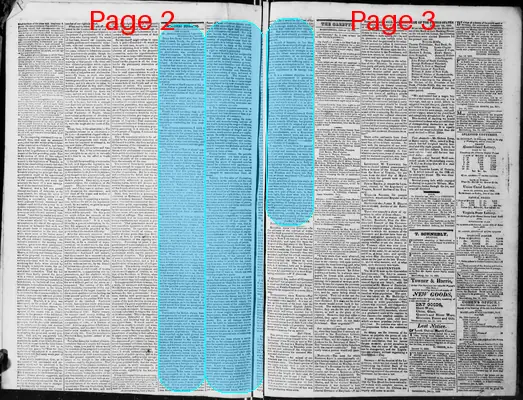
Martinsburg Gazette And Public Advertiser
Martinsburg, Berkeley County, West Virginia
What is this article about?
James Madison's letter to Judge Joseph C. Cabell defends the constitutional power of Congress to impose tariffs and restrictions on imports to encourage domestic productions, outlining exceptions to laissez-faire trade policy including lack of reciprocity, war effects, infant industries, and attracting foreign labor.
Merged-components note: This is the publication of Mr. Madison's letter on the tariff, a single logical unit continued across pages 2 and 3. Relabeled to editorial as it is an opinionated political letter.
Clippings
1 of 2
OCR Quality
Full Text
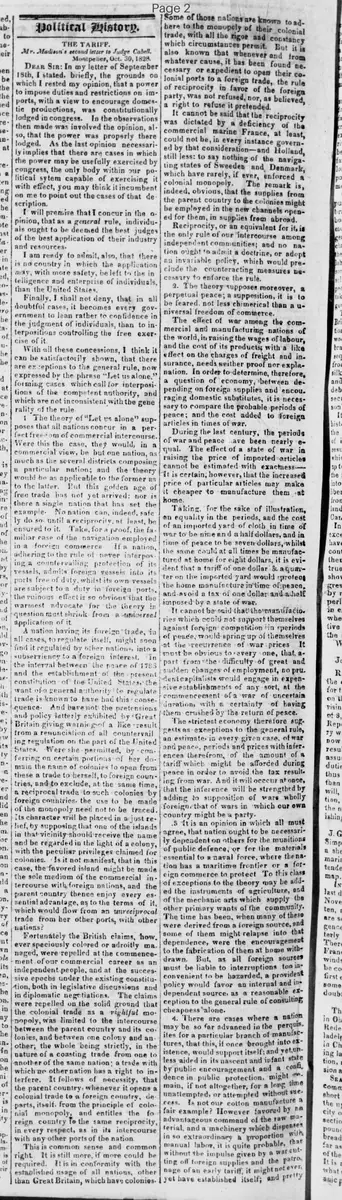
THE TARIFF.
Mr. Madison's second letter to Judge Cabell.
Montpelier, Oct. 30, 1828.
Dear Sir: In my letter of September 18th, I stated, briefly, the grounds on which I rested my opinion, that a power to impose duties and restrictions on imports, with a view to encourage domestic productions, was constitutionally lodged in Congress. In the observations then made was involved the opinion, also, that the power was properly there lodged. As the last opinion necessarily implies that there are cases in which the power may be usefully exercised by Congress, the only body within our political system capable of exercising it with effect, you may think it incumbent on me to point out the cases of that description.
I will premise that I concur in the opinion, that as a general rule, individuals ought to be deemed the best judges of the best application of their industry and resources. I am ready to admit, also, that there is no country in which the application may, with more safety, be left to the intelligence and enterprise of individuals, than the United States. Finally, I shall not deny, that in all doubtful cases, it becomes every government to lean rather to confidence in the judgment of individuals, than to interpositions controlling the free exercise of it.
With all these concessions, I think it can be satisfactorily shown, that there are exceptions to the general rule, now expressed by the phrase "Let us alone," forming cases which call for interpositions of the competent authority, and which are not inconsistent with the generality of the rule.
1. The theory of "Let us alone" supposes that all nations concur in a perfect free dom of commercial intercourse. Were this the case, they would, in a commercial view, be but one nation, as much as the several districts composing a particular nation; and the theory would be as applicable to the former as to the latter. But this golden age of free trade has not yet arrived: nor is there a single nation that has set the example. No nation can, indeed, safely do so, until a reciprocity, at least, be ensured to it. Take, for a proof, the familiar case of the navigation employed in a foreign commerce. If a nation, adhering to the rule of never interposing a countervailing protection of its vessels, admits foreign vessels into its ports free of duty, whilst its own vessels are subject to a duty in foreign ports, the ruinous effect is so obvious that the warmest advocate for the theory in question must shrink from a universal application of it.
A nation having its foreign trade, in all cases, to regulate itself, might soon find it regulated by other nations, into a subserviency to a foreign interest. In the interval between the peace of 1783 and the establishment of the present constitution of the United States, the want of a general authority to regulate trade is known to have had this consequence. And have not the pretensions and policy latterly exhibited by Great Britain given warning of a like result from a renunciation of all countervailing regulation on the part of the United States. Were she permitted, by conferring on certain portions of her do main the name of colonies to open from these a trade to herself, to foreign countries, and to exclude, at the same time, a reciprocal trade to such colonies by foreign countries, the use to be made of the monopoly need not to be traced. Its character will be placed in a just relief, by supposing that one of the islands in that vicinity should receive the name and be regarded in the light of a colony, with the peculiar privileges claimed for colonies. Is it not manifest, that in this case, the favored island might be made the sole medium of the commercial intercourse with foreign nations, and the parent country thence enjoy every essential advantage, as to the terms of it, which would flow from an unreciprocal trade from her other ports, with other nations?
Fortunately the British claims, however speciously colored or adroitly managed, were repelled at the commencement of our commercial career as an independent people, and at the successive epochs under the existing constitution, both in legislative discussions and in diplomatic negotiations. The claims were repelled on the solid ground that the colonial trade as a rightful monopoly, was limited to the intercourse between the parent country and its colonies, and between one colony and another; the whole being strictly, in the nature of a coasting trade from one to another of the same nation; a trade with which no other nation has a right to interfere. It follows of necessity, that the parent country, whenever it opens a colonial trade to a foreign country, departs, itself, from the principle of colonial monopoly, and entitles the foreign country to the same reciprocity, in every respect, as in its intercourse with any other ports of the nation.
This is common sense and common right. It is still more, if more could be required. It is in conformity with the established usage of all nations, other than Great Britain, which have colonies. Some of those nations are known to adhere to the monopoly of their colonial trade, with all the rigor and constancy which circumstances permit. But it is also known that whenever and from whatever cause, it has been found necessary or expedient to open their colonial ports to a foreign trade, the rule of reciprocity in favor of the foreign party, was not refused, nor, as believed, a right to refuse it pretended.
It cannot be said that the reciprocity was dictated by a deficiency of the commercial marine. France, at least, could not be, in every instance governed by that consideration—and Holland, still less: to say nothing of the navigating states of Sweden and Denmark, which have rarely, if ever, enforced a colonial monopoly. The remark is, indeed, obvious, that the supplies from the parent country to the colonies might be employed in the new channels opened for them, in supplies from abroad.
Reciprocity, or an equivalent for it, is the only rule of our intercourse among independent communities; and no nation ought to admit a doctrine, or adopt an invariable policy, which would preclude the counteracting measures necessary to enforce the rule.
2. The theory supposes moreover, a perpetual peace; a supposition, it is to be feared, not less chimerical than a universal freedom of commerce. The effect of war among the commercial and manufacturing nations of the world, in raising the wages of labour, and the cost of its products; with a like effect on the charges of freight and insurance, needs neither proof nor explanation. In order to determine, therefore, a question of economy, between depending on foreign supplies and encouraging domestic substitutes, it is necessary to compare the probable periods of peace; and the cost added to foreign articles in times of war.
During the last century, the periods of war and peace have been nearly equal. The effect of a state of war in raising the price of imported articles cannot be estimated with exactness.—it is certain; however, that the increased price of particular articles may make it cheaper to manufacture them at home.
Taking, for the sake of illustration, an equality in the periods, and the cost of an imported yard of cloth in time of war to be nine and a half dollars, and in time of peace to be seven dollars, whilst the same could at all times be manufactured at home for eight dollars, it is evident that a tariff of one dollar a quarter on the imported yard would protect the home manufacture in time of peace, and avoid a tax of one dollar and a half imposed by a state of war.
It cannot be said that the manufactures which could not support themselves against foreign competition in periods of peace, would spring up of themselves at the recurrence of war prices. It must be obvious to every one, that, apart from the difficulty of great and sudden changes of employment, no prudent capitalists would engage in expensive establishments of any sort, at the commencement of a war of uncertain duration, with a certainty of having them crushed by the return of peace.
The strictest economy therefore suggests as exceptions to the general rule, an estimate, in every given case, of war and peace, periods and prices with inferences therefrom, of the amount of a tariff which might be afforded during peace in order to avoid the tax resulting from war. And it will occur at once, that the inference will be strengthened by adding to supposition of wars wholly foreign, that of wars in which our own country might be a party.
As it is an opinion in which all must agree, that a nation ought to be necessarily dependent on others for the munitions of public defence, or for the materials essential to a naval force, where the nation has a maritime frontier or a foreign commerce to protect. To this class of exceptions to the theory may be added the instruments of agriculture, and of the mechanic arts which supply the other primary wants of the community.
The time has been, when many of these were derived from a foreign source, and some of them might relapse into that dependence, were the encouragement to the fabrication of them at home withdrawn. But, as all foreign sources must be liable to interruptions too inconvenient to be hazarded, a provident policy would favor an internal and independent source, as a reasonable exception to the general rule of consulting cheapness alone.
4. There are cases where a nation may be so far advanced in the perquisites for a particular branch of manufactures, that this, if once brought into existence, would support itself; and yet, unless aided in its nascent and infant state by public encouragement and a confidence in public protection, might remain, if not altogether, for a long time unattempted, or attempted without success. Is not our cotton manufacture a fair example? However favored by an advantageous command of the raw material in so extraordinary a proportion with the machinery which dispenses with manual labor, it is quite probable that without the impulse given by a war cutting off foreign supplies and the patronage of an early tariff, it might not yet have established itself; and pretty certain that it would not have been in so thriving a condition as it is.
An uncompromising friend of Reform.
It is certain, that it would be far short of the prosperous condition which enables it to face, in foreign markets, the fabrics of that nation that defies all other competitors. The number must be small, that have not to have been cheaply purchased by the tariff which nursed it into its present maturity.
5. Should it happen, as has been suspected to be an object, though not of foreign government itself, of its manufacturing capitalists, to strangle in the cradle the infant manufactures of an extensive customer, or an anticipated rival, it would surely, in such a case, be incumbent on the suffering party, so far to make an exception to the "let alone" policy, as to parry the evil by opposite regulations of its foreign commerce.
6. It is a common objection to the public encouragement of particular branches of industry, that it calls off laborers from other branches found to be more profitable; and the objection is in general a weighty one. But it loses that character in proportion to the effect of the encouragement in attracting skillful laborers from abroad. Something of this sort has already taken place among ourselves, and much more of it is in prospect; and as far as it has taken or may take place, it forms an exception to the general policy in question.
The history of manufactures in Great Britain, the greatest manufacturing nation in the world, informs us that the woollen branch, till of late her greatest branch, owed both its original and subsequent growths to persecuted exiles from the Netherlands; and that her silk manufactures, now a flourishing and favourite branch were not less indebted to emigrants flying from the persecuted edicts of France. - Anderson's History of Commerce.
It appears, indeed, from the general history of manufacturing industry, that the prompt and successful introduction of it into new situations, has been the result of emigrants from countries in which manufactures had gradually grown into a prosperous state, as in Italy on the fall of the Greek empire; from Italy into Spain and Flanders, on the loss of liberty in Florence and other cities; and from Flanders and France into England, as above mentioned-Franklin's Canada pamphlet.
In the selection of cases here made, as exceptions to the 'let alone' theory, none have been included which were deemed controvertible. And if I have viewed them, or a part of them only, in their true light, they show what was to be shown, that the power granted to Congress to encourage domestic products by regulations of foreign trade was properly granted, inasmuch as the power is in effect, confined to that body and may, when exercised with a sound legislative discretion, provide the better for the safety and prosperity of the nation.
With great esteem and regard,
JAMES MADISON.
Joseph C. Cabell, Esq.
What sub-type of article is it?
What keywords are associated?
What entities or persons were involved?
Editorial Details
Primary Topic
Constitutional Power Of Congress To Impose Tariffs Encouraging Domestic Industry
Stance / Tone
Supportive Of Congressional Tariff Powers With Exceptions To Laissez Faire Policy
Key Figures
Key Arguments