Thank you for visiting SNEWPapers!
Sign up free
Editorial
June 1, 1832
Rhode Island American And Gazette
Providence, Providence County, Rhode Island
What is this article about?
An opinion piece argues that personal debt contradicts American ideals of liberty and independence, likening borrowers to servants of lenders, and urges frugality to avoid greater degradation than political tyranny.
Clipping
OCR Quality
95%
Excellent
Full Text
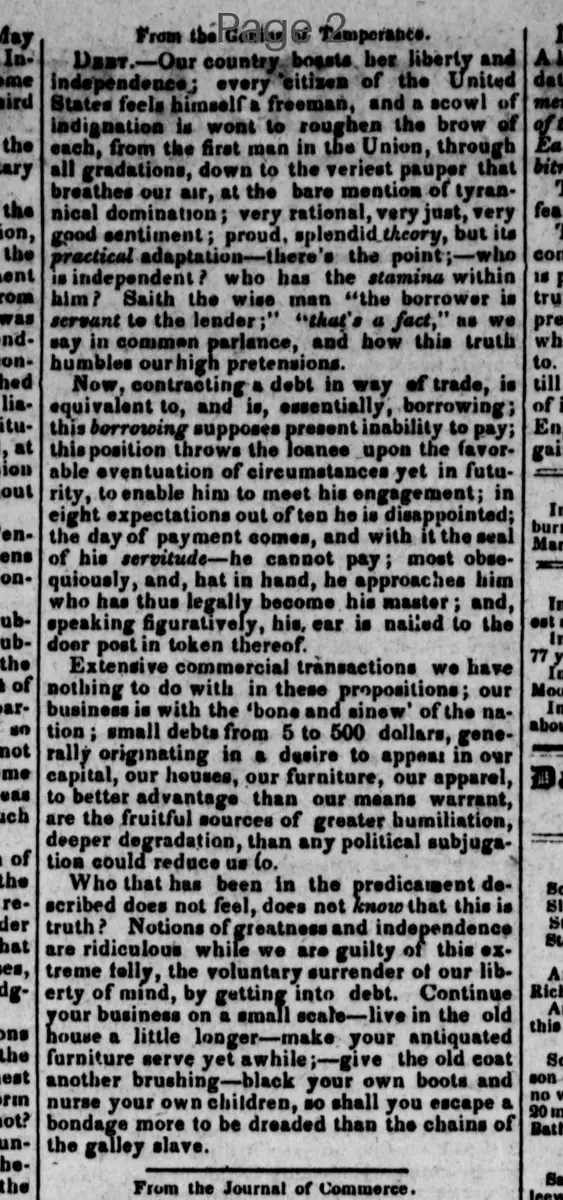
DEAR SIR.—Our country boasts her liberty and independence; every citizen of the United States feels himself a freeman, and a scowl of indignation is wont to roughen the brow of each, from the first man in the Union, through all gradations, down to the veriest pauper that breathes our air, at the bare mention of tyrannical domination; very rational, very just, very good sentiment; proud, splendid theory, but its practical adaptation—there's the point;—who is independent? who has the stamina within him? Saith the wise man "the borrower is servant to the lender;" "that's a fact," as we say in common parlance, and how this truth humbles our high pretensions.
Now, contracting a debt in way of trade, is equivalent to, and is, essentially, borrowing; this borrowing supposes present inability to pay; this position throws the loanee upon the favorable eventuation of circumstances yet in futurity, to enable him to meet his engagement; in eight expectations out of ten he is disappointed: the day of payment comes, and with it the seal of his servitude—he cannot pay; most obsequiously, and, hat in hand, he approaches him who has thus legally become his master; and, speaking figuratively, his ear is nailed to the door post in token thereof.
Extensive commercial transactions we have nothing to do with in these propositions; our business is with the 'bone and sinew' of the nation; small debts from 5 to 500 dollars, generally originating in a desire to appear in our capital, our houses, our furniture, our apparel, to better advantage than our means warrant, are the fruitful sources of greater humiliation, deeper degradation, than any political subjugation could reduce us to.
Who that has been in the predicament described does not feel, does not know that this is truth? Notions of greatness and independence are ridiculous while we are guilty of this extreme folly, the voluntary surrender of our liberty of mind, by getting into debt. Continue your business on a small scale—live in the old house a little longer—make your antiquated furniture serve yet awhile;—give the old coat another brushing—black your own boots and nurse your own children, so shall you escape a bondage more to be dreaded than the chains of the galley slave.
Now, contracting a debt in way of trade, is equivalent to, and is, essentially, borrowing; this borrowing supposes present inability to pay; this position throws the loanee upon the favorable eventuation of circumstances yet in futurity, to enable him to meet his engagement; in eight expectations out of ten he is disappointed: the day of payment comes, and with it the seal of his servitude—he cannot pay; most obsequiously, and, hat in hand, he approaches him who has thus legally become his master; and, speaking figuratively, his ear is nailed to the door post in token thereof.
Extensive commercial transactions we have nothing to do with in these propositions; our business is with the 'bone and sinew' of the nation; small debts from 5 to 500 dollars, generally originating in a desire to appear in our capital, our houses, our furniture, our apparel, to better advantage than our means warrant, are the fruitful sources of greater humiliation, deeper degradation, than any political subjugation could reduce us to.
Who that has been in the predicament described does not feel, does not know that this is truth? Notions of greatness and independence are ridiculous while we are guilty of this extreme folly, the voluntary surrender of our liberty of mind, by getting into debt. Continue your business on a small scale—live in the old house a little longer—make your antiquated furniture serve yet awhile;—give the old coat another brushing—black your own boots and nurse your own children, so shall you escape a bondage more to be dreaded than the chains of the galley slave.
What sub-type of article is it?
Moral Or Religious
Social Reform
Economic Policy
What keywords are associated?
Debt
Independence
Liberty
Frugality
Servitude
Borrowing
What entities or persons were involved?
United States Citizens
Borrower
Lender
Editorial Details
Primary Topic
Dangers Of Personal Debt Undermining Independence
Stance / Tone
Moral Exhortation Against Debt
Key Figures
United States Citizens
Borrower
Lender
Key Arguments
National Pride In Liberty Is Contradicted By Personal Debt
Borrowing Equates To Servitude As 'The Borrower Is Servant To The Lender'
Small Debts From Vanity Lead To Greater Humiliation Than Political Subjugation
Live Frugally Within Means To Preserve True Independence