Thank you for visiting SNEWPapers!
Sign up free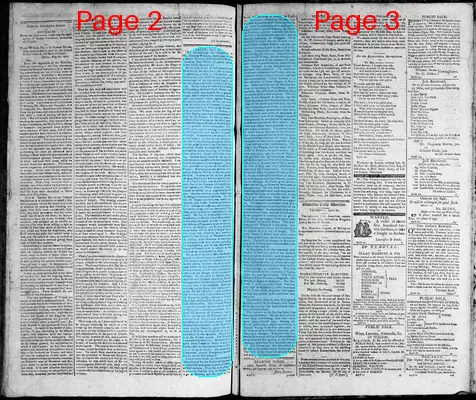
Alexandria Daily Advertiser
Alexandria, Virginia
What is this article about?
Reports from French papers detail the 1805 Anglo-Russian alliance against France, its subsidies and provisions, and how recent events frustrated it. Updates on Prussian gains, diplomatic protests, troop movements across Europe, Italian relocations, Austrian changes, Moravian mortality, German territorial adjustments, Parisian health measures, notable deaths, and commercial disruptions.
Merged-components note: These two components continue the same article on European foreign news, with sequential reading order across pages.
Clippings

1 of 2
OCR Quality
Full Text
[We acknowledge our obligations to Mr. Thomas Williams, supercargo of the schooner Eleanor, in 36 days from Nantz, arrived at Marblehead, for papers which he has kindly favored us.]
By the help of the French papers from Marblehead, we have been able to obtain the following articles of information. In the Moniteur of the 15th February, are given translations of the diplomatic papers in the late alliance upon the continent of Europe. By the treaty of 11th of April 1805, at Petersburg, between Great Britain and Russia, a plan was formed for a general league, and to employ five hundred thousand continental troops against France. The motives which are offered, are to oblige an evacuation of Hanover, to secure the independence of Holland and Switzerland, to restore Piedmont to Sardinia, to relieve Naples, and obtain an evacuation of Italy by the French. To have, to restore such an order of things, as the allied powers should judge sufficient, in the best manner to prevent future usurpations. One million and a quarter sterling is promised by the English for each hundred thousand of troops. A separate article extends the encouragement to Austria and Sweden. Another article provides that as the whole number might be raised, that four hundred thousand should be immediately raised, and another article providing for the Russians after they should leave their country. Another article declares that no intentions are to meddle with the internal affairs of any country or for conquest. Another provides to oppose all the allies of France. Another gives the promise of a million from the British to the first on the field. A secret article is then given, obliging Austria and Sweden to be in action in a limited time, and an additional article, that if the Russians did exceed the first number of troops promised, they should be entitled to an augmentation of pay. Another article provides respecting the design to announce hostilities. On the 9th of August provision was made for Austria, and Count Stadion pronounces three millions not sufficient, and reserves for future claims, and the court of Vienna, after explanations, subscribed to the treaty. On the 3d of December 1804, at Stockholm, the British court had promised to pay sixty thousand pounds to assist in the defence of Pomerania, upon the opening of it to the English, and Russia acceded to the treaty. On the 31st of August 1805, this treaty was renewed, and provision made for the defence of Pomerania, and the landing of the Russians in that country was stipulated, with articles providing for the subsidies, and for the Hanoverian troops in Pomerania to be subject to the orders of the commander in chief.
On the 3d of October 1805, the Swedes agreed to furnish troops to unite with the allied powers against their common enemy. In this outline we have the negociations upon which the late important events have been produced, which have so completely frustrated the designs of this memorable alliance. In the north of Europe, many opinions are indulged respecting the advantages which Prussia will derive from the present state of the continent. Some speculations assign him a very ample recompence for his inflexibility, and represent that the same spirit which professes to humble Naples for perfidy, will enrich Prussia which has withstood all the policy of England and its allies.
The forces of Prussia are to be increased, and the title of elector of Westphalia is already mentioned. Dernstorf the minister of Denmark, was at Berlin on the 4th of February, and the minister from Bavaria had presented his new letter to the Prussian court. Count Munster had protested, on the 3d of Feb. upon leaving Hanover, against the measures of Prussia, in virtue of the powers with which he was invested. The protest is in the French papers.
The Prussian troops had left Bayreuth. Metternich, formerly from Vienna to Berlin, is to go to Russia, and the Austrian minister at Bavaria, Constantine passed Konigsberg towards Prussia, is to go to Berlin.
The grand duke of Russia on the 29th January had an interview with prince Joseph of France. The viceroy prince of the two Sicilies had proposed without success. From the same place, it is reported, that the king of Naples was to go to Messina, and the queen to Palermo without success. Letters from Rome say, that the hereditary prince of the two Sicilies had proposed to Jersey, and the king of Sardinia to Cagliari. It is said, that general Matthew Dumas was in possession of Venetian Dalmatia. Great preparations were made at Venice to receive prince Eugene, on the 2d of February, and the Carnival this year has been with uncommon splendor, and an unusual concourse of strangers. From Ratisbon we learn that the French continued to pass towards France, and that the last division would pass on the 10th of February. It is already announced that the French have left Austria. General Clarke, when he left Vienna, left the strongest expressions in favor of the conduct of chancellor Thugut, in preserving the peace of that city. Changes in the administration of that court were expected. The archduke Ferdinand commanded at Vienna, and the archduke Charles was to have the supreme military command. Count Stadion is to take the place of baron Hugel, at Ratisbon. Count Stadion was the Austrian minister in the treaty at Petersburg. Great mortality has prevailed in Moravia since the armies were in that country. The soldiers in the hospital at Brunn, say the Hamburg papers, have been buried by loads. Many of the inhabitants have died, but the evil has been confined chiefly to the towns. The Germanic powers that have been invested with new titles, or possessed of new territory have been engaged in such arrangements as are adapted to secure the immediate exercise of their power. Bavaria and Baden have prepared to settle their limits in Swabia. The prince bishop of Trent was at Munich on the 9th Feb. and it was expected that he would exercise his spiritual functions over all Tyrol. New arrangements have been proposed in the Tyrol, and are under consideration. Freiburg, in the Brisgau, had the arms of the elector of Baden in the public places. Bavaria was quiet, and the city of Munich was guarded only by the troops, without any military service from the citizens. The prince of Bavaria was at Paris on the 10th of Feb. and very affectionately received at the French court. It is reported that the office of Grand Master of Malta, is to be re-united to the house of Bavaria in the person of prince Charles, second son of the king. In Paris, great precautions are taking to preserve the health of that great city. On the 12th Feb. a city ordinance was published respecting the exercise of any trades or manufacture, or the use of any laboratory, from which the health of the inhabitants could be endangered. The emperor has accepted from Versailles a compliment in the character of its ancient manners. It compared its present with its former state, and ask the presence of the emperor to retrieve all its glory. Pino, the grand surgeon of the great army of France, has died at Brunn. The Austrian general Werneck is also dead. Admiral Gravina had not so far recovered of his wounds as to be out of danger. The heavy losses of Russia have made room for many promotions, which are announced. The political changes in Germany give great interruption to the present commerce of the empire. At Frankfort, little was expected from the fair of that city, and it was deemed prudent not to maintain such branches of the English trade as might subject the city to any additional evils, as its present situation makes it anxious to know what will be its fate amongst its neighbors. Provision has been made for the pensioners of Venice, under the new government. The Porte will have a new minister in England. The anarchy of Egypt is confessed. The Servians, in order to guard their frontiers, have been more exposed to the incursions of the Turks from Belgrade, and appear without any system in the hostilities they maintain. The Swedes, little as they have gained by their activity in the alliance, have found in the past season that their natural riches have not failed them. Their success in the herring fishery has been extraordinary. On the parts of their coast near Gothenburg, they had taken more than 150,000 tons. Among the French publications which are noticed, is Depons' Voyage in the four past years, to the Eastern parts of South America, published in 5 volumes. Esmenard has presented the second edition of his celebrated poem, entitled Navigation, to the French emperor, and it was very favorably received. The French say, that this poet in his 2d edition has done himself double honor. The work is now disposed into six books, and with great improvements.
What sub-type of article is it?
What keywords are associated?
What entities or persons were involved?
Where did it happen?
Foreign News Details
Primary Location
Continental Europe
Event Date
15th February 1806
Key Persons
Outcome
alliance designs frustrated; prussian forces to increase with possible title of elector of westphalia; great mortality in moravia; deaths of pino, werneck; gravina in danger; russian promotions; commercial interruptions in germany.
Event Details
French papers detail the 1805 treaties forming the Anglo-Russian alliance against France, including subsidies for 500,000 troops, provisions for Austria, Sweden, and Pomerania defense. Recent events have thwarted the alliance. Speculations on Prussian benefits for neutrality; diplomatic visits and protests in Berlin and Hanover. Troop movements: Prussians leave Bayreuth, French pass Ratisbon to France, leave Austria. Italian news: relocations to Messina, Palermo, Cagliari; preparations for Prince Eugene in Venice. Austrian administrative changes; Moravian epidemic. German territorial settlements in Bavaria, Baden, Tyrol. Parisian health ordinances; compliments to emperor. Notable deaths and promotions. Disruptions to German commerce; Egyptian anarchy; Swedish fishery success; new French publications.