Thank you for visiting SNEWPapers!
Sign up free
Daily National Intelligencer
Washington, District Of Columbia
What is this article about?
Legal analysis argues that the United States retains its pre-war fishing rights on Newfoundland banks under the 1783 treaty, unaffected by the War of 1812 or the silent Ghent treaty, per laws of nations as cited from Vattel.
Clipping
OCR Quality
Full Text
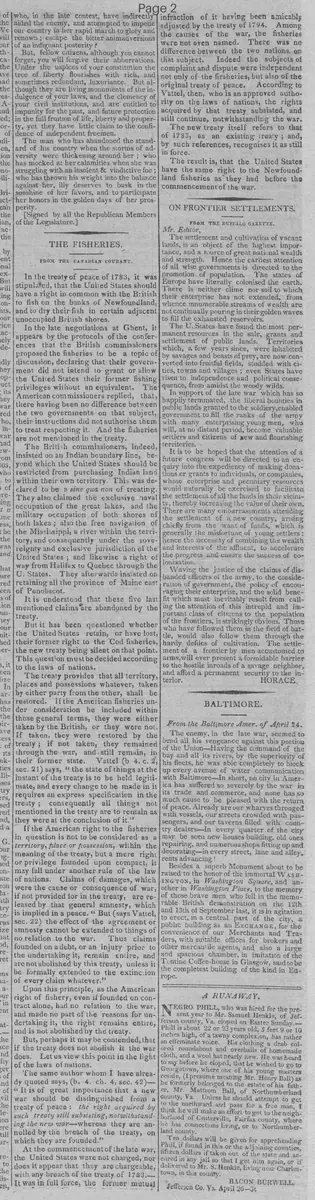
FROM THE CANADIAN COURANT.
In the treaty of peace of 1783, it was stipulated, that the United States should have a right in common with the British to fish on the banks of Newfoundland and to dry their fish in certain adjacent unoccupied British shores.
In the late negotiations at Ghent, it appears by the protocols of the conferences that the British commissioners proposed the fisheries to be a topic of discussion, declaring that their government did not intend to grant or allow the United States their former fishing privileges without an equivalent. The American commissioners replied, that, there having been no difference between the two governments on that subject, their instructions did not authorise them to treat respecting it. And the fisheries are not mentioned in the treaty.
The British commissioners, indeed, insisted on an Indian boundary line, beyond which the United States should be restricted from purchasing Indian land within their own territory. This was declared to be a sine qua non of treating. They also claimed the exclusive naval occupation of the great lakes, and the military occupation of both shores of both lakes; also the free navigation of the Mississippi, a river within the territory, and consequently under the sovereignty and exclusive jurisdiction of the United States ; and likewise a right of way from Halifax to Quebec through the U. States. They afterwards insisted on retaining all the province of Maine east of Penobscot.
It is understood that these five last mentioned claims are abandoned by the treaty.
But it has been questioned whether the United States retain, or have lost, their former right to the Cod fisheries, the new treaty being silent on that point. This question must be decided according to the laws of nations.
The treaty provides that all territory. places and possessions whatever, taken by either party from the other, shall be restored. If the American fisheries under consideration be included within those general terms, they were either taken by the British, or they were not. If taken, they were restored by the treaty; if not taken, they remained through the war, and still remain, in their former state. Vattel (b 4. c. 2, sec. 21) says, " the state of things at the instant of the treaty is to be held legitimate, and every change to be made in it requires an express specification in the treaty; consequently all things not mentioned in the treaty are to remain as they were at the conclusion of it."
If the American right to the fisheries in question is not to be considered as a territory, place or possession, within the meaning of the treaty, but a mere right or privilege founded upon compact, it may fall under another rule of the law of nations. Claims of damages, which were the cause or consequence of war, if not provided for in the treaty, are released by that general amnesty, which is implied in a peace. " But (says Vattel, sec. 22) the effect of the agreement or amnesty cannot be extended to things of no relation to the war. Thus claims founded on a debt, or an injury prior to the undertaking it, remain entire, and are not abolished by this treaty, unless it be formally extended to the extinction of every claim whatever."
Upon this principle, as the American right of fishery, even if founded on contract alone, had no relation to the war, and made no part of the reasons for undertaking it, the right remains entire, and is not abolished by the treaty.
But, perhaps it may be contended, that if the treaty does not abolish it the war does. Let us view this point in the light of the laws of nations.
The same author whom I have already quoted says, (b. 4. ch. 4, sec. 42)-- "It is of great importance that a new war should be distinguished from a treaty of peace: the right acquired by such treaty still subsisting, notwithstanding the new war--whereas they are annulled by the breach of the treaty, on which they are founded."
At the commencement of the late war, the United States were not charged, nor does it appear that they are chargeable, with any breach of the treaty of 1783. It was in full force, the former mutual infraction of it having been amicably adjusted by the treaty of 1794. Among the causes of the war, the fisheries were not even named. There was no difference between the two nations on that subject. Indeed the subjects of complaint and dispute were independent not only of the fisheries, but also of the original treaty of peace. According to Vattel, then, who is an approved authority on the laws of nations, the rights acquired by that treaty subsisted, and still continue, notwithstanding the war.
The new treaty itself refers to that of 1783, as an existing treaty; and, by such references, recognises it as still in force.
The result is, that the United States have the same right to the Newfoundland fisheries as they had before the commencement of the war.
What sub-type of article is it?
What keywords are associated?
Where did it happen?
Foreign News Details
Primary Location
Newfoundland
Event Date
1783 And 1814
Outcome
united states retain fishing rights on newfoundland banks as per 1783 treaty, unaffected by war of 1812 or ghent treaty.
Event Details
Analysis of 1783 treaty stipulating US rights to fish on Newfoundland banks and dry fish on adjacent shores. British proposed discussing fisheries at Ghent but Americans declined as no dispute existed; treaty silent on it. Other British claims abandoned. Per laws of nations (Vattel), rights persist as not related to war and treaty restores status quo.