Thank you for visiting SNEWPapers!
Sign up free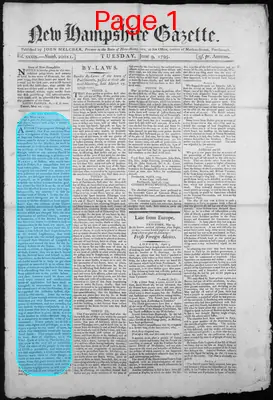
Letter to Editor
June 9, 1795
The New Hampshire Gazette
Portsmouth, Rockingham County, New Hampshire
What is this article about?
A letter criticizes federal court practices that deny debtors prison limits upon execution, citing the case of Mr. Warren in Boston. It urges citizens to petition legislatures to request Congress amend judiciary laws to protect personal liberty, aligning with state practices and constitutional rights.
Clipping
OCR Quality
98%
Excellent
Full Text
FOR THE GAZETTE.
Mr. Melcher,
Please to give the following a place in your next paper, and you will oblige a number of your Customers.
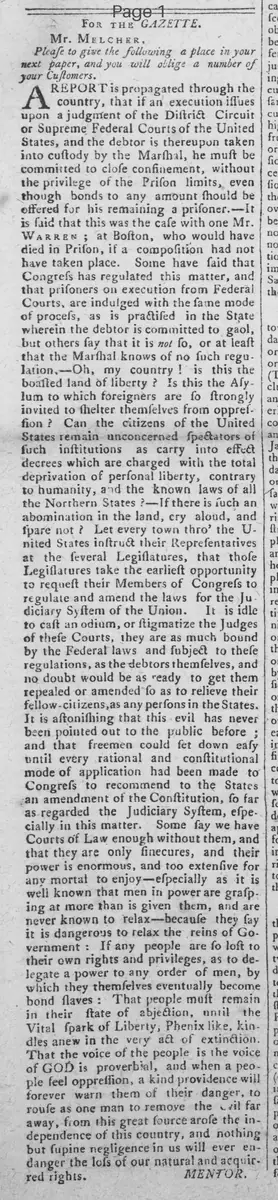
REPORT is propagated through the country, that if an execution issues upon a judgment of the District Circuit or Supreme Federal Courts of the United States, and the debtor is thereupon taken into custody by the Marshal, he must be committed to close confinement, without the privilege of the Prison limits, even though bonds to any amount should be offered for his remaining a prisoner.--It is said that this was the case with one Mr. WARREN; at Boston, who would have died in Prison, if a composition had not have taken place. Some have said that Congress has regulated this matter, and that prisoners on execution from Federal Courts, are indulged with the same mode of process, as is practiced in the State wherein the debtor is committed to gaol, but others say that it is not so, or at least that the Marshal knows of no such regulation,--Oh, my country! is this the boasted land of liberty? Is this the Asylum to which foreigners are so strongly invited to shelter themselves from oppression? Can the citizens of the United States remain unconcerned spectators of such institutions as carry into effect decrees which are charged with the total deprivation of personal liberty, contrary to humanity, and the known laws of all the Northern States?--If there is such an abomination in the land, cry aloud, and spare not? Let every town thro' the United States instruct their Representatives at the several Legislatures, that those Legislatures take the earliest opportunity to request their Members of Congress to regulate and amend the laws for the Judiciary System of the Union. It is idle to cast an odium, or stigmatize the Judges of these Courts, they are as much bound by the Federal laws and subject to these regulations, as the debtors themselves, and no doubt would be as ready to get them repealed or amended so as to relieve their fellow-citizens, as any persons in the States. It is astonishing that this evil has never been pointed out to the public before: and that freemen could set down easy until every rational and constitutional mode of application had been made to Congress to recommend to the States --an amendment of the Constitution, so far as regarded the Judiciary System, especially in this matter. Some say we have Courts of Law enough without them, and that they are only sinecures, and their power is enormous, and too extensive for any mortal to enjoy--especially as it is well known that men in power are grasping at more than is given them, and are never known to relax--because they say it is dangerous to relax the reins of Government: If any people are so lost to their own rights and privileges, as to delegate a power to any order of men, by which they themselves eventually become bond slaves: That people must remain in their state of abjection, until the Vital spark of Liberty, Phoenix like, kindles anew in the very act of extinction. That the voice of the people is the voice of GOD is proverbial, and when a people feel oppression, a kind providence will forever warn them of their danger, to rouse as one man to remove the evil far away, from this great source arose the independence of this country, and nothing but supine negligence in us will ever endanger the loss of our natural and acquired rights.
MENTOR.
Mr. Melcher,
Please to give the following a place in your next paper, and you will oblige a number of your Customers.
REPORT is propagated through the country, that if an execution issues upon a judgment of the District Circuit or Supreme Federal Courts of the United States, and the debtor is thereupon taken into custody by the Marshal, he must be committed to close confinement, without the privilege of the Prison limits, even though bonds to any amount should be offered for his remaining a prisoner.--It is said that this was the case with one Mr. WARREN; at Boston, who would have died in Prison, if a composition had not have taken place. Some have said that Congress has regulated this matter, and that prisoners on execution from Federal Courts, are indulged with the same mode of process, as is practiced in the State wherein the debtor is committed to gaol, but others say that it is not so, or at least that the Marshal knows of no such regulation,--Oh, my country! is this the boasted land of liberty? Is this the Asylum to which foreigners are so strongly invited to shelter themselves from oppression? Can the citizens of the United States remain unconcerned spectators of such institutions as carry into effect decrees which are charged with the total deprivation of personal liberty, contrary to humanity, and the known laws of all the Northern States?--If there is such an abomination in the land, cry aloud, and spare not? Let every town thro' the United States instruct their Representatives at the several Legislatures, that those Legislatures take the earliest opportunity to request their Members of Congress to regulate and amend the laws for the Judiciary System of the Union. It is idle to cast an odium, or stigmatize the Judges of these Courts, they are as much bound by the Federal laws and subject to these regulations, as the debtors themselves, and no doubt would be as ready to get them repealed or amended so as to relieve their fellow-citizens, as any persons in the States. It is astonishing that this evil has never been pointed out to the public before: and that freemen could set down easy until every rational and constitutional mode of application had been made to Congress to recommend to the States --an amendment of the Constitution, so far as regarded the Judiciary System, especially in this matter. Some say we have Courts of Law enough without them, and that they are only sinecures, and their power is enormous, and too extensive for any mortal to enjoy--especially as it is well known that men in power are grasping at more than is given them, and are never known to relax--because they say it is dangerous to relax the reins of Government: If any people are so lost to their own rights and privileges, as to delegate a power to any order of men, by which they themselves eventually become bond slaves: That people must remain in their state of abjection, until the Vital spark of Liberty, Phoenix like, kindles anew in the very act of extinction. That the voice of the people is the voice of GOD is proverbial, and when a people feel oppression, a kind providence will forever warn them of their danger, to rouse as one man to remove the evil far away, from this great source arose the independence of this country, and nothing but supine negligence in us will ever endanger the loss of our natural and acquired rights.
MENTOR.
What sub-type of article is it?
Persuasive
Political
Provocative
What themes does it cover?
Constitutional Rights
Crime Punishment
Politics
What keywords are associated?
Federal Courts
Debtor Imprisonment
Prison Limits
Judiciary Reform
Personal Liberty
Constitutional Amendment
Marshal Custody
What entities or persons were involved?
Mentor.
Mr. Melcher
Letter to Editor Details
Author
Mentor.
Recipient
Mr. Melcher
Main Argument
federal court executions lead to debtors' close confinement without prison limits, denying liberty contrary to state laws; citizens should urge legislatures to request congress amend judiciary laws and possibly the constitution to protect personal freedom.
Notable Details
Case Of Mr. Warren In Boston Who Nearly Died In Prison
Call To Instruct Representatives And Cry Aloud Against The Abomination
References To Voice Of The People As Voice Of God And Phoenix Like Revival Of Liberty