Thank you for visiting SNEWPapers!
Sign up free
The National Intelligencer And Washington Advertiser
Washington, District Of Columbia
What is this article about?
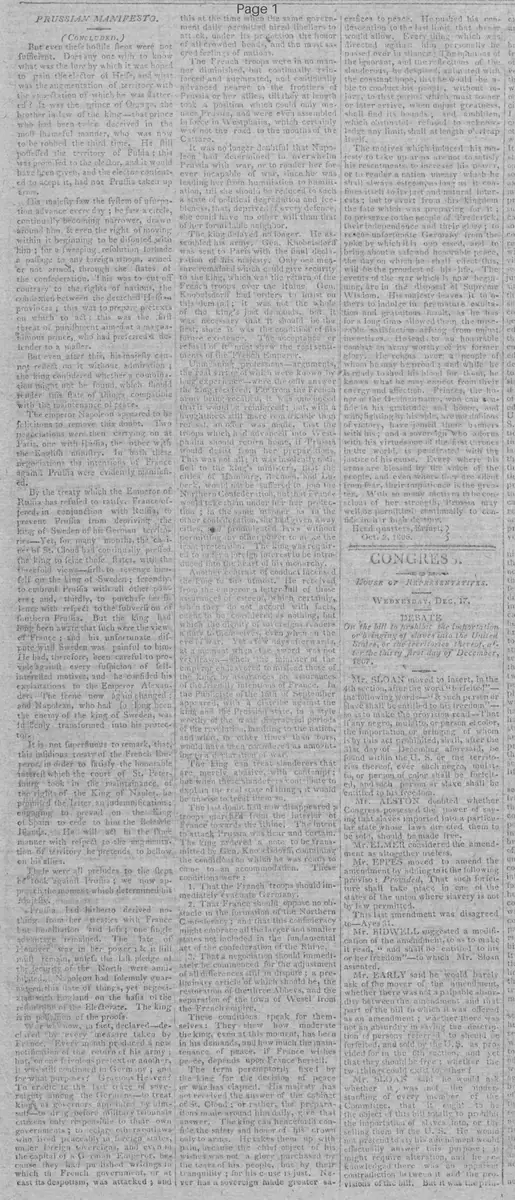
The Prussian King's manifesto (conclusion) details grievances against Napoleon, including territorial encroachments, failed negotiations, and French military threats in Germany, justifying Prussia's declaration of war. Issued from Erfurt on October 2, 1806.
Clipping
OCR Quality
Full Text
(CONCLUDED.)
But even these hostile terms were not sufficient. Does any one wish to know what was the lure by which it was hoped to gain the Elector of Hesse, and what was the augmentation of territory with the expectation of which he was flattered? It was the prince of Orange, the brother-in-law of the king—that prince who had been twice deceived in the most shameful manner, who was now to be robbed the third time. He still possessed the territory of Fulda: this was promised to the elector, and it would have been given, and the elector consented to accept it, had not Prussia taken up arms.
His majesty saw the germ of usurpation advance every day; he saw a circle, continually becoming narrower, drawn around him & even the right of moving within it beginning to be disputed with him: for a sweeping resolution forbade a passage to any foreign troops, armed or not armed, through the states of the confederation. This was to cut off, contrary to the rights of nations, the cohesion between the detached Hessian provinces; this was to prepare pretexts on which to act: this was the first threat of punishment aimed at a magnanimous prince, who had preferred a defender to a master.
But even after this, his majesty cannot reflect on it without admiration; the king considered whether a combination might not be found, which should render this state of things compatible with the maintenance of peace.
The emperor Napoleon appeared to be solicitous to remove this doubt. Two negotiations were then carrying on at Paris, one with Russia, the other with the English ministry. In both these negotiations the intentions of France against Prussia were evidently manifested.
By the treaty which the Emperor of Russia has refused to ratify, France offered, in conjunction with Russia, to prevent Prussia from depriving the king of Sweden of his German territories—Yet, for many months, the cabinet of St. Cloud had continually pressed the king to seize those states, with the threefold views—first to revenge himself on the king of Sweden: secondly, to embroil Prussia with all other powers; and, thirdly, to purchase her silence with respect to the subversion of northern Prussia. But the king had long been aware that such were the views of France: and his unfortunate dispute with Sweden was painful to him.
He had, therefore, been careful to provide against every suspicion of self-interested motives, and he confided his explanations to the Emperor Alexander. The scene now again changed; and Napoleon, who had so long been the enemy of the king of Sweden, was suddenly transformed into his protector.
It is not superfluous to remark, that, this insidious treaty of the French Emperor, in order to satisfy the honorable interest which the court of St. Petersburg took in the maintenance of the rights of the King of Naples, he promised the latter an indemnification; engaging to prevail on the King of Spain to cede to him the Balearic Islands. He will act in the same manner with respect to the augmentation of territory he pretends to bestow on his allies.
These were all preludes to the steps he took against Prussia; we now approach the moment which determined his Majesty's decision.
Prussia had hitherto derived nothing from her treaties with France but humiliation and loss; one single advantage remained. The state of Hanover was in her power: & it still must remain, unless the last pledge of the security of the North were annihilated. Napoleon had solemnly guaranteed this state of things, yet negotiations with England on the basis of this restoration of the Electorate. The king is in possession of the proofs.
War was now, in fact, declared by every measure taken by France. Every month produced a new notification of the return of his army; but, on one frivolous pretext or another, it was still continued in Germany; and for what purposes? (Gracious Heaven!) To eradicate the last trace of sovereignty among the German—to treat kings as governors appointed by himself—to drag before military tribunals citizens only responsible to their own governments; to declare others outlaws who lived peaceably in foreign states, under foreign sovereigns, and even in the capital of a German Emperor, because they had published writings in which the French government, or at least its despotism, was attacked; and this at the time when the same government daily permitted hired libellers, to attack, under its protection the honor of all crowned heads, and the most sacred feelings of nations.
The French troops were in no manner diminished, but continually reinforced and augmented, and continually advanced nearer to the frontiers of Prussia or her allies, till they at length took a position which could only menace Prussia, and were even assembled in force in Westphalia, which certainly was not the road to the mouths of the Cattaro.
It was no longer doubtful that Napoleon had determined to overwhelm Prussia with war, or to render her for ever incapable of war, since he was leading her from humiliation to humiliation, till she should be reduced to such a state of political degradation and feebleness, that, deprived of every defence, she could have no other will than that of her formidable neighbor.
The king delayed no longer. He assembled his army. Gen. Knobelsdorff was sent to Paris with the final declaration of his majesty. Only one measure remained which could give security to the king, which was the return of the French troops over the Rhine. Gen. Knobelsdorff had orders to insist on this demand; it was not the whole of the king's just demands, but it was necessary that it should be the first, since it was the condition of his future existence. The acceptance or refusal of it must show the real sentiments of the French Emperor.
Unmeaning professions—arguments, the real worth of which were known by long experience—were the only answer the king received. Far from the French army being recalled, it was announced that it would be reinforced; but, with a haughtiness still more remarkable than refusal, an offer was made, that the troops which had advanced into Westphalia should return home, if Prussia would desist from her preparations.
This was not all; it was insolently notified to the king's ministers, that the cities of Hamburg, Bremen, and Lubeck, would not be suffered to join any Northern Confederation, but that France would take them under her protection; in the same manner as in the other confederation, she had given away cities, and promulgated laws without permitting any other power to make the least pretension. The King was required to suffer a foreign interest to be introduced into the heart of his monarchy.
Another contrast of conduct incensed the King to the utmost. He received from the emperor a letter full of those assurances of esteem, which, certainly, when they do not accord with facts, ought to be considered as nothing, but which the dignity of sovereigns renders it a duty to themselves, even when on the eve of war. Yet a few days afterwards, at a moment when the sword was not yet drawn—When the minister of the emperor endeavored to mislead those of the King, by assurances on assurances of the friendly intentions of France. In the Publiciste of the 18th of September appeared, with a diatribe against the king and the Prussian state, in a style worthy of the most disgraceful periods of the revolution, insulting to the nation, and what, in other times than ours, would have been considered as amounting to a declaration of war.
The king can treat slanderers that are merely abusive, with contempt; but when these slanderers contribute to explain the real state of things, it would be unwise to treat them so.
The last doubt had now disappeared; troops marched from the interior of France towards the Rhine. The intent to attack Prussia was clear and certain.
The king ordered a note to be transmitted by Gen. Knobelsdorff, containing the conditions on which he was ready to come to an accommodation. These conditions were:
1. That the French troops should immediately evacuate Germany.
2. That France should oppose no obstacle in the formation of the Northern Confederacy; and that this confederacy might embrace all the larger and smaller states not included in the fundamental act of the confederation of the Rhine.
3. That a negotiation should immediately be commenced for the adjustment of all differences still in dispute; a preliminary article of which should be, the restoration of the three Abbeys, and the separation of the town of Wesel from the French empire.
These conditions speak for themselves: They show how moderate the king, even at this moment, has been in his demands, and how much the maintenance of peace, if France wishes peace, depends upon France herself.
The term peremptorily fixed by the King for the decision of peace or war has elapsed. His majesty has not received the answer of the cabinet of St. Cloud; or rather, the preparations made around him daily, give that answer. The king can henceforth confide the safety and honor of his crown only to arms. He takes them up with pain, because the chief object of his wishes was not a glory purchased by the tears of his people, but by their tranquility; for his cause is just. Never has a sovereign made greater sacrifices to peace. He paused his condescension to the last limit that honor would allow. Every thing which was directed against him personally he passed over in silence. The opinions of the ignorant, and the reflections of the slanderous, he despised, and contented with the constant hope, that he would be able to conduct his people, without injury, to that period which must sooner or later arrive, when unjust greatness, shall find its bounds; and ambition, which obstinately refused to acknowledge any limit, shall at length overleap itself.
The motives which induced his majesty to take up arms are not to satisfy his resentments, to increase his power, or to render a nation uneasy with which he shall always esteem, as long as it confines itself to its just and natural interests; but to avert from his kingdom the fate which was preparing for it; to preserve to the people of Frederick their independence and their glory; to rescue unfortunate Germany from the yoke by which it is oppressed, and to bring about a safe and honorable peace, the day on which he shall effect this, will be the proudest of his life. The events of the war which is now beginning, are in the disposal of Supreme Wisdom. His majesty leaves it to others to indulge in premature exultation and gratuitous insult, as he has for a long time allowed them the miserable satisfaction arising from unjust invectives. He goes to an honorable combat an army worthy of its former glory. He reigns over a people of whom he may be proud; and while he is ready to shed his blood for them, he knows what he may expect from their energy and affection. Princes, the honor of the German name, who can confide in his gratitude and honor, and who, fighting by his side, are not dubious of victory, have joined their banners with his; and a sovereign who adorns with his virtues one of the first thrones in the World, is penetrated with the justice of his cause. Every where his arms are blessed by the voice of the people, and even where they are silent from fear, their impatience is the greater. With so many motives to be conscious of her strength, Prussia may well depend entirely to confide in her high destiny.
Head quarters, Erfurt, Oct. 2, 1806.
What sub-type of article is it?
What keywords are associated?
What entities or persons were involved?
Where did it happen?
Foreign News Details
Primary Location
Prussia
Event Date
Oct. 2, 1806
Key Persons
Outcome
prussia assembles army and declares war on france after failed negotiations and french military threats; conditions for peace unmet.
Event Details
The Prussian King outlines escalating French aggressions, including territorial promises to allies, military reinforcements in Germany, failed diplomacy with demands for French troop evacuation, and insults in French press, leading to Prussia taking up arms to defend independence and liberate Germany.