Thank you for visiting SNEWPapers!
Sign up free
The Enquirer
Richmond, Henrico County, Virginia
What is this article about?
Diplomatic exchanges in London between US Ministers Monroe and Pinkney and British Foreign Secretary Canning in October 1807, addressing the unratified 1806 treaty, French decrees, impressment from US vessels, and the Chesapeake-Leopard incident. Includes Monroe's February 1808 letter to Madison defending the negotiations.
Merged-components note: These components form a continuous diplomatic correspondence (public documents, Part III and start of Part IV) on US-UK treaty negotiations and impressment, indicated by sequential reading order and explicit continuation in text.
Clippings
1 of 2
OCR Quality
Full Text
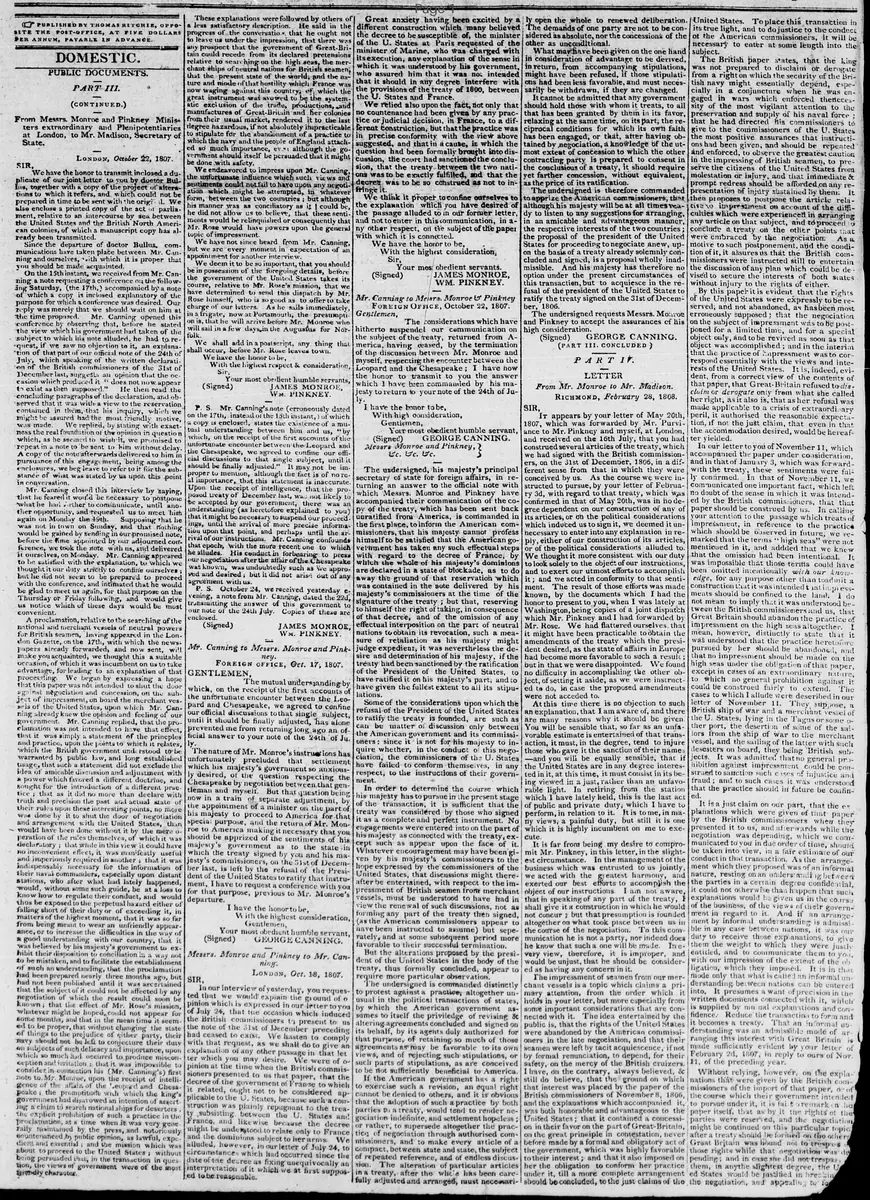
DOMESTIC.
PUBLIC DOCUMENTS.
PART III (continued.)
From Messrs. Monroe and Pinkney Ministers extraordinary and Plenipotentiaries at London, to Mr. Madison, Secretary of State.
London, October 22, 1807.
SIR,
We have the honor to transmit inclosed a duplicate of our joint letter to you by doctor Bullus, together with a copy of the project of alterations to which it refers, and which could not be prepared in time to be sent with the original. We also enclose a printed copy of the act of parliament, relative to an intercourse by sea between the United States and the British North American colonies, of which a manuscript copy has already been transmitted.
Since the departure of doctor Bullus, communications have taken place between Mr. Canning and ourselves, with which it is proper that you should be made acquainted.
On the 15th instant, we received from Mr. Canning a note requesting a conference on the following Saturday, (the 17th,) accompanied by a note of which a copy is inclosed explanatory of the purpose for which a conference was desired. Our reply was merely that we should wait on him at the time proposed. Mr. Canning opened this conference by observing that, before he stated the view which his government had taken of the subject to which his note alluded, he had to request, if we saw no objection to it, an explanation of that part of our official note of the 24th of July, which speaking of the written declaration of the British commissioners of the 31st of December last, suggests an opinion that the occasion which produced it "does not now appear to exist as then supposed."
He then read the concluding paragraphs of the declaration, and observed that it was with a view to the reservation contained in them, that his inquiry, which we might be assured had the most friendly motive, was made. We replied, by stating with exactness the real foundation of the opinion in question which, as he seemed to wish it, we promised to repeat in a note to be sent to him without delay. A copy of the note afterwards delivered to him in pursuance of this engagement, being among the enclosures, we beg leave to refer to it for the substance of what was stated by us upon this point in conversation.
Mr. Canning closed this interview by saying, that he feared it would be necessary to postpone what he had further to communicate, until another opportunity, and requested us to meet him again on Monday the 19th. Supposing that he was not in town on Sunday, and that nothing would be gained by sending in our promised note, before the time appointed by our adjourned conference, we took the note with us, and delivered it ourselves, on Monday. Mr. Canning appeared to be satisfied with the explanation, to which we thought it our duty strictly to confine ourselves; but he did not seem to be prepared to proceed with the conference, and intimated that he would be glad to meet us again, for that purpose on the Thursday or Friday following, and would give us notice which of these days would be most convenient.
A proclamation, relative to the searching of the national and merchant vessels of neutral powers for British seamen, having appeared in the London Gazette, on the 17th, with which the newspapers already forwarded, and now sent, will make you acquainted, we thought this a suitable occasion, of which it was incumbent on us to take advantage, for leading to an explanation of that proceeding. We began by expressing a hope that this paper was not intended to shut the door against negociation and concession, on the subject of impressment, on board the merchant vessels of the United States, upon which Mr. Canning already knew the opinion and feeling of our government. Mr. Canning replied, that the proclamation was not intended to have that effect, that it was simply a statement of the principles and practice, upon the points to which it relates, which the British government understood to be warranted by public law, and long established usage, that such a statement did not exclude the idea of amicable discussion and adjustment with a power which favored a different doctrine, and sought for the introduction of a different practice ; that as it did no more than declare with truth and precision the past and actual state of their rules upon these interesting points, no more was done by it to shut the door of negotiation and arrangement with the United States, than would have been done without it by the mere operation of the rules themselves, of which it was declaratory ; that while in this view it could have no inconvenient effect, it was manifestly useful and imperiously required in another ; that it was indispensably necessary for the information of their naval commanders, especially upon distant stations, who after what had lately happened, would, without some such guide, be at a loss to know how to regulate their conduct, and would thus be exposed to the perpetual hazard either of falling short of their duty or of exceeding it, in matters of the highest moment, that it was so far from being meant to wear an unfriendly appearance, or to increase the difficulties in the way of a good understanding with our country, that it was believed by his majesty's government to exhibit their disposition to conciliation in a way not to be mistaken, and to facilitate the establishment of such an understanding, that the proclamation had been prepared nearly three months ago, but had not been published until it was ascertained that the subject of it could not be affected by any negotiation of which the result could soon be known; that the effect of Mr. Rose's mission, whatever might be hoped, could not appear for some months, and that in the mean time it seemed to be proper, that without changing the state of things to the prejudice of either party, their navy should not be left to conjecture their duty on subjects of such delicacy and importance, upon which so much had occurred to produce misconception and irritation; that it was impossible to consider in connection his (Mr. Canning's) first note to Mr. Monroe, upon the receipt of intelligence of the affair of the Leopard and Chesapeake; the promptitude with which the king's government had disavowed an intention of asserting a claim to search national ships for deserters. the explicit prohibition of such a practice in the proclamation, at a time when it was very generally maintained by the press, and notoriously countenanced by public opinion, as lawful, expedient and essential ; and the mission which was about to proceed to the United States ; without being persuaded that, in the transaction in question, the views of government were of the most friendly character.
These explanations were followed by others of less satisfactory description. He said in the progress of the conversation, that he ought not to leave us under the impression, that there was any prospect that the government of Great-Britain could recede from its declared pretensions relative to searching on the high seas, the merchant ships of neutral nations for British seamen; that the present state of the world; and the nature and mode of that hostility which France was now waging against this country; of, which the great instrument was avowed to be the systematic exclusion of the trade, productions, and manufactures of Great-Britain and her colonies from their usual market, rendered it to the last degree hazardous, if not absolutely impracticable to stipulate for the abandonment of a practice to which the navy and the people of England attached so much importance, even although the government should itself be persuaded that it might be done with safety,
We endeavored to impress upon Mr. Canning, the unfortunate influence which such views and sentiments could not fail to have upon any negotiation which might be attempted, in whatever form, between the two countries; but although his manner was as conciliatory as it could be, he did not allow us to believe, that these sentiments would be relinquished or consequently that Mr. Rose would have powers upon the general topic of impressment.
We have not since heard from Mr. Canning, but we are every moment in expectation of an appointment for another interview.
We deem it to be so important, that you should be in possession of the foregoing details, before the government of the United States takes its course, relative to Mr. Rose's mission, that we have determined to send this dispatch by Mr. Rose himself, who is so good as to offer to take charge of our letters. As he sails immediately, in a frigate, now at Portsmouth, the presumption is, that he will arrive before Mr. Monroe who will sail in a few days in the Augustus for Norfolk.
We shall add in a postscript, any thing that shall occur, before Mr. Rose leaves town.
We have the honor to be,
With the highest respect & consideration,
Sir,
Your most obedient humble servants,
(Signed) JAMES MONROE,
WM. PINKNEY.
P. S. Mr. Canning's note (erroneously dated on the 17th, instead of the 15th instant,) of which a copy is enclosed, states the existence of a mutual understanding between him and us, "by which, on the receipt of the first accounts of the unfortunate encounter between the Leopard and the Chesapeake, we agreed to confine our official discussions to that single subject, until it should be finally adjusted." It may not be improper to mention, although the fact is of no real importance, that this statement is inaccurate. Upon the receipt of intelligence, that the proposed treaty of December last, was not likely to be accepted by our government, there was an understanding (as heretofore explained to you) that it might be necessary to suspend our proceedings, until the arrival of more precise information upon that point, and perhaps until the arrival of our instructions. Mr. Canning confounds that epoch, with the more recent one to which he alludes. His conduct in forbearing to press our negotiation after the affair of the Chesapeake was known, was undoubtedly such as we approved and desired; but it did not arise out of any agreement with us.
P. S. October 24, we received yesterday evening, a note from Mr. Canning, dated the 22d, transmitting the answer of this government to our note of the 24th July. Copies of these are enclosed.
(Signed) JAMES MONROE,
WM. PINKNEY.
Mr. Canning to Messrs. Monroe and Pinkney.
Foreign Office, Oct. 17, 1807.
GENTLEMEN,
The mutual understanding by which, on the receipt of the first accounts of the unfortunate encounter between the Leopard and Chesapeake, we agreed to confine our official discussions to that single subject, until it should be finally adjusted, has alone prevented me from returning long ago an official answer to your note of the 24th of July.
The nature of Mr. Monroe's instructions has unfortunately precluded that settlement which his majesty's government so anxiously desired, of the question respecting the Chesapeake by negotiation between that gentleman and myself. But that question being now in a train of separate adjustment, by the appointment of a minister on the part of his majesty to proceed to America for that special purpose, and the return of Mr. Monroe to America making it necessary that you should be apprized of the sentiments of his majesty's government as to the state in which the treaty signed by you and his majesty's commissioners, on the 31st of December last, is left by the refusal of the President of the United States to ratify that instrument, I have to request a conference with you for that purpose, previous to Mr. Monroe's departure.
I have the honor to be,
With the highest consideration,
Gentlemen,
Your most obedient humble servant,
(Signed) GEORGE CANNING.
Messrs. Monroe and Pinkney to Mr. Canning.
London, Oct. 18, 1807.
SIR,
In our interview of yesterday, you requested that we would explain the ground of opinion which is expressed in our letter to you of July 24, that the occasion which induced the British commissioners to present to us the note of the 31st of December preceding had ceased to exist. We hasten to comply with that request, as we shall do to give an explanation of any other passage in that letter which you may desire. We were of opinion at the time when the British commissioners presented to us that paper, that the decree of the government of France to which it related, ought not to be considered applicable to the U. States, because such a construction was plainly repugnant to the treaty subsisting between the U. States and France, and likewise because the decree might be understood to relate only to France and the dominions subject to her arms. We alluded, however, in our letter of July 24, to circumstances which had occurred since the date of the decree as fixing unequivocally an interpretation of it which we at first supposed to be reasonable.
Great anxiety having been excited by a different construction which many believed the decree to be susceptible of, the minister of the U. States at Paris requested of the minister of Marine, who was charged with its execution, any explanation of the sense in which it was understood by his government, who assured him that it was not intended that it should in any degree interfere with the provisions of the treaty of 1800, between the U. States and France.
We relied also upon the fact, not only that no countenance had been given by any practice or judicial decision, in France, to a different construction, but that the practice was in precise conformity with the view above suggested, and that in a cause, in which the question had been formally brought into discussion, the court had sanctioned the conclusion, that the treaty between the two nations was to be exactly fulfilled, and that the decree was to be so construed as not to infringe it.
We think it proper to confine ourselves to the explanation which you have desired of the passage alluded to in our former letter, and not to enter in this communication, in any other respect, on the subject of the paper with which it is connected.
We have the honor to be,
With the highest consideration,
Sir,
Your most obedient servants.
(Signed) JAMES MONROE,
WM. PINKNEY.
Mr. Canning to Messrs. Monroe & Pinkney
Foreign Office, October 22, 1807.
Gentlemen,
The considerations which have hitherto suspended our communication on the subject of the treaty, returned from America, having ceased, by the termination of the discussion between Mr. Monroe and myself, respecting the encounter between the Leopard and the Chesapeake; I have now the honor to transmit to you the answer which I have been commanded by his majesty to return to your note of the 24th of July.
I have the honor to be,
With high consideration,
Gentlemen,
Your most obedient humble servant,
(Signed) GEORGE CANNING.
Messrs Monroe and Pinkney, &c. &c. &c.
The undersigned, his majesty's principal secretary of state for foreign affairs, in returning an answer to the official note with which Messrs. Monroe and Pinkney have accompanied their communication of the copy of the treaty, which has been sent back unratified from America, is commanded in the first place. to inform the American commissioners, that his majesty cannot profess himself to be satisfied that the American government has taken any such effectual steps with regard to the decree of France, by which the whole of his majesty's dominions are declared in a state of blockade, as to do away the ground of that reservation which was contained in the note delivered by his majesty's commissioners at the time of the signature of the treaty ; but that, reserving to himself the right of taking, in consequence of that decree, and of the omission of any effectual interposition on the part of neutral nations to obtain its revocation, such a measure of retaliation as his majesty might judge expedient, it was nevertheless the desire and determination of his majesty, if the treaty had been sanctioned by the ratification of the President of the United States, to have ratified it on his majesty's part; and to have given the fullest extent to all its stipulations.
Some of the considerations upon which the refusal of the President of the United States to ratify the treaty is founded, are such as can be matter of discussion only between the American government and its commissioners: since it is not for his majesty to inquire whether, in the conduct of this negotiation, the commissioners of the U. States have failed to conform themselves, in any respect, to the instructions of their government.
In order to determine the course which his majesty has to pursue in the present stage of the transaction, it is sufficient that the treaty was considered by those who signed it as a complete and perfect instrument. No engagements were entered into on the part of his majesty as connected with the treaty, except such as appear upon the face of it. Whatever encouragement may have been given by his majesty's commissioners to the hope expressed by the commissioners of the United States, that discussions might thereafter be entertained, with respect to the impressment of British seamen from merchant vessels, must be understood to have had in view the renewal of such discussions, not as forming any part of the treaty then signed, (as the American commissioners appear to have been instructed to assume) but separately, and at some subsequent period more favorable to their successful termination.
But the alterations proposed by the president of the United States in the body of the treaty, thus formally concluded, appear to require more particular observation.
The undersigned is commanded distinctly to protest against a practice, altogether unusual in the political transactions of states, by which the American government assumes to itself the privilege of revising. & altering agreements concluded and signed on its behalf, by its agents duly authorized for that purpose, of retaining so much of those agreements as may be favorable to its own views, and of rejecting such stipulations, or such parts of stipulations, as are conceived to be not sufficiently beneficial to America. If the American government has a right to exercise such a revision, an equal right cannot be denied to others, and it is obvious that the adoption of such a practice by both parties to a treaty, would tend to render negotiation indefinite, and settlement hopeless; or rather, to supersede altogether the practice of negotiation through authorised commissioners, and to make every article of a compact, between state and state, the subject of repeated reference, and of endless discussion. The alteration of particular articles in a treaty, after the whole has been carefully adjusted and arranged, must necessarily open the whole to renewed deliberation The demands of one party are not to be considered as absolute, nor the concessions of the other as unconditional. What may have been given on the one hand in consideration of advantage to be derived, in return, from accompanying stipulations, might have been refused, if those stipulations had been less favorable, and must necessarily be withdrawn, if they are changed. It cannot be admitted that any government should hold those with whom it treats, to all that has been granted by them in its favor, relaxing at the same time, on its part; the reciprocal conditions for which its own faith has been engaged: or that, after having obtained by negotiation, a knowledge of the utmost extent of concession to which the other contracting party is prepared to consent in the conclusions of a treaty. it should require yet farther concession, without equivalent, as the price of its ratification.
The undersigned is therefore commanded to apprize the American commissioners, that although his majesty will be at all times ready to listen to any suggestions for arranging, in an amicable and advantageous manner, the respective interests of the two countries; the proposal of the president of the United States for proceeding to negotiate anew, upon the basis of a treaty already solemnly concluded and signed, is a proposal wholly inadmissible. And his majesty has therefore no option under the present circumstances of this transaction, but to acquiesce in the refusal of the president of the United States to ratify the treaty signed on the 31st of December, 1806.
The undersigned requests Messrs. Monroe and Pinkney to accept the assurances of his high consideration.
(Signed) GEORGE CANNING.
(PART III. CONCLUDED)
PART IV.
LETTER
From Mr. Monroe to Mr. Madison.
Richmond, February 28, 1808.
SIR,
It appears by your letter of May 20th, 1807, which was forwarded by Mr. Purviance to Mr. Pinkney and myself, at London, and received on the 16th July, that you had construed several articles of the treaty, which we had signed with the British commissioners, on the 31st of December, 1806, in a different sense from that in which they were conceived by us. As the course we were instructed to pursue, by your letter of February 3d, with regard to that treaty, which was confirmed in that of May 20th, was in no degree dependent on our construction of any of its articles, or on the political considerations which induced us to sign it, we deemed it unnecessary to enter into any explanation in reply, either of our construction of its articles, or of the political considerations alluded to. We thought it more consistent with our duty to look solely to the object of our instructions, and to exert our utmost efforts to accomplish it; and we acted in conformity to that sentiment. The result of those efforts was made known, by the documents which I had the honor to present to you, when I was lately at Washington, being copies of a joint dispatch which Mr. Pinkney and I had forwarded by Mr. Rose. We had flattered ourselves, that it might have been practicable to obtain the amendments of the treaty which the president desired, as the state of affairs in Europe had become more favorable to such a result ; but in that we were disappointed. We found no difficulty in accomplishing the other object, of setting it aside; as we were instructed to do, in case the proposed amendments were not acceded to.
At this time there is no objection to such an explanation, that I am aware of, and there are many reasons why it should be given. You will be sensible that, so far as an unfavorable estimate is entertained of that transaction, it must, in the degree, tend to injure those who gave it the sanction of their names --and you will be equally sensible, that if the United States are in any degree interested in it, at this time, it must consist in its being viewed in a just, rather than an unfavorable light. In retiring from the station which I have lately held, this is the last act of public and private duty; which I have to perform, in relation to it. It is to me, in many views; a painful duty, but still it is one which it is highly incumbent on me to execute.
It is far from being my desire to compromise Mr. Pinkney, in this letter, in the slightest circumstance. In the management of the business which was entrusted to us jointly, we acted with the greatest harmony, and exerted our best efforts to accomplish the object of our instructions. I am not aware, that in speaking of any part of the treaty, I shall give it a construction in which he would not concur ? but that presumption is founded altogether on what took place between us in the course of the negotiation. To this communication he is not a party, nor indeed does he know that such a one will be made. In every view, therefore, it is improper, and would be unjust, that he should be considered as having any concern in it.
The impressment of seamen from our merchant vessels is a topic which claims a primary attention, from the order which it holds in your letter, but more especially from some important considerations that are connected with it. The idea entertained by the public is, that the rights of the United States were abandoned by the American commissioners in the late negotiation, and that their seamen were left by tacit acquiescence, if not by formal renunciation, to depend, for their safety, on the mercy of the British cruizers. I have, on the contrary, always believed: & still do believe, that the ground on which that interest was placed by the paper of the British commissioners of November 8, 1806, and the explanations which accompanied it, was both honorable and advantageous to the United States : that it contained a concession in their favor on the part of Great-Britain. on the great principle in contestation, never before made by a formal and obligatory act of the government, which was highly favorable to their interest; and that it also imposed on her the obligation to conform her practice under it, till a more complete arrangement should be concluded, to the just claims of the United States. To place this transaction in its true light, and to do justice to the conduct of the American commissioners, it will be necessary to enter at some length into the subject.
The British paper states, that the king was not prepared to disclaim or derogate from a right on which the security of the British navy might essentially depend, especially in a conjuncture when he was engaged in wars which enforced the necessity of the most vigilant attention to the preservation and supply of his naval force ; that he had directed his commissioners to give to the commissioners of the U. States the most positive assurances that instructions had been given, and should be repeated and enforced, to observe the greatest caution in the impressing of British seamen, to prevent the citizens of the United States from molestation or injury, and that immediate & prompt redress should be afforded on any representation of injury sustained by them: It then proposes to postpone the article relative to impressment on account of the difficulties which were experienced in arranging any article on that subject, and to proceed to conclude a treaty on the other points that were embraced by the negotiation. As a motive to such postponement, and the condition of it, it assures us that the British commissioners were instructed still to entertain the discussion of any plan which could be devised to secure the interests of both states without injury to the rights of either.
By this paper it is evident that the rights of the United States were expressly to be reserved; and not abandoned, as has been most erroneously supposed; that the negotiation on the subject of impressment was to be postponed for a limited time, and for a special object only, and to be revived as soon as that object was accomplished; and in the interim that the practice of impressment was to correspond essentially with the views and interests of the United States. It is, indeed, evident, from a correct view of the contents of that paper, that Great-Britain refused to disclaim or derogate only from what she called her right, as it also is, that as her refusal was made applicable to a crisis of extraordinary peril, it authorized the reasonable expectation, if not the just claim, that even in that the accommodation desired, would be hereafter yielded.
In our letter to you of November 11, which accompanied the paper under consideration. and in that of January 3, which was forwarded with the treaty. these sentiments were fully confirmed. In that of November 11. we communicated one important fact, which left no doubt of the sense in which it was intended by the British commissioners, that that paper should be construed by us. In calling your attention to the passage which treats of impressment, in reference to the practice which should be observed in future, we remarked that the terms "high seas" were not mentioned in it, and added that we knew that the omission had been intentional. It was impossible that those terms could have been omitted intentionally with our knowledge, for any purpose other than to admit a construction that it was intended that impressments should be confined to the land: I do not mean to imply that it was understood between the British commissioners and us, that Great Britain should abandon the practice of impressment on the high seas altogether. I mean, however, distinctly to state that it was understood that the practice heretofore pursued by her should be abandoned, and that no impressment should be made on the high seas under the obligation of that paper, except in cases of an extraordinary nature, to which no general prohibition against it could be construed fairly to extend. The cases to which I allude were described in our letter of November 11. They suppose, a British ship of war and a merchant vessel of the U. States; lying in the Tagus or some other port, the desertion of some of the sailors from the ship of war to the merchant vessel, and the sailing of the latter with such deserters on board, they being British subjects. It was admitted that no general prohibition against impressment could be construed to sanction such cases of injustice and fraud; and to such cases it was understood that the practice should in future be confined.
It is a just claim on our part, that the explanations which were given of that paper by the British commissioners when they presented it to us, and afterwards while the negotiation was depending, which we communicated to you in due order of time, should be taken into view, in a fair estimate of our conduct in that transaction. As the arrangement which they proposed was of an informal nature, resting on an understanding between the parties in a certain degree confidential. it could not otherwise than happen that such explanations would be given us in the course of the business, of the views of their government in regard to it. And if an arrangement by informal understanding is admissible in any case between nations, it was our duty to receive those explanations, to give them the weight to which they were justly entitled, and to communicate them to you. with our impression of the extent of the obligation, which they imposed. It is in that mode only that what is called an informal understanding between nations can be entered into, It presumes a want of precision in the written documents connected with it, which is supplied by mutual explanations and confidence, Reduce the transaction to form and it becomes a treaty. That an informal understanding was an admissible mode of arranging this interest with Great Britain is made sufficiently evident by your letter of February 2d, 1807, in reply to ours of Nov. 11, of the preceding year.
Without relying, however, on the explanations that were given by the British commissioners of the import of that paper, or of the course which their government intended to pursue under it, it is fair to remark on the paper itself, that as by it the rights of the parties were reserved, and the negotiation might be continued on this particular topic after a treaty should be formed on the others Great Britain was bound not to trespass on those rights while that negotiation was depending; and in case she did not trespass, them, in any the slightest degree, the United States would be justified in breaking the negotiation, and appealing, to arms.
Vindication of their rights. The mere circumstance of entertaining amicable negotiation by one party for the adjustment of a controversy, where no right had been acknowledged in it by the other, gives to the latter a just claim to such forbearance on the part of the former. But the entertainment of a negotiation for the express purpose of securing interests sanctioned by acknowledged rights, makes such claim irresistible.
We were, therefore, decidedly of opinion, that the paper of the British commissioners placed the interest of impressment on ground which it was both safe and honorable for the United States to admit: that in short, it gave their government the command of the subject for every necessary and useful purpose. Attached to the treaty it was the basis or condition, on which the treaty rested. Strong in its character in their favor on the great question of right, and admitting a favorable construction on others, it placed them on more elevated ground in those respects than they had held before; and by keeping the negotiation open to obtain a more complete adjustment, the administration was armed with the most effectual means of securing it. By this arrangement the government possessed a power to coerce without being compelled to assume the character belonging to coercion, and was able to give effect to that power without violating the relations of amity between the countries. The right to break off the negotiation and appeal to force, could never be lost sight of in any discussion on the subject; while there was no obligation to make that appeal till necessity compelled it. If Great Britain conformed her practice to the rule prescribed by the paper of November 8, and the explanations which accompanied it, our government might rest on that ground with advantage; but if she departed from that rule and a favorable opportunity offered for the accomplishment of a more complete and satisfactory arrangement, by a decisive effort, it would be at liberty to seize such opportunity for the advantage of the country.
These considerations, founded on a view of the proposed arrangement itself, furnished strong inducements to us to proceed to the other objects of the negotiation. There were other considerations of a different character, which recommended it with still greater force. Had we refused to proceed in the negotiation, what was the alternative which such a refusal presented to our view? The negotiation would have been at an end, after having failed in all its objects; for if this interest was not arranged, none others could be. The attitude which the governments held towards each other, was in a certain degree hostile. Injuries had been inflicted by one party, and resentment shown by the other, the latter having taken a step in the case of the non-importation law, which was intended to vindicate the public rights and honor by being made the means of obtaining a redress of those injuries. The measure was intended for the ministry of Mr. Pitt, from which the injuries were received; but by the removal of that ministry, and the delay which took place in the passage of the law, it came into operation against the ministry of Mr. Fox and Lord Grenville, who would not have rendered these injuries, and against whom of course such a weapon would not have been raised. Notwithstanding the existence of that law, and the attitude which still remained between the governments, it was impossible to appeal to it as a strong motive of action with the new ministry. Such an appeal was sure to produce more harm than good. It would have lost us all claim on the generous feelings and liberal policy, which the new ministry was believed to indulge and disposed to adopt towards the United States. The negotiation, therefore, with the new ministry, was conducted by policy, as well as by inclination, on friendly and conciliatory principles. Should it fail, however, in its object, and be broken off, the relation between the two parties would change in an instant. From that moment the new ministry would stand on the ground of the old one, and the nation be united in all its political parties against us. The attitude would become in fact, what the exterior announced it to be, hostile, and it was difficult to perceive how it could be changed, and peace be preserved with honor to the United States. They could not recede from the ground which they had taken, or accept, by compulsion, terms which they had rejected in an amicable negotiation. War, therefore, seemed to be the inevitable consequence of such a state of things, and I was far from considering it an alternative which ought to be preferred to the arrangement which was offered to us. When I took into view the prosperous and happy condition of the United States compared with that of other nations; that, as a neutral power, they were almost the exclusive carriers of the productions of the whole world; and that in commerce they flourished beyond example, notwithstanding the losses which they occasionally suffered, I was strong in the opinion that those blessings ought not to be hazarded in such a question. Many other considerations tended to confirm me in that sentiment. I knew that the United States were not prepared for war; that their coast was unfortified, and their cities in a great measure defenceless: that their militia, in many of the states, was neither armed nor trained: and that their whole revenue was derived from commerce. I could not presume that there was just cause to doubt which of the alternatives ought to be preferred. Had it, however, been practicable to terminate the negotiation, without such an adjustment as that proposed, and without taking any decisive measure in consequence of its failure, what was to become of the non-importation law? If suffered to remain in force, it was sure to produce war. Great Britain, it was known, would enter into no arrangement, by treaty, which did not provide for its repeal: and there was little reason to presume after the rupture of the negotiation, by which the relation between the parties would be less friendly, that she would become more accommodating. It was, on the contrary, fairly to be concluded, that if any arrangement whatever should be practicable, it would be a less advantageous one than that which we had sanctioned. Some disposition of it was, therefore indispensably necessary, in any course which might be taken. These considerations had much weight in deciding that which was pursued, and I frankly own, that a sincere desire to afford to the administration an honorable opportunity for its repeal, which, under existing circumstances, it did not seem probable that it could be longer useful, and might be injurious, was a strong motive with me to incur the responsibility which I took on myself in that transaction. To the arrangement proposed we gave our sanction. We undertook to submit it to the consideration of our government, taking care to inform the British commissioners, that we had no power to conclude a treaty that would be obligatory on the United States which did not arrange in a satisfactory manner the interest of impressment. We agreed also to proceed in a discussion of the other objects of the negotiation, and eventually concluded a treaty; it being understood, from what we had frequently stated, that if our government should disapprove the arrangement relative to impressment, the whole would fall with it. Thus the United States enjoyed the advantage of being at liberty to accept or reject the arrangement, while on the British government it was binding. With one party it was a project, with the other a treaty. There was in truth nothing unreasonable in this circumstance, as the British commissioners, acting in the presence of the cabinet, consulted and took its instruction on every point, while our distance from our government rendered such a recurrence to it impossible. This advantage however proceeded from the nature of the transaction; it was not the effect of finesse on our part. We advanced in the negotiation, and concluded a treaty in a firm belief, that although it fell short of what we had expected to obtain, it was nevertheless, in the then state of affairs, such a one as the United States might adopt with credit and advantage. I have no doubt that the British commissioners entertained still greater confidence in such a result. The circumstance of our finally agreeing to sanction the arrangement rather than break off the negotiation, at which issue we had frequently stood, in the progress of it, was calculated to make that impression. But it was much strengthened by a knowledge, that the whole arrangement would expose them to very severe and probably successful attacks from the opposition, while they had no expectation that it would be popular in the country. By your letter of Feb. 3d, 1807, in reply to ours of Nov. 11th, 1806, the course which the government resolved to pursue was announced. By it we were informed, that the President disapproved the informal arrangement proposed by the British commissioners relative to impressment, and was resolved to enter into no treaty with the British government, which when limited to, or short of strict right on every other point, should include in it no article on that particular one; that in case such an article could not be obtained, we should terminate the negotiation without any formal compact whatever, but with a mutual understanding, founded on friendly and liberal discussions and explanations; that in practice each party would entirely conform to what should be thus informally settled between them. And we were authorised to give assurances, in case such an arrangement should be satisfactory in substance, that as long as it should be respected in practice particularly on the subjects of neutral trade & impressment the president would earnestly, and probably successfully, recommend it to Congress not to permit the non-importation law to go into operation; and in the mean time, that he would exercise the power vested in him by an act of congress, if no intervening intelligence forbade it, of suspending its operation till the meeting of congress, who, being in session, would have an opportunity of making due provision for the case; & finally, that if a treaty, which did not provide for the interest of impressment should have been concluded before the receipt of that letter, we should candidly apprise the British commissioners of the reasons why it would not be ratified, and invite them to enter again on the business with a view to such a result as was desired. By this letter, the arrangement which we had sanctioned, comprising the informal one relative to impressment, and that by treaty on the other topics, was rejected, and in lieu of it, we were instructed to enter into an informal understanding or arrangement of the whole subject, and as was to be inferred from the fair import of the letter, on the same conditions. It was the more to be presumed that the government was willing to accept, in the mode which it proposed, the conditions which we might be able to obtain in the other, from the consideration, that the latter were under its view at the time the instructions were given, by the paper of the British commissioners of November 8th, and our letter of the 11th, and the certainty with which it, as well as we, must have been impressed, that more favorable could not be expected. In defending myself against the imputation of having sacrificed the rights of our seamen, I shall be permitted to derive support from the conduct of the government itself in the same interest. Under that impression, I have to remark, that I consider the conduct of the government as furnishing the most ample vindication of that of the American commissioners. The government was equally willing to enter into some arrangement which should preserve the peace of the country, although it should not accomplish the object which had been so ardently desired. The only difference between the plan which we sanctioned, and that which it proposed, was that the whole arrangement should be informal. Had the administration resorted to war as a preferable alternative, or been willing to leave the business unsettled, its policy and example might have been plead against us; but in offering to accept the same conditions in an informal mode; & to withdraw, in some form, the non-importation law as a motive to it, it shewed that the considerations which had been respected by us, had as much weight with it. But the conduct of the administration furnishes other strong arguments in favor of the arrangement proposed by the American commissioners. By engaging to observe the informal arrangement which we were instructed to enter into, as long as Great Britain should observe it, it seemed as if the United States would be deprived of the right of insisting on other terms, however favorable the opportunity for it might be, while Great Britain would be at liberty to depart from such an arrangement whenever the events of war furnished her an adequate motive for it. This was the opposite of our arrangement, as I have stated above; by which as we presumed, she would be bound and we free. Certainty to our merchants was all-important. Any fair well-defined rule, within which they might prosecute in safety their enterprizes, although it might fall short in some respect of our just claims, might perhaps be preferable to frequent collisions which put every thing at hazard. In any event it was an object of great importance to keep the peace of the country in our own hands, by retaining the right to resort to war when it suited us and then only.
(Mr. Monroe's letter to be continued.)
What sub-type of article is it?
What keywords are associated?
What entities or persons were involved?
Where did it happen?
Foreign News Details
Primary Location
London
Event Date
October 22, 1807
Key Persons
Outcome
the 1806 treaty remains unratified by the us; britain refuses to abandon impressment from merchant vessels; ongoing negotiations with no resolution on key issues like impressment; explanations provided on french decrees and chesapeake incident.
Event Details
US Ministers Monroe and Pinkney report to Secretary Madison on conferences with British Foreign Secretary Canning regarding the unratified Monroe-Pinkney Treaty of 1806, interpretations of French decrees, British proclamation on searching neutral vessels, and the Leopard-Chesapeake affair. Canning protests US proposed alterations to the treaty and insists on Britain's right to impressment. Monroe later defends the negotiations in a letter from Richmond.