Thank you for visiting SNEWPapers!
Sign up free
Literary
August 22, 1861
Danbury Times
Danbury, Fairfield County, Connecticut
What is this article about?
Narrative of a day's walking tour on August 15 through northern Fairfield and Litchfield Counties, Connecticut, by W. H. Francis and the Times editor, describing wild landscapes, rural inhabitants, a mountain climb, encounters with a negro family, abandoned furniture, scenic views, and a hearty outdoor dinner.
Clipping
OCR Quality
95%
Excellent
Full Text
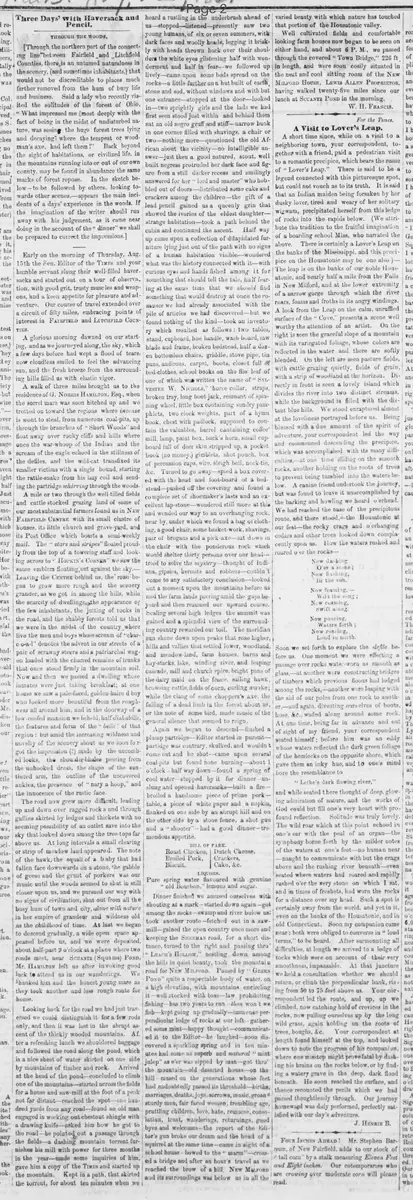
Three Days' with Haversack and Pencil,
Through the woods,
I.
Through the northern part of the connecting line between Fairfield and Litchfield Counties, there is an untamed naturalness in the scenery (and sometimes inhabitants) that would not be discreditable to places much farther removed from the hum of busy life and business. Said a lady who recently visited the solitudes of the forest of Ohio. "What impressed me most deeply with the fact of being in the midst of undisturbed nature, was seeing the huge forest trees lying and decaying where the tempest or woodman's axe, had left them!" Back beyond the sight of habitations, or civilized life, in the mountains running into or out of our own county, may be found in abundance the same marks of forest repose. In the sketch below—to be followed by others, looking towards other scenes,—appears the main incidents of a day's experience in the woods. If the imagination of the writer should run away with his judgement, as it came near doing in the account of the "dinner" we shall be prepared to correct the impressions.
Early on the morning of Thursday, Aug. 15th the Gen. Editor of the Times and your humble servant slung their well-filled haversacks and started out on a tour of observation, with good grit, trusty muscles and weapons, and a keen appetite for pleasure and adventure. Our course of travel extended over a circuit of fifty miles, embracing points of interest in FAIRFIELD and LITCHFIELD COUNTIES.
A glorious morning dawned on our starting, and as we journeyed along, the sky, which a few days before had wept a flood of tears now cloudless smiled to feel the advancing sun, and the fresh breeze from the surrounding hills filled us with elastic vigor.
A walk of three miles brought us to the residence of G. Norris Hamilton, Esq., when the sorrel mare was soon hitched up and we trotted on toward the regions where incense is wont to steal, from numerous coal-pits, up through the branches of "Short Woods" and float away over rocky cliffs and hills where once the war-whoop of the Indian and the scream of the eagle echoed in the stillness of the defiles, and the wild-cat transfixed its smaller victims with a single bound, starting the rattle-snake from his lazy coil and sending the partridge whirring through the woods.
A mile or two through the well-tilled fields and cattle stocked grazing land of some of our most substantial farmers found us in New Fairfield Centre with its small cluster of houses, its little church and grave-yard, and its Post Office which boasts a semi-weekly mail. The "stars and stripes" floated proudly from the top of a towering staff and looking across to "Hopkin's Corner" we saw the same emblem floating out against the sky.
Leaving the Centre behind us, the road began to grow more rough and the scenery grander, as we got in among the hills, while the scarcity of dwellings, the appearance of the few inhabitants, the jutting of rocks in the road, and the shabby forests told us that we were in the midst of the country where live the men and boys whose scream of 'char-c-o-a-l' denotes the advent in our streets of a pair of scrawny steers and a patriarchal wagon loaded with the charred remains of trunks that once stood firmly in the mountain soil.
Now and then we passed a dwelling whose inmates were just taking breakfast; at one house we saw a pale-faced, golden-haired boy who looked more beautiful from the roughness all around him, and in the doorway of a low-roofed mansion we beheld, half dishabille, the features and form of the "belle" of that region: but amid the increasing wildness and novelty of the scenery about us we soon forgot the impression (?) made by the uncombed locks, the shoulder-blades peering from the unhooked dress, the shape of the sun-tinted arm, the outline of the uncovered ankles, the presence of "nary a hoop," and the innocence of the rustic face.
The road now grew more difficult, leading up and down over ragged rocks and through gullies skirted by ledges and thickets with no seeming possibility of an outlet save into the sky that looked down among the tree-tops far above us. At long intervals a small clearing or strip of meadow land appeared. The note of the hawk, the squall of a baby that had fallen face downwards on a stone, the gabble of geese and the grunt of porkers was our music until the woods seemed to shut in still closer upon us, and we pursued our way with no signs of civilization, shut out from all the busy hum of town and city, alone with nature in her empire of grandeur and wildness old as the childhood of time. At last we began to descend gradually, a wide open space appeared before us, and we were deposited, about half-past 9 o'clock at a place where two roads meet, near Squanz (Squams) Pond.
Mr. Hamilton left us after invoking good luck to attend us in our wanderings. We thanked him and the honest young mare as they took another and less rough route for home.
Looking back for the road we had just traversed we could distinguish it for a few rods only, and then it was lost in the abrupt ascent of the thickly wooded mountains. After a refreshing lunch we shouldered baggage and followed the road along the pond, which is a nice sheet of water skirted on one side by mountains of timber and rock. Arrived at the head of the pond—concluded to climb one of the mountains—started across the fields for a house and saw-mill at the foot of a peak not far distant—reached the spot one hundred yards from any road—found an old man engaged in working out chestnut shingle with a drawing knife—asked him how he got to the road—he pointed out a passage through the fields a dashing mountain torrent furnishes his mill with power for three months in the year—made some inquiries of him, gave him a copy of the Times and started up the mountain. Kept in a path, that skirted the torrent, for about ten minutes when we heard a rustling in the underbrush ahead of us—stopped—listened—presently saw two young humans, of six or seven summers, with dark faces and woolly heads, legging it briskly with heads thrown back over their shoulder the white eyes glistening half with wonderment and half in fear—we followed up lively—came upon some beds spread on the rocks—a little further on a hut built of earth stone and sod, without windows and with but one entrance—stopped at the door—looked in—two sprightly girls and the lads we had first seen stood just within and behind them sat an old negro gruff and stiff—narrow bunk in one corner filled with shavings, a chair or two—nothing more—questioned the old African about the vicinity—no intelligible answer—just then a good natured, stout, well built negress protruded her dark face and figure from a still darker recess and smilingly answered for her "lord and master" who hobbled out of doors—distributed some cake and crackers among the children—the gift of a lead pencil gained us a queenly grin that showed the ivories of the eldest daughter—strange habitation—took a path behind the cabin and continued the ascent. Half way up came upon a collection of dilapidated furniture lying just out of the path with no signs of a human habitation visible—wondered what was the history connected with it—with curious eyes and hands fished among it for something that should tell the tale, half fearing at the same time that we should find something that would destroy at once the romance we had already associated with the pile of articles we had discovered—but we found nothing of the kind—took an inventory which resulted as follows: two tables, stand, cupboard, hoe handle, wash-board, saw blade and frame, broken bedstead, half a dozen bottomless chairs, griddle, stove pipe, tin pans, andirons, carpet, boots, closet full of bed-clothes, school books on the fly leaf of one of which was written the name of "Sylvester W. Nichols," horse collar, straps broken tray, long boot-jack, remnant of spinning wheel, little box containing sundry pamphlets, two clock weights, part of a hymn book, chest with padlock, supposed to contain the valuables, barrel containing coffee mill, lamp, paint box, buck's horn, small cupboard full of deer skin stripped up, a pocket book (no money,) gimblets, shot pouch, box of percussion caps, wire, sleigh bell, neck-tie, &c. Turned to go away—spied a box covered with the head and foot-board of a bedstead—pushed off the covering and found a complete set of shoemaker's lasts and an excellent lap-stone—wondered still more at this and wended our way to an overhanging rock, near by, under which we found a bag of clothing, a good chair, some basket-work, shavings, pair of brogans and a pick-axe—sat down in the chair with the ponderous rock which would shelter thirty persons over our head—tried to solve the mystery—thought of Indians, gipsies, hermits and robbers—couldn't come to any satisfactory conclusion—looked out a moment upon the mountains before us and the farm lands peering amid the gaps beyond and then resumed our upward course.
Scaling several high ledges the summit was gained and a splendid view of the surrounding country rewarded our toil. The meridian sun shone down upon peaks that rose higher, hills and valleys that settled lower, woodland and meadow-land, farm houses, barns and hay-stacks, lake, winding river, and leaping cascade, mill and church spire, bright pans of the dairy maid on the fence, sailing hawk, browsing cattle, fields of corn, curling smoke; while the clang of some chopper's axe, the falling of a dead limb in the forest about us, or the note of some bird, made music of the general silence that seemed to reign.
Again we began to descend—flushed a plump partridge—Editor started in pursuit—partridge was contrary, skulked, and wouldn't come out and be shot—came upon several coal-pits but found none burning—about 1 o'clock—half way down—found a spring of cool water—stopped by it for dinner—unslung and opened haversacks—built a fire—broiled a handsome piece of prime pork—table, a piece of white paper and a napkin flanked on one side by an abrupt hill and on the other side by a stone fence, a shot gun and a "shooter"—had a good dinner—tremendous appetite.
BILL OF FARE.
Roast Chicken,
Dutch Cheese
Broiled Pork,
Crackers,
Biscuit,
Cake, &c.
LIQUORS.
Pure spring water flavoured with genuine
"old Bourbon," lemons and sugar.
Dinner finished we amused ourselves with shooting at a mark—started down again—got among the rocks—swamp and river below us; took another route—fetched out in a saw-mill—gained the open country once more and keeping the Sherman road, for a short distance, turned to the right and passing thro' "Leach's Hollow," nestling down among the hills in quiet beauty, took the mountain road for New Milford. Passed by Green Pond quite a respectable body of water, on a high elevation, with mountains encircling it—well stocked with bass—law prohibiting fishing—has two years to run—then won't we fish—kept going up gradually—immense perpendicular ledge of rocks at our left—gathered some mint—happy thought—communicated it to the Editor—he laughed—soon discovered a sparkling spring and in ten minutes had some as superb and natural "mint julep" as e'er was sipped by man—got thro' the mountain—old deserted house—on the hill—mused on the generations whose feet had undoubtedly passed its threshold—births, marriages, deaths, joys, sorrows, music, groans sturdy men, fair faced women, trembling age, prattling children, love, hate, remorse, consolation, trust, wanderings, returnings, good byes and welcomes—the report of the Editor's gun broke our dream and the head of a squirrel at the same time—came in sight of a school house—bowed to the "marm"—crossed a bridge and after an hour's travel as we reached the brow of a hill, New Milford and its surroundings was below us in all the varied beauty with which nature has touched that portion of the Housatonic valley.
Well cultivated fields and comfortable looking farm houses now began to be seen on either hand, and about 6 P. M., we passed through the covered "Town Bridge," 226 ft in length, and were soon cosily situated in the neat and cool sitting room of the New Milford House, Lewis Allen Proprietor having walked twenty-five miles since our lunch at Squanz Pond in the morning.
W. H. FRANCIS.
Through the woods,
I.
Through the northern part of the connecting line between Fairfield and Litchfield Counties, there is an untamed naturalness in the scenery (and sometimes inhabitants) that would not be discreditable to places much farther removed from the hum of busy life and business. Said a lady who recently visited the solitudes of the forest of Ohio. "What impressed me most deeply with the fact of being in the midst of undisturbed nature, was seeing the huge forest trees lying and decaying where the tempest or woodman's axe, had left them!" Back beyond the sight of habitations, or civilized life, in the mountains running into or out of our own county, may be found in abundance the same marks of forest repose. In the sketch below—to be followed by others, looking towards other scenes,—appears the main incidents of a day's experience in the woods. If the imagination of the writer should run away with his judgement, as it came near doing in the account of the "dinner" we shall be prepared to correct the impressions.
Early on the morning of Thursday, Aug. 15th the Gen. Editor of the Times and your humble servant slung their well-filled haversacks and started out on a tour of observation, with good grit, trusty muscles and weapons, and a keen appetite for pleasure and adventure. Our course of travel extended over a circuit of fifty miles, embracing points of interest in FAIRFIELD and LITCHFIELD COUNTIES.
A glorious morning dawned on our starting, and as we journeyed along, the sky, which a few days before had wept a flood of tears now cloudless smiled to feel the advancing sun, and the fresh breeze from the surrounding hills filled us with elastic vigor.
A walk of three miles brought us to the residence of G. Norris Hamilton, Esq., when the sorrel mare was soon hitched up and we trotted on toward the regions where incense is wont to steal, from numerous coal-pits, up through the branches of "Short Woods" and float away over rocky cliffs and hills where once the war-whoop of the Indian and the scream of the eagle echoed in the stillness of the defiles, and the wild-cat transfixed its smaller victims with a single bound, starting the rattle-snake from his lazy coil and sending the partridge whirring through the woods.
A mile or two through the well-tilled fields and cattle stocked grazing land of some of our most substantial farmers found us in New Fairfield Centre with its small cluster of houses, its little church and grave-yard, and its Post Office which boasts a semi-weekly mail. The "stars and stripes" floated proudly from the top of a towering staff and looking across to "Hopkin's Corner" we saw the same emblem floating out against the sky.
Leaving the Centre behind us, the road began to grow more rough and the scenery grander, as we got in among the hills, while the scarcity of dwellings, the appearance of the few inhabitants, the jutting of rocks in the road, and the shabby forests told us that we were in the midst of the country where live the men and boys whose scream of 'char-c-o-a-l' denotes the advent in our streets of a pair of scrawny steers and a patriarchal wagon loaded with the charred remains of trunks that once stood firmly in the mountain soil.
Now and then we passed a dwelling whose inmates were just taking breakfast; at one house we saw a pale-faced, golden-haired boy who looked more beautiful from the roughness all around him, and in the doorway of a low-roofed mansion we beheld, half dishabille, the features and form of the "belle" of that region: but amid the increasing wildness and novelty of the scenery about us we soon forgot the impression (?) made by the uncombed locks, the shoulder-blades peering from the unhooked dress, the shape of the sun-tinted arm, the outline of the uncovered ankles, the presence of "nary a hoop," and the innocence of the rustic face.
The road now grew more difficult, leading up and down over ragged rocks and through gullies skirted by ledges and thickets with no seeming possibility of an outlet save into the sky that looked down among the tree-tops far above us. At long intervals a small clearing or strip of meadow land appeared. The note of the hawk, the squall of a baby that had fallen face downwards on a stone, the gabble of geese and the grunt of porkers was our music until the woods seemed to shut in still closer upon us, and we pursued our way with no signs of civilization, shut out from all the busy hum of town and city, alone with nature in her empire of grandeur and wildness old as the childhood of time. At last we began to descend gradually, a wide open space appeared before us, and we were deposited, about half-past 9 o'clock at a place where two roads meet, near Squanz (Squams) Pond.
Mr. Hamilton left us after invoking good luck to attend us in our wanderings. We thanked him and the honest young mare as they took another and less rough route for home.
Looking back for the road we had just traversed we could distinguish it for a few rods only, and then it was lost in the abrupt ascent of the thickly wooded mountains. After a refreshing lunch we shouldered baggage and followed the road along the pond, which is a nice sheet of water skirted on one side by mountains of timber and rock. Arrived at the head of the pond—concluded to climb one of the mountains—started across the fields for a house and saw-mill at the foot of a peak not far distant—reached the spot one hundred yards from any road—found an old man engaged in working out chestnut shingle with a drawing knife—asked him how he got to the road—he pointed out a passage through the fields a dashing mountain torrent furnishes his mill with power for three months in the year—made some inquiries of him, gave him a copy of the Times and started up the mountain. Kept in a path, that skirted the torrent, for about ten minutes when we heard a rustling in the underbrush ahead of us—stopped—listened—presently saw two young humans, of six or seven summers, with dark faces and woolly heads, legging it briskly with heads thrown back over their shoulder the white eyes glistening half with wonderment and half in fear—we followed up lively—came upon some beds spread on the rocks—a little further on a hut built of earth stone and sod, without windows and with but one entrance—stopped at the door—looked in—two sprightly girls and the lads we had first seen stood just within and behind them sat an old negro gruff and stiff—narrow bunk in one corner filled with shavings, a chair or two—nothing more—questioned the old African about the vicinity—no intelligible answer—just then a good natured, stout, well built negress protruded her dark face and figure from a still darker recess and smilingly answered for her "lord and master" who hobbled out of doors—distributed some cake and crackers among the children—the gift of a lead pencil gained us a queenly grin that showed the ivories of the eldest daughter—strange habitation—took a path behind the cabin and continued the ascent. Half way up came upon a collection of dilapidated furniture lying just out of the path with no signs of a human habitation visible—wondered what was the history connected with it—with curious eyes and hands fished among it for something that should tell the tale, half fearing at the same time that we should find something that would destroy at once the romance we had already associated with the pile of articles we had discovered—but we found nothing of the kind—took an inventory which resulted as follows: two tables, stand, cupboard, hoe handle, wash-board, saw blade and frame, broken bedstead, half a dozen bottomless chairs, griddle, stove pipe, tin pans, andirons, carpet, boots, closet full of bed-clothes, school books on the fly leaf of one of which was written the name of "Sylvester W. Nichols," horse collar, straps broken tray, long boot-jack, remnant of spinning wheel, little box containing sundry pamphlets, two clock weights, part of a hymn book, chest with padlock, supposed to contain the valuables, barrel containing coffee mill, lamp, paint box, buck's horn, small cupboard full of deer skin stripped up, a pocket book (no money,) gimblets, shot pouch, box of percussion caps, wire, sleigh bell, neck-tie, &c. Turned to go away—spied a box covered with the head and foot-board of a bedstead—pushed off the covering and found a complete set of shoemaker's lasts and an excellent lap-stone—wondered still more at this and wended our way to an overhanging rock, near by, under which we found a bag of clothing, a good chair, some basket-work, shavings, pair of brogans and a pick-axe—sat down in the chair with the ponderous rock which would shelter thirty persons over our head—tried to solve the mystery—thought of Indians, gipsies, hermits and robbers—couldn't come to any satisfactory conclusion—looked out a moment upon the mountains before us and the farm lands peering amid the gaps beyond and then resumed our upward course.
Scaling several high ledges the summit was gained and a splendid view of the surrounding country rewarded our toil. The meridian sun shone down upon peaks that rose higher, hills and valleys that settled lower, woodland and meadow-land, farm houses, barns and hay-stacks, lake, winding river, and leaping cascade, mill and church spire, bright pans of the dairy maid on the fence, sailing hawk, browsing cattle, fields of corn, curling smoke; while the clang of some chopper's axe, the falling of a dead limb in the forest about us, or the note of some bird, made music of the general silence that seemed to reign.
Again we began to descend—flushed a plump partridge—Editor started in pursuit—partridge was contrary, skulked, and wouldn't come out and be shot—came upon several coal-pits but found none burning—about 1 o'clock—half way down—found a spring of cool water—stopped by it for dinner—unslung and opened haversacks—built a fire—broiled a handsome piece of prime pork—table, a piece of white paper and a napkin flanked on one side by an abrupt hill and on the other side by a stone fence, a shot gun and a "shooter"—had a good dinner—tremendous appetite.
BILL OF FARE.
Roast Chicken,
Dutch Cheese
Broiled Pork,
Crackers,
Biscuit,
Cake, &c.
LIQUORS.
Pure spring water flavoured with genuine
"old Bourbon," lemons and sugar.
Dinner finished we amused ourselves with shooting at a mark—started down again—got among the rocks—swamp and river below us; took another route—fetched out in a saw-mill—gained the open country once more and keeping the Sherman road, for a short distance, turned to the right and passing thro' "Leach's Hollow," nestling down among the hills in quiet beauty, took the mountain road for New Milford. Passed by Green Pond quite a respectable body of water, on a high elevation, with mountains encircling it—well stocked with bass—law prohibiting fishing—has two years to run—then won't we fish—kept going up gradually—immense perpendicular ledge of rocks at our left—gathered some mint—happy thought—communicated it to the Editor—he laughed—soon discovered a sparkling spring and in ten minutes had some as superb and natural "mint julep" as e'er was sipped by man—got thro' the mountain—old deserted house—on the hill—mused on the generations whose feet had undoubtedly passed its threshold—births, marriages, deaths, joys, sorrows, music, groans sturdy men, fair faced women, trembling age, prattling children, love, hate, remorse, consolation, trust, wanderings, returnings, good byes and welcomes—the report of the Editor's gun broke our dream and the head of a squirrel at the same time—came in sight of a school house—bowed to the "marm"—crossed a bridge and after an hour's travel as we reached the brow of a hill, New Milford and its surroundings was below us in all the varied beauty with which nature has touched that portion of the Housatonic valley.
Well cultivated fields and comfortable looking farm houses now began to be seen on either hand, and about 6 P. M., we passed through the covered "Town Bridge," 226 ft in length, and were soon cosily situated in the neat and cool sitting room of the New Milford House, Lewis Allen Proprietor having walked twenty-five miles since our lunch at Squanz Pond in the morning.
W. H. FRANCIS.
What sub-type of article is it?
Journey Narrative
Essay
What themes does it cover?
Nature
Agriculture Rural
Social Manners
What keywords are associated?
Travel Narrative
Connecticut Woods
Rural Scenery
Forest Exploration
Mountain Journey
What entities or persons were involved?
W. H. Francis.
Literary Details
Title
Three Days' With Haversack And Pencil
Author
W. H. Francis.
Subject
Tour Of Observation Through Fairfield And Litchfield Counties
Key Lines
What Impressed Me Most Deeply With The Fact Of Being In The Midst Of Undisturbed Nature, Was Seeing The Huge Forest Trees Lying And Decaying Where The Tempest Or Woodman's Axe, Had Left Them!
A Glorious Morning Dawned On Our Starting, And As We Journeyed Along, The Sky, Which A Few Days Before Had Wept A Flood Of Tears Now Cloudless Smiled To Feel The Advancing Sun, And The Fresh Breeze From The Surrounding Hills Filled Us With Elastic Vigor.
Scaling Several High Ledges The Summit Was Gained And A Splendid View Of The Surrounding Country Rewarded Our Toil.
Bill Of Fare. Roast Chicken, Dutch Cheese Broiled Pork, Crackers, Biscuit, Cake, &C. Liquors. Pure Spring Water Flavoured With Genuine "Old Bourbon," Lemons And Sugar.