Thank you for visiting SNEWPapers!
Sign up free
Virginia Argus
Richmond, Virginia
What is this article about?
An American citizen detained in England during the War of 1812 shares observations on British trade monopoly, naval policy, and war prosecution. He urges the US to prohibit neutral trade, British licenses, and exports of provisions to pressure Britain into peace, while highlighting poor conditions for American prisoners.
Merged-components note: Continuation of the letter to the editors across pages.
Clippings
1 of 2
OCR Quality
Full Text
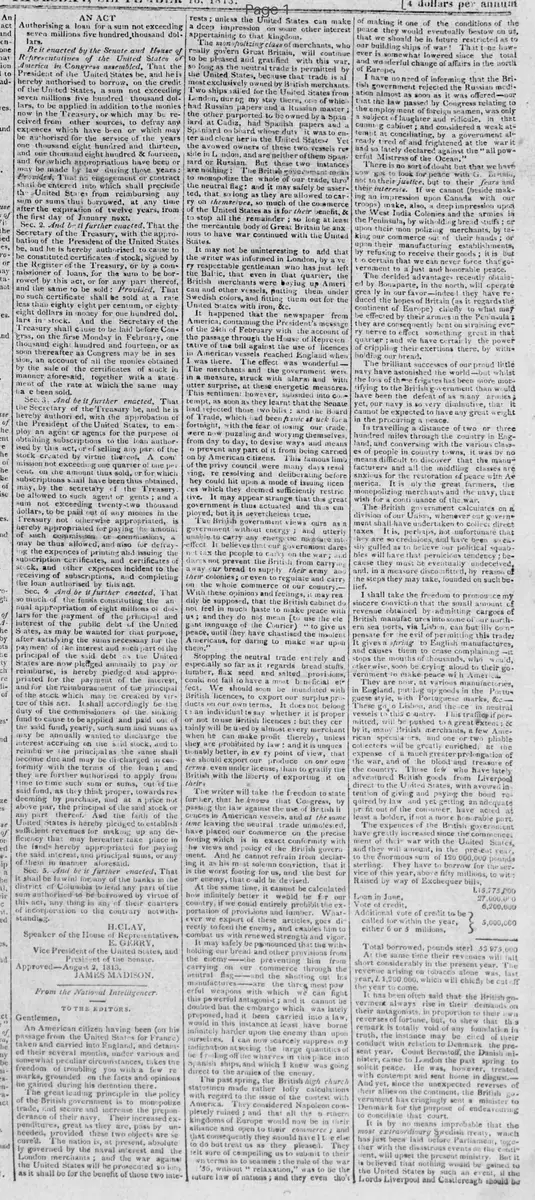
TO THE EDITORS.
Gentlemen,
An American citizen having been (on his passage from the United States for France) taken and carried into England, and detained there several months, under various and somewhat peculiar circumstances, takes the freedom of troubling you with a few remarks, grounded on the facts and opinions he gained during his detention there.
The great leading principle in the policy of the British government is to monopolize trade, and secure and increase the preponderance of their navy. Their increased expenditures, great as they are, pass by unheeded, provided these two objects are secured. The nation is, at present, absolutely governed by the naval interest and the London merchants; and the war against the United States will be prosecuted so long as it shall be for the benefit of those two interests; unless the United States can make a deep impression on some other interest appertaining to that kingdom.
The monopolizing class of merchants, who really govern Great Britain, will continue to be pleased and gratified with this war, so long as the neutral trade is permitted by the United States, because that trade is almost exclusively owned by British merchants. Two ships sailed for the United States from London, during my stay there, one of which had Russian papers and a Russian master; the other purported to be owned by a Spaniard at Cadiz, had Spanish papers and a Spaniard on board whose duty it was to enter and clear her in the United States. Yet the avowed owners of these two vessels reside in London, and are neither of them Spaniard or Russian. But these two instances are nothing: The British government mean to monopolize the whole of our trade, thro' the neutral flag: and it may safely be asserted, that, so long as they are allowed to carry on themselves, so much of the commerce of the United States as is for their benefit, & to stop all the remainder; so long at least the mercantile body of Great Britain be anxious to have war continued with the United States.
It may not be uninteresting to add that the writer was informed in London, by a very respectable gentleman who has just left the Baltic, that even in that quarter, the British merchants were buying up American and other vessels, putting them under Swedish colors, and fitting them out for the United States with iron, &c.
It happened that the newspaper from America, containing the President's message of the 24th of February with the account of the passage through the House of Representatives of the bill against the use of licences in American vessels reached England when I was there. The effect was wonderful--The merchants and the government were in a measure, struck with alarm and with utter surprise, at these energetic measures. This sentiment however, subsided into contempt, as soon as they learnt that the Senate had rejected those two bills: and the Board of Trade, which had been much struck for a fortnight, with the fear of losing our trade, were now puzzling and worrying themselves, from day to day, to devise ways and means to prevent any part of it from being carried on by American citizens. This famous limb of the privy council were many days resolving, re-resolving and deliberating before they could hit upon a mode of issuing licences which they deemed sufficiently restrictive. It may appear strange that this great government is thus actuated and thus employed, but it is nevertheless true.
The British government views ours as a government without energy; and utterly unable to carry any energetic measure into effect. It believes that our government dares not tax the people to carry on the war; and dares not prevent the British from carrying away our bread to supply their army and their colonies; or even to regulate and carry on the whole commerce of our country. With these opinions and feelings, it may readily be supposed, that the British cabinet do not feel in much haste to make peace with us; and they do not mean (to use the elegant language of the Courier) to give us peace, until they have chastised the insolent Americans, for daring to make war upon them.
Stopping the neutral trade entirely and especially so far as it regards bread stuffs, lumber, flax seed and salted provisions, could not fail to have a most beneficial effect. We should soon be inundated with British licences, to export our surplus produce on our own terms. It does not belong to an individual to say whether it is proper or not to use British licences: but they certainly will be used by almost every merchant when he can make profit thereby, unless they are prohibited by law: and it is unquestionably better, in every point of view, that we should export our produce on our own terms even under license, than to gratify the British with the liberty of exporting it on theirs.
The writer will take the freedom to state further, that he knows that Congress, by passing the law against the use of British licences in American vessels, and at the same time leaving the neutral trade unmolested, have placed our commerce on the precise footing which is in exact conformity with the views and policy of the British government. And he cannot refrain from declaring it as his most solemn conviction, that it is the worst footing for us, and the best for our enemy, that could be devised.
At the same time, it cannot be calculated how infinitely better it would be for our country, if we could entirely prohibit the exportation of provisions and lumber. Whatever we export of these articles, goes directly to feed the enemy, and enables him to combat us with renewed strength and vigor. It may safely be pronounced that the withholding our bread and other provisions from the enemy--the preventing him from carrying on our commerce through the neutral flag--and the shutting out his manufactures---are the three most powerful weapons with which we can fight this powerful antagonist; and it cannot be doubted but the embargo which was lately proposed, had it been carried into a law, would in this instance at least have borne infinitely harder upon the enemy than upon ourselves. I can now scarcely suppress my indignation at seeing the large quantities of beef rolling off the wharves in this place into Spanish ships, and which I knew was going direct to the armies of the enemy.
The past spring, the British high church statesmen made rather lofty calculations with regard to the issue of the contest with America. They considered Napoleon completely ruined: and that all the northern kingdoms of Europe would now be in their alliance and open to their commerce; and that consequently they should have little else to do but treat us as they pleased. They felt sure of compelling us to submit to their own terms as to seamen: the rule of the war of '56, without "relaxation," was to be the future law of nations: and they even thought of making it one of the conditions of the peace they would eventually bestow on us, that we should be in future restricted as to our building ships of war! That however is somewhat lowered since the total and wonderful change of affairs in the north of Europe.
I have no need of informing you that the British government rejected the Russian mediation almost as soon as it was offered--nor that the law passed by Congress relating to the employment of foreign seamen, was only a subject of laughter and ridicule, in that cunning cabinet; and considered a weak attempt at conciliating, by a government already tired of and frightened at the war it had so lately declared against the "all powerful Mistress of the Ocean."
There is no sort of doubt but that we have now got to look for peace with G. Britain, not to their justice, but to their fears and their interest. If we cannot (beside making an impression upon Canada with our troops) make, also, a deep impression upon the West India Colonies and the armies in the Peninsula, by withholding bread stuffs; or upon their monopolizing merchants, by taking our commerce out of their hands; or upon their manufacturing establishments, by refusing to receive their goods; it is too certain that we can never force that government to a just and honorable peace.
The decided advantages recently obtained by Bonaparte, in the north, will operate greatly in our favor--indeed they have reduced the hopes of Britain (as it regards the continent of Europe) chiefly to what may be effected by their armies in the Peninsula; they are consequently bent on straining every nerve to effect something great in that quarter; and we have certainly the power of crippling their exertions there, by withholding our bread.
The brilliant successes of our proud little navy have astonished the world--but whilst the loss of the frigates has been more mortifying to the British government than would have been the defeat of as many armies yet, our navy is so very diminutive, that it cannot be expected to have any great weight in the procuring a peace.
In travelling a distance of two or three hundred miles through the country in England, and conversing with the various classes of people in country towns, it was by no means difficult to discover that the manufacturers and all the middling classes are anxious for the restoration of peace with America. It is only the great farmers, the monopolizing merchants and the navy, that wish for a continuance of the war.
The British government calculates on a division of our Union, whenever our government shall have undertaken to collect direct taxes. It is, perhaps, not unfortunate that they are so credulous, and have been so easily gulled as to believe our political squabbles will have that pernicious tendency; because they must be eventually undeceived, and, in a measure discomfited, by reason of the steps they may take, founded on such belief.
I shall take the freedom to pronounce my sincere conviction that the small amount of revenue obtained by admitting cargoes of British manufactures into some of our northern sea ports, via Lisbon, can but illy compensate for the evil of permitting this trade: It gives a spring to English manufactures, and causes them to cease complaining--it stops the mouths of thousands, who would, otherwise, soon be crying aloud to their government to make peace with America. They are now, at various manufactories, in England, putting up goods in the Portuguese style, with Portuguese marks, &c-- These go to Lisbon, and then in neutral vessels to this country. This traffic, if permitted, will be pushed to a great extent; & by it, many British merchants, a few American speculators, and one or two pliable collectors will be greatly enriched, at the expense of a much greater prolongation of the war, and of the blood and treasure of the country. Those few who have lately adventured British goods from Liverpool direct to the United States, with avowed intention of giving and paying the bond required by law and yet getting an adequate profit out of the consumer, have acted at least a bolder, if not a more honorable part.
The expenses of the British government have greatly increased since the commencement of their war with the United States, and they will amount, in the present year, to the enormous sum of 120,000,000 pounds sterling. They have to borrow for the service of this year, above fifty millions, to wit:
Raised by way of Exchequer bills, 15,775,000
Loan in June, 27,000,000
Vote of credit, 6,200,000
Additional vote of credit to be called for within the year, either 6 or 5 millions,
Total borrowed, pounds sterling 53,975,000
At the same time their revenues will fall short considerably in the present year. The revenue arising on tobacco alone was, last year, L. 1,200,000, which will chiefly be cut off the year to come.
It has been often said that the British government always rise in their demands on their antagonists, in proportion to their own reverses of fortune, but, to shew that this remark is totally void of any foundation in truth, the instance may be cited of their conduct with relation to Denmark the present year. Count Bernstorff, the Danish minister, came to London the past spring to solicit peace. He was, however, treated with contempt and sent home in disgust. And yet, since the unexpected reverses of their allies on the Continent, the British government has cringingly sent a minister to Denmark for the purpose of endeavouring to conciliate that Court.
It is by no means improbable that the most extraordinary Swedish treaty, which has just been laid before Parliament, together with the disastrous events on the Continent, will upset the present ministry. But it is believed that nothing would be gained to the United States by such an event, if the Lords Liverpool and Castlereagh should be.
replaced (as they probably would be) by Canning and Wellesley.
I need not touch upon the subject of the conduct of the British government relating to American seamen on board British ships of war. I must however take the liberty to say a few words in behalf of the American prisoners in England: because I know their situation, and because they are not permitted to speak for themselves.
These Americans, who have all been made prisoners of war, whilst engaged in legal and honorable pursuits, feel impressively that they are not the least deserving citizens: they therefore feel the full force of every neglect. Many of the parole prisoners have been already confined more than six months: about one third part of them are totally destitute of funds, and are consequently compelled to live on the pitiful allowance furnished them by the British government. One shilling and three pence per day, in a place where beef is sold per pound, is not so much as 12 cents would be in most of the country towns of the United States. The bank paper of England is so much depreciated, that a Spanish dollar is worth 5s. 10d. 1-2, and a guinea 27s.; whilst the prices of eatables are from 50 to 100 per cent. dearer than in the country towns of the United States. Those of the parole prisoners who have an abundant property at home, are some of them caught in England without funds and without the power of procuring them in any possible way—their situation is therefore insupportable.
The prisoners in the gaols and prison ships are better situated than the parole prisoners, with regard to the quantum of food furnished: but although the quantity of their food is nearly sufficient, they suffer severely with regard to the quality, and labour under difficulties which require attention.
If the American agent should be authorised and directed to furnish the small pittance of from 20 to 25 cents per week, to each American prisoner in those filthy gaols and prison ships, for the purpose of buying soap, vegetables, &c. it would not only contribute to the comfort of all, but would undoubtedly save the lives of very many valuable seamen and useful citizens.
This communication is made by one who has always been politically opposed in sentiment and action to the present majority of his fellow-citizens; but who has nevertheless as ardent a desire as any one can have, that the present contest may end with honor and advantage to his country. He trusts that the motive with which he has written will operate as an apology, even though the communication should not convey any information either useful or new.
A CITIZEN OF THE U. STATES.
August 2d, 1813.
What sub-type of article is it?
What themes does it cover?
What keywords are associated?
What entities or persons were involved?
Letter to Editor Details
Author
A Citizen Of The U. States.
Recipient
To The Editors.
Main Argument
the us should prohibit neutral trade, british licenses in american vessels, and exports of provisions and lumber to deprive britain of resources, weaken their war effort, and force a just peace, as current policies benefit british merchants and navy.
Notable Details