Thank you for visiting SNEWPapers!
Sign up free
Editorial
July 3, 1819
Daily National Intelligencer
Washington, District Of Columbia
What is this article about?
The editorial quotes a British observer praising the American government's republican simplicity as an example against European nobility's oppression. It critiques U.S. aristocracy of wealth, preference for titled foreigners over merit, and calls for reform emphasizing talent over titles, contrasting with merit-based French society.
Clipping
OCR Quality
98%
Excellent
Full Text
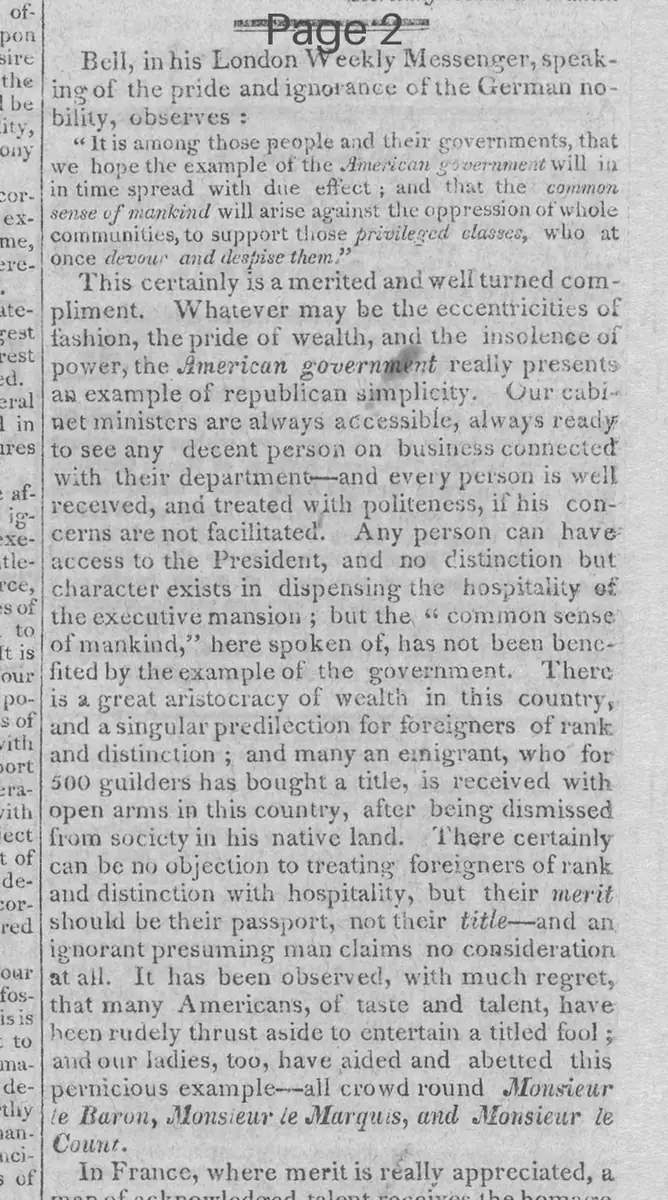
Bell, in his London Weekly Messenger, speaking of the pride and ignorance of the German nobility, observes:
"It is among those people and their governments, that we hope the example of the American government will in time spread with due effect; and that the common sense of mankind will arise against the oppression of whole communities, to support those privileged classes, who at once devour and despise them."
This certainly is a merited and well turned compliment. Whatever may be the eccentricities of fashion, the pride of wealth, and the insolence of power, the American government really presents an example of republican simplicity. Our cabinet ministers are always accessible, always ready to see any decent person on business connected with their department—and every person is well received, and treated with politeness, if his concerns are not facilitated. Any person can have access to the President, and no distinction but character exists in dispensing the hospitality of the executive mansion; but the "common sense of mankind," here spoken of, has not been benefited by the example of the government. There is a great aristocracy of wealth in this country, and a singular predilection for foreigners of rank and distinction; and many an emigrant, who for 500 guilders has bought a title, is received with open arms in this country, after being dismissed from society in his native land. There certainly can be no objection to treating foreigners of rank and distinction with hospitality, but their merit should be their passport, not their title—and an ignorant presuming man claims no consideration at all. It has been observed, with much regret, that many Americans, of taste and talent, have been rudely thrust aside to entertain a titled fool: and our ladies, too, have aided and abetted this pernicious example--all crowd round Monsieur le Baron, Monsieur le Marquis, and Monsieur le Count.
In France, where merit is really appreciated, a man of acknowledged talent receives the homage of general respect, while noblemen without merit are generally disregarded. We have much to reform in these things.--Nat. Adv.
"It is among those people and their governments, that we hope the example of the American government will in time spread with due effect; and that the common sense of mankind will arise against the oppression of whole communities, to support those privileged classes, who at once devour and despise them."
This certainly is a merited and well turned compliment. Whatever may be the eccentricities of fashion, the pride of wealth, and the insolence of power, the American government really presents an example of republican simplicity. Our cabinet ministers are always accessible, always ready to see any decent person on business connected with their department—and every person is well received, and treated with politeness, if his concerns are not facilitated. Any person can have access to the President, and no distinction but character exists in dispensing the hospitality of the executive mansion; but the "common sense of mankind," here spoken of, has not been benefited by the example of the government. There is a great aristocracy of wealth in this country, and a singular predilection for foreigners of rank and distinction; and many an emigrant, who for 500 guilders has bought a title, is received with open arms in this country, after being dismissed from society in his native land. There certainly can be no objection to treating foreigners of rank and distinction with hospitality, but their merit should be their passport, not their title—and an ignorant presuming man claims no consideration at all. It has been observed, with much regret, that many Americans, of taste and talent, have been rudely thrust aside to entertain a titled fool: and our ladies, too, have aided and abetted this pernicious example--all crowd round Monsieur le Baron, Monsieur le Marquis, and Monsieur le Count.
In France, where merit is really appreciated, a man of acknowledged talent receives the homage of general respect, while noblemen without merit are generally disregarded. We have much to reform in these things.--Nat. Adv.
What sub-type of article is it?
Social Reform
What keywords are associated?
Republican Simplicity
Aristocracy Of Wealth
Foreign Titles
Merit Over Title
Social Reform
American Society
What entities or persons were involved?
American Government
President
German Nobility
French Society
London Weekly Messenger
Editorial Details
Primary Topic
Critique Of American Preference For Foreign Titles Over Merit
Stance / Tone
Critical Of Social Snobbery, Advocating Merit Based Respect
Key Figures
American Government
President
German Nobility
French Society
London Weekly Messenger
Key Arguments
American Government Exemplifies Republican Simplicity And Accessibility
U.S. Society Shows Aristocracy Of Wealth And Favoritism Toward Titled Foreigners
Titles Should Not Supersede Merit; Ignorant Nobles Deserve No Special Treatment
Americans Of Talent Are Sidelined For Titled Fools
France Properly Values Merit Over Nobility
Reform Needed In American Social Attitudes