Thank you for visiting SNEWPapers!
Sign up free
Literary
March 1, 1924
Richmond Planet
Richmond, Virginia
What is this article about?
Mary White Ovington, NAACP director, reviews Albert Loyal Crane's book 'Race Differences in Inhibition,' detailing a psychological test on 50 white and 50 Black subjects measuring fear responses to a descending weight and electric shock. Results show negligible sex and race differences, but Crane biases interpretations toward white superiority, which Ovington critiques as flawed and presumptuous.
Clipping
OCR Quality
95%
Excellent
Full Text
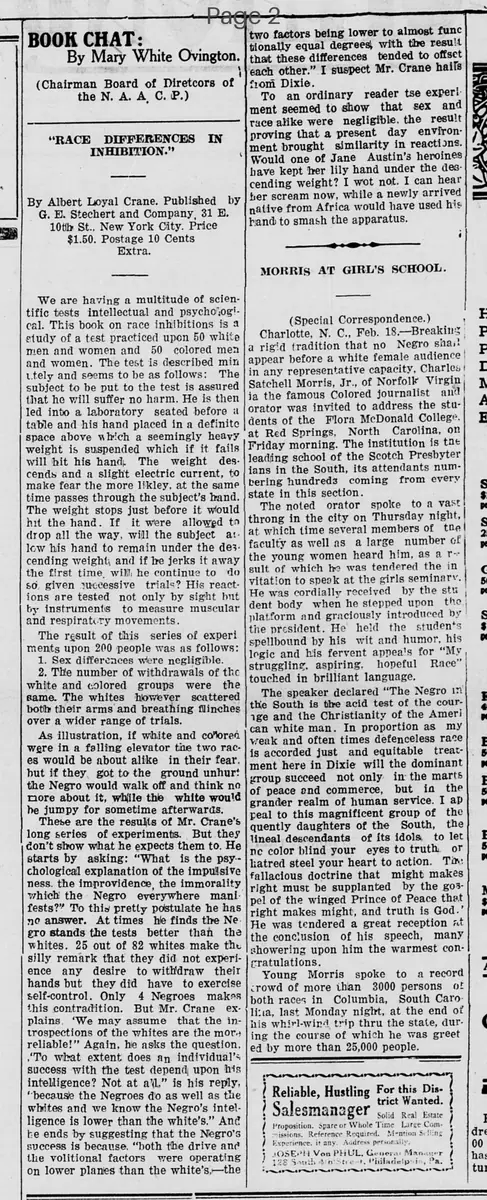
BOOK CHAT:
By Mary White Ovington.
(Chairman Board of Directors of the N. A. A. C. P.)
"RACE DIFFERENCES IN INHIBITION."
By Albert Loyal Crane. Published by G. E. Stechert and Company. 31 E. 10th St., New York City. Price $1.50. Postage 10 Cents Extra.
We are having a multitude of scientific tests intellectual and psychological. This book on race inhibitions is a study of a test practiced upon 50 white men and women and 50 colored men and women. The test is described minutely and seems to be as follows: The subject to be put to the test is assured that he will suffer no harm. He is then led into a laboratory seated before a table and his hand placed in a definite space above which a seemingly heavy weight is suspended which if it fails will hit his hand. The weight descends and a slight electric current, to make fear the more likely, at the same time passes through the subject's hand. The weight stops just before it would hit the hand. If it were allowed to drop all the way, will the subject allow his hand to remain under the descending weight; and if he jerks it away the first time will he continue to do so given successive trials? His reactions are tested not only by sight but by instruments to measure muscular and respiratory movements.
The result of this series of experiments upon 200 people was as follows:
1. Sex differences were negligible.
2. The number of withdrawals of the white and colored groups were the same. The whites however scattered both their arms and breathing flinches over a wider range of trials.
As illustration, if white and colored were in a falling elevator the two races would be about alike in their fear, but if they got to the ground unhurt the Negro would walk off and think no more about it, while the white would be jumpy for some time afterwards.
These are the results of Mr. Crane's long series of experiments. But they don't show what he expects them to. He starts by asking: 'What is the psychological explanation of the impulsiveness, the improvidence, the immorality which the Negro everywhere manifests?' To this pretty postulate he has no answer. At times he finds the Negro stands the tests better than the whites. 25 out of 82 whites make the silly remark that they did not experience any desire to withdraw their hands but they did have to exercise self-control. Only 4 Negroes make this contradiction. But Mr. Crane explains. We may assume that the introspections of the whites are the more reliable! Again, he asks the question. 'To what extent does an individual's success with the test depend upon his intelligence? Not at all,' is his reply, 'because the Negroes do as well as the whites and we know the Negro's intelligence is lower than the white's.' And he ends by suggesting that the Negro's success is because 'both the drive and the volitional factors were operating on lower planes than the white's, the two factors being lower to almost functionally equal degrees, with the result that these differences tended to offset each other.' I suspect Mr. Crane hails from Dixie.
To an ordinary reader the experiment seemed to show that sex and race alike were negligible, the result proving that a present day environment brought similarity in reactions. Would one of Jane Austen's heroines have kept her lily hand under the descending weight? I wot not. I can hear her scream now, while a newly arrived native from Africa would have used his hand to smash the apparatus.
By Mary White Ovington.
(Chairman Board of Directors of the N. A. A. C. P.)
"RACE DIFFERENCES IN INHIBITION."
By Albert Loyal Crane. Published by G. E. Stechert and Company. 31 E. 10th St., New York City. Price $1.50. Postage 10 Cents Extra.
We are having a multitude of scientific tests intellectual and psychological. This book on race inhibitions is a study of a test practiced upon 50 white men and women and 50 colored men and women. The test is described minutely and seems to be as follows: The subject to be put to the test is assured that he will suffer no harm. He is then led into a laboratory seated before a table and his hand placed in a definite space above which a seemingly heavy weight is suspended which if it fails will hit his hand. The weight descends and a slight electric current, to make fear the more likely, at the same time passes through the subject's hand. The weight stops just before it would hit the hand. If it were allowed to drop all the way, will the subject allow his hand to remain under the descending weight; and if he jerks it away the first time will he continue to do so given successive trials? His reactions are tested not only by sight but by instruments to measure muscular and respiratory movements.
The result of this series of experiments upon 200 people was as follows:
1. Sex differences were negligible.
2. The number of withdrawals of the white and colored groups were the same. The whites however scattered both their arms and breathing flinches over a wider range of trials.
As illustration, if white and colored were in a falling elevator the two races would be about alike in their fear, but if they got to the ground unhurt the Negro would walk off and think no more about it, while the white would be jumpy for some time afterwards.
These are the results of Mr. Crane's long series of experiments. But they don't show what he expects them to. He starts by asking: 'What is the psychological explanation of the impulsiveness, the improvidence, the immorality which the Negro everywhere manifests?' To this pretty postulate he has no answer. At times he finds the Negro stands the tests better than the whites. 25 out of 82 whites make the silly remark that they did not experience any desire to withdraw their hands but they did have to exercise self-control. Only 4 Negroes make this contradiction. But Mr. Crane explains. We may assume that the introspections of the whites are the more reliable! Again, he asks the question. 'To what extent does an individual's success with the test depend upon his intelligence? Not at all,' is his reply, 'because the Negroes do as well as the whites and we know the Negro's intelligence is lower than the white's.' And he ends by suggesting that the Negro's success is because 'both the drive and the volitional factors were operating on lower planes than the white's, the two factors being lower to almost functionally equal degrees, with the result that these differences tended to offset each other.' I suspect Mr. Crane hails from Dixie.
To an ordinary reader the experiment seemed to show that sex and race alike were negligible, the result proving that a present day environment brought similarity in reactions. Would one of Jane Austen's heroines have kept her lily hand under the descending weight? I wot not. I can hear her scream now, while a newly arrived native from Africa would have used his hand to smash the apparatus.
What sub-type of article is it?
Essay
Satire
What themes does it cover?
Political
Moral Virtue
What keywords are associated?
Book Review
Race Inhibition
Psychological Test
Naacp
Racial Bias
Fear Response
White Superiority
What entities or persons were involved?
By Mary White Ovington. (Chairman Board Of Directors Of The N. A. A. C. P.)
Literary Details
Title
Book Chat
Author
By Mary White Ovington. (Chairman Board Of Directors Of The N. A. A. C. P.)
Subject
Review Of 'Race Differences In Inhibition' By Albert Loyal Crane
Form / Style
Book Review Essay Critiquing Racial Bias In Psychological Research
Key Lines
What Is The Psychological Explanation Of The Impulsiveness, The Improvidence, The Immorality Which The Negro Everywhere Manifests?
We May Assume That The Introspections Of The Whites Are The More Reliable!
I Suspect Mr. Crane Hails From Dixie.
To An Ordinary Reader The Experiment Seemed To Show That Sex And Race Alike Were Negligible