Thank you for visiting SNEWPapers!
Sign up free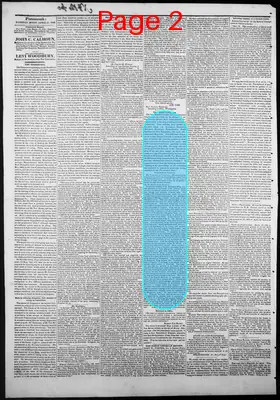
The New Hampshire Gazette
Portsmouth, Rockingham County, New Hampshire
What is this article about?
The Virginia State Convention in Richmond recommended November 1843 for the National Convention, differing from other states' May 1844 preference. Whigs interpret this as Democratic Party division between Calhoun and Van Buren factions, but a convention member affirms unity and no candidate preference was expressed.
Clipping
OCR Quality
Full Text
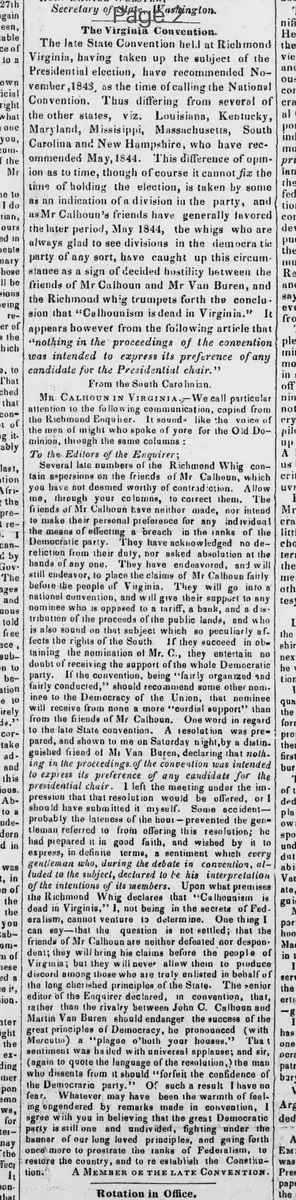
The late State Convention held at Richmond Virginia, having taken up the subject of the Presidential election, have recommended November, 1843, as the time of calling the National Convention, Thus differing from several of the other states, viz. Louisiana, Kentucky, Maryland, Mississippi, Massachusetts, South Carolina and New Hampshire, who have recommended May, 1844. This difference of opinion as to time, though of course it cannot fix the time of holding the election, is taken by some as an indication of a division in the party, and as Mr Calhoun's friends have generally favored the later period, May 1844, the whigs who are always glad to see divisions in the democratic party of any sort, have caught up this circumstance as a sign of decided hostility between the friends of Mr Calhoun and Mr Van Buren, and the Richmond whig trumpets forth the conclusion that "Calhounism is dead in Virginia." It appears however from the following article that "nothing in the proceedings of the convention was intended to express its preference of any candidate for the Presidential chair."
From the South Carolinian.
Mr. Calhoun In Virginia.—We call particular attention to the following communication, copied from the Richmond Enquirer. It sounds like the voice of the men of might who spoke of yore for the Old Dominion, through the same columns:
To the Editors of the Enquirer;
Several late numbers of the Richmond Whig contain aspersions on the friends of Mr Calhoun, which you have not deemed worthy of contradiction. Allow me, through your columns, to correct them. The friends of Mr Calhoun have neither made, nor intend to make their personal preference for any individual the means of effecting a breach in the ranks of the Democratic party. They have acknowledged no dereliction from their duty, nor asked absolution at the hands of any one. They have endeavored, and will still endeavor, to place the claims of Mr Calhoun fairly before the people of Virginia. They will go into a national convention, and will give their support to any nominee who is opposed to a tariff, a bank, and a distribution of the proceeds of the public lands, and who is also sound on that subject which so peculiarly affects the rights of the South. If they succeed in obtaining the nomination of Mr. C., they entertain no doubt of receiving the support of the whole Democratic party. If the convention, being "fairly organized and fairly conducted," should recommend some other nominee to the Democracy of the Union, that nominee will receive from none a more "cordial support" than from the friends of Mr Calhoun. One word in regard to the late State convention. A resolution was prepared, and shown to me on Saturday night, by a distinguished friend of Mr. Van Buren, declaring that nothing in the proceedings of the convention was intended to express its preference of any candidate for the presidential chair. I left the meeting under the impression that that resolution would be offered, or I should have submitted it myself. Some accident—probably the lateness of the hour—prevented the gentleman referred to from offering this resolution; he had prepared it in good faith, and wished by it to express, in definite terms, a sentiment which every gentleman who, during the debate in convention, alluded to the subject, declared to be his interpretation of the intentions of its members. Upon what premises the Richmond Whig declares that "Calhounism is dead in Virginia," I, not being in the secrets of Federalism, cannot venture to determine. One thing I can say—that the question is not settled; that the friends of Mr Calhoun are neither defeated nor despondent; they will bring his claims before the people of Virginia; but they will never allow them to produce discord among those who are truly enlisted in behalf of the long cherished principles of the State. The senior editor of the Enquirer declared, in convention, that, rather than the rivalry between John C. Calhoun and Martin Van Buren should endanger the success of the great principles of Democracy, he pronounced (with Mercutio) a "plague o' both your houses," That sentiment was hailed with universal applause; and sir, (again to quote the language of the resolution,) the man who dissents from it should "forfeit the confidence of the Democratic party." Of such a result I have no fear. Whatever may have been the warmth of feeling engendered by remarks made in convention, I agree with you in believing that the great Democratic party is still one and undivided, fighting under the banner of our long loved principles, and going forth once more to prostrate the ranks of Federalism, to restore the country, and to re-establish the Constitution."
A Member of the Late Convention
What sub-type of article is it?
What keywords are associated?
What entities or persons were involved?
Where did it happen?
Domestic News Details
Primary Location
Richmond, Virginia
Event Date
Late State Convention
Key Persons
Outcome
the convention recommended november 1843 for the national convention without expressing preference for any presidential candidate; assurances of democratic party unity despite whig claims of division.
Event Details
The Virginia State Convention recommended November 1843 for calling the National Convention, differing from other states' May 1844 recommendation. Whigs claimed this indicated division between Calhoun and Van Buren supporters, declaring 'Calhounism is dead in Virginia.' A communication from a convention member, published in the Richmond Enquirer and South Carolinian, clarified no candidate preference was intended, affirmed support for any suitable Democratic nominee, and emphasized party unity against Federalism.