Thank you for visiting SNEWPapers!
Sign up free
Daily National Intelligencer
Washington, District Of Columbia
What is this article about?
British forces attacked Havre de Grace, Maryland, on or around May 3, 1813, landing 400 men who burned 24 houses, plundered the town, and destroyed Stump's warehouse and Hughes' Iron Works. Casualties: 3-4 Americans and similar number of British killed. Editorial condemns the act as barbaric violation of war laws.
Merged-components note: This is a continuation of the article on the attack on Havre-de-Grace across pages.
Clippings
1 of 2
OCR Quality
Full Text
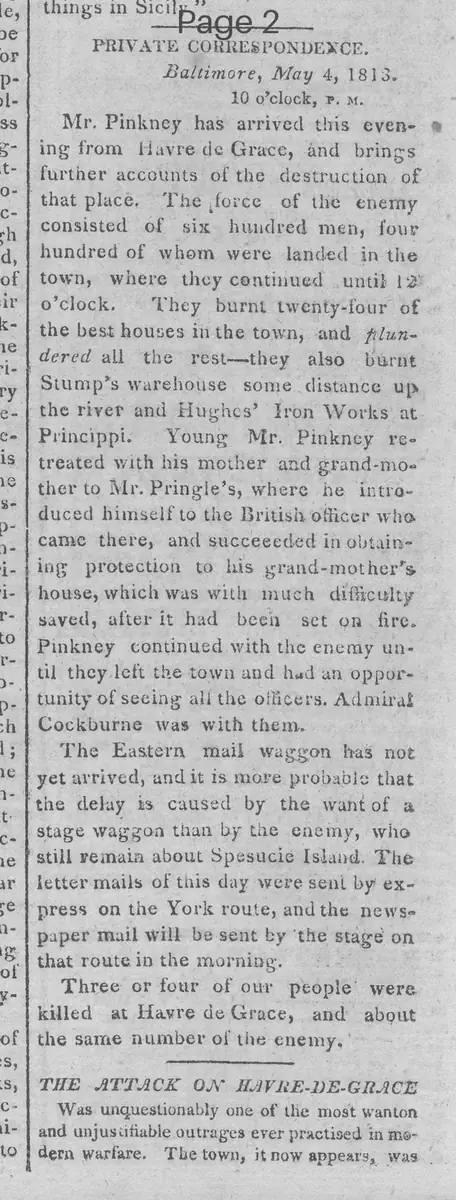
Baltimore, May 4, 1813.
10 o'clock, P. M.
Mr. Pinkney has arrived this evening from Havre de Grace, and brings further accounts of the destruction of that place. The force of the enemy consisted of six hundred men, four hundred of whom were landed in the town, where they continued until 12 o'clock. They burnt twenty-four of the best houses in the town, and plundered all the rest--they also burnt Stump's warehouse some distance up the river and Hughes' Iron Works at Principi. Young Mr. Pinkney retreated with his mother and grand-mother to Mr. Pringle's, where he introduced himself to the British officer who came there, and succeeded in obtaining protection to his grand-mother's house, which was with much difficulty saved, after it had been set on fire. Pinkney continued with the enemy until they left the town and had an opportunity of seeing all the officers. Admiral Cockburne was with them. The Eastern mail waggon has not yet arrived, and it is more probable that the delay is caused by the want of a stage waggon than by the enemy, who still remain about Spesucie Island. The letter mails of this day were sent by express on the York route, and the newspaper mail will be sent by the stage on that route in the morning. Three or four of our people were killed at Havre de Grace, and about the same number of the enemy,
THE ATTACK ON HAVRE-DE-GRACE
Was unquestionably one of the most wanton and unjustifiable outrages ever practised in modern warfare. The town, it now appears, was
not wholly destroyed, but partially burnt and generally plundered in a manner that would have disgraced a band of pirates. This destruction of private property was without any possible object. The United States had done no act for which it could be a retaliation; there were no public works at the place inviting assault; on no ground can it be justified; and it can be considered in no other light than as a base and dishonorable violation of the law of nations and of honorable or civilized warfare.
Let the object have been what it might, the destruction of the iron works, or the stoppage of the mails, which we allow to have been legitimate objects, neither of these, nor any other pretence can palliate the unnecessary depredations which have taken place. Private property is respected in war unless where retaliation justifies its destruction; or where it is destroyed inevitably in an attack on the fortifications, public or private armaments, or public works; or where its destruction is necessary to the attainment of a great public object. The bombardment and conflagration of towns has long been ranked among the barbarisms of our forefathers, and exploded in war as disgraceful and dishonorable. It has remained for the British nation, "the bulwark of our religion," which boasts of its magnanimity and generosity to its foes, to revive the savage war against women and children, and the wanton devastation of private property on our seaboard; and to excite a war of murder and pillage by their Indian allies, "regulars and militia" in the interior. The effect of these repeated outrages will unquestionably be to aggravate the hostility towards Great Britain already pervading the country; and to throw impediments in the way of the conclusion of an honorable peace. A few more such affairs as the massacre at the river Raisin, the bombardment of Lewistown, and the conflagration of Frenchtown and Havre-de-Grace, and there will no longer be any difference of sentiment in the Nation.
What sub-type of article is it?
What keywords are associated?
What entities or persons were involved?
Where did it happen?
Domestic News Details
Primary Location
Havre De Grace
Event Date
May 4, 1813
Key Persons
Outcome
three or four americans killed and about the same number of the enemy; twenty-four houses burnt, town plundered, stump's warehouse and hughes' iron works destroyed; grandmother's house saved with difficulty after being set on fire.
Event Details
British force of six hundred men, four hundred landed in Havre de Grace until 12 o'clock, burnt twenty-four best houses, plundered the rest, burnt Stump's warehouse up the river and Hughes' Iron Works at Principi. Enemy remained about Spesucie Island. Mails rerouted via York. Editorial describes attack as wanton outrage, partial burning and plundering without justification, violating laws of war.