Thank you for visiting SNEWPapers!
Sign up free
Story
November 26, 1950
Atlanta Daily World
Atlanta, Fulton County, Georgia
What is this article about?
Article on children's eating habits, explaining tensions from parental control and advice for fostering pleasure in meals through restraint and example. Excerpts from Adelaide A. Eiserer.
Clipping
OCR Quality
100%
Excellent
Full Text
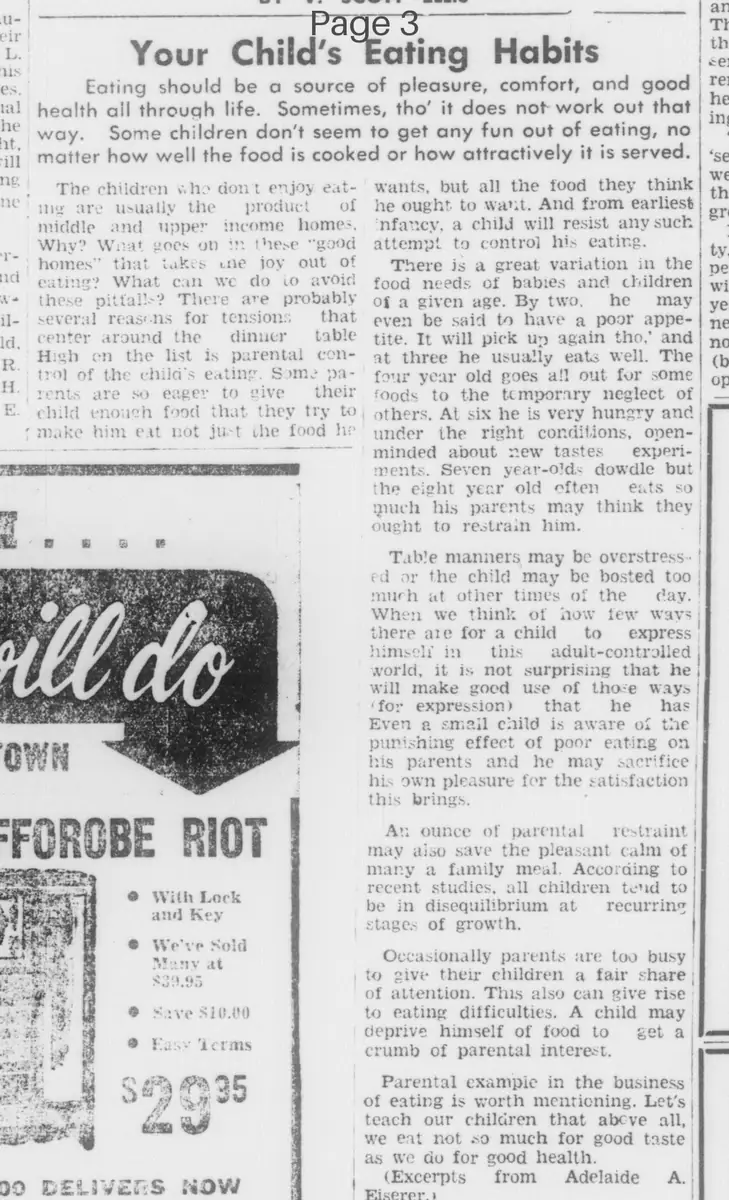
Your Child's Eating Habits
Eating should be a source of pleasure, comfort, and good health all through life.
Sometimes, though it does not work out that way.
Some children don't seem to get any fun out of eating, no matter how well the food is cooked or how attractively it is served.
The children who don't enjoy eating are usually the product of middle and upper income homes.
Why? What goes on in these "good homes" that takes the joy out of eating? What can we do to avoid these pitfalls? There are probably several reasons for tension that center around the dinner table.
High on the list is parental control of the child's eating. Some parents are so eager to give their child enough food that they try to make him eat not just the food he wants, but all the food they think he ought to want. And from earliest infancy, a child will resist any such attempt to control his eating.
There is a great variation in the food needs of babies and children of a given age. By two, he may even be said to have a poor appetite. It will pick up again though, and at three he usually eats well. The four year old goes all out for some foods to the temporary neglect of others. At six he is very hungry and under the right conditions, open-minded about new tastes experiments. Seven year-olds dawdle but the eight year old often eats so much his parents may think they ought to restrain him.
Table manners may be over-stressed or the child may be bossed too much at other times of the day. When we think of how few ways there are for a child to express himself in this adult-controlled world, it is not surprising that he will make good use of those ways for expression that he has.
Even a small child is aware of the punishing effect of poor eating on his parents and he may sacrifice his own pleasure for the satisfaction this brings.
An ounce of parental restraint may also save the pleasant calm of many a family meal. According to recent studies, all children tend to be in disequilibrium at recurring stages of growth.
Occasionally parents are too busy to give their children a fair share of attention. This also can give rise to eating difficulties. A child may deprive himself of food to get a crumb of parental interest.
Parental example in the business of eating is worth mentioning. Let's teach our children that above all, we eat not so much for good taste as we do for good health.
(Excerpts from Adelaide A. Eiserer.)
Eating should be a source of pleasure, comfort, and good health all through life.
Sometimes, though it does not work out that way.
Some children don't seem to get any fun out of eating, no matter how well the food is cooked or how attractively it is served.
The children who don't enjoy eating are usually the product of middle and upper income homes.
Why? What goes on in these "good homes" that takes the joy out of eating? What can we do to avoid these pitfalls? There are probably several reasons for tension that center around the dinner table.
High on the list is parental control of the child's eating. Some parents are so eager to give their child enough food that they try to make him eat not just the food he wants, but all the food they think he ought to want. And from earliest infancy, a child will resist any such attempt to control his eating.
There is a great variation in the food needs of babies and children of a given age. By two, he may even be said to have a poor appetite. It will pick up again though, and at three he usually eats well. The four year old goes all out for some foods to the temporary neglect of others. At six he is very hungry and under the right conditions, open-minded about new tastes experiments. Seven year-olds dawdle but the eight year old often eats so much his parents may think they ought to restrain him.
Table manners may be over-stressed or the child may be bossed too much at other times of the day. When we think of how few ways there are for a child to express himself in this adult-controlled world, it is not surprising that he will make good use of those ways for expression that he has.
Even a small child is aware of the punishing effect of poor eating on his parents and he may sacrifice his own pleasure for the satisfaction this brings.
An ounce of parental restraint may also save the pleasant calm of many a family meal. According to recent studies, all children tend to be in disequilibrium at recurring stages of growth.
Occasionally parents are too busy to give their children a fair share of attention. This also can give rise to eating difficulties. A child may deprive himself of food to get a crumb of parental interest.
Parental example in the business of eating is worth mentioning. Let's teach our children that above all, we eat not so much for good taste as we do for good health.
(Excerpts from Adelaide A. Eiserer.)
What sub-type of article is it?
Parenting Advice
What themes does it cover?
Family
Moral Virtue
What keywords are associated?
Child Eating Habits
Parental Control
Family Meals
Growth Stages
Eating Pleasure
What entities or persons were involved?
Adelaide A. Eiserer
Story Details
Key Persons
Adelaide A. Eiserer
Story Details
Discusses why some children in middle and upper income homes dislike eating due to parental control, overemphasis on manners, and lack of attention; advises restraint, positive example, and understanding growth stages to foster enjoyment of meals.