Thank you for visiting SNEWPapers!
Sign up free
Story
July 3, 1923
Perth Amboy Evening News
Perth Amboy, Middlesex County, New Jersey
What is this article about?
Article by Arthur Budd on the origins, religious role in China, and evolution of firecrackers from devil-scaring devices to gunpowder and fireworks, noting their cultural use and impact on U.S. imports.
Clipping
OCR Quality
82%
Good
Full Text
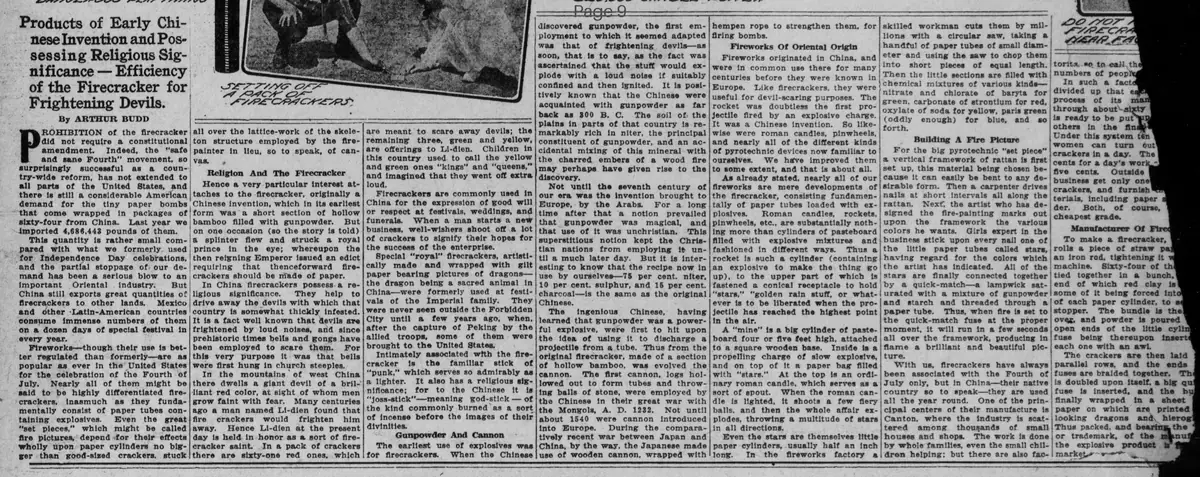
Products of Early Chinese Invention and Possessing Religious Significance—Efficiency of the Firecracker for Frightening Devils.
By ARTHUR BUDD
Prohibition of the firecracker and safe and sane Fourth movement, although the amendment did not require a constitutional change. Indeed, the safe and sane [movement was] surprisingly successful as a country-wide reform, has not extended to all parts of the United States, and there is still a considerable American demand for the tiny paper bombs that come wrapped in packages of sixty-four from China. Last year we imported 4,686,443 pounds of them. This quantity is rather small compared with what we formerly used for Independence Day celebrations, and the partial stoppage of our demand has been a serious blow to an important Oriental industry. But China still exports great quantities of firecrackers to other lands. Mexico and other Latin-American countries consume immense numbers of them on a dozen days of special festival in every year. Fireworks—though their use is better regulated than formerly—are as popular as ever in the United States for the celebration of the Fourth of July. Nearly all of them might be said to be highly differentiated firecrackers, inasmuch as they fundamentally consist of paper tubes containing explosives. Even the great set pieces, which might be called fire pictures, depend for their effects wholly upon paper cylinders no bigger than good-sized crackers stuck all over the lattice-work of the skeleton structure employed by the fire painter in lieu, so to speak, of canvas.
Religion And The Firecracker
Hence a very particular interest attaches to the firecracker, originally a Chinese invention, which in its earliest form was a short section of hollow bamboo filled with gunpowder. But on one occasion (so the story is told) a splinter flew and struck a royal prince in the eye; whereupon the then reigning Emperor issued an edict requiring that thenceforward firecrackers should be made of paper. In China firecrackers possess a religious significance. They help to drive away the devils with which that country is somewhat thickly infested. It is a fact well known that devils are frightened by loud noises, and since prehistoric times bells and gongs have been employed to scare them. For this very purpose it was that bells were first hung in church steeples. In the mountains of west China there dwells a giant devil of a brilliant red color, at sight of whom men grow faint with fear. Many centuries ago a man named Li-dien found that fire crackers would frighten him away. Hence Li-dien at the present day is held in honor as a sort of firecracker saint. In a pack of crackers there are sixty-one red ones, which are meant to scare away devils; the remaining three, green and yellow, are offerings to Li-dien. Children in this country used to call the yellow and green ones "kings" and "queens," and imagined that they went off extra loud. Firecrackers are commonly used in China for the expression of good will or respect at festivals, weddings, and funerals. When a man starts a new business, well-wishers shoot off a lot of crackers to signify their hopes for the success of the enterprise. Special "royal" firecrackers, artistically made and wrapped with gilt paper bearing pictures of dragons—the dragon being a sacred animal in China—were formerly used at festivals of the Imperial family. They were never seen outside the Forbidden City until a few years ago, when, after the capture of Peking by the allied troops, some of them were brought to the United States. Intimately associated with the firecracker is the familiar stick of "punk," which serves so admirably as a lighter. It also has a religious significance; for to the Chinese it is "joss-stick"—meaning god-stick—of the kind commonly burned as a sort of incense before the images of their divinities.
Gunpowder And Cannon
The earliest use of explosives was for firecrackers. When the Chinese discovered gunpowder, the first employment to which it seemed adapted was that of frightening devils—as soon as, that is to say, as the fact was ascertained that the stuff would explode with a loud noise if suitably confined and then ignited. It is positively known that the Chinese were acquainted with gunpowder as far back as 300 B. C. The soil of the plains in parts of that country is remarkably rich in niter, the principal constituent of gunpowder, and an accidental mixing of this mineral with the charred embers of a wood fire may perhaps have given rise to the discovery. Not until the seventh century of our era was the invention brought to Europe, by the Arabs. For a long time after that a notion prevailed that gunpowder was magical, and that use of it was unchristian. This superstitious notion kept the Christian nations from employing it until a much later day. But it is interesting to know that the recipe now in use by ourselves—75 per cent. niter, 10 per cent. sulphur, and 15 per cent. charcoal—is the same as the original Chinese. The ingenious Chinese, having learned that gunpowder was a powerful explosive, were first to hit upon the idea of using it to discharge a projectile from a tube. Thus from the original firecracker, made of a section of hollow bamboo, was evolved the cannon. The first cannon, logs hollowed out to form tubes and throwing balls of stone, were employed by the Chinese in their great war with the Mongols, A. D. 1232. Not until about 1540 were cannon introduced into Europe. During the comparatively recent war between Japan and China, by the way, the Japanese made use of wooden cannon, wrapped with hempen rope to strengthen them, for firing bombs.
Fireworks Of Oriental Origin
Fireworks originated in China, and were in common use there for many centuries before they were known in Europe. Like firecrackers, they were useful for devil-scaring purposes. The rocket was doubtless the first projectile fired by an explosive charge. It was a Chinese invention. So likewise were roman candles, pinwheels, and nearly all of the different kinds of pyrotechnic devices now familiar to ourselves. We have improved them to some extent, and that is about all. As already stated, nearly all of our fireworks are mere developments of the firecracker, consisting fundamentally of paper tubes loaded with explosives. Roman candles, rockets, pinwheels, etc., are substantially nothing more than cylinders of pasteboard filled with explosive mixtures and fashioned in different ways. Thus a rocket is such a cylinder (containing an explosive to make the thing go up), to the upper part of which is fastened a conical receptacle to hold "stars," "golden rain" stuff, or whatever is to be liberated when the projectile has reached the highest point in the air. A "mine" is a big cylinder of pasteboard four or five feet high, attached to a square wooden base. Inside is a propelling charge of slow explosive, and on top of it a paper bag filled with "stars." At the top is an ordinary roman candle, which serves as a sort of spout. When the roman candle is lighted, it shoots a few fiery balls, and then the whole affair explodes, throwing a multitude of stars in all directions. Even the stars are themselves little paper cylinders, usually half an inch long. In the fireworks factory a skilled workman cuts them by millions with a circular saw, taking a handful of paper tubes of small diameter and using the saw to chop them into short pieces of equal length. Then the little sections are filled with chemical mixtures of various kinds—nitrate and chlorate of baryta for green, carbonate of strontium for red, oxylate of soda for yellow, paris green (oddly enough) for blue, and so forth.
Building A Fire Picture
For the big pyrotechnic "set piece" a vertical framework of rattan is first set up, this material being chosen because it can easily be bent to any desirable form. Then a carpenter drives nails at short intervals all along the rattan. Next, the artist who has designed the fire-painting marks out upon the framework the various colors he wants. Girls expert in the business stick upon every nail one of the little paper tubes called stars, having regard for the colors which the artist has indicated. All of the stars are finally connected together by a quick-match—a lampwick saturated with a mixture of gunpowder and starch and threaded through a paper tube. Thus, when fire is set to the quick-match fuse at the proper moment, it will run in a few seconds all over the framework, producing in flame a brilliant and beautiful picture. With us, firecrackers have always been associated with the Fourth of July only, but in China—their native country so to speak—they are used all the year round. One of the principal centers of their manufacture is Canton, where the industry is scattered among thousands of small houses and shops. The work is done by whole families, even the small children helping; but there are also factories. [In such a factory, the work is] divided up [among] forts, so to call the numbers of people [; each process of its manufacture goes through about sixty [steps, and is] ready to be put up [by] others in the final [stages]. Under this system ten women can turn out [thousands of] crackers in a day. [They get] five cents for a day's work [; outside business get only one] cents. [Merchants supply] crackers, and furnish materials, including paper [and pow]der. Both, of course, [use the] cheapest grade. Manufacturer Of Fire[d]crackers To make a firecracker, [a worker] rolls a piece of straw paper [around] an iron rod, tightening it w[ith a] machine. Sixty-four of th[ese are] tied together in a bunch, [the] end of which red clay is [applied, some of it being forced into the] open ends of each paper cylinder, to se[rve as a] stopper. The bundle is the[n turned] over, and powder is poured [into the] open ends of the little cylin[ders, a] fuse being thereupon insert[ed in] each one with an awl. The crackers are then laid [in] parallel rows, and the ends [of the] fuses are braided together. Th[is braid] is doubled upon itself, a big qui[ck] fuse is inserted, and the bu[ndle is] finally wrapped in a sheet [of] paper on which are printed look[ing dragons and hierog]lyphs. Thus packed, and bearing the or [trademark] of the m[anuf]acturer, the explosive product is [sent to] markets.
By ARTHUR BUDD
Prohibition of the firecracker and safe and sane Fourth movement, although the amendment did not require a constitutional change. Indeed, the safe and sane [movement was] surprisingly successful as a country-wide reform, has not extended to all parts of the United States, and there is still a considerable American demand for the tiny paper bombs that come wrapped in packages of sixty-four from China. Last year we imported 4,686,443 pounds of them. This quantity is rather small compared with what we formerly used for Independence Day celebrations, and the partial stoppage of our demand has been a serious blow to an important Oriental industry. But China still exports great quantities of firecrackers to other lands. Mexico and other Latin-American countries consume immense numbers of them on a dozen days of special festival in every year. Fireworks—though their use is better regulated than formerly—are as popular as ever in the United States for the celebration of the Fourth of July. Nearly all of them might be said to be highly differentiated firecrackers, inasmuch as they fundamentally consist of paper tubes containing explosives. Even the great set pieces, which might be called fire pictures, depend for their effects wholly upon paper cylinders no bigger than good-sized crackers stuck all over the lattice-work of the skeleton structure employed by the fire painter in lieu, so to speak, of canvas.
Religion And The Firecracker
Hence a very particular interest attaches to the firecracker, originally a Chinese invention, which in its earliest form was a short section of hollow bamboo filled with gunpowder. But on one occasion (so the story is told) a splinter flew and struck a royal prince in the eye; whereupon the then reigning Emperor issued an edict requiring that thenceforward firecrackers should be made of paper. In China firecrackers possess a religious significance. They help to drive away the devils with which that country is somewhat thickly infested. It is a fact well known that devils are frightened by loud noises, and since prehistoric times bells and gongs have been employed to scare them. For this very purpose it was that bells were first hung in church steeples. In the mountains of west China there dwells a giant devil of a brilliant red color, at sight of whom men grow faint with fear. Many centuries ago a man named Li-dien found that fire crackers would frighten him away. Hence Li-dien at the present day is held in honor as a sort of firecracker saint. In a pack of crackers there are sixty-one red ones, which are meant to scare away devils; the remaining three, green and yellow, are offerings to Li-dien. Children in this country used to call the yellow and green ones "kings" and "queens," and imagined that they went off extra loud. Firecrackers are commonly used in China for the expression of good will or respect at festivals, weddings, and funerals. When a man starts a new business, well-wishers shoot off a lot of crackers to signify their hopes for the success of the enterprise. Special "royal" firecrackers, artistically made and wrapped with gilt paper bearing pictures of dragons—the dragon being a sacred animal in China—were formerly used at festivals of the Imperial family. They were never seen outside the Forbidden City until a few years ago, when, after the capture of Peking by the allied troops, some of them were brought to the United States. Intimately associated with the firecracker is the familiar stick of "punk," which serves so admirably as a lighter. It also has a religious significance; for to the Chinese it is "joss-stick"—meaning god-stick—of the kind commonly burned as a sort of incense before the images of their divinities.
Gunpowder And Cannon
The earliest use of explosives was for firecrackers. When the Chinese discovered gunpowder, the first employment to which it seemed adapted was that of frightening devils—as soon as, that is to say, as the fact was ascertained that the stuff would explode with a loud noise if suitably confined and then ignited. It is positively known that the Chinese were acquainted with gunpowder as far back as 300 B. C. The soil of the plains in parts of that country is remarkably rich in niter, the principal constituent of gunpowder, and an accidental mixing of this mineral with the charred embers of a wood fire may perhaps have given rise to the discovery. Not until the seventh century of our era was the invention brought to Europe, by the Arabs. For a long time after that a notion prevailed that gunpowder was magical, and that use of it was unchristian. This superstitious notion kept the Christian nations from employing it until a much later day. But it is interesting to know that the recipe now in use by ourselves—75 per cent. niter, 10 per cent. sulphur, and 15 per cent. charcoal—is the same as the original Chinese. The ingenious Chinese, having learned that gunpowder was a powerful explosive, were first to hit upon the idea of using it to discharge a projectile from a tube. Thus from the original firecracker, made of a section of hollow bamboo, was evolved the cannon. The first cannon, logs hollowed out to form tubes and throwing balls of stone, were employed by the Chinese in their great war with the Mongols, A. D. 1232. Not until about 1540 were cannon introduced into Europe. During the comparatively recent war between Japan and China, by the way, the Japanese made use of wooden cannon, wrapped with hempen rope to strengthen them, for firing bombs.
Fireworks Of Oriental Origin
Fireworks originated in China, and were in common use there for many centuries before they were known in Europe. Like firecrackers, they were useful for devil-scaring purposes. The rocket was doubtless the first projectile fired by an explosive charge. It was a Chinese invention. So likewise were roman candles, pinwheels, and nearly all of the different kinds of pyrotechnic devices now familiar to ourselves. We have improved them to some extent, and that is about all. As already stated, nearly all of our fireworks are mere developments of the firecracker, consisting fundamentally of paper tubes loaded with explosives. Roman candles, rockets, pinwheels, etc., are substantially nothing more than cylinders of pasteboard filled with explosive mixtures and fashioned in different ways. Thus a rocket is such a cylinder (containing an explosive to make the thing go up), to the upper part of which is fastened a conical receptacle to hold "stars," "golden rain" stuff, or whatever is to be liberated when the projectile has reached the highest point in the air. A "mine" is a big cylinder of pasteboard four or five feet high, attached to a square wooden base. Inside is a propelling charge of slow explosive, and on top of it a paper bag filled with "stars." At the top is an ordinary roman candle, which serves as a sort of spout. When the roman candle is lighted, it shoots a few fiery balls, and then the whole affair explodes, throwing a multitude of stars in all directions. Even the stars are themselves little paper cylinders, usually half an inch long. In the fireworks factory a skilled workman cuts them by millions with a circular saw, taking a handful of paper tubes of small diameter and using the saw to chop them into short pieces of equal length. Then the little sections are filled with chemical mixtures of various kinds—nitrate and chlorate of baryta for green, carbonate of strontium for red, oxylate of soda for yellow, paris green (oddly enough) for blue, and so forth.
Building A Fire Picture
For the big pyrotechnic "set piece" a vertical framework of rattan is first set up, this material being chosen because it can easily be bent to any desirable form. Then a carpenter drives nails at short intervals all along the rattan. Next, the artist who has designed the fire-painting marks out upon the framework the various colors he wants. Girls expert in the business stick upon every nail one of the little paper tubes called stars, having regard for the colors which the artist has indicated. All of the stars are finally connected together by a quick-match—a lampwick saturated with a mixture of gunpowder and starch and threaded through a paper tube. Thus, when fire is set to the quick-match fuse at the proper moment, it will run in a few seconds all over the framework, producing in flame a brilliant and beautiful picture. With us, firecrackers have always been associated with the Fourth of July only, but in China—their native country so to speak—they are used all the year round. One of the principal centers of their manufacture is Canton, where the industry is scattered among thousands of small houses and shops. The work is done by whole families, even the small children helping; but there are also factories. [In such a factory, the work is] divided up [among] forts, so to call the numbers of people [; each process of its manufacture goes through about sixty [steps, and is] ready to be put up [by] others in the final [stages]. Under this system ten women can turn out [thousands of] crackers in a day. [They get] five cents for a day's work [; outside business get only one] cents. [Merchants supply] crackers, and furnish materials, including paper [and pow]der. Both, of course, [use the] cheapest grade. Manufacturer Of Fire[d]crackers To make a firecracker, [a worker] rolls a piece of straw paper [around] an iron rod, tightening it w[ith a] machine. Sixty-four of th[ese are] tied together in a bunch, [the] end of which red clay is [applied, some of it being forced into the] open ends of each paper cylinder, to se[rve as a] stopper. The bundle is the[n turned] over, and powder is poured [into the] open ends of the little cylin[ders, a] fuse being thereupon insert[ed in] each one with an awl. The crackers are then laid [in] parallel rows, and the ends [of the] fuses are braided together. Th[is braid] is doubled upon itself, a big qui[ck] fuse is inserted, and the bu[ndle is] finally wrapped in a sheet [of] paper on which are printed look[ing dragons and hierog]lyphs. Thus packed, and bearing the or [trademark] of the m[anuf]acturer, the explosive product is [sent to] markets.
What sub-type of article is it?
Curiosity
Historical Event
What themes does it cover?
Providence Divine
What keywords are associated?
Firecrackers
Chinese Invention
Religious Significance
Gunpowder
Fireworks
Devil Scaring
What entities or persons were involved?
Arthur Budd
Li Dien
Where did it happen?
China
Story Details
Key Persons
Arthur Budd
Li Dien
Location
China
Event Date
As Far Back As 300 B.C.
Story Details
The article discusses the history, invention, and religious significance of firecrackers in China, their use to frighten devils, evolution into gunpowder and cannons, and development into modern fireworks.