Thank you for visiting SNEWPapers!
Sign up free
Editorial
September 17, 1832
Lynchburg Virginian
Lynchburg, Virginia
What is this article about?
Editorial from Lynchburg, Sept. 17, 1832, presents Richard H. Wilde's sketches of prominent U.S. statesmen from the 11th Congress: William Lowndes, William Pinkney, John Randolph, John C. Calhoun, Henry Clay, and Daniel Webster. It defends Clay against partisan attacks amid his presidential nomination and critiques Calhoun's Nullification doctrine as ambition-driven.
Clipping
OCR Quality
95%
Excellent
Full Text
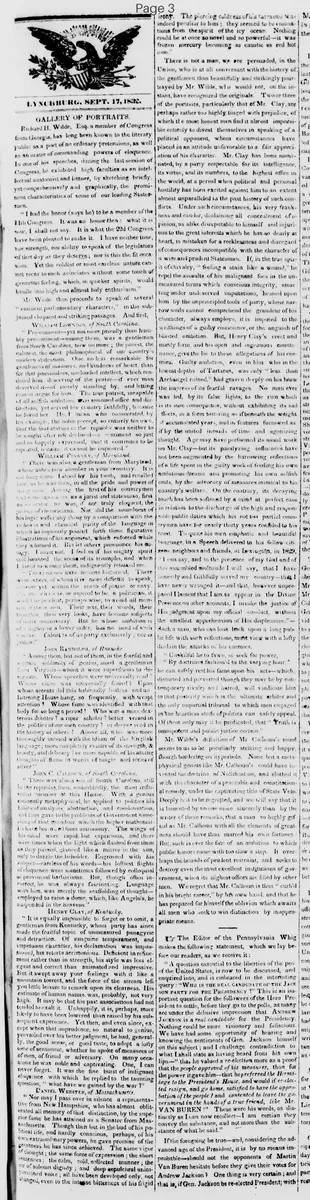
LYNCHBURG, SEPT. 17, 1832.
GALLERY OF PORTRAITS.
Richard H. Wilde, Esq. a member of Congress from Georgia, has long been known to the literary public as a poet of no ordinary pretensions, as well as an orator of commanding powers of eloquence. In one of his speeches, during the last session of Congress, he exhibited high faculties as an intellectual anatomist and limner, by sketching briefly, yet comprehensively and graphically, the prominent characteristics of some of our leading Statesmen.
"I had the honor (says he) to be a member of the 11th Congress. It was an honor then: what it is now, I shall not say. It is what the 22d Congress have been pleased to make it. I have neither time, nor strength, nor ability to speak of the legislators of that day as they deserve; nor is this the fit occasion. Yet the coldest or most careless nature cannot recur to such associates without some touch of generous feeling, which, in quicker spirits, would kindle into high and almost holy enthusiasm."
Mr. Wilde then proceeds to speak of several "eminent parliamentary characters," in the subjoined eloquent and striking passages. And first, WILLIAM LOWNDES, of South Carolina.
"Pre-eminent—yet not more proudly than humbly pre-eminent—among them, was a gentleman from South Carolina, now no more; the purest, the calmest, the most philosophical of our country's modern statesmen. One no less remarkable for gentleness of manners, and kindness of heart, than for that passionless, unclouded intellect, which rendered him deserving of the praise—if ever man deserved it—of merely standing by, and letting reason argue for him. The true patriot, incapable of all selfish ambition, so shunned office and distinction, yet served his country faithfully, because he loved her. He, I mean, who consecrated, by his example, the noble precept, so entirely his own, that the first station in the republic was neither to be sought after nor declined—a sentiment so just and so happily expressed, that it continues to be repeated, because it cannot be improved."
WILLIAM PINKNEY, of Maryland.
"There was also, a gentleman from Maryland, whose ashes now slumber in your cemetery. It is not long since I stood by his tomb, and recalled him as he was then, in all the pride and power of his genius. Among the first of his countrymen in newness of reputation as a jurist and statesman, first as orator he was, if not truly eloquent, the guide of historians. Nor did the soundness of his logic suffer anything by a comparison with the richness and classical purity of the language in which he copiously poured forth those figurative illustrations of his argument, which enforced while they adorned it. But let others pronounce his eulogy. I must not. I feel as if his mighty spirit still haunted the scene of its triumphs, and when I dared to wrong them, indignantly rebuked me."
These names have become historical. There were others, of whom it is more difficult to speak, because yet within the reach of praise or envy in which all is, or aspired to be, a politician, it would be prudent, perhaps wise, to avoid all mention. Their acts, their words, their thoughts, their very looks, have become subjects of party controversy. But he whose ambition is of a higher or a lower order, has no need of such talent is of no party exclusively; nor is justice."
JOHN RANDOLPH, of Roanoke.
Among them, but not of them, in the fearful and solitary sublimity of genius, stood a gentleman from Virginia—whom it were superfluous to designate. Whose speeches were universally read? Whose satire was universally feared? Upon whose accents did this habitually listless and unlistening House hang, so frequently, with wrapt attention? Whose fame was identified with that body for so long a period? Who was a more dexterous debater? a riper scholar? better versed in the politics of our own country? or deeper read in the history of others? Above all, who was more thoroughly imbued with the idiom of the English language; more completely master of its strength, beauty, and delicacy! or more capable of breathing thoughts of flame in words of magic and tones of silver!"
JOHN C. CALHOUN, of South Carolina.
"There was also a son of South Carolina, still in the republic, then, undoubtedly, the most influential member of this House. With a genius eminently metaphysical, he applied to politics his habits of analysis, abstraction, and condensation, and thus gave to the problems of Government some such thing of that grandeur which the higher mathematics have borrowed from astronomy. The wings of his mind were rapid, but capricious, and there were times when the light which flashed from them, as they passed, glanced like a mirror in the sun, only to dazzle the beholder. Engrossed with his subject—careless of his words—his loftiest flights of eloquence were sometimes followed by colloquial or provincial barbarisms. But, though often incorrect, he was always fascinating. Language with him, was merely the scaffolding of thought—employed to raise a dome, which, like Angelo's, he suspended in the heavens."
HENRY CLAY, of Kentucky.
"It is equally impossible to forget or to omit, a gentleman from Kentucky, whom party has since made the fruitful topic of unmeasured panegyric and detraction. Of sanguine temperament, and impetuous character, his declamation was impassioned, his retorts acrimonious. Deficient in refinement rather than in strength, his style was less elegant and correct than animated and impressive. But it swept away your feelings with it like a mountain torrent, and the force of the stream left you little leisure to remark upon its clearness. His estimate of human nature was, probably, not very high. It may be that his past associations had not tended to exalt it. Unhappily, it is, perhaps, more likely to have been lowered than raised by his subsequent experience. Yet then, and even since, except when that imprudence, so natural to genius, prevailed over his better judgment, he had, generally, the good sense, or good taste, to adopt a lofty tone of sentiment, whether he spoke of measures or of men, of friend or adversary. On many occasions he was noble and captivating. One, I can never forget. It was the fine burst of indignant eloquence with which he replied to the taunting question, 'what have we gained by the war?'"
DANIEL WEBSTER, of Massachusetts.
"Nor may I pass over in silence a representative from New Hampshire, who has almost obliterated all memory of that distinction, by the superior fame he has attained as a Senator from Massachusetts. Though then but in the bud of his political life, and hardly conscious, perhaps, of his own extraordinary powers, he gave promise of the greatness he has since achieved. The same vigor of thought; the same force of expression; the short sentences; the calm, cold, collected manner; the air of solemn dignity; and deep sepulchral unpassioned voice; all have been developed only, not changed, even to the intense bitterness of his frigid front. The piercing coldness of his sarcasms was indeed peculiar to him; they seemed to be emanations from the spirit of the icy ocean. Nothing could be at once so novel and so powerful—it was frozen mercury becoming as caustic as red hot iron.
There is not a man, we are persuaded, in the Union, who is at all conversant with the history of the gentlemen thus beautifully and strikingly portrayed by Mr. Wilde, who would not, on the instant, have recognized the originals. Two or three of the portraits, particularly that of Mr. Clay, are perhaps rather too highly tinged with prejudice, of which the most honest men find it almost impossible entirely to divest themselves in speaking of a political opponent, whom circumstances have placed in an attitude unfavorable to a fair appreciation of his character. Mr. Clay has been nominated, by a party respectable for its intelligence, its virtue, and its numbers, to the highest office in the world, at a period when political and personal hostility has been excited against him to an extent almost unparalleled in the past history of such conflicts. Under such circumstances, his very frankness and candor, disdaining all concealment of opinion, as alike disreputable to himself and injurious to the great interests which he has so dearly at heart, is mistaken for a recklessness and disregard of consequences incompatible with the character of a wise and prudent Statesman. If, in the true spirit of chivalry, "feeling a stain like a wound," he repel the assaults of his malignant foes in the unmeasured terms which conscious integrity, smarting under undeserved imputations, heaped upon him by the unprincipled tools of party, whose narrow souls cannot comprehend the grandeur of his character, always employs, it is imputed to the writhings of a guilty conscience, or the anguish of blasted ambition. But, Henry Clay's erect and manly form, and his open and ingenuous countenance, give the lie to these allegations of his enemies. Guilty ambition, even in him who in the lowest depths of Tartarus, was only "less than Archangel ruined," had graven deeply on his brow the impress of its fearful ravages. No man ever was led, by its false lights, to the ruin which is its sure consequence, without exhibiting its sad effects, in a form tottering as if beneath the weight of accumulated years, and in features furrowed as if by the united inroads of time and agonizing thought. Age may have performed its usual work on Mr. Clay—but its paralyzing influences have not been augmented by the harrowing reflections of a life spent in the guilty work of feeding his own ambitious dreams and promoting his own selfish ends, by the advocacy of measures inimical to his country's welfare. On the contrary, its decaying touch has been softened by a mind at perfect ease in relation to the discharge of the high and responsible public duties which his not too partial countrymen have for nearly thirty years confided to his trust. To quote his own emphatic and beautiful language, in a Speech delivered to his fellow-citizens, neighbors and friends, at Lexington, in 1829: 'I can say, and in the presence of my God and of this assembled multitude I will say, that I have honestly and faithfully served my country—that I have never wronged it—and that, however unprepared I lament that I am to appear in the Divine Presence on other accounts, I invoke the justice of His judgment upon my official conduct, without the smallest apprehension of His displeasure.'—Such a man, who can look back upon a long public life with such reflections, must view with a lofty disdain the attacks of his enemies.
"Unskilful he to fawn, or seek for power,
By doctrines fashion'd to the varying hour,"
he can safely rest his fame upon his acts—which, distorted and perverted though they may be by contemporary rivalry and hatred, will vindicate him to that posterity which is the ultimate arbiter and the only impartial tribunal to which men engaged in the heartless strife of politics can safely appeal. Of it only may it be predicated, that "Truth is omnipotent and public justice certain."
Mr. Wilde's definition of Mr. Calhoun's mind seems to us to be peculiarly striking and happy, though bordering on hyperbole. None but a metaphysical genius like Mr. Calhoun's could have invented the doctrine of Nullification, and clothed it with the character of a peaceable and constitutional remedy, under the captivating title of State Veto. Deeply is it to be regretted, and we will say that it is lamented by no one more sincerely than by the writer of these remarks, that a man so highly gifted as Mr. Calhoun with all the elements of greatness should have thus marred his own fortunes. But, such is ever the fate of an ambition to which public honors come with too slow a step. It overleaps the bounds of prudent restraint, and seeks to destroy even the most excellent institutions of government, when its highest offices are filled by other men. We regret that Mr. Calhoun is thus "curb'd in his bright career," by his own hand, and that he has prepared for himself the oblivion which awaits all men who seek to win distinction by inappropriate means.
GALLERY OF PORTRAITS.
Richard H. Wilde, Esq. a member of Congress from Georgia, has long been known to the literary public as a poet of no ordinary pretensions, as well as an orator of commanding powers of eloquence. In one of his speeches, during the last session of Congress, he exhibited high faculties as an intellectual anatomist and limner, by sketching briefly, yet comprehensively and graphically, the prominent characteristics of some of our leading Statesmen.
"I had the honor (says he) to be a member of the 11th Congress. It was an honor then: what it is now, I shall not say. It is what the 22d Congress have been pleased to make it. I have neither time, nor strength, nor ability to speak of the legislators of that day as they deserve; nor is this the fit occasion. Yet the coldest or most careless nature cannot recur to such associates without some touch of generous feeling, which, in quicker spirits, would kindle into high and almost holy enthusiasm."
Mr. Wilde then proceeds to speak of several "eminent parliamentary characters," in the subjoined eloquent and striking passages. And first, WILLIAM LOWNDES, of South Carolina.
"Pre-eminent—yet not more proudly than humbly pre-eminent—among them, was a gentleman from South Carolina, now no more; the purest, the calmest, the most philosophical of our country's modern statesmen. One no less remarkable for gentleness of manners, and kindness of heart, than for that passionless, unclouded intellect, which rendered him deserving of the praise—if ever man deserved it—of merely standing by, and letting reason argue for him. The true patriot, incapable of all selfish ambition, so shunned office and distinction, yet served his country faithfully, because he loved her. He, I mean, who consecrated, by his example, the noble precept, so entirely his own, that the first station in the republic was neither to be sought after nor declined—a sentiment so just and so happily expressed, that it continues to be repeated, because it cannot be improved."
WILLIAM PINKNEY, of Maryland.
"There was also, a gentleman from Maryland, whose ashes now slumber in your cemetery. It is not long since I stood by his tomb, and recalled him as he was then, in all the pride and power of his genius. Among the first of his countrymen in newness of reputation as a jurist and statesman, first as orator he was, if not truly eloquent, the guide of historians. Nor did the soundness of his logic suffer anything by a comparison with the richness and classical purity of the language in which he copiously poured forth those figurative illustrations of his argument, which enforced while they adorned it. But let others pronounce his eulogy. I must not. I feel as if his mighty spirit still haunted the scene of its triumphs, and when I dared to wrong them, indignantly rebuked me."
These names have become historical. There were others, of whom it is more difficult to speak, because yet within the reach of praise or envy in which all is, or aspired to be, a politician, it would be prudent, perhaps wise, to avoid all mention. Their acts, their words, their thoughts, their very looks, have become subjects of party controversy. But he whose ambition is of a higher or a lower order, has no need of such talent is of no party exclusively; nor is justice."
JOHN RANDOLPH, of Roanoke.
Among them, but not of them, in the fearful and solitary sublimity of genius, stood a gentleman from Virginia—whom it were superfluous to designate. Whose speeches were universally read? Whose satire was universally feared? Upon whose accents did this habitually listless and unlistening House hang, so frequently, with wrapt attention? Whose fame was identified with that body for so long a period? Who was a more dexterous debater? a riper scholar? better versed in the politics of our own country? or deeper read in the history of others? Above all, who was more thoroughly imbued with the idiom of the English language; more completely master of its strength, beauty, and delicacy! or more capable of breathing thoughts of flame in words of magic and tones of silver!"
JOHN C. CALHOUN, of South Carolina.
"There was also a son of South Carolina, still in the republic, then, undoubtedly, the most influential member of this House. With a genius eminently metaphysical, he applied to politics his habits of analysis, abstraction, and condensation, and thus gave to the problems of Government some such thing of that grandeur which the higher mathematics have borrowed from astronomy. The wings of his mind were rapid, but capricious, and there were times when the light which flashed from them, as they passed, glanced like a mirror in the sun, only to dazzle the beholder. Engrossed with his subject—careless of his words—his loftiest flights of eloquence were sometimes followed by colloquial or provincial barbarisms. But, though often incorrect, he was always fascinating. Language with him, was merely the scaffolding of thought—employed to raise a dome, which, like Angelo's, he suspended in the heavens."
HENRY CLAY, of Kentucky.
"It is equally impossible to forget or to omit, a gentleman from Kentucky, whom party has since made the fruitful topic of unmeasured panegyric and detraction. Of sanguine temperament, and impetuous character, his declamation was impassioned, his retorts acrimonious. Deficient in refinement rather than in strength, his style was less elegant and correct than animated and impressive. But it swept away your feelings with it like a mountain torrent, and the force of the stream left you little leisure to remark upon its clearness. His estimate of human nature was, probably, not very high. It may be that his past associations had not tended to exalt it. Unhappily, it is, perhaps, more likely to have been lowered than raised by his subsequent experience. Yet then, and even since, except when that imprudence, so natural to genius, prevailed over his better judgment, he had, generally, the good sense, or good taste, to adopt a lofty tone of sentiment, whether he spoke of measures or of men, of friend or adversary. On many occasions he was noble and captivating. One, I can never forget. It was the fine burst of indignant eloquence with which he replied to the taunting question, 'what have we gained by the war?'"
DANIEL WEBSTER, of Massachusetts.
"Nor may I pass over in silence a representative from New Hampshire, who has almost obliterated all memory of that distinction, by the superior fame he has attained as a Senator from Massachusetts. Though then but in the bud of his political life, and hardly conscious, perhaps, of his own extraordinary powers, he gave promise of the greatness he has since achieved. The same vigor of thought; the same force of expression; the short sentences; the calm, cold, collected manner; the air of solemn dignity; and deep sepulchral unpassioned voice; all have been developed only, not changed, even to the intense bitterness of his frigid front. The piercing coldness of his sarcasms was indeed peculiar to him; they seemed to be emanations from the spirit of the icy ocean. Nothing could be at once so novel and so powerful—it was frozen mercury becoming as caustic as red hot iron.
There is not a man, we are persuaded, in the Union, who is at all conversant with the history of the gentlemen thus beautifully and strikingly portrayed by Mr. Wilde, who would not, on the instant, have recognized the originals. Two or three of the portraits, particularly that of Mr. Clay, are perhaps rather too highly tinged with prejudice, of which the most honest men find it almost impossible entirely to divest themselves in speaking of a political opponent, whom circumstances have placed in an attitude unfavorable to a fair appreciation of his character. Mr. Clay has been nominated, by a party respectable for its intelligence, its virtue, and its numbers, to the highest office in the world, at a period when political and personal hostility has been excited against him to an extent almost unparalleled in the past history of such conflicts. Under such circumstances, his very frankness and candor, disdaining all concealment of opinion, as alike disreputable to himself and injurious to the great interests which he has so dearly at heart, is mistaken for a recklessness and disregard of consequences incompatible with the character of a wise and prudent Statesman. If, in the true spirit of chivalry, "feeling a stain like a wound," he repel the assaults of his malignant foes in the unmeasured terms which conscious integrity, smarting under undeserved imputations, heaped upon him by the unprincipled tools of party, whose narrow souls cannot comprehend the grandeur of his character, always employs, it is imputed to the writhings of a guilty conscience, or the anguish of blasted ambition. But, Henry Clay's erect and manly form, and his open and ingenuous countenance, give the lie to these allegations of his enemies. Guilty ambition, even in him who in the lowest depths of Tartarus, was only "less than Archangel ruined," had graven deeply on his brow the impress of its fearful ravages. No man ever was led, by its false lights, to the ruin which is its sure consequence, without exhibiting its sad effects, in a form tottering as if beneath the weight of accumulated years, and in features furrowed as if by the united inroads of time and agonizing thought. Age may have performed its usual work on Mr. Clay—but its paralyzing influences have not been augmented by the harrowing reflections of a life spent in the guilty work of feeding his own ambitious dreams and promoting his own selfish ends, by the advocacy of measures inimical to his country's welfare. On the contrary, its decaying touch has been softened by a mind at perfect ease in relation to the discharge of the high and responsible public duties which his not too partial countrymen have for nearly thirty years confided to his trust. To quote his own emphatic and beautiful language, in a Speech delivered to his fellow-citizens, neighbors and friends, at Lexington, in 1829: 'I can say, and in the presence of my God and of this assembled multitude I will say, that I have honestly and faithfully served my country—that I have never wronged it—and that, however unprepared I lament that I am to appear in the Divine Presence on other accounts, I invoke the justice of His judgment upon my official conduct, without the smallest apprehension of His displeasure.'—Such a man, who can look back upon a long public life with such reflections, must view with a lofty disdain the attacks of his enemies.
"Unskilful he to fawn, or seek for power,
By doctrines fashion'd to the varying hour,"
he can safely rest his fame upon his acts—which, distorted and perverted though they may be by contemporary rivalry and hatred, will vindicate him to that posterity which is the ultimate arbiter and the only impartial tribunal to which men engaged in the heartless strife of politics can safely appeal. Of it only may it be predicated, that "Truth is omnipotent and public justice certain."
Mr. Wilde's definition of Mr. Calhoun's mind seems to us to be peculiarly striking and happy, though bordering on hyperbole. None but a metaphysical genius like Mr. Calhoun's could have invented the doctrine of Nullification, and clothed it with the character of a peaceable and constitutional remedy, under the captivating title of State Veto. Deeply is it to be regretted, and we will say that it is lamented by no one more sincerely than by the writer of these remarks, that a man so highly gifted as Mr. Calhoun with all the elements of greatness should have thus marred his own fortunes. But, such is ever the fate of an ambition to which public honors come with too slow a step. It overleaps the bounds of prudent restraint, and seeks to destroy even the most excellent institutions of government, when its highest offices are filled by other men. We regret that Mr. Calhoun is thus "curb'd in his bright career," by his own hand, and that he has prepared for himself the oblivion which awaits all men who seek to win distinction by inappropriate means.
What sub-type of article is it?
Partisan Politics
Constitutional
What keywords are associated?
Statesmen Portraits
Henry Clay Defense
John Calhoun Nullification
Richard Wilde Speech
11th Congress
Political Eloquence
Partisan Attacks
What entities or persons were involved?
Richard H. Wilde
William Lowndes
William Pinkney
John Randolph
John C. Calhoun
Henry Clay
Daniel Webster
Editorial Details
Primary Topic
Portraits Of Leading American Statesmen And Defense Of Henry Clay
Stance / Tone
Admiring And Defensive Toward Statesmen, Particularly Supportive Of Henry Clay Against Partisan Attacks, Critical Of John C. Calhoun's Nullification Doctrine
Key Figures
Richard H. Wilde
William Lowndes
William Pinkney
John Randolph
John C. Calhoun
Henry Clay
Daniel Webster
Key Arguments
Wilde's Sketches Vividly Capture The Characteristics Of Eminent Statesmen From The 11th Congress.
Lowndes Exemplified Pure, Philosophical Patriotism Without Selfish Ambition.
Pinkney Was Renowned For Juristic And Oratorical Genius.
Randolph Stood Out For Satirical Genius, Scholarly Depth, And Mastery Of Language.
Calhoun's Metaphysical Genius Applied To Politics But Led To Flawed Eloquence And Nullification Doctrine.
Clay's Impassioned Style And Noble Sentiments Are Defended Against Accusations Of Recklessness And Ambition.
Webster's Cold, Powerful Sarcasm And Dignified Manner Promised Future Greatness.
Clay's Frankness Is Mistaken For Imprudence Amid Political Hostility During His Presidential Nomination.
Calhoun's Ambition Has Marred His Fortunes By Inventing Nullification As A Destructive Remedy.