Thank you for visiting SNEWPapers!
Sign up free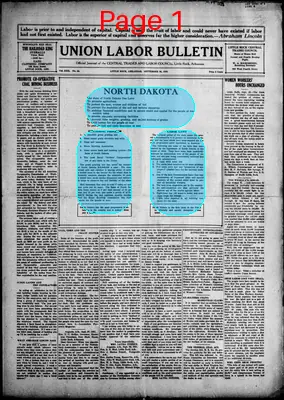
Union Labor Bulletin
Little Rock, Pulaski County, Arkansas
What is this article about?
North Dakota's progressive laws and institutions promote agriculture, protect workers, stabilize finances, and provide affordable services like hail insurance and banking, with labor laws enacted in 1919 recognizing union labor.
Clipping
OCR Quality
Full Text
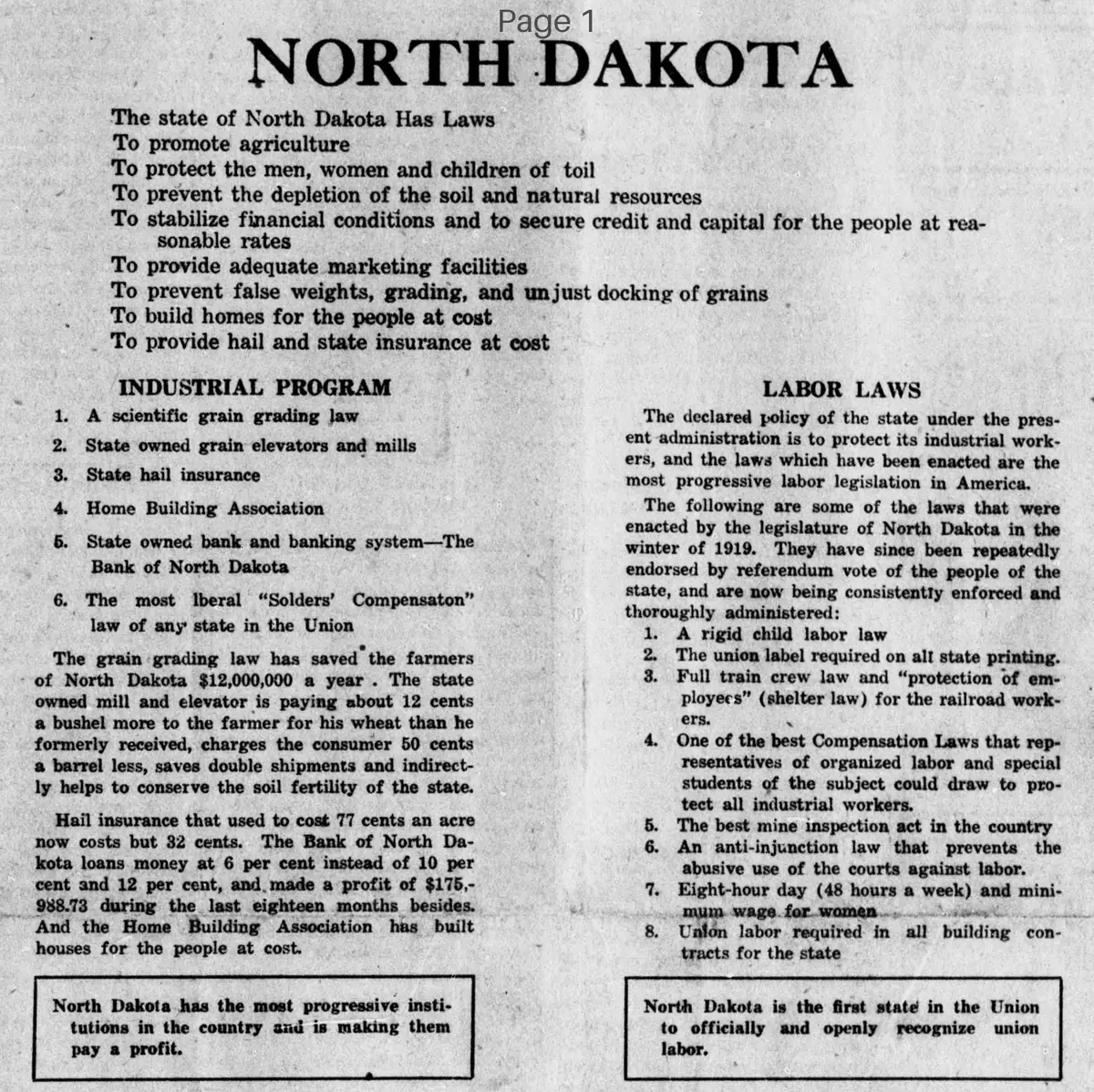
The state of North Dakota Has Laws
To promote agriculture
To protect the men, women and children of toil
To prevent the depletion of the soil and natural resources
To stabilize financial conditions and to secure credit and capital for the people at reasonable rates
To provide adequate marketing facilities
To prevent false weights, grading, and unjust docking of grains
To build homes for the people at cost
To provide hail and state insurance at cost
INDUSTRIAL PROGRAM
1. A scientific grain grading law
2. State owned grain elevators and mills
3. State hail insurance
4. Home Building Association
5. State owned bank and banking system-The Bank of North Dakota
6. The most liberal "Soldiers' Compensation" law of any state in the Union
The grain grading law has saved the farmers of North Dakota $12,000,000 a year . The state owned mill and elevator is paying about 12 cents a bushel more to the farmer for his wheat than he formerly received, charges the consumer 50 cents a barrel less, saves double shipments and indirectly helps to conserve the soil fertility of the state.
Hail insurance that used to cost 77 cents an acre now costs but 32 cents. The Bank of North Dakota loans money at 6 per cent instead of 10 per cent and 12 per cent, and made a profit of $175,988.73 during the last eighteen months besides.
And the Home Building Association has built houses for the people at cost.
North Dakota has the most progressive institutions in the country and is making them pay a profit.
LABOR LAWS
The declared policy of the state under the present-administration is to protect its industrial workers, and the laws which have been enacted are the most progressive labor legislation in America.
The following are some of the laws that were enacted by the legislature of North Dakota in the winter of 1919. They have since been repeatedly endorsed by referendum vote of the people of the state, and are now being consistently enforced and thoroughly administered:
1. A rigid child labor law
2. The union label required on all state printing.
3. Full train crew law and "protection of employees" (shelter law)for the railroad workers.
4. One of the best Compensation Laws that representatives of organized labor and special students of the subject could draw to protect all industrial workers.
5. The best mine inspection act in the country
6. An anti-injunction law that prevents the abusive use of the courts against labor.
7. Eight-hour day (48 hours a week) and minimum wage.for women.
8. Union labor required in all building contracts for the state
North Dakota is the first state in the Union to officially and openly recognize union labor.
What sub-type of article is it?
What keywords are associated?
Where did it happen?
Domestic News Details
Primary Location
North Dakota
Event Date
Winter Of 1919
Outcome
grain grading law saves farmers $12,000,000 yearly; state mill pays 12 cents more per bushel to farmers, charges 50 cents less per barrel to consumers; hail insurance reduced from 77 to 32 cents per acre; bank of north dakota loans at 6% with $175,988.73 profit in last 18 months; homes built at cost; labor laws endorsed by referendum and enforced.
Event Details
North Dakota enacted laws to promote agriculture, protect workers and resources, stabilize finances, provide marketing and insurance at cost. Industrial program includes grain grading, state-owned elevators/mills, hail insurance, home building, state bank, soldiers' compensation. Labor laws from 1919 include child labor restrictions, union label on printing, full train crews, worker compensation, mine inspection, anti-injunction, eight-hour day and minimum wage for women, union labor in state contracts. State recognizes union labor officially.