Thank you for visiting SNEWPapers!
Sign up free
Story
April 9, 1791
The New Hampshire Gazette And General Advertiser
Portsmouth, Rockingham County, New Hampshire
What is this article about?
Innkeeper shares letter from farmer Peter Thrift to a local club, detailing a composting method using hogs in a mud yard to create rich manure, boosting crop yields and farm fertility without expanding land.
Clipping
OCR Quality
98%
Excellent
Full Text
From the Gazette of the United States.
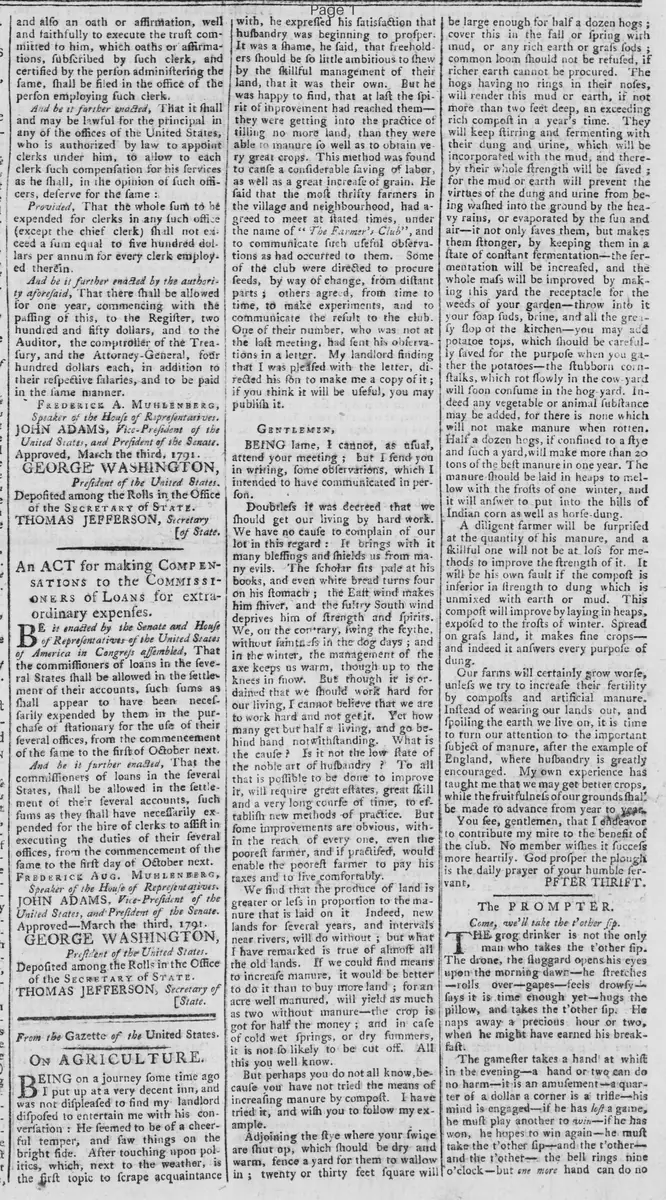
ON AGRICULTURE.
Being on a journey some time ago I put up at a very decent inn, and was not displeased to find my landlord disposed to entertain me with his conversation. He seemed to be of a cheerful temper, and saw things on the bright side. After touching upon politics, which, next to the weather, is the first topic to scrape acquaintance with, he expressed his satisfaction that husbandry was beginning to prosper. It was a shame, he said, that freeholders should be so little ambitious to show by the skillful management of their land, that it was their own. But he was happy to find, that at last the spirit of improvement had reached them--they were getting into the practice of tilling no more land, than they were able to manure so well as to obtain very great crops. This method was found to cause a considerable saving of labor, as well as a great increase of grain. He said that the most thrifty farmers in the village and neighbourhood, had agreed to meet at stated times, under the name of "The Farmer's Club", and to communicate such useful observations as had occurred to them. Some of the club were directed to procure seeds, by way of change, from distant parts; others agreed, from time to time, to make experiments, and to communicate the result to the club. One of their number, who was not at the last meeting, had sent his observations in a letter. My landlord finding that I was pleased with the letter, directed his son to make me a copy of it: if you think it will be useful, you may publish it.
GENTLEMEN,
Being lame, I cannot, as usual, attend your meeting; but I send you in writing, some observations, which I intended to have communicated in person.
Doubtless it was decreed that we should get our living by hard work. We have no cause to complain of our lot in this regard: It brings with it many blessings and shields us from many evils. The scholar sits pale at his books, and even white bread turns sour on his stomach; the East wind makes him shiver, and the sultry South wind deprives him of strength and spirits. We, on the contrary, swing the scythe, without faintness in the dog days; and in the winter, the management of the axe keeps us warm, though up to the knees in snow. But though it is ordained that we should work hard for our living, I cannot believe that we are to work hard and not get it. Yet how many get but half a living, and go behind hand notwithstanding. What is the cause? Is it not the low state of the noble art of husbandry? To all that is possible to be done to improve it, will require great estates, great skill and a very long course of time, to establish new methods of practice. But some improvements are obvious, within the reach of every one, even the poorest farmer, and if practised, would enable the poorest farmer to pay his taxes and to live comfortably.
We find that the produce of land is greater or less in proportion to the manure that is laid on it. Indeed, new lands for several years, and intervals near rivers, will do without: but what I have remarked is true of almost all the old lands. If we could find means to increase manure, it would be better to do it than to buy more land; for an acre well manured, will yield as much as two without manure--the crop is got for half the money; and in case of cold wet springs, or dry summers, it is not so likely to be cut off. All this you well know.
But perhaps you do not all know, because you have not tried the means of increasing manure by compost. I have tried it, and wish you to follow my example.
Adjoining the sty where your swine are shut up, which should be dry and warm, fence a yard for them to wallow in; twenty or thirty feet square will be large enough for half a dozen hogs; cover this in the fall or spring with mud, or any rich earth or grass sods; common loam should not be refused, if richer earth cannot be procured. The hogs having no rings in their noses, will render this mud or earth, if not more than two feet deep, an exceeding rich compost in a year's time. They will keep stirring and fermenting with their dung and urine, which will be incorporated with the mud, and thereby their whole strength will be saved; for the mud or earth will prevent the virtues of the dung and urine from being washed into the ground by the heavy rains, or evaporated by the sun and air--it not only saves them, but makes them stronger, by keeping them in a state of constant fermentation--the fermentation will be increased, and the whole mass will be improved by making this yard the receptacle for the weeds of your garden--throw into it your soap suds, brine, and all the greasy slop of the kitchen--you may add potatoe tops, which should be carefully saved for the purpose when you gather the potatoes--the stubborn corn-stalks, which rot slowly in the cow-yard will soon consume in the hog-yard. Indeed any vegetable or animal substance may be added, for there is none which will not make manure when rotten.
Half a dozen hogs, if confined to a sty and such a yard, will make more than 20 tons of the best manure in one year. The manure should be laid in heaps to mellow with the frosts of one winter, and it will answer to put into the hills of Indian corn as well as horse-dung.
A diligent farmer will be surprised at the quantity of his manure, and a skillful one will not be at a loss for methods to improve the strength of it. It will be his own fault if the compost is inferior in strength to dung which is unmixed with earth or mud. This compost will improve by laying in heaps, exposed to the frosts of winter. Spread on grass land, it makes fine crops; and indeed it answers every purpose of dung.
Our farms will certainly grow worse, unless we try to increase their fertility by composts and artificial manure. Instead of wearing our lands out, and spoiling the earth we live on, it is time to turn our attention to the important subject of manure, after the example of England, where husbandry is greatly encouraged. My own experience has taught me that we may get better crops, while the fruitfulness of our grounds shall be made to advance from year to year.
You see, gentlemen, that I endeavor to contribute my mite to the benefit of the club. No member wishes it success more heartily. God prosper the plough is the daily prayer of your humble servant,
Peter Thrift.
ON AGRICULTURE.
Being on a journey some time ago I put up at a very decent inn, and was not displeased to find my landlord disposed to entertain me with his conversation. He seemed to be of a cheerful temper, and saw things on the bright side. After touching upon politics, which, next to the weather, is the first topic to scrape acquaintance with, he expressed his satisfaction that husbandry was beginning to prosper. It was a shame, he said, that freeholders should be so little ambitious to show by the skillful management of their land, that it was their own. But he was happy to find, that at last the spirit of improvement had reached them--they were getting into the practice of tilling no more land, than they were able to manure so well as to obtain very great crops. This method was found to cause a considerable saving of labor, as well as a great increase of grain. He said that the most thrifty farmers in the village and neighbourhood, had agreed to meet at stated times, under the name of "The Farmer's Club", and to communicate such useful observations as had occurred to them. Some of the club were directed to procure seeds, by way of change, from distant parts; others agreed, from time to time, to make experiments, and to communicate the result to the club. One of their number, who was not at the last meeting, had sent his observations in a letter. My landlord finding that I was pleased with the letter, directed his son to make me a copy of it: if you think it will be useful, you may publish it.
GENTLEMEN,
Being lame, I cannot, as usual, attend your meeting; but I send you in writing, some observations, which I intended to have communicated in person.
Doubtless it was decreed that we should get our living by hard work. We have no cause to complain of our lot in this regard: It brings with it many blessings and shields us from many evils. The scholar sits pale at his books, and even white bread turns sour on his stomach; the East wind makes him shiver, and the sultry South wind deprives him of strength and spirits. We, on the contrary, swing the scythe, without faintness in the dog days; and in the winter, the management of the axe keeps us warm, though up to the knees in snow. But though it is ordained that we should work hard for our living, I cannot believe that we are to work hard and not get it. Yet how many get but half a living, and go behind hand notwithstanding. What is the cause? Is it not the low state of the noble art of husbandry? To all that is possible to be done to improve it, will require great estates, great skill and a very long course of time, to establish new methods of practice. But some improvements are obvious, within the reach of every one, even the poorest farmer, and if practised, would enable the poorest farmer to pay his taxes and to live comfortably.
We find that the produce of land is greater or less in proportion to the manure that is laid on it. Indeed, new lands for several years, and intervals near rivers, will do without: but what I have remarked is true of almost all the old lands. If we could find means to increase manure, it would be better to do it than to buy more land; for an acre well manured, will yield as much as two without manure--the crop is got for half the money; and in case of cold wet springs, or dry summers, it is not so likely to be cut off. All this you well know.
But perhaps you do not all know, because you have not tried the means of increasing manure by compost. I have tried it, and wish you to follow my example.
Adjoining the sty where your swine are shut up, which should be dry and warm, fence a yard for them to wallow in; twenty or thirty feet square will be large enough for half a dozen hogs; cover this in the fall or spring with mud, or any rich earth or grass sods; common loam should not be refused, if richer earth cannot be procured. The hogs having no rings in their noses, will render this mud or earth, if not more than two feet deep, an exceeding rich compost in a year's time. They will keep stirring and fermenting with their dung and urine, which will be incorporated with the mud, and thereby their whole strength will be saved; for the mud or earth will prevent the virtues of the dung and urine from being washed into the ground by the heavy rains, or evaporated by the sun and air--it not only saves them, but makes them stronger, by keeping them in a state of constant fermentation--the fermentation will be increased, and the whole mass will be improved by making this yard the receptacle for the weeds of your garden--throw into it your soap suds, brine, and all the greasy slop of the kitchen--you may add potatoe tops, which should be carefully saved for the purpose when you gather the potatoes--the stubborn corn-stalks, which rot slowly in the cow-yard will soon consume in the hog-yard. Indeed any vegetable or animal substance may be added, for there is none which will not make manure when rotten.
Half a dozen hogs, if confined to a sty and such a yard, will make more than 20 tons of the best manure in one year. The manure should be laid in heaps to mellow with the frosts of one winter, and it will answer to put into the hills of Indian corn as well as horse-dung.
A diligent farmer will be surprised at the quantity of his manure, and a skillful one will not be at a loss for methods to improve the strength of it. It will be his own fault if the compost is inferior in strength to dung which is unmixed with earth or mud. This compost will improve by laying in heaps, exposed to the frosts of winter. Spread on grass land, it makes fine crops; and indeed it answers every purpose of dung.
Our farms will certainly grow worse, unless we try to increase their fertility by composts and artificial manure. Instead of wearing our lands out, and spoiling the earth we live on, it is time to turn our attention to the important subject of manure, after the example of England, where husbandry is greatly encouraged. My own experience has taught me that we may get better crops, while the fruitfulness of our grounds shall be made to advance from year to year.
You see, gentlemen, that I endeavor to contribute my mite to the benefit of the club. No member wishes it success more heartily. God prosper the plough is the daily prayer of your humble servant,
Peter Thrift.
What sub-type of article is it?
Curiosity
Biography
What themes does it cover?
Moral Virtue
Triumph
What keywords are associated?
Agriculture
Manure
Compost
Hogs
Farmers Club
Land Improvement
What entities or persons were involved?
Peter Thrift
Where did it happen?
Village And Neighbourhood
Story Details
Key Persons
Peter Thrift
Location
Village And Neighbourhood
Event Date
Some Time Ago
Story Details
A traveler at an inn discusses agriculture with the landlord, who shares a letter from Peter Thrift to the Farmer's Club. Thrift describes hard work in farming, the importance of manure, and a method to create compost using a hog yard with mud, earth, and kitchen waste to produce 20 tons of manure yearly, improving land fertility like in England.