Thank you for visiting SNEWPapers!
Sign up free
Clarksville Weekly Chronicle
Clarksville, Montgomery County, Tennessee
What is this article about?
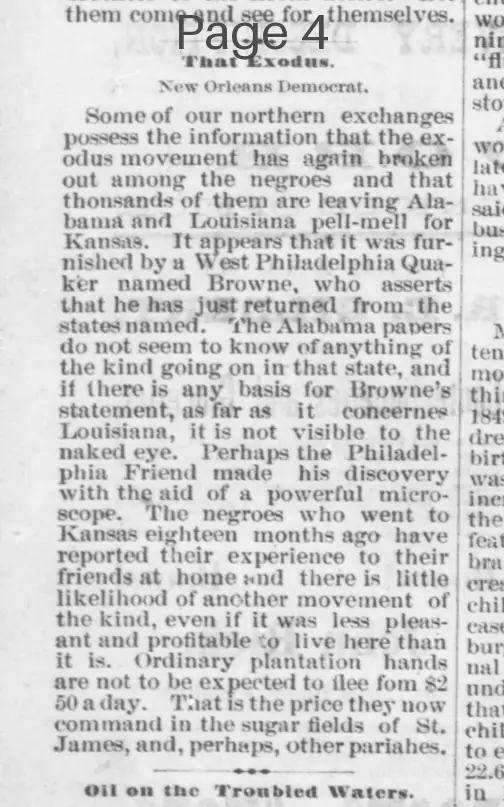
The New Orleans Democrat reports skepticism toward claims by a Philadelphia Quaker named Browne of a new mass exodus of Black people from Alabama and Louisiana to Kansas, noting no visible evidence, high wages in sugar fields ($2.50/day), and unfavorable reports from previous migrants 18 months ago.
Clipping
OCR Quality
Full Text
New Orleans Democrat,
Some of our northern exchanges possess the information that the exodus movement has again broken out among the negroes and that thousands of them are leaving Alabama and Louisiana pell-mell for Kansas. It appears that it was furnished by a West Philadelphia Quaker named Browne, who asserts that he has just returned from the states named. The Alabama papers do not seem to know of anything of the kind going on in that state, and if there is any basis for Browne's statement, as far as it concerns Louisiana, it is not visible to the naked eye. Perhaps the Philadelphia Friend made his discovery with the aid of a powerful microscope. The negroes who went to Kansas eighteen months ago have reported their experience to their friends at home and there is little likelihood of another movement of the kind, even if it was less pleasant and profitable to live here than it is. Ordinary plantation hands are not to be expected to flee from $2.50 a day. That is the price they now command in the sugar fields of St. James, and, perhaps, other parishes.
What sub-type of article is it?
What keywords are associated?
What entities or persons were involved?
Where did it happen?
Domestic News Details
Primary Location
Alabama And Louisiana
Key Persons
Outcome
no visible exodus in louisiana; high wages of $2.50 a day in st. james sugar fields; previous migrants' experiences discourage new movement
Event Details
Northern exchanges report, based on Quaker Browne's claims after visiting, that thousands of negroes are fleeing Alabama and Louisiana for Kansas; local papers and observations find no evidence, attributing skepticism to profitable conditions and past reports