Thank you for visiting SNEWPapers!
Sign up free
Imperial Valley Press
El Centro, Imperial County, California
What is this article about?
Roger Babson warns that a global recession could spark a new world war amid German aggression. US economic recovery may prevent this. Germany strengthens via Austria's annexation, eyeing eastward expansion through commerce toward the Black Sea, potentially forcing alignments like Italy with Britain and France.
Clipping
OCR Quality
Full Text
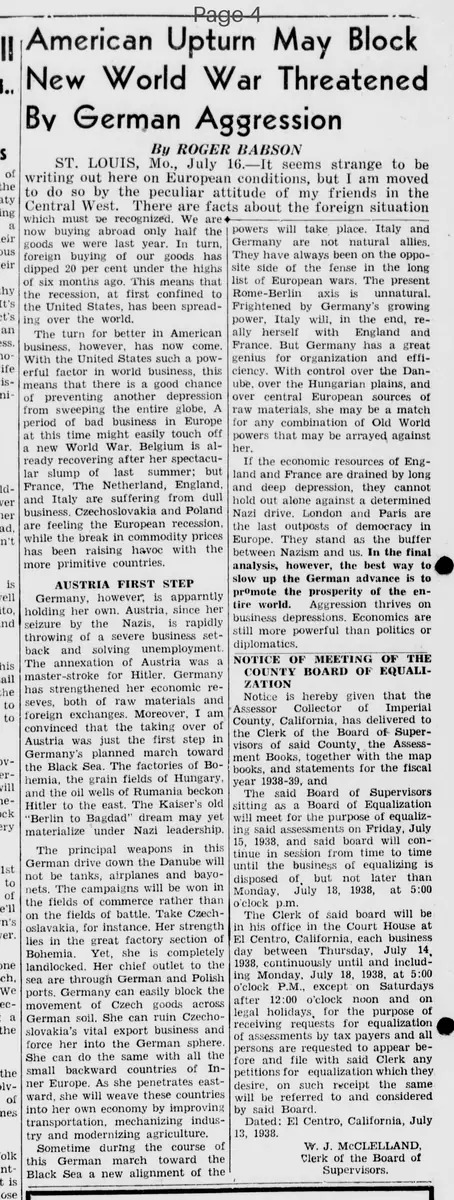
New World War Threatened
By German Aggression
By ROGER BABSON
ST. LOUIS, Mo., July 16.-It seems strange to be writing out here on European conditions, but I am moved to do so by the peculiar attitude of my friends in the Central West. There are facts about the foreign situation which must be recognized. We are now buying abroad only half the goods we were last year. In turn, foreign buying of our goods has dipped 20 per cent under the highs of six months ago. This means that the recession, at first confined to the United States, has been spreading over the world.
The turn for better in American business, however, has now come. With the United States such a powerful factor in world business, this means that there is a good chance of preventing another depression from sweeping the entire globe. A period of bad business in Europe at this time might easily touch off a new World War. Belgium is already recovering after her spectacular slump of last summer; but France, The Netherlands, England, and Italy are suffering from dull business. Czechoslovakia and Poland are feeling the European recession, while the break in commodity prices has been raising havoc with the more primitive countries.
AUSTRIA FIRST STEP
Germany, however, is apparently holding her own. Austria, since her seizure by the Nazis, is rapidly throwing off a severe business set-back and solving unemployment. The annexation of Austria was a master-stroke for Hitler. Germany has strengthened her economic reserves, both of raw materials and foreign exchanges. Moreover, I am convinced that the taking over of Austria was just the first step in Germany's planned march toward the Black Sea. The factories of Bohemia, the grain fields of Hungary, and the oil wells of Rumania beckon Hitler to the east. The Kaiser's old "Berlin to Bagdad" dream may yet materialize under Nazi leadership.
The principal weapons in this German drive down the Danube will not be tanks, airplanes and bayonets. The campaigns will be won in the fields of commerce rather than on the fields of battle. Take Czechoslovakia, for instance. Her strength lies in the great factory section of Bohemia. Yet, she is completely landlocked. Her chief outlet to the sea are through German and Polish ports. Germany can easily block the movement of Czech goods across German soil. She can ruin Czechoslovakia's vital export business and force her into the German sphere. She can do the same with all the small backward countries of Inner Europe. As she penetrates eastward, she will weave these countries into her own economy by improving transportation, mechanizing industry and modernizing agriculture.
Sometime during the course of this German march toward the Black Sea a new alignment of the powers will take place. Italy and Germany are not natural allies. They have always been on the opposite side of the fence in the long list of European wars. The present Rome-Berlin axis is unnatural.
Frightened by Germany's growing power, Italy will, in the end, really herself with England and France. But Germany has a great genius for organization and efficiency. With control over the Danube, over the Hungarian plains, and over central European sources of raw materials, she may be a match for any combination of Old World powers that may be arrayed against her.
If the economic resources of England and France are drained by long and deep depression, they cannot hold out alone against a determined Nazi drive. London and Paris are the last outposts of democracy in Europe. They stand as the buffer between Nazism and us. In the final analysis, however, the best way to slow up the German advance is to promote the prosperity of the entire world. Aggression thrives on business depressions. Economics are still more powerful than politics or diplomatics.
What sub-type of article is it?
What keywords are associated?
What entities or persons were involved?
Where did it happen?
Foreign News Details
Primary Location
Germany
Key Persons
Outcome
austria recovering from business setback and unemployment after nazi seizure; germany strengthened economically; potential italian realignment with england and france; threat of new world war if depression deepens.
Event Details
Global recession spreads from US, affecting Europe; US upturn may prevent worldwide depression and war. Germany holds steady, uses Austria annexation as first step toward Black Sea via economic control over Czechoslovakia, Hungary, Rumania. Italy may ally with England, France against Germany; world prosperity key to slowing Nazi advance.