Thank you for visiting SNEWPapers!
Sign up free
Literary
May 11, 1759
The New Hampshire Gazette
Portsmouth, Rockingham County, New Hampshire
What is this article about?
An astronomical observation from Cambridge dated May 2, 1759, detailing the path, visibility, and motion of a comet that appeared in early April, including its passage through southern constellations and explanations of its northward shift.
Clipping
OCR Quality
95%
Excellent
Full Text
Cambridge, May 2. 1759.
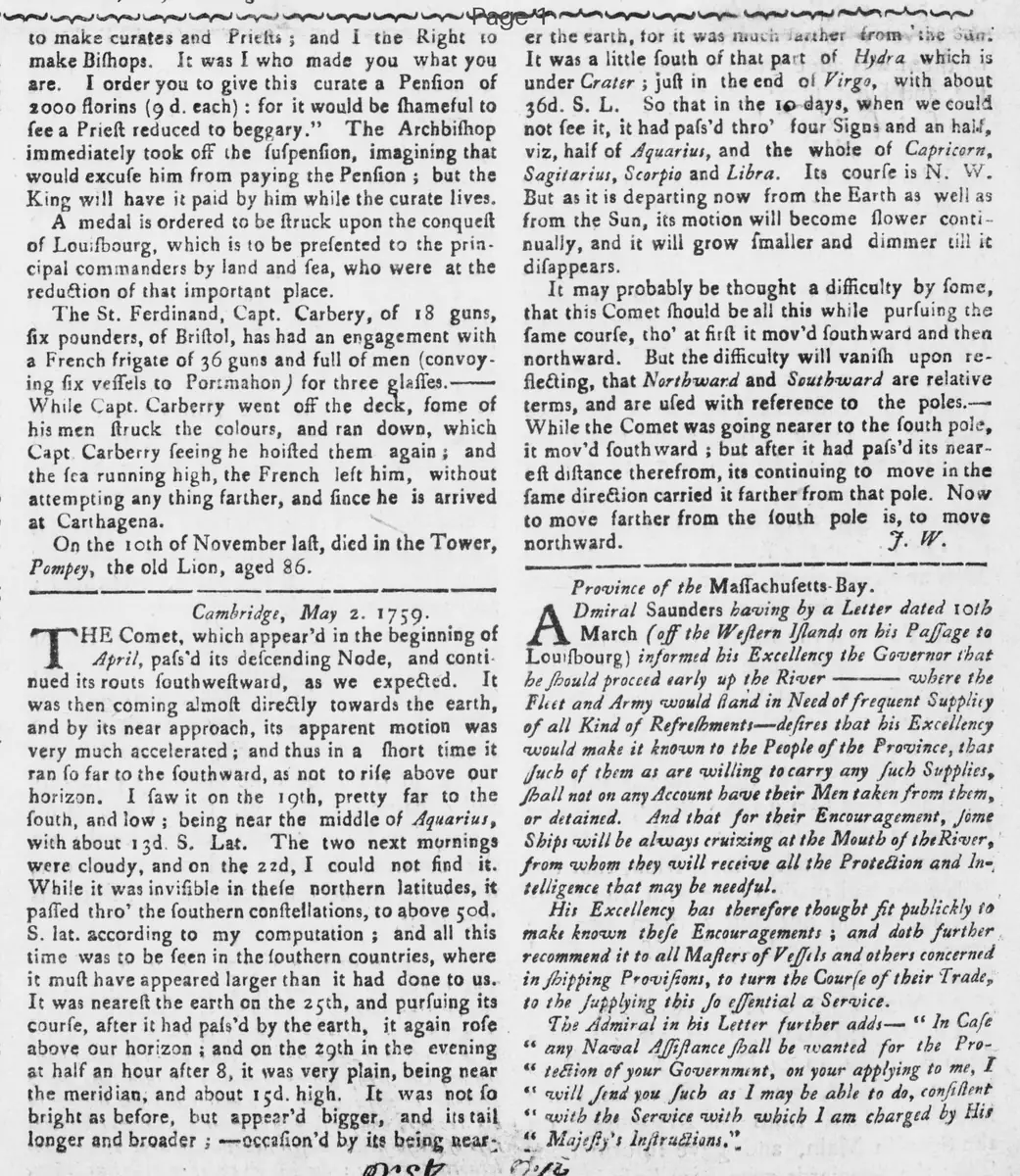
THE Comet, which appear'd in the beginning of April, pass'd its descending Node, and continued its routs southwestward, as we expected. It was then coming almost directly towards the earth, and by its near approach, its apparent motion was very much accelerated: and thus in a short time it ran so far to the southward, as not to rise above our horizon. I saw it on the 19th, pretty far to the south, and low; being near the middle of Aquarius, with about 13d. S. Lat. The two next mornings were cloudy, and on the 22d, I could not find it. While it was invisible in these northern latitudes, it passed thro' the southern constellations, to above 30d. S. lat. according to my computation; and all this time was to be seen in the southern countries, where it must have appeared larger than it had done to us. It was nearest the earth on the 25th, and pursuing its course, after it had pass'd by the earth, it again rose above our horizon; and on the 29th in the evening at half an hour after 8, it was very plain, being near the meridian, and about 15d. high. It was not so bright as before, but appear'd bigger, and its tail longer and broader; --occasion'd by its being nearer the earth, for it was much further from the Sun. It was a little south of that part of Hydra which is under Crater; just in the end of Virgo, with about 36d. S. L. So that in the 10 days, when we could not see it, it had pass'd thro' four Signs and an half, viz, half of Aquarius, and the whole of Capricorn, Sagittarius, Scorpio and Libra. Its course is N. W. But as it is departing now from the Earth as well as from the Sun, its motion will become slower continually, and it will grow smaller and dimmer till it disappears.
It may probably be thought a difficulty by some, that this Comet should be all this while pursuing the same course, tho' at first it mov'd southward and then northward. But the difficulty will vanish upon reflecting, that Northward and Southward are relative terms, and are used with reference to the poles. While the Comet was going nearer to the south pole, it mov'd southward; but after it had pass'd its nearest distance therefrom, its continuing to move in the same direction carried it farther from that pole. Now to move farther from the south pole is, to move northward.
F. W.
THE Comet, which appear'd in the beginning of April, pass'd its descending Node, and continued its routs southwestward, as we expected. It was then coming almost directly towards the earth, and by its near approach, its apparent motion was very much accelerated: and thus in a short time it ran so far to the southward, as not to rise above our horizon. I saw it on the 19th, pretty far to the south, and low; being near the middle of Aquarius, with about 13d. S. Lat. The two next mornings were cloudy, and on the 22d, I could not find it. While it was invisible in these northern latitudes, it passed thro' the southern constellations, to above 30d. S. lat. according to my computation; and all this time was to be seen in the southern countries, where it must have appeared larger than it had done to us. It was nearest the earth on the 25th, and pursuing its course, after it had pass'd by the earth, it again rose above our horizon; and on the 29th in the evening at half an hour after 8, it was very plain, being near the meridian, and about 15d. high. It was not so bright as before, but appear'd bigger, and its tail longer and broader; --occasion'd by its being nearer the earth, for it was much further from the Sun. It was a little south of that part of Hydra which is under Crater; just in the end of Virgo, with about 36d. S. L. So that in the 10 days, when we could not see it, it had pass'd thro' four Signs and an half, viz, half of Aquarius, and the whole of Capricorn, Sagittarius, Scorpio and Libra. Its course is N. W. But as it is departing now from the Earth as well as from the Sun, its motion will become slower continually, and it will grow smaller and dimmer till it disappears.
It may probably be thought a difficulty by some, that this Comet should be all this while pursuing the same course, tho' at first it mov'd southward and then northward. But the difficulty will vanish upon reflecting, that Northward and Southward are relative terms, and are used with reference to the poles. While the Comet was going nearer to the south pole, it mov'd southward; but after it had pass'd its nearest distance therefrom, its continuing to move in the same direction carried it farther from that pole. Now to move farther from the south pole is, to move northward.
F. W.
What sub-type of article is it?
Essay
What themes does it cover?
Nature
What keywords are associated?
Comet
Astronomy
Observation
Celestial Motion
1759
Cambridge
What entities or persons were involved?
F. W.
Literary Details
Author
F. W.
Subject
Observation Of The April 1759 Comet
Key Lines
The Comet, Which Appear'd In The Beginning Of April, Pass'd Its Descending Node, And Continued Its Routs Southwestward, As We Expected.
It Was Nearest The Earth On The 25th, And Pursuing Its Course, After It Had Pass'd By The Earth, It Again Rose Above Our Horizon;
Its Course Is N. W. But As It Is Departing Now From The Earth As Well As From The Sun, Its Motion Will Become Slower Continually, And It Will Grow Smaller And Dimmer Till It Disappears.
Northward And Southward Are Relative Terms, And Are Used With Reference To The Poles.