Thank you for visiting SNEWPapers!
Sign up free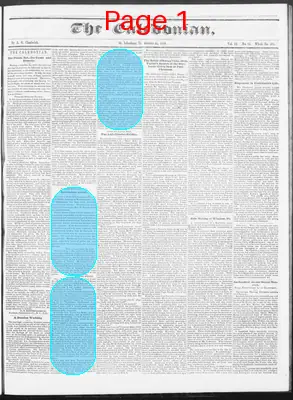
Story
October 14, 1848
The Caledonian
Saint Johnsbury, Caledonia County, Vermont
What is this article about?
A letter from Rev. Mr. Lamb, former army chaplain under Gen. Zachary Taylor, testifies to Taylor's orthodox religion, Whig politics, opposition to slavery expansion and Mexican War, total abstinence, Christian devotion, and high character, shared via Dea. Joseph White in Winchendon, June 20, 1848.
Clipping
OCR Quality
98%
Excellent
Full Text
From the Worcester Aegis.
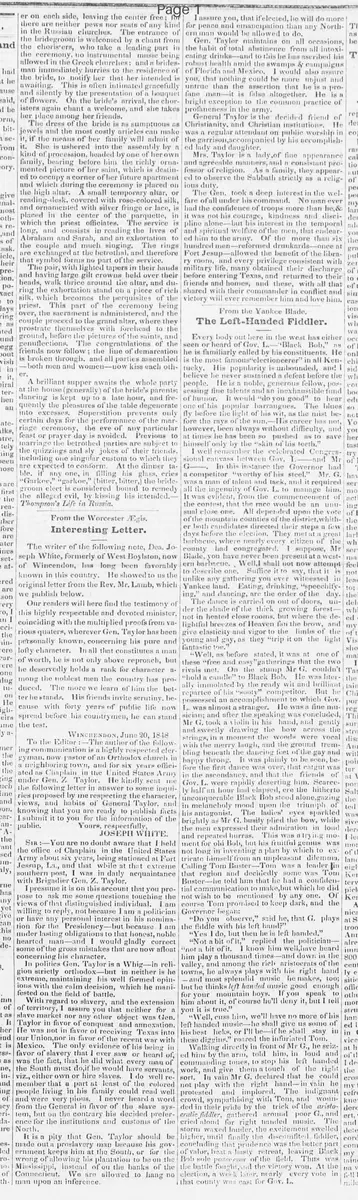
Interesting Letter.
The writer of the following note, Dea. Joseph White, formerly of West Boylston, now of Winchendon, has long been favorably known in this country. He showed to us the original letter from the Rev. Mr. Lamb, which we publish below.
Our readers will here find the testimony of this highly respectable and devoted minister, coinciding with the multiplied proofs from various quarters, wherever Gen. Taylor has been personally known, concerning his pure and lofty character. In all that constitutes a man of worth, he is not only above reproach, but he deservedly holds a rank for character among the noblest men the country has produced. The more we learn of him the better he stands. His friends invite scrutiny, because with forty years of public life now spread before his countrymen, he can stand the test.
Winchendon, June 20, 1848.
To the Editor:—The author of the following communication is a highly respected clergyman, now pastor of an Orthodox church in a neighboring town, and for six years officiated as Chaplain in the United States Army under Gen. Z. Taylor. He kindly sent me the following letter in answer to some inquiries proposed by me respecting the character, views, and habits of General Taylor, and knowing that you are ready to publish facts I submit it to you for the information of the public.
Yours, respectfully,
Sir:—You are no doubt aware that I held the office of Chaplain in the United States Army about six years, being stationed at Fort Jesup, La., and that while at that extreme southern post, I was in daily acquaintance with Brigadier Gen. Z. Taylor.
I presume it is on this account that you propose to ask me some questions touching the views of that distinguished individual. I am willing to reply, not because I am a politician or have any personal interest in his nomination for the Presidency—but because I am under lasting obligations to that honest, noble hearted man—and I would gladly correct some of the gross mistakes that are now afloat concerning his character.
In politics Gen. Taylor is a Whig—in religion strictly orthodox—but in neither is he extreme, maintaining his well formed opinions with the calm decision, which he manifested on the field of battle.
With regard to slavery, and the extension of territory, I assure you that neither for a slave market nor any other object was Gen. Taylor in favor of conquest and annexation. He was not in favor of receiving Texas into our Union, nor in favor of the recent war with Mexico. The only evidence of his being in favor of slavery that I ever saw or heard of, was the fact, that he did what every man of the South must do, if he would have servants, viz., either own or hire slaves. I do well remember that a part at least of the colored people living in his family could read well and were very pious. I never heard a word from the General in favor of the slave system, but on the contrary his decided preference for the institutions and customs of the North.
It is a pity that Gen. Taylor should be made out a pro-slavery man because his government keeps him at the South, or for the wrong of allowing his plantation to be on the Mississippi, instead of on the banks of the Connecticut. We are allowed to hang no man upon an inference.
I assure you, that if elected, he will do more for peace and emancipation than any Northern man would be allowed to do.
Gen. Taylor maintains on all occasions the habit of total abstinence from all intoxicating drinks—and to this he has ascribed his robust health amid the swamps & campaigns of Florida and Mexico. I would also assure you, that nothing could be more unjust and untrue than the assertion that he is a profane man—it is false altogether. He is a bright exception to the common practice of profaneness in the army.
General Taylor is the decided friend of Christianity, and Christian institutions. He was a regular attendant on public worship in the garrison, accompanied by his accomplished lady and daughter.
Mrs. Taylor is a lady of fine appearance and agreeable manners, and a consistent professor of religion. As a family, they appeared to observe the Sabbath strictly as a religious duty.
The Gen. took a deep interest in the welfare of all under his command. No man ever had the confidence of troops more than he, & it was not his courage, kindness and discipline alone—but his interest in the temporal and spiritual welfare of the men, that endeared him to the army. Of the more than six hundred men—reformed drunkards—once at Fort Jesup—allowed the benefit of the library room, and every privilege consistent with military life, many obtained their discharge before entering Texas, and returned to their friends and homes, and these, with all that shared with their commander in conflict and victory will ever remember him and love him.
Interesting Letter.
The writer of the following note, Dea. Joseph White, formerly of West Boylston, now of Winchendon, has long been favorably known in this country. He showed to us the original letter from the Rev. Mr. Lamb, which we publish below.
Our readers will here find the testimony of this highly respectable and devoted minister, coinciding with the multiplied proofs from various quarters, wherever Gen. Taylor has been personally known, concerning his pure and lofty character. In all that constitutes a man of worth, he is not only above reproach, but he deservedly holds a rank for character among the noblest men the country has produced. The more we learn of him the better he stands. His friends invite scrutiny, because with forty years of public life now spread before his countrymen, he can stand the test.
Winchendon, June 20, 1848.
To the Editor:—The author of the following communication is a highly respected clergyman, now pastor of an Orthodox church in a neighboring town, and for six years officiated as Chaplain in the United States Army under Gen. Z. Taylor. He kindly sent me the following letter in answer to some inquiries proposed by me respecting the character, views, and habits of General Taylor, and knowing that you are ready to publish facts I submit it to you for the information of the public.
Yours, respectfully,
Sir:—You are no doubt aware that I held the office of Chaplain in the United States Army about six years, being stationed at Fort Jesup, La., and that while at that extreme southern post, I was in daily acquaintance with Brigadier Gen. Z. Taylor.
I presume it is on this account that you propose to ask me some questions touching the views of that distinguished individual. I am willing to reply, not because I am a politician or have any personal interest in his nomination for the Presidency—but because I am under lasting obligations to that honest, noble hearted man—and I would gladly correct some of the gross mistakes that are now afloat concerning his character.
In politics Gen. Taylor is a Whig—in religion strictly orthodox—but in neither is he extreme, maintaining his well formed opinions with the calm decision, which he manifested on the field of battle.
With regard to slavery, and the extension of territory, I assure you that neither for a slave market nor any other object was Gen. Taylor in favor of conquest and annexation. He was not in favor of receiving Texas into our Union, nor in favor of the recent war with Mexico. The only evidence of his being in favor of slavery that I ever saw or heard of, was the fact, that he did what every man of the South must do, if he would have servants, viz., either own or hire slaves. I do well remember that a part at least of the colored people living in his family could read well and were very pious. I never heard a word from the General in favor of the slave system, but on the contrary his decided preference for the institutions and customs of the North.
It is a pity that Gen. Taylor should be made out a pro-slavery man because his government keeps him at the South, or for the wrong of allowing his plantation to be on the Mississippi, instead of on the banks of the Connecticut. We are allowed to hang no man upon an inference.
I assure you, that if elected, he will do more for peace and emancipation than any Northern man would be allowed to do.
Gen. Taylor maintains on all occasions the habit of total abstinence from all intoxicating drinks—and to this he has ascribed his robust health amid the swamps & campaigns of Florida and Mexico. I would also assure you, that nothing could be more unjust and untrue than the assertion that he is a profane man—it is false altogether. He is a bright exception to the common practice of profaneness in the army.
General Taylor is the decided friend of Christianity, and Christian institutions. He was a regular attendant on public worship in the garrison, accompanied by his accomplished lady and daughter.
Mrs. Taylor is a lady of fine appearance and agreeable manners, and a consistent professor of religion. As a family, they appeared to observe the Sabbath strictly as a religious duty.
The Gen. took a deep interest in the welfare of all under his command. No man ever had the confidence of troops more than he, & it was not his courage, kindness and discipline alone—but his interest in the temporal and spiritual welfare of the men, that endeared him to the army. Of the more than six hundred men—reformed drunkards—once at Fort Jesup—allowed the benefit of the library room, and every privilege consistent with military life, many obtained their discharge before entering Texas, and returned to their friends and homes, and these, with all that shared with their commander in conflict and victory will ever remember him and love him.
What sub-type of article is it?
Biography
What themes does it cover?
Moral Virtue
Justice
What keywords are associated?
General Taylor
Character Testimony
Whig Politics
Anti Slavery Views
Temperance
Christian Devotion
Army Chaplain
What entities or persons were involved?
Dea. Joseph White
Rev. Mr. Lamb
Gen. Z. Taylor
Mrs. Taylor
Where did it happen?
Fort Jesup, La.
Story Details
Key Persons
Dea. Joseph White
Rev. Mr. Lamb
Gen. Z. Taylor
Mrs. Taylor
Location
Fort Jesup, La.
Event Date
June 20, 1848
Story Details
Rev. Lamb's letter testifies to Gen. Taylor's Whig politics, orthodox religion, opposition to slavery expansion and Mexican War, total abstinence, Christian devotion, family piety, and leadership in reforming soldiers, defending his character against misconceptions.